
Your Guide to Anxious Attachment Healing in 2026
When you have an anxious attachment style, healing can feel like a far-off, impossible dream. It's the process of finding a sense of safety inside yourself so you're no longer driven by a deep fear of abandonment or a constant, draining need for reassurance.
This isn't about becoming a different person. It’s about calming the deep-seated anxiety and learning to build the grounded, confident relationships you’ve always wanted.
The First Steps on Your Healing Journey
Does this sound familiar? Lying awake at night, replaying a conversation over and over, with that all-too-familiar knot of anxiety twisting in your stomach. If that’s your reality right now, please know you are not alone. This is where the healing journey begins.
And I want you to hear this loud and clear: healing is not just possible, it's a practical, step-by-step process. This guide is built on a compassionate approach that combines proven attachment work with the science of nervous system regulation. It's all about building true security from the inside out.
Where Does This Anxiety Come From?
Anxious attachment isn't a character flaw; it’s a survival strategy that your body learned a long time ago.
It often starts in our early years, when the emotional connection with caregivers was inconsistent or unpredictable. Your young nervous system learned that relationships feel unsafe, which put it on high alert. This is why, as an adult, you might find yourself constantly scanning for tiny signs of rejection or feeling a wave of panic when a partner simply needs some space.
The constant worry, the need for reassurance—that’s your system’s way of trying to prevent disconnection. The good news? You can absolutely rewire this response.
Healing from anxious attachment is not about erasing your past. It’s about teaching your body and mind that you are safe in the present, capable of handling uncertainty, and worthy of steady, unconditional love—starting with the love you give yourself.
To get there, we focus on three core pillars: understanding your patterns, learning to regulate your body’s responses, and then practicing new ways of showing up in your relationships.
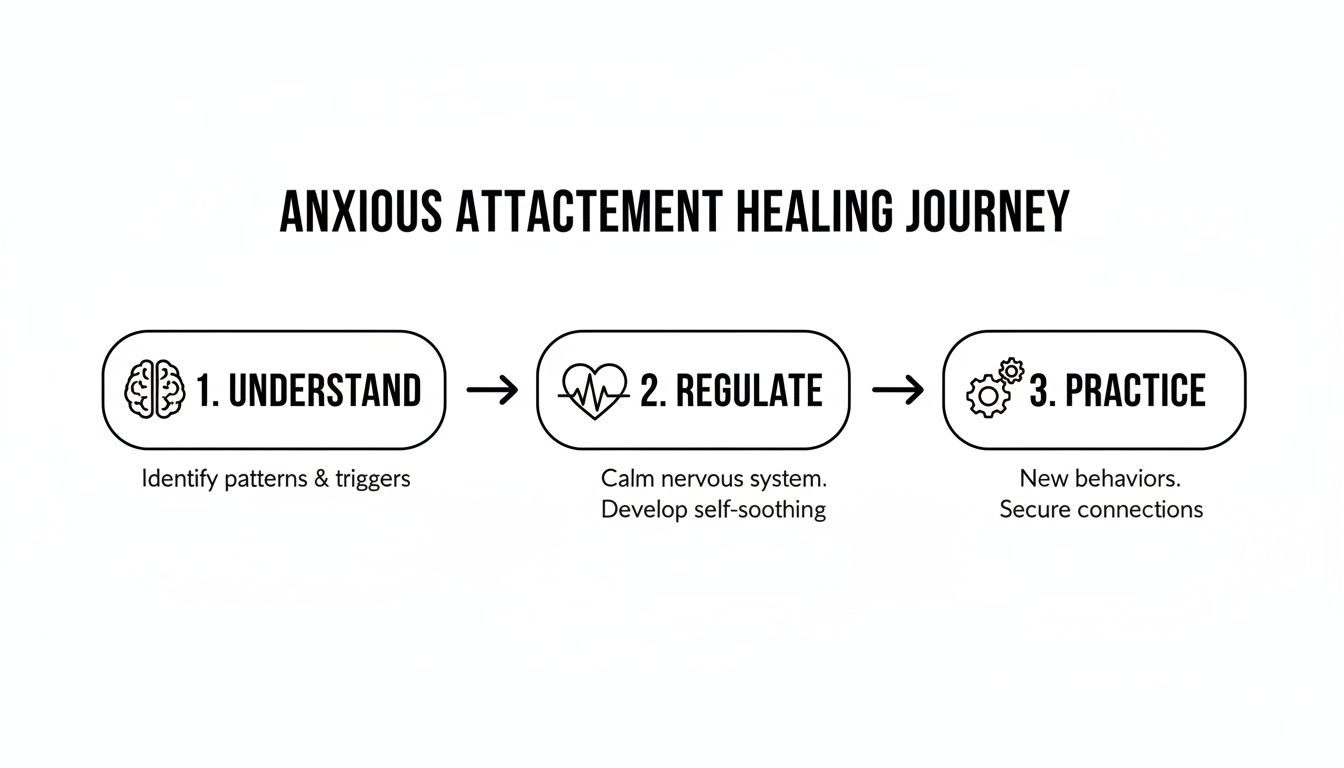
This simple model—Understand, Regulate, Practice—is the foundation of our work together. It moves healing from a vague idea to a clear, actionable path.
This table breaks down these three pillars, giving you a clear picture of the journey ahead.
| Pillar | What It Involves | Why It Matters |
|---|---|---|
| Understand | Identifying your specific attachment triggers and protest behaviors (like withdrawing or picking fights). | Awareness is the first step. You can't change a pattern you don't see. |
| Regulate | Using simple, body-based (somatic) exercises to calm your nervous system when you feel anxious. | This creates a pause between feeling an anxious trigger and having an automatic, reactive response. |
| Practice | Learning to communicate your needs clearly and self-soothe in moments of distress. | This is where you actively build new, secure relationship habits with yourself and others. |
By working through these pillars, you create a new blueprint for how you experience love and connection.
Creating a New Blueprint for Love
Here’s the thing: you can’t think your way out of anxious attachment. True healing requires creating a felt sense of safety in your own body. This is where nervous system regulation becomes your superpower.
When you learn to calm your body’s stress response, you create a crucial space between an anxious feeling and a reactive behavior. In that tiny pause, you gain the power to choose a different, more secure response. It’s in those small, consistent choices that you begin to build an entirely new way of relating to the world.
This process boils down to a few key skills:
- Pinpointing your triggers: Getting crystal clear on what people, situations, or even thoughts send your anxiety into overdrive.
- Learning to self-soothe: Giving yourself the comfort and reassurance you used to desperately seek from others.
- Communicating with clarity: Expressing your needs and feelings directly, without using protest behaviors or expecting your partner to be a mind reader.
If you’re just starting out and aren’t totally sure about your patterns, our guide on what attachment style am I? is a great place to begin. It can bring so much clarity.
The rest of this guide will walk you through exactly how to do this, step by step. You have the power to create the secure, connected, and loving relationships you truly deserve. Let’s get started.
Understanding Why You Feel So Anxious in Relationships
That heart-pounding panic when your partner doesn’t text back right away. The exhausting mental loop of replaying a simple conversation, dissecting it for some hidden, negative meaning. If this sounds painfully familiar, you know the internal rollercoaster of anxious attachment all too well.
But I need you to hear this first: this is not a character flaw. It’s not a sign that you’re “needy” or “too much.” That deep, churning anxiety is actually a survival strategy your nervous system learned a long, long time ago—most likely in your childhood—all to protect you from the terrifying feeling of disconnection.
When we’re little, our entire sense of safety is tied to how our caregivers respond to us. If that connection felt unpredictable—sometimes you got warmth and presence, other times distance or dismissal—your system learned a powerful, lasting lesson: relationships are unstable, and you have to stay on high alert to keep them from disappearing. This becomes the unconscious blueprint we carry right into our adult relationships.
The Blueprint in Action: A Real-World Example
Let's say you're dating someone new. It's going great, but one night, their texts suddenly get shorter, less frequent. For someone with a secure attachment style, this might not even cause a blip on their radar. Their thought process is simple: "Oh, they must be busy with work." And they’d go on with their evening.
For you, though? It’s a five-alarm fire.
Your nervous system, still running on that old childhood blueprint, flags this shift as a direct threat of abandonment. Your mind immediately starts to spiral:
- "Did I say something wrong on our last date?"
- "Are they losing interest? I bet they met someone else."
- "My stomach is in knots. I can't focus on anything until I know we're okay."
This isn't you being dramatic; it's a very real activation of an old survival response. Your body is physically shifting into a state of high alert—a version of fight, flight, or freeze. You can learn more about how to spot these states in our article on the four primary trauma responses. Understanding that this is a biological reaction, not a personal failing, is the first real step toward healing.
The Reassurance-Seeking Feedback Loop
So when that wave of panic crashes over you, what’s the first impulse? To do something, anything, to close that gap and feel connected again. This is where a pattern I see so often in my clients emerges: excessive reassurance seeking (ERS).
It’s sending that follow-up text: "Hey, just checking in, is everything okay with us?" Or maybe you find a reason to call, desperate to hear a reassuring tone in their voice. While this might give you a fleeting moment of relief, it traps you in a frustrating feedback loop. You get a temporary fix, but the core fear is still there, just waiting for the next trigger.
This constant need for validation isn't a sign of weakness; it's the echo of a young part of you that never got the consistent reassurance it needed to feel safe in the world. Recognizing this is an act of profound self-compassion.
This pattern is exhausting for you and can be confusing for your partner, often creating the very distance you’re terrified of. And this isn't just a feeling; it has measurable effects. A study published in a leading medical journal found that people with anxious attachment styles engage in 11% more daily excessive reassurance seeking, a behavior strongly linked to heightened depression and negative moods. You can read the full research on the impact of ERS on emotional health to see the science behind this cycle.
Taking Your Power Back
Once you can connect your internal emotional storm to this psychological framework, everything starts to change. It’s so empowering. Your struggles stop being about who you are and become about what you learned. The anxiety is not you; it's a response pattern, and patterns can be changed.
The very first step in any real healing journey is simple: just start to notice.
- Notice the tightness that grips your chest when a flicker of uncertainty appears.
- Notice the almost magnetic pull to check your phone for the tenth time.
- Notice the story your mind immediately starts weaving about being abandoned or unloved.
When you become an observer of these patterns, you create a tiny, precious sliver of space between the trigger and your reaction. In that space, you'll find your power. That’s where you begin the beautiful work of teaching your nervous system that you are safe now, even with the normal, messy, wonderful ups and downs of a real relationship.
Practical Exercises to Calm Your Nervous System
Theory is one thing, but what do you do in the heat of the moment? You’ve just sent a vulnerable text, and now every minute of silence feels like a confirmation of your worst fears. This is where anxious attachment healing moves from your head into your body.
Instead of just talking about anxiety, I want to give you real, body-based exercises you can use to find relief in minutes. The goal is to interrupt that anxiety spiral before it takes over, giving you the power to choose a grounded response instead of a panicked reaction.
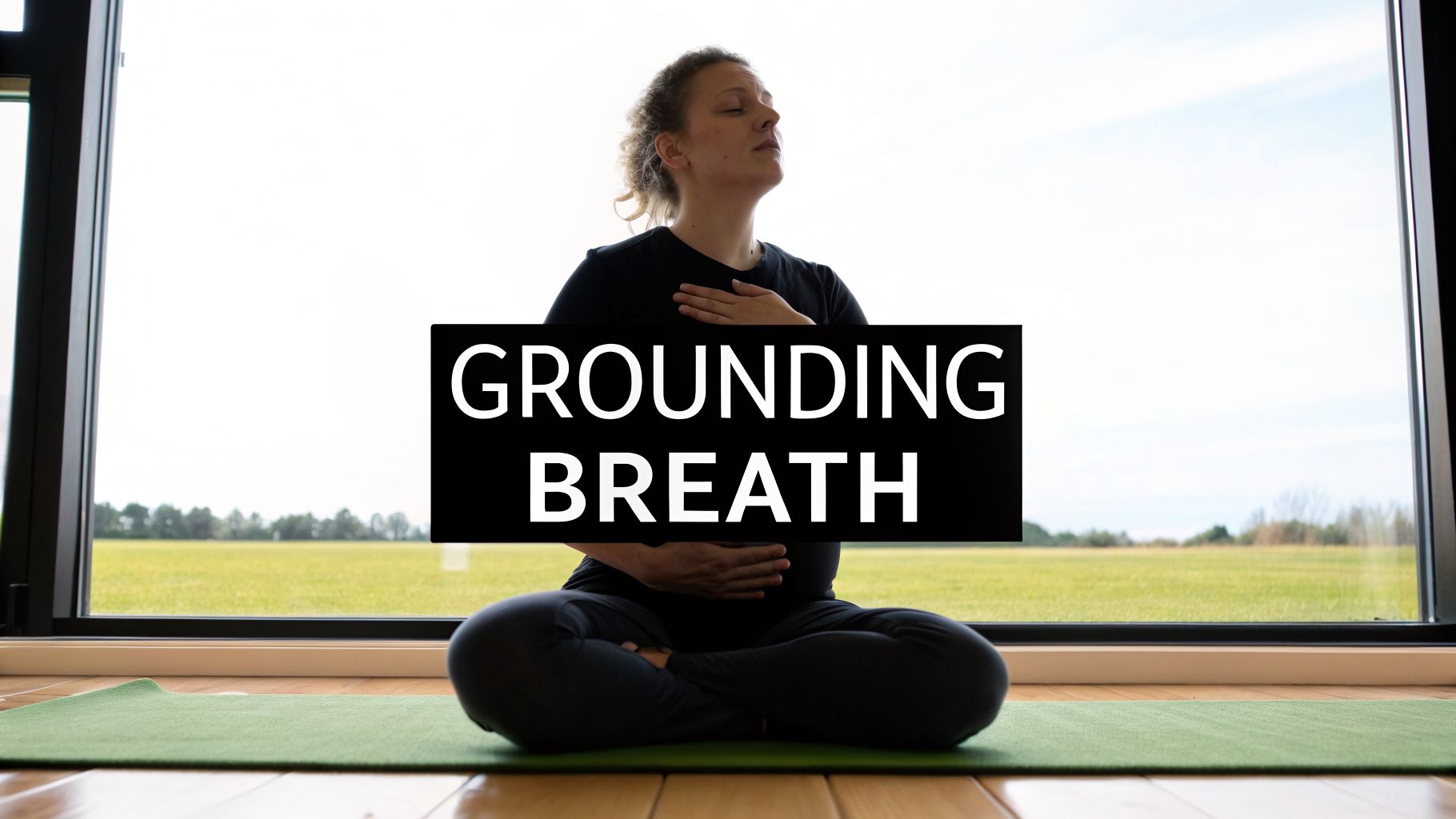
These aren’t just distractions; they are tools for building internal safety and lowering emotional reactivity. Below, I’ll walk you through a few of my go-to exercises. You'll also see a video where I personally guide you through a powerful somatic exercise, showing you exactly how to find calm when you feel activated.
The 5-4-3-2-1 Grounding Method
When your mind is racing with "what ifs," this technique pulls you out of the future and slams you right back into the present moment. It does this by forcing you to engage your five senses. It’s incredibly simple and you can do it anywhere—in your car, at your desk, in the middle of a grocery store—without anyone knowing.
Here’s how it works:
- Notice 5 things you can see. Just acknowledge them silently. The blue pen on my desk, a crack in the ceiling, the green leaves outside my window, my reflection in the dark screen, the texture of my jeans.
- Notice 4 things you can feel. This is about physical sensation, not emotion. The soft fabric of my sweater, the firm pressure of the chair beneath me, the coolness of my ring on my finger, a strand of hair on my cheek.
- Notice 3 things you can hear. Tune in to the sounds around you, near and far. The low hum of the refrigerator, the distant sound of traffic, the rhythm of my own quiet breathing.
- Notice 2 things you can smell. This one might take a little more effort. The faint scent of coffee from this morning, the smell of the soap on my hands.
- Notice 1 thing you can taste. The lingering aftertaste of toothpaste, or just the neutral taste inside your mouth.
This exercise forces your brain to focus on concrete, sensory information, which interrupts the abstract loop of anxious thoughts. You can't worry about a text message when you're busy trying to identify a smell.
Simple Box Breathing for Instant Calm
Anxious breathing is often shallow and rapid, a pattern that screams danger to your nervous system. By consciously slowing your breath down, you send a powerful message back to your brain: I am safe. Box breathing is a classic for a reason—it works.
Imagine drawing a box with your breath:
- Breathe in slowly through your nose for a count of 4.
- Gently hold your breath at the top for a count of 4.
- Exhale slowly through your mouth for a count of 4.
- Pause at the bottom for a count of 4.
Repeat this cycle for just a minute or two. The predictable, even rhythm is deeply regulating for a nervous system on high alert. You can learn even more powerful techniques in our guide on ways to regulate your nervous system.
This isn’t about "getting rid of" anxiety. It’s about building the capacity to hold it without letting it control you. Each time you use one of these tools, you are casting a vote for your own internal security.
For so many of us with anxious attachment, the deepest fear is rejection. That fear can feel so intense it's physically painful. Learning to regulate these big emotional responses is key. Exploring effective rejection sensitive dysphoria treatment strategies can be especially helpful if you find your reactions to perceived criticism or rejection feel overwhelming.
Somatic Discharge Through Shaking
Have you ever seen an animal shake its whole body after a stressful encounter, like a near-miss with a car? That’s not random. It's a natural, built-in way to discharge all the adrenaline and cortisol that just flooded its system. We humans have the same mechanism, but we’ve been taught to suppress it—to "keep it together."
When you feel that restless, jittery energy of anxiety buzzing under your skin, give it somewhere to go.
- Find a private space where you won’t feel self-conscious.
- Stand with your feet shoulder-width apart, knees slightly bent.
- Start by just shaking out your hands and wrists. Let them be floppy.
- Let that movement travel up into your arms and shoulders.
- Allow your whole body to gently shake and vibrate for a minute or two. Let your head and jaw go.
I know, it might feel silly at first. But this is one of the most effective ways to release stored-up stress from your body. It helps complete the stress cycle, telling your nervous system the threat has passed and it's safe to return to a state of balance. This is a foundational part of anxious attachment healing—moving from mental anguish to physical release.
How Anxious Attachment Healing Transforms Your Health
Anxious attachment is so much more than an emotional struggle; it quietly wreaks havoc on your physical health. That constant state of high alert—the hypervigilance of waiting for a text, analyzing a partner's every word, or living in fear of disconnection—isn’t just in your head. It’s a full-body experience, and it takes a massive physiological toll.
When you live this way, your nervous system is almost always simmering in a low-grade fight-or-flight response. Your body gets flooded with stress hormones like cortisol, bracing for a threat that never quite arrives but also never really leaves. This chronic activation is exhausting, and it has real, tangible consequences for your well-being.
The Hidden Costs of Relationship Anxiety
This state of high alert directly impacts your body's most critical functions. When your system is busy prioritizing survival, it puts other essential processes on the back burner.
- Disrupted Sleep: Hypervigilance makes it incredibly difficult to get deep, restorative rest. You might struggle to fall asleep, find yourself waking up all night, or feel drained even after a full eight hours. This is your nervous system staying on "guard duty."
- Weakened Immune System: Chronic stress actively suppresses your immune response. This makes you much more susceptible to getting sick, so you might catch every cold that goes around or find it takes forever to recover.
- Increased Inflammation: Elevated cortisol is a major driver of systemic inflammation, which is tied to a whole host of chronic health issues.
This isn't just a theory. Research shows that people with anxious attachment styles face very real physiological consequences. For example, studies have found that insecure attachment can lead to higher inflammation markers, fewer protective T-cells, and in some cases, even slower wound healing—all linked back to the chronic stress and poor sleep that go hand-in-hand with attachment anxiety. You can read more about these specific findings on attachment and immunity.
Healing as an Act of Physical Self-Care
Understanding this mind-body link is a game-changer. It reframes anxious attachment healing as a profound act of physical self-care for your entire body. Every single time you use a regulation technique, you are directly pushing back against these negative health impacts.
When you practice the grounding exercises we talked about earlier—like box breathing or the 5-4-3-2-1 method—you’re doing so much more than just calming your thoughts. You are sending a direct, biological signal to your body that you are safe.
Practicing nervous system regulation isn't just about feeling less anxious in the moment. It's about lowering your cortisol, reducing inflammation, and allowing your body to finally exit survival mode so it can rest, repair, and heal.
This is exactly why a body-based, trauma-informed approach is so powerful. You’re working at the root of the anxiety—the nervous system itself—to create holistic, lasting change for both your mind and your body. As you build this sense of internal safety, you'll start to notice benefits that extend far beyond your relationships.
Supporting Your Body's Recovery
As you do this deep emotional work, it’s absolutely vital to support your physical health. Since poor sleep is one of the biggest consequences of a dysregulated nervous system, focusing on rest is a powerful place to start. A holistic approach to healing has to include optimizing your physical well-being; incorporating effective sleep hygiene tips for optimal wellness can make a huge difference in your emotional and mental recovery.
Even simple shifts can be incredibly supportive:
- Creating a calming, predictable bedtime routine.
- Limiting screen time for an hour or so before bed.
- Making sure your bedroom is dark, cool, and quiet.
By tending to your body's needs with the same compassion you're learning to give your anxious parts, you accelerate your healing. You show your entire system—mind, body, and heart—that it is finally safe, supported, and worthy of care.
Recognizing the Signs of Your Healing Progress
How do you know all this deep, internal work is actually working? When you're healing from anxious attachment, progress rarely feels like a lightning bolt moment. It’s not some dramatic, overnight transformation.
Instead, it shows up in the quiet, subtle shifts. It’s in the small moments where you choose a new response, feel a wave of calm wash over you where there used to be a storm, or simply notice your old patterns without letting them hijack your entire day.
This isn't just about "feeling less anxious." It’s about learning to spot the real-world evidence of your growth. Think of this as your guide to celebrating those hard-won victories—the small, consistent changes that prove you're on the right path.
These signs are proof that you’re building a new, more secure relationship with yourself, one choice at a time.
The Pause Before the Reaction
One of the very first, most powerful signs of healing is something I call The Pause. It’s that tiny sliver of time that suddenly appears between an anxious trigger and your old, automatic reaction.
Before, a partner's slightly distant mood might have sent you into an immediate spiral of fear, sparking a desperate need to text, call, and "fix" whatever you assumed was wrong.
Now, you might still feel that initial pang of anxiety, but you don't immediately act on it. You find yourself able to just… breathe. In that small space, you remember you have a choice. Maybe you use a regulation tool instead of sending that reactive text.
This pause is everything. It's the moment you take your power back from the automatic, fear-based programming of your nervous system. It’s where conscious choice begins and true healing takes root.
Shifting from External to Internal Validation
Another massive milestone is when you start to notice you're not constantly looking outside yourself for reassurance. You begin turning inward for the comfort and safety you once desperately outsourced to others.
What does this look like in real life?
- A wave of loneliness hits, but instead of immediately texting someone just to feel seen, you place a hand on your heart and offer yourself a moment of compassion.
- You feel a flicker of insecurity at work. Your first impulse isn't to fish for a compliment from a colleague, but to find a quiet space, take a few deep breaths, and ground yourself.
This doesn't mean you stop valuing connection or needing people. It means you're no longer using others as a remote control for your own nervous system. You are slowly, surely, becoming your own source of safety.
A New Perspective on Relationships
It might surprise you to learn that nearly half of the population is navigating relationships from an insecure attachment style. When you consider the 85% intergenerational transmission rate—meaning attachment patterns are often passed down from parents to children—it’s clear that a huge number of us are operating from an anxious, avoidant, or disorganized place. You can read more about how attachment styles are passed down on crackliffe.com.
The incredible news? Healing is completely possible. By using targeted practices like nervous system regulation and trauma-informed care, we can rewire these old patterns for ourselves and break the cycle for generations to come.
As you heal, you'll see your own reactions and expectations in relationships begin to change. The table below shows some real-world examples of what this shift actually looks like.
From Anxious Reactions to Secure Responses
| Situation | The Old Anxious Pattern | Your New Secure Response |
|---|---|---|
| Your partner is quiet or distant | Assuming they're upset with you; sending multiple texts asking, "Are we okay?" | Recognizing they may be stressed; giving them space and checking in calmly later. |
| Feeling lonely or insecure | Immediately reaching for your phone to seek external validation from a partner. | Pausing to practice a self-soothing exercise; identifying and naming the feeling yourself. |
| A minor conflict arises | Fearing abandonment takes over; you quickly apologize to avoid being left. | Staying present in the disagreement; expressing your needs while also hearing theirs. |
| Starting a new relationship | Moving very quickly, idealizing the person, and becoming preoccupied with their feelings. | Pacing the relationship, staying grounded in reality, and maintaining your own life and hobbies. |
Recognizing yourself in the "New Secure Response" column, even just once in a while, is a monumental win. Each one of those moments is another brick in the foundation of your new, secure self. Please, celebrate that.
Your Anxious Attachment Healing Questions Answered
As you start to put these pieces together, it's completely normal for questions to pop up. This is the part of my work where I see a lot of the same worries surface for my clients, so I want to address them head-on.
Let’s talk about some of the most common concerns I hear. Think of this as a conversation to clear up any lingering doubts, so you can feel confident taking your next steps.
How Long Does Anxious Attachment Healing Take?
This is always the first question, and my honest answer is that it's a personal journey, not a race. Progress isn’t a straight line; you'll have incredible days and some really tough ones. The most important thing to remember is that consistency is always more important than perfection.
Many people I work with feel a real, noticeable drop in their daily anxiety within just a few months of consistently using these tools. Maybe you notice you can handle a delayed text message without spiraling—that's a massive win.
Deeper, lasting change—the kind where a secure response becomes your new normal—takes longer. The real goal of anxious attachment healing isn't to get rid of anxiety forever. It's about building a new, secure relationship with yourself so that anxiety no longer runs the show.
Can I Heal My Anxious Attachment on My Own?
Absolutely. You can make incredible strides just by using the resources and exercises in this guide. Simply understanding your patterns and practicing self-regulation are foundational steps you can absolutely take on your own.
But it’s also true that attachment wounds happen in relationship to others, and they often heal best inside of a safe, supportive relationship. This is where getting professional support can be a game-changer.
Working with a certified attachment-focused practitioner can seriously speed up your progress. They offer feedback that's specific to you, co-regulation in real-time, and a safe space to unpack the deeper stuff that can feel way too overwhelming to face alone. If you feel stuck, please know that asking for help is a profound sign of strength.
What If My Partner Is Not Supportive?
This is such a common and valid fear. The most important thing to remember is that this healing journey is for you, not for them. As you begin to change—setting boundaries, asking for what you need—the entire dynamic of your relationship is going to shift.
Some partners might feel threatened by this, while others will be inspired to grow right alongside you. Your only job is to focus on what you can control: your own responses and your own nervous system.
You can tell them you’re doing this work to become a healthier, more present partner. But if they consistently undermine your healing, it might become necessary to lovingly ask yourself if the relationship truly supports the person you are becoming.
Is It Too Late for Me to Heal in Midlife?
It is absolutely, unequivocally never too late. In fact, I find that midlife can be one of the most powerful times for anxious attachment healing. Big life changes—like an empty nest, career shifts, or perimenopause—have a way of bringing old wounds to the surface so they can finally be seen.
So many of the women I work with in midlife have the wisdom, life experience, and deep motivation to finally address these core patterns. Your brain can create new neural pathways (this is called neuroplasticity) at any age.
Working with someone who understands the unique intersection of hormonal shifts and attachment styles can provide exactly the kind of support needed during this transformative time.
At Securely Loved, guiding adults through this exact process is my life's work. If you feel that familiar pull of anxiety and are ready to build a life where you feel safe, grounded, and deeply connected, I'm here to help. You don't have to do this alone.
I invite you to book a free, 15-minute connection call with me to see if we're a good fit. Visit Securely Loved to take your next step toward lasting healing.