

Nervous System Regulation Therapy: Discover Calm and Build Secure Relationships
Nervous system regulation is about teaching your body's alarm system the difference between a real, five-alarm fire and a piece of burnt toast. It's how we find our way back to a sense of calm and safety, especially after dealing with trauma or years of inconsistent emotional support.
When you've lived in survival mode, feeling chronically anxious, overwhelmed, or even numb becomes your normal. For example, you might find yourself snapping at your kids over a spilled drink and then feeling a wave of shame, realizing your reaction was way bigger than the situation. Or perhaps you feel a constant, low-grade hum of anxiety that makes it impossible to relax, even on a day off. This work helps you shift out of that constant state of alert and into one where you can genuinely connect—with yourself and with others.
What Is Nervous System Regulation and Why It Matters
Imagine your body has an internal alarm system, kind of like a smoke detector. A healthy, well-adjusted system is brilliant—it goes off when there's actual smoke, signaling real danger. But for so many of us who grew up without consistent safety or who have experienced trauma, that internal alarm is way too sensitive. It starts treating every minor stressor like a catastrophe. A partner looking at their phone while you're talking doesn't just feel rude; it feels like abandonment.
That's exactly what it feels like to have a dysregulated nervous system. Your body's "control center" gets stuck on high alert or, on the flip side, just completely shuts down, even when there’s no real threat in sight. Nervous system regulation therapy is the work of gently recalibrating that internal smoke detector.
This isn’t about just “thinking positive” or forcing yourself to calm down. Instead, it’s about teaching your body, on a deep, physiological level, that you are actually safe right now. For anyone who spends their days feeling on edge, emotionally distant, or just plain exhausted from the effort of it all, this is a profound shift.
Understanding Your Body's Three Core States
A huge part of this work is realizing that your feelings aren't just "in your head." They are deeply physical, rooted in your body’s powerful survival responses. We're not talking about character flaws here; we're talking about three distinct biological states your body can shift into.
Safe and Social: This is your home base. It’s the state of connection, calm, and genuine engagement. You feel present, grounded, and open to connecting with the world. Think of a lazy Sunday morning, laughing with a loved one over coffee—your breathing is easy, your body feels relaxed, and there's a sense of "okay-ness."
Fight or Flight (Sympathetic): When that internal alarm goes off, your system floods with adrenaline and cortisol. Your heart might race, your muscles get tight, and you feel anxious, angry, or panicked. This is your body getting ready to either fight a threat or run for your life. It's the feeling you get when you're late for a crucial meeting and hit traffic, that surge of frustrated, helpless energy.
Shutdown (Dorsal Vagal): If the threat feels too big to fight or flee, your system can hit the emergency brake and go into a shutdown state. This often feels like numbness, exhaustion, hopelessness, or disconnection. It’s that "checked out" feeling after a long, draining argument, where you just want to curl up on the couch and binge-watch TV, too tired to even think or feel.
For many people, these aren't just fleeting reactions; they become the default setting. You might be living in a constant, low-grade hum of anxiety (fight or flight) or a persistent fog of emptiness (shutdown).
These responses are biological, not broken. Your body learned these patterns as a brilliant way to help you survive incredibly difficult circumstances. The goal of therapy is to gently show your body that those old strategies aren't needed anymore, because your current reality is safe.
Simply recognizing which state you're in is the first step toward taking your power back. It validates that feeling jittery, overwhelmed, or numb isn't a sign you're failing—it's a logical, physical response. By working with a therapist, you can learn to gently guide your body out of these "danger" modes and back into the "safe and social" state more often.
This is where true healing from anxious or avoidant attachment patterns begins. It's what allows you to finally build the secure, grounded, and loving relationships you've always deserved.
The Science of How Your Body Holds Onto Stress
Have you ever wondered why a small disagreement can feel like a five-alarm fire? Or why you live with a constant, humming sense of being on edge, even when things are objectively okay?
To really get it, we need to look at the brilliant science behind your body’s survival programming. This isn't about blaming yourself for "overreacting." It’s about appreciating how your body learned to keep you safe, and the key to this is understanding Polyvagal Theory. Think of it as the missing user manual for your nervous system.
This theory helps us make sense of our automatic, deeply physical reactions to the world. It all comes down to the vagus nerve, the longest cranial nerve in your body. Picture this nerve as a super-fast communication highway running from your brainstem down through your heart, lungs, and gut.
This highway is constantly sending messages back and forth, telling your brain whether your environment feels safe or threatening. It’s like a sophisticated internal antenna, always scanning for signals. Is it tuned to the "safe and social" frequency, letting you feel calm and connected? Or is it picking up "danger," sending your whole body into high alert?
Your Body's Internal Blueprint for Safety
The way this antenna is "tuned" isn't random at all. It was calibrated by your earliest life experiences. If you grew up with caregivers who were consistently available and in tune with your needs—for instance, they scooped you up when you cried and soothed you with a calm voice—your system learned to default to that "safe and social" channel.
But if your early world was unpredictable, scary, or emotionally inconsistent—perhaps your parents were struggling with their own issues and were often distracted or irritable—your antenna was wired to become exceptionally good at detecting potential threats. This is a brilliant survival adaptation, not a flaw. Your body learned that being hypervigilant—always scanning for danger—was the absolute best way to stay safe when the world felt unsafe.
This understanding completely changed how we approach healing. In the 1990s, Stephen Porges's groundbreaking Polyvagal Theory shifted our view of the nervous system's role in trauma, laying the groundwork for modern nervous system regulation therapy. His work explained why so many of us experience that persistent hyperarousal or overwhelm; it’s a physiological imprint, not a character failing. Later, people like Bessel van der Kolk brought this into the mainstream, showing us that trauma literally rewires the brain and body, which is why body-based (somatic) approaches are so critical.
This diagram shows how we move between these different states in our body.
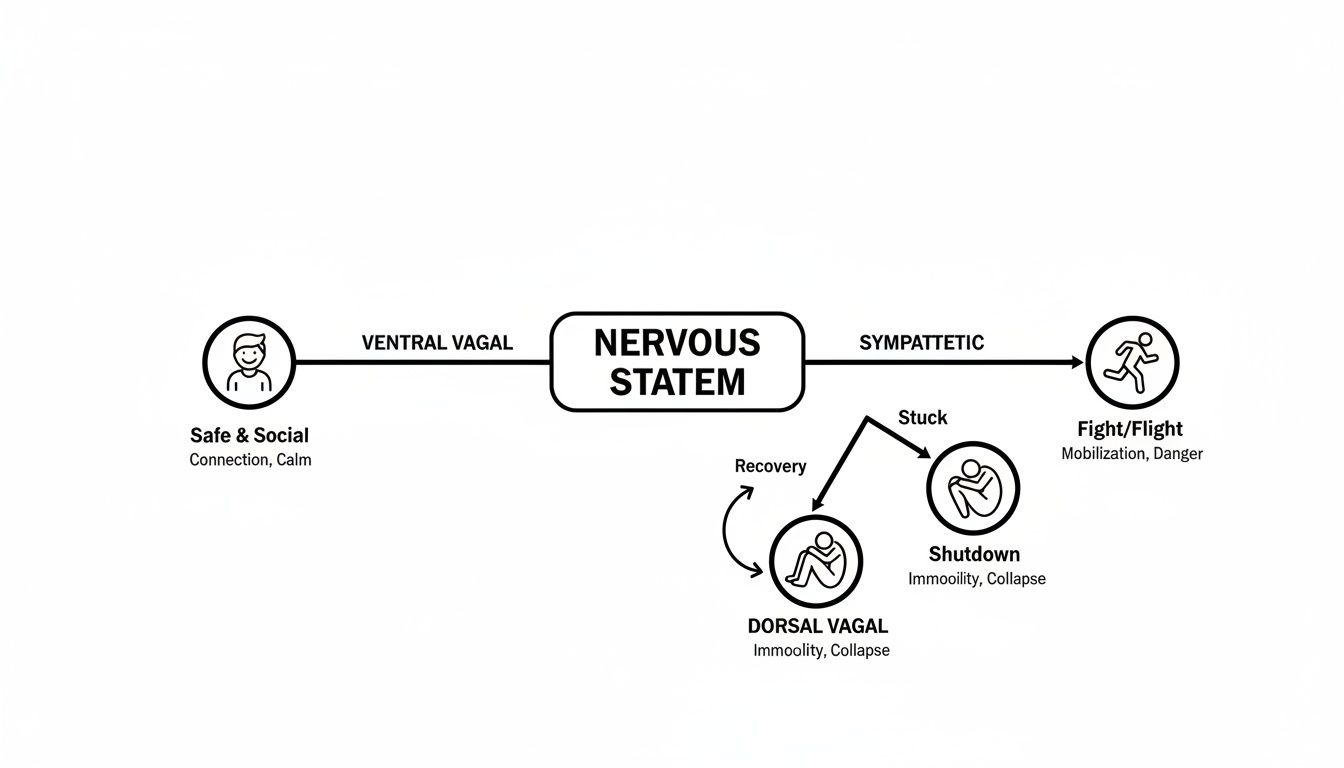
What this shows is that these aren't just "moods." They are distinct biological states—safe, mobilized, or immobilized—and each one has a purpose.
Why Your Reactions Make Perfect Sense
When your nervous system is wired for threat, even tiny stressors can trigger a full-blown survival response. A partner's distracted tone or a friend canceling plans can be read by your body as a sign of abandonment or rejection—a very real danger to your younger self.
This is what triggers one of two automatic defensive states:
- Fight/Flight (Sympathetic Nervous System): You get mobilized. Your heart pounds, your thoughts race, and you feel a surge of anxiety, anger, or panic. It’s that flash of rage when someone cuts you off in traffic, or the wave of panic when you see an unexpected bill. This is your body getting ready to confront the threat or run from it.
- Shutdown/Freeze (Dorsal Vagal System): If the threat feels too big or inescapable, your system might just slam on the brakes. You could feel numb, empty, disconnected, or completely exhausted, like you’re fading away. This is the feeling of wanting to disappear after a deeply critical comment from your boss, where you just feel hollowed out.
These are not conscious choices. They are ancient, hardwired survival mechanisms designed to protect you. Understanding the difference between these states is foundational to healing, and you can learn more by exploring the fight, flight,freeze, and fawn responses in our detailed guide.
By understanding the "why" behind your reactions, you can shift from self-blame to self-compassion. Your responses are biological, not broken.
This realization is the very first step toward reclaiming your sense of safety. Nervous system regulation therapy gives you the tools to gently communicate to your body that the old dangers are gone. You can learn to consciously guide your system out of high alert and back to a place of groundedness, presence, and connection.
A Look Inside a Nervous System Therapy Session
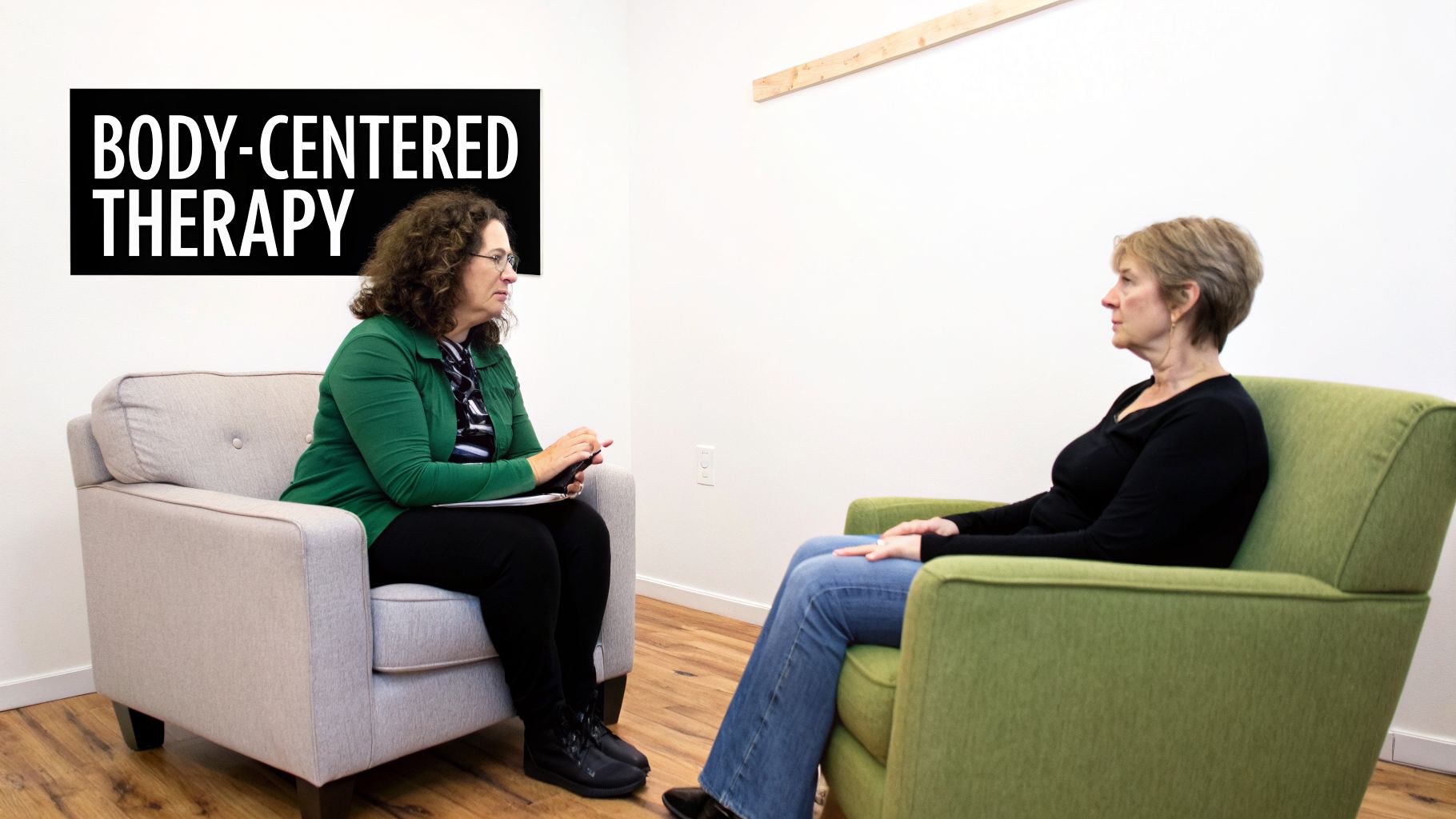
The idea of retraining your body’s automatic stress response can feel a little abstract. What does nervous system regulation therapy actually look like when you’re in the room (or on a video call) with your therapist? It’s a shift away from just talking about your problems and into the world of feeling and experiencing your body in a whole new way.
Unlike traditional talk therapy, which mostly uses the thinking part of your brain, this work is what we call a “bottom-up” approach. It starts with the body's physical sensations, because that’s where trauma and chronic stress get stored.
It’s a gentler, more direct way to get to the root of your reactions. Instead of analyzing why you felt anxious during a difficult conversation, your therapist will guide you to notice what anxiety feels like in your body in that very moment.
Moving Beyond Just Talk
In a session, we might explore leading approaches like Somatic Experiencing (SE) or Sensorimotor Psychotherapy. Think of Somatic Experiencing as learning to hear your body’s whispers before they turn into screams. It’s a gentle method that helps you release trapped survival energy by guiding you to notice physical sensations without getting overwhelmed by them.
Sensorimotor Psychotherapy is similar, blending mindful awareness of the body with insights from attachment theory and neuroscience. It helps you connect the dots between your physical patterns—like tensing your shoulders when you feel criticized—and your emotional history. You can even find therapies like Orofacial Myofunctional Therapy that focus on the connection between your facial muscles, breathing, and regulation.
The core idea is simple: your body holds the story. By learning to listen to its language—the language of sensation—you can start to rewrite the ending. It’s about processing stored trauma gently, without having to painfully re-live it.
This focus on the body is why these therapies are finally getting the recognition they deserve. The global somatic therapy market, which is driven by these nervous system regulation techniques, is projected to hit USD 12.40 billion by 2032. This shows a massive shift in how we approach mental health. For many adults struggling with attachment trauma, traditional talk therapy just isn't enough. Sensorimotor psychotherapy, a leader in this space, is proving more effective for PTSD symptoms because it uniquely blends cognitive and body-based work, getting straight to the physiological roots of anxious, avoidant, or disorganized patterns formed in childhood.
A Real-World Example in Session
Let’s imagine a real (but anonymized) scenario. You're talking with your therapist, Bev Mitelman, about a recent disagreement with your partner where you felt yourself shutting down and becoming emotionally distant—a classic response.
Instead of just dissecting the conversation, Bev might guide you with gentle curiosity:
Bringing Awareness: “As you talk about that moment, can you notice what’s happening in your body right now? Is there any tightness, heat, or tension anywhere?”
Tracking Sensations: You might notice a familiar tightness in your chest. Bev would encourage you to just stay with that sensation for a moment—not to change it, but simply to observe it. “Okay, a tightness in the chest. How big is it? Does it have a shape or a color?”
Introducing a Resource: “What would it feel like to place a hand over your heart, right where you feel that tightness? Just notice the warmth of your hand there.”
This simple act of gentle touch is a “resource.” It brings a sense of comfort and safety to the part of your body that’s holding stress. You aren’t trying to force the tightness to go away. Instead, you're offering it a moment of care.
This process is often called pendulation. It involves gently moving your awareness back and forth between the difficult sensation (the tightness) and a resource (the warmth of your hand). It helps your nervous system learn that it can experience a little bit of distress without becoming completely overwhelmed. You’re building your capacity to stay present and regulated, even when things feel hard.
This makes the therapeutic process feel tangible and safe. Each session builds on the last, giving you real tools you can use in the moment to stop overwhelm in its tracks. It’s a core piece of effective trauma therapy for adults, teaching you that you have the power to soothe your own system.
Your At-Home Toolkit for Calming a Stressed-Out Nervous System
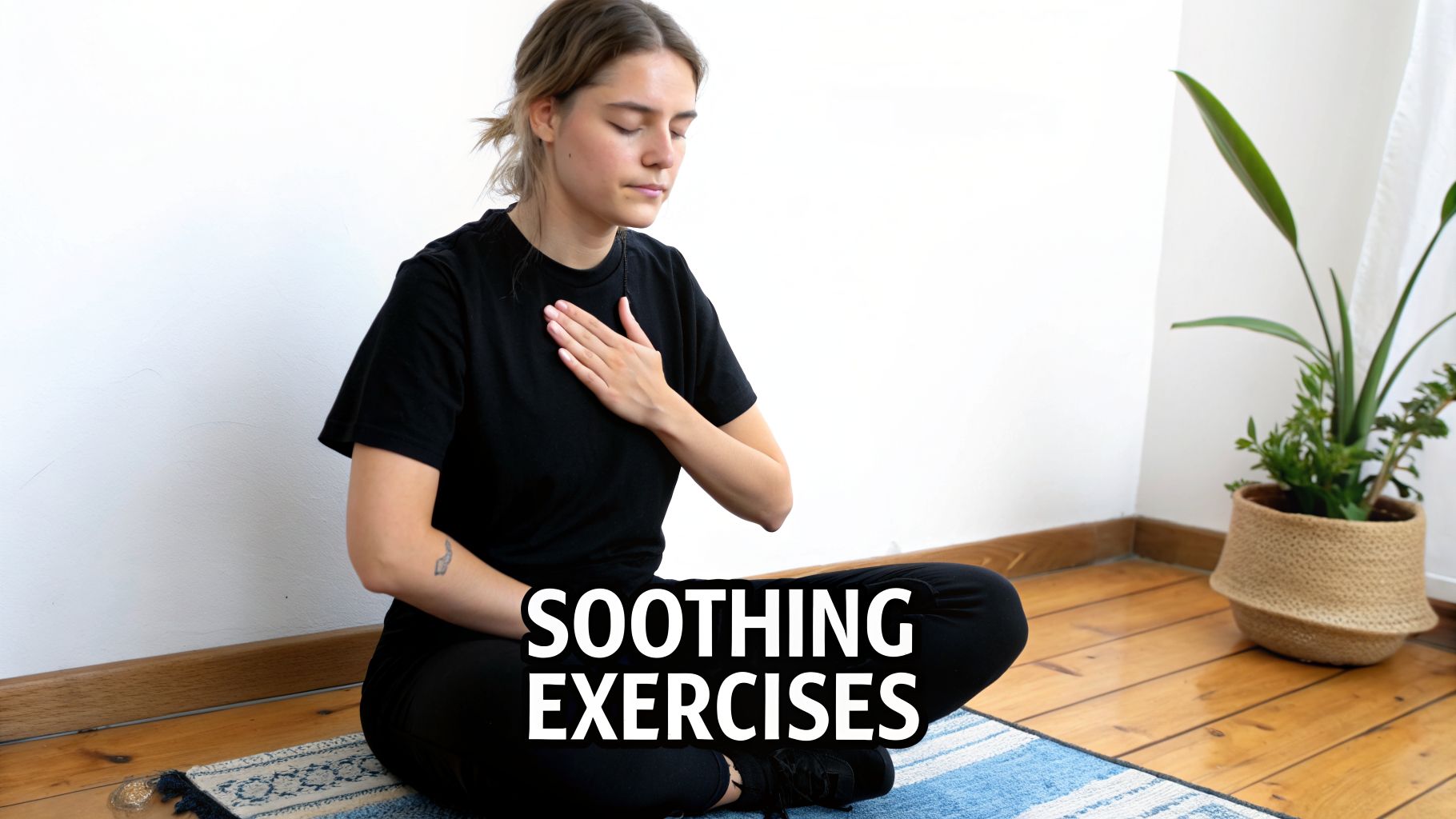
While our work together in therapy is where we do the deep digging, the moments between sessions are where you build real, lasting resilience. It’s about creating your own personal ‘First-Aid Kit’—a set of simple, powerful tools that can bring you back to yourself when you feel overwhelmed.
Think of these practices as a direct conversation with your body. Instead of trying to think your way out of anxiety or shutdown, you’re using physical sensation to send your nervous system a clear message: “You are safe right now.”
The Orienting Exercise
When we feel threatened—whether the threat is real or just a painful memory—our world shrinks. Our focus narrows into tunnel vision, constantly scanning for danger. This exercise intentionally breaks that pattern, using your senses to tell the "watchtower" in your brain that the immediate environment is safe.
- Start wherever you are, sitting or standing.
- Slowly, gently, let your head turn from side to side. Allow your eyes to just drift across the room. Don’t force anything.
- Let your gaze land on whatever catches your attention—a lamp, a picture frame, a plant. Silently name it. Notice its color, its shape.
- Tune into the sounds around you, near and far. The hum of the computer, a car passing outside. Just notice them without judgment.
By simply taking in the details of the present moment, you are telling your brain to stand down. You’re confirming that there's no tiger in the room, giving your body permission to finally relax out of fight-or-flight.
Self-Soothing Touch: The Butterfly Hug
Touch is one of the most primal and powerful ways to regulate our nervous system. The Butterfly Hug is a beautiful way to give yourself the comfort you might be craving from someone else. It uses something called bilateral stimulation—a fancy term for engaging both sides of your brain, which is incredibly grounding.
- Cross your arms over your chest, placing your right hand on your left shoulder and your left hand on your right.
- Begin to gently tap your shoulders, alternating one hand and then the other, like the soft fluttering of butterfly wings.
- Breathe slowly and deeply as you tap. Continue for a minute or two, or until you feel a wave of calm wash over you.
This simple act mimics the feeling of a secure hug. You are physically offering yourself the safety and comfort you need, right in that moment.
Vagal Toning: Humming and Breathing
Your vagus nerve is like the superhighway of your nervous system's calming system. You can gently activate its soothing branch through something as simple as sound and breath. Many of these at-home practices are essentially natural vagus nerve stimulation techniques.
The key isn't about doing these exercises perfectly. It's about the intention—the simple, loving act of offering yourself a moment of care.
Humming is a wonderful way to do this. It creates a gentle vibration in your throat and chest that directly stimulates the vagus nerve.
- Take a slow, comfortable breath in.
- As you exhale, just make a "hmmmmmm" sound for as long as it feels good.
- Pay attention to the gentle vibration in your chest. Let it be a soothing anchor.
- Repeat this for 5-10 breaths.
This is a tool you can use anywhere—in your car before a tough conversation, at your desk when you feel stressed, or while you're waiting for the kettle to boil.
Your Nervous System Regulation Toolkit
Here’s a quick-glance table of these simple, powerful exercises you can use anywhere to find calm.
| Technique | When to Use It | How It Works (In Simple Terms) |
|---|---|---|
| The Orienting Exercise | When you feel anxious, panicky, or stuck in your head. | Tells your brain's "danger scanner" that your current surroundings are safe, allowing you to relax. |
| The Butterfly Hug | When you feel lonely, scared, or need immediate comfort. | Mimics a calming hug and uses rhythm to soothe both sides of your brain, grounding you in your body. |
| Vagal Toning (Humming) | When you feel on edge, irritable, or disconnected. | The vibration stimulates the vagus nerve, which acts like a "brake" on your stress response. |
Remember, these aren't just tricks; they are profound ways of communicating with your body in its own language.
To give you a real-life example of a grounding exercise, I've included a video from my own channel. Follow along as I demonstrate this beautiful technique you can use whenever you need it.
Is This Approach Right for You?
Does this sound like you? You’re a powerhouse in your career, but when it comes to love, you feel insecure, anxious, and constantly second-guessing everything. Or maybe you’re trying to pick up the pieces after a brutal heartbreak, drowning in a sea of grief that feels like it will never end.
Perhaps you’re a parent who adores your kids, but you find yourself reacting to them in ways that feel disturbingly familiar—like an echo from your own childhood. These moments leave you feeling ashamed, confused, and out of control.
If any of this hits home, you’re not alone. These aren't just personality quirks; they are massive red flags pointing directly to a dysregulated nervous system. If you feel like you’re stuck in a loop, trying to logic your way out of patterns that just won’t budge, nervous system regulation therapy might be the very thing you've been missing.
Why Your Relationships Feel So Hard
These painful relational patterns often trace back to our earliest bonds, forming what we call an attachment style. It’s the blueprint your body learned for connection.
The Successful Professional with Relationship Anxiety: This often points to an anxious attachment style. You might deeply crave connection but live with a constant, nagging fear of being left. This can make you overthink texts, constantly seek reassurance, or accidentally push partners away with the sheer intensity of your need for closeness.
The Person Drowning After Heartbreak: Heartbreak is tough for everyone, but for someone with an insecure attachment style, it can feel like your entire world has shattered. That overwhelming, all-consuming emotion is a sign your nervous system is stuck in a state of high alert (fight-or-flight) or complete collapse (shutdown).
The Reactive Parent: This can be a sign of disorganized attachment. Your own unresolved childhood pain gets triggered by your children's perfectly normal behaviors. Before you know it, your nervous system has hijacked the situation, defaulting to old survival patterns that leave you feeling like a stranger in your own body.
The common thread here is a deep-seated lack of internal safety. Long ago, your body learned that connection could be unpredictable, dangerous, or conditional. Nervous system regulation is about teaching your body, on a physical level, how to build that safety within yourself first. That’s the foundation for creating the secure, lasting love you actually want.
When You've Talked About It Enough
Have you spent years in traditional talk therapy? You’ve gained amazing insights. You understand exactly why you do what you do… yet you’re still caught in the same painful emotional and relational cycles. I see this all the time, and it’s not because you’ve failed. It’s because something is missing.
Talk therapy is brilliant, but it mostly works with the logical, thinking part of your brain (the "top-down" approach). But here's the thing: your attachment patterns and trauma responses aren't stored in your thoughts. They're stored in your body—in the very wiring of your nervous system.
Nervous system regulation works from the "bottom-up." We go straight to the physiological root of the problem, helping your body finally learn that the danger has passed. It’s about creating an experience of safety, not just talking about it.
The proof is in the results. Clinical trials show that therapies focused on the nervous system lead to huge improvements in emotion regulation. One study found that Negative Mood Regulation (NMR) scores for trauma survivors jumped from 93.05 to 107.73 after treatment—proving more effective than supportive counseling or medication alone. This is especially true for those of us who experienced childhood adversity, which is so common for people with anxious attachment. You can learn more about these powerful findings on nervous system regulation if you want to geek out on the science.
This is where real, lasting change happens. When your body finally believes it’s safe, your mind can let go of the anxiety, and your relationships can finally start to feel like home.
Your Path to Healing and Secure Relationships
If you’ve made it this far, I hope one thing is clear: that chronic feeling of being unsafe, on edge, or shut down isn’t a personal failing. It’s a physiological response held in your body. And the best part? You have the power to gently retrain your nervous system, building a new foundation for resilience and deeper, more meaningful connections.
This isn’t about erasing your past—that’s impossible. It’s about creating a future where you finally feel safe inside your own skin and secure in the love you give and receive. It’s about coming home to yourself.
A Different Way Forward
If you've ever felt like you just talk in circles about your problems without anything actually changing, you’re not alone. So many of us know what our patterns are, but we feel powerless to stop them. This is where nervous system regulation therapy comes in.
It’s the work that goes beneath the story and targets the root of the struggle—the protective patterns locked deep inside your body. This is how we bridge the gap between intellectually understanding why you do something and having the capacity to actually do it differently.
Instead of being thrown around by waves of anxiety or collapsing into a familiar shutdown, you can learn to be the calm anchor in your own emotional storm. Through this work, you’ll start to discover that:
- You can feel safe and grounded, even when life feels messy or uncertain.
- You can create relationships built on real trust and mutual respect, not old fears.
- You can show up for the people you love with presence and care, breaking painful generational cycles.
Healing is not a linear path, but a spiral. With each turn, you revisit old wounds with new strength and greater wisdom, transforming them into sources of power and self-compassion.
Your Invitation to a New Beginning
Does any of this resonate? If you’re reading this and feel even a tiny glimmer of hope that things could be different for you, please listen to that. That’s your sign.
If you’re ready to take that first, gentle step toward a life that feels more regulated, connected, and genuinely joyful, I invite you to book a free, 15-minute connection call with me.
Think of it as a no-pressure chat to see if this approach feels right. You can ask your questions, share a bit about what you’re looking for, and get a feel for the work. You don’t have to have it all figured out. You just have to be willing to start.
This work is about so much more than just managing symptoms; it’s about reclaiming your birthright to feel secure and loved. If you'd like to understand more about how this connects to your relationship patterns, you might find our overview on attachment trauma therapy helpful.
Your journey toward feeling secure can start right here.
Your Questions Answered: A Little More on Nervous System Regulation
Stepping into a new way of healing always brings up questions. That’s completely normal. Feeling clear and confident about what’s ahead is a huge part of feeling safe enough to even start. So let’s get into some of the most common things people ask about nervous system regulation therapy.
I've Tried Talk Therapy for Years, Can This Still Help Me?
Yes, absolutely. In fact, this is probably the most common reason people find their way to this work. If you’ve spent years in talk therapy and feel like you logically understand all your patterns but are still stuck in them, you are so far from alone.
Traditional talk therapy mostly works with the prefrontal cortex—the thinking, logical part of your brain. It’s incredibly valuable for gaining insight, but it often can't quite reach the deeper, non-verbal parts of your brain and body where trauma and old survival responses are stored. For example, you can know that a partner needing space isn't a rejection, but you still feel a wave of panic in your body.
Nervous system regulation flips the script and works from the “bottom up.” It speaks directly to your body in the language it actually understands—sensation. This is how we gently help your system release stored survival stress and teach it that it’s finally safe now. For many, it’s the missing piece of the puzzle, the thing that finally helps them feel different after years of just talking about it.
It’s what bridges that frustrating gap between knowing what you want to do and finally having the capacity in your body to actually do it.
How Is This Different From Mindfulness?
This is a fantastic question, because they are definitely related, but they aren’t the same. Think of mindfulness as the practice of turning on a light in a dark room. It’s the essential skill of paying attention to the present moment—your thoughts, feelings, and what’s happening in your body—without judging it. You finally get to see what’s really there.
Nervous system regulation therapy takes that awareness and asks, "Okay, now what do we do with it?" It introduces active regulation and processing.
It’s the difference between simply noticing you’re in the middle of a storm (mindfulness) and learning how to build a sturdy boat to navigate the waves (regulation). For instance, you might mindfully notice a familiar tightness in your chest. Regulation therapy then gives you specific tools—like the Butterfly Hug or a grounding exercise—to work with that sensation, soothe it, and guide your system back to a place of genuine calm and safety.
How Long Does It Take to See Results?
This journey is so unique to each person, but it helps to have a realistic idea of what to expect. Many people tell me they feel a sense of relief or calm even after the first few sessions, just from learning some new grounding tools. For instance, being able to use a simple breathing technique to stop a panic attack before it fully takes hold is a huge, empowering win. Those early wins are so important and validating.
But the deep, lasting change we’re aiming for comes from creating new neural pathways in your brain, and that’s a process that takes time and consistency. It’s like forging a new trail in a dense forest. The first few times you walk it, it takes focus and effort. But the more you use that path, the clearer and more automatic it becomes.
So while some relief can come quickly, true, sustainable healing is a gradual process. The goal isn’t a quick fix. It’s about building the profound, lasting safety that comes from fundamentally rewiring your body's response to stress. This becomes the solid foundation for building the secure, healthy relationships you truly deserve.
Your journey toward feeling grounded, safe, and connected can start today. At Securely Loved, we provide the compassionate, expert guidance you need to heal old wounds and build the life you deserve. If you're ready to explore this path further, we invite you to book a free 15-minute connection call.