

What Is Interdependence and How Does It Heal Anxiety?
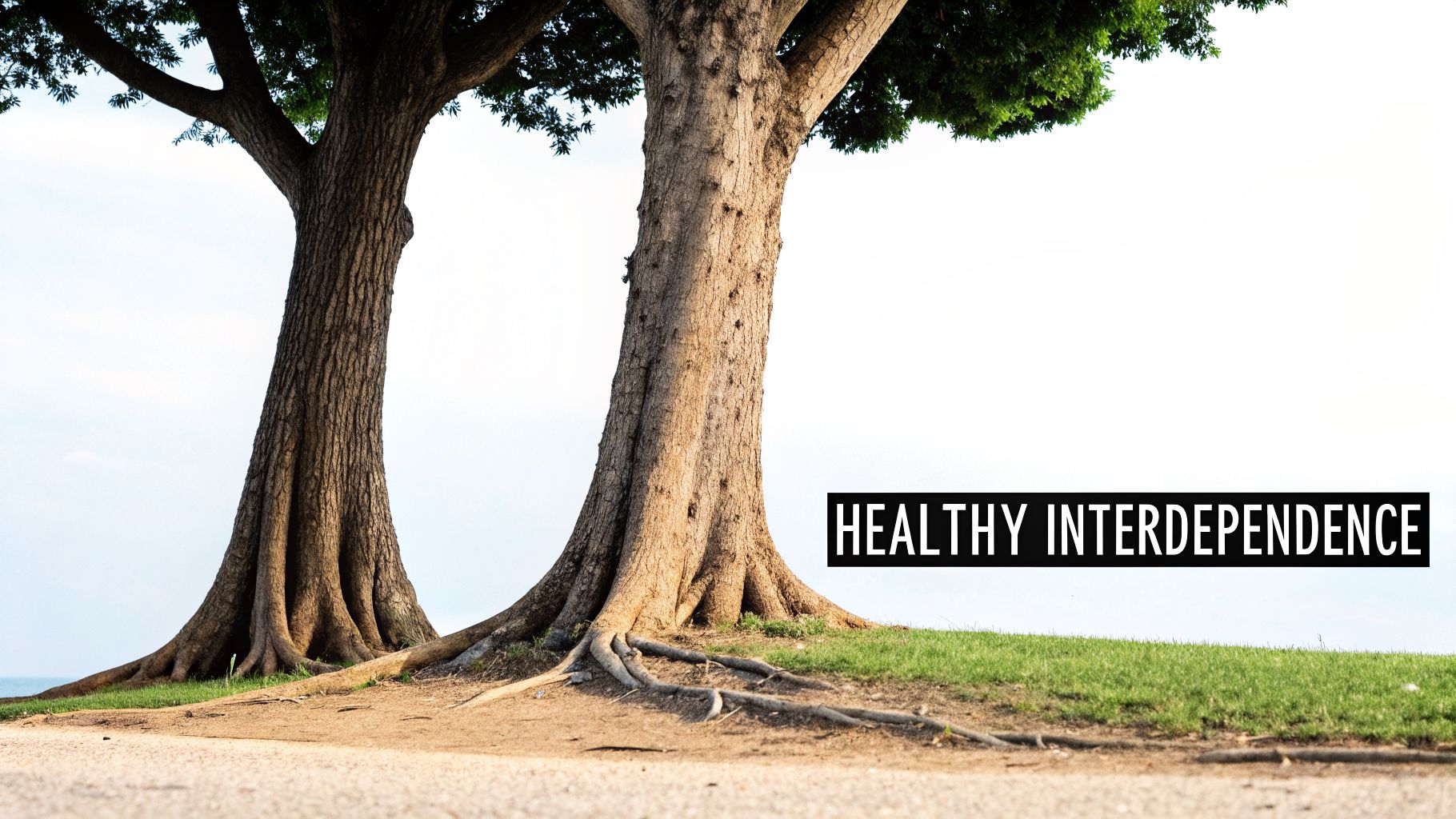
When I think about what a truly healthy relationship looks like, I often picture two strong, vibrant trees growing side-by-side. Their roots intertwine, sharing nutrients and providing support against the storms, yet each tree stands whole and complete on its own.
This is the heart of interdependence. It’s the beautiful, secure space where two people can be deeply connected without losing themselves in the process.
What Interdependence in a Relationship Really Means
So many of us are taught to see relationships as a choice between two extremes: total independence, where we keep our partners at arm’s length, or codependency, where we completely merge with them and lose our own identity. But there’s a healthier, more fulfilling path right in the middle.
Interdependence isn’t about needing someone to complete you. It’s about two complete individuals choosing to build a life together, creating a partnership that enhances who they are—both as a couple and as individuals. It's where you can be your most authentic self while also experiencing the deep connection and support of a partnership that feels both safe and liberating.
This visual shows exactly how interdependence fits between other common relationship dynamics.
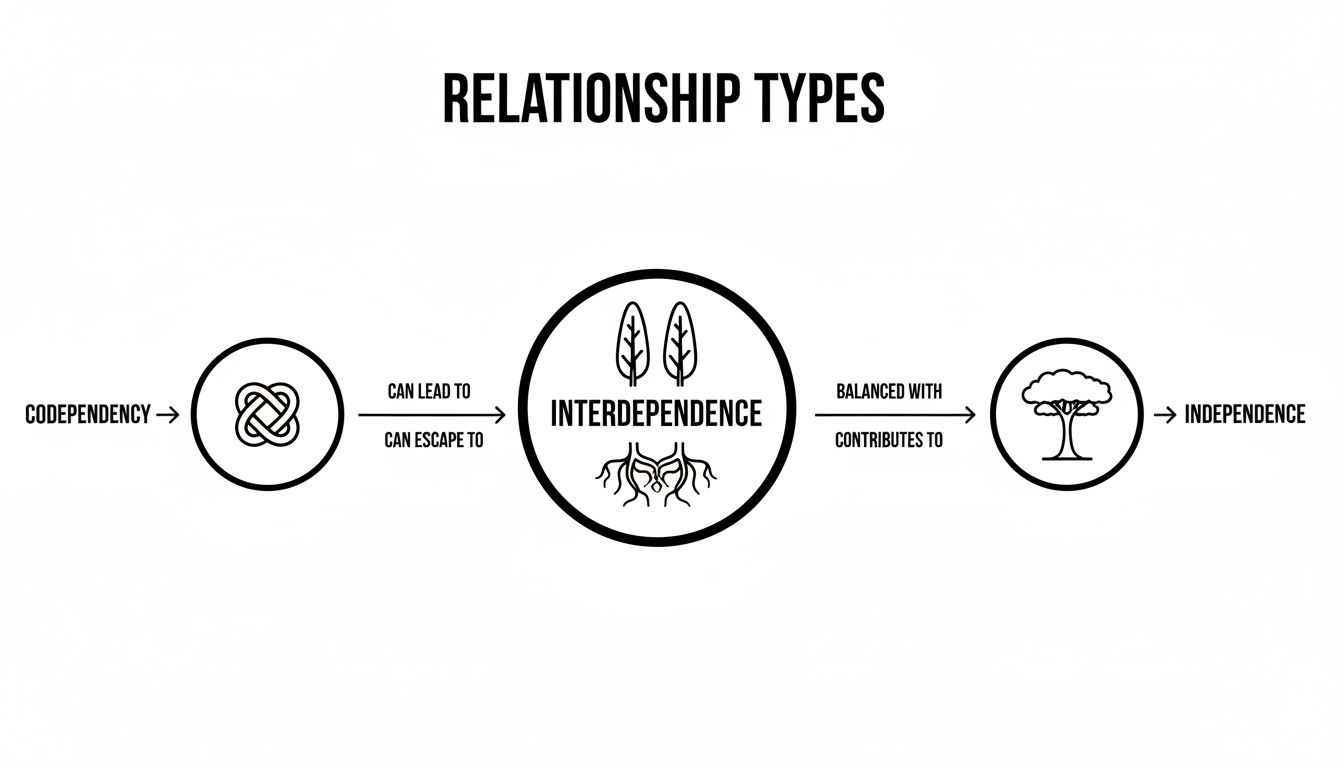
As you can see, interdependence is the healthy middle ground, steering clear of the tangled chaos of codependency and the lonely distance of total independence.
To help you get a clearer picture of where your own patterns might fall, this table breaks down the core differences.
The Relationship Spectrum at a Glance
This table compares the core characteristics of dependence, independence, and interdependence to help you quickly identify your own relational patterns.
| Characteristic | Dependence (Enmeshment) | Independence (Isolation) | Interdependence (Connection) |
|---|---|---|---|
| Sense of Self | "I am nothing without you." | "I don't need anyone." | "I am whole on my own, and I choose to share my life with you." |
| Boundaries | Blurred or nonexistent; you feel responsible for your partner's feelings. | Rigid and inflexible; you keep others at a distance to protect yourself. | Clear yet flexible; you can state your needs while respecting your partner's. |
| Conflict | Avoided at all costs to keep the peace; feels threatening. | Handled alone or avoided by withdrawing; connection is severed. | Seen as an opportunity for growth; you work through it as a team. |
| Decision-Making | You can't make choices without your partner's approval. | You make decisions alone, rarely consulting your partner. | You value your partner's input but maintain your own autonomy. |
| Support System | Your partner is your only source of support. | You rely only on yourself and resist asking for help. | You have a strong support network of your own, plus your partner. |
Looking at this, can you see familiar patterns? There's no judgment here—just an opportunity to understand what's driving your connections.
The "We" and the "Me"
In an interdependent relationship, there’s a strong sense of “we” that never erases the individual “me.” You and your partner are a team, facing life’s challenges and celebrating joys together. At the same time, you both maintain your own identities, hobbies, friendships, and personal goals.
This balance is absolutely crucial. It means your self-worth isn’t tied to your partner’s approval or the relationship’s daily ups and downs. You feel secure enough in yourself to give and receive support freely, without the constant fear of being swallowed up or abandoned.
An interdependent relationship is a partnership of equals. It’s built on the understanding that vulnerability is not weakness and that true connection thrives when both people feel whole on their own.
How Does Interdependence Feel in Real Life?
Let’s make this practical. Imagine you land a huge promotion at work.
In an interdependent dynamic, you’re excited to share the news, knowing your partner will genuinely celebrate your individual success. Your partner feels proud of you and sees your win as a positive for the team, not as a threat to their own standing. There's no competition or resentment—just shared joy.
Contrast this with a codependent scenario, where your partner might feel insecure or left behind by your success. Or an overly independent one, where you might not even feel the need to share the news because your lives are so separate.
The same goes for navigating disagreements. In an interdependent partnership, conflict isn’t a sign that the relationship is doomed. It’s an opportunity for growth. You can express different opinions and work toward a solution that respects both of your needs, without feeling like you have to “lose” yourself just to keep the peace.
Interdependence isn't a destination you arrive at, but a dynamic practice. It’s a conscious, moment-to-moment effort to foster both intimacy and autonomy. When you do, you create a resilient, trusting bond where two people can grow together without losing the very parts of themselves that make them unique.
How Your Attachment Style Shapes Your Relationships
If you've ever wondered why building a relationship that feels both connected and free is so difficult, your attachment style holds the key. This internal map, formed in our earliest years, guides how we handle intimacy, how much space we need, and how safe we feel being vulnerable.
Understanding your style is the first, most compassionate step to changing the patterns that no longer serve you. It’s not about blame; it’s about recognizing that your reactions often come from old wounds trying to keep you safe.
The Anxious Attachment View of Interdependence
If you have an anxious attachment style, your deepest fear is abandonment. The idea of your partner wanting space can feel like a direct threat, sending your nervous system into a panic.
Let’s say your partner wants a night out with their friends. For you, it might trigger a wave of fear, with thoughts like:
- "If they really loved me, they wouldn’t want to leave me tonight."
- "What if they have more fun without me? Is this the beginning of the end?"
- "I feel so alone and terrified when they're gone."
This isn’t you being "needy." It’s your attachment system screaming "DANGER!" because your childhood blueprint taught you that closeness equals safety. You might find yourself sending a flood of texts or picking a fight just to close that gap, accidentally pushing for an enmeshed connection that suffocates you both.
The Avoidant Attachment View of Interdependence
On the other side is the avoidant attachment style. If this is you, your core wound is the fear of being engulfed or controlled. True intimacy feels like a trap, and your go-to strategy is to create distance to protect your independence.
Let's use a different real-world example. Your partner wants to plan a vacation together, just the two of you. Your internal alarms might start blaring:
- "This is way too much. I feel suffocated."
- "I need some space. I feel like I'm losing myself in this."
- "Depending on someone else feels weak and dangerous."
Your programming taught you that hyper-independence is the only way to stay safe. When things feel too close, you might retreat into work, hobbies, or emotionally shut down, keeping balanced interdependence just out of reach.
"Your attachment pattern is not a life sentence. It is a learned set of relational habits and nervous system responses that can be understood, healed, and rewired for secure connection."
Disorganized Attachment and the Push-Pull Dynamic
For those with a disorganized attachment style, relationships are a confusing paradox: you desperately want love but are also terrified of it. This creates a "come here, go away" dance rooted in early experiences that felt chaotic or frightening.
One moment, you might feel incredibly close to your partner. The next, you might push them away with anger or withdrawal. The steady rhythm of interdependence feels impossible because your internal world is constantly bouncing between the anxious fear of being left and the avoidant fear of being trapped. Building a stable, interdependent partnership has to start with healing the underlying trauma and learning how to create safety within your own body first.
Recognizing these patterns is a game-changer. If any of this resonates, I encourage you to go deeper and discover your own attachment style. This understanding is where your journey toward secure, fulfilling love truly begins.
Interdependence vs. Codependence: Spotting the Difference
Getting clear on the subtle but powerful differences between healthy interdependence and unhealthy codependency is the first step to building a love that feels both safe and freeing. Both dynamics involve deep connection, but one helps you grow while the other keeps you stuck and anxious.
Let's break down the tangible signs that separate a healthy team from an unhealthy entanglement.
Hallmarks of a Healthy Interdependent Connection
In an interdependent partnership, the goal is mutual support without sacrificing who you are. It’s about creating a powerful “we” that celebrates the “me.”
- You Celebrate Each Other’s Wins: When your partner gets a promotion, you feel genuine joy for them. Their success isn't a threat—it’s a win for the team.
- You Have Separate Hobbies and Friendships: You both have your own interests and friends, and you don’t feel guilty about it. A night out with your people isn’t a betrayal; it’s a necessary way to recharge.
- You Navigate Disagreements Respectfully: Conflict is seen as a normal part of life, not a sign the world is ending. You can state your needs and work toward a solution together, knowing a difference of opinion won't shatter your foundation.
A core sign of interdependence is feeling like a team. You and your partner are two whole individuals who choose to face life side-by-side.
Red Flags of a Codependent Dynamic
Codependency often feels like a confusing mix of intense closeness and a deep, gnawing anxiety. The lines between you and your partner get so blurry that you’re not sure where you end and they begin.
This is a classic pattern for people who fall into enabling behaviors, often born from a need to feel essential. If this sounds familiar, you can learn more about why codependents enable others in our detailed article.
Here are a few real-world red flags:
- Feeling Responsible for Your Partner's Emotions: You spend your days walking on eggshells, trying to manage your partner’s moods. For example, you might cancel your own plans because you sense your partner is in a bad mood and you feel it’s your job to cheer them up.
- Losing Your Own Identity: Your hobbies, goals, and even your opinions start to fade. You might find yourself saying "I don't know, what do you want to watch?" every single time, because you've lost touch with your own preferences.
- Your Self-Worth Is Tied to the Relationship: The thought of the relationship ending sends you into a spiral of panic. Your value as a person feels completely dependent on having your partner’s approval.
This feeling of being dangerously entangled isn't just an emotional state; it shows up everywhere. Think about it: when there's a major breakdown in global supply chains, the shockwaves are felt by everyone. It triggers a system-wide crisis, much like a divorce or breakup can send our personal world into chaos. The solution isn't to become totally isolated, but to build smarter, more resilient systems—both in the world and in our lives.
For adults healing from attachment trauma, this parallel is powerful. A sudden heartbreak can feel like a personal economic collapse. But just as healthy economies rebuild with new strategies, we can use trauma-informed tools to rebuild our own sense of security. Learning to regulate our nervous system allows us to become adaptable and resilient, creating a stable foundation for interdependent bonds.
The Real-World Benefits of an Interdependent Relationship
Learning to build an interdependent relationship is about fundamentally shifting how the partnership feels in your body—moving from a connection that drains you to one that fills you up. The rewards are tangible, everyday experiences. Imagine feeling securely connected to your partner without that constant, low-level hum of anxiety that something’s about to go wrong.
That’s the goal. It’s a space where you can finally relax, knowing you’re loved for exactly who you are.
A Powerful Buffer Against Stress and Anxiety
One of the most profound benefits of healthy interdependence is its power to help regulate your nervous system. When you feel genuinely safe with your partner, they become a source of co-regulation.
This means their calm presence can physically help soothe your anxiety, and you can do the same for them. This relational container makes life’s inevitable storms feel much more manageable. For example, after a stressful day at work, simply being able to sit with your partner in shared silence, knowing you don’t have to “perform,” can lower your heart rate and calm your mind.
This dynamic isn’t just in your head. If inconsistent care in childhood wired you for relational anxiety, external stressors today can feel ten times worse. Learning to build internal safety is like creating your own emotional buffer, similar to how economists create stability amidst global uncertainty, as explored in this economic outlook from Mastercard.
Fueling Personal Growth and Resilience
In a codependent dynamic, when one person grows, it can feel like a threat. In an interdependent relationship, it’s a reason to celebrate.
This creates an environment where you are encouraged to chase your own goals. Think about deciding to go back to school or start a new business. In an interdependent partnership, your partner becomes your biggest cheerleader, helping you study or brainstorming ideas with you, because your growth enriches the team.
This dynamic builds personal resilience because you know your self-worth isn’t hanging on the relationship’s success. You are a whole person on your own. That security gives you the freedom to evolve without fear of losing your connection.
An interdependent partnership acts as a secure base from which both individuals can explore the world. It’s not about needing each other to feel complete; it’s about choosing each other to make life richer.
Deeper Intimacy and Authentic Connection
True, soul-deep intimacy can only happen with vulnerability and authenticity—two things that feel way too scary in codependent dynamics. Interdependence creates the safety net required for both partners to show up as their real, imperfect selves.
When you’re not constantly trying to manage your partner’s feelings, you can connect on a completely different level. The passion that grows from that space feels both exciting and deeply secure. You can finally share your deepest fears and wildest dreams, knowing you’ll be met with respect and love, not judgment. This authentic connection is the ultimate reward for doing the work to understand what is interdependence and build it in your own life.
Actionable Steps to Cultivate Healthy Interdependence
Knowing what interdependence is and actually living it are two very different things. This isn't just a mental shift; it’s an embodied one. The goal is to build new habits that help regulate your nervous system and create a deep sense of safety within yourself.
These steps are designed to be practical and grounded in nervous system science. Think of them as a roadmap to start building the skills for a truly interdependent partnership, starting today.
Practice Somatic Self-Awareness
Before you can tell a partner what you need, you have to know what you need yourself. This starts with somatic self-awareness—tuning into your body's physical sensations to understand your emotions.
Actionable Insight:
Set a timer for two minutes. Close your eyes and scan your body from your toes to your head. Don't judge, just notice.
- Is there a tightness in your chest? That might be anxiety.
- A knot in your stomach? That could be unspoken fear.
- Tension in your jaw? That's often unexpressed anger.
These sensations are your body talking to you. Noticing them is the first step toward clearly knowing what you need in any given moment.
Use Compassionate Boundary Scripts
Setting boundaries can feel terrifying if you fear conflict or abandonment. The key is to frame your needs not as a rejection, but as a way to take care of yourself so you can show up better in the relationship. This is a non-negotiable part of interdependence. It's also helpful for couples to apply these essential communication tips for couples.
Actionable Insight:
Instead of saying, "You're suffocating me," try a compassionate script:
- For needing solo time: "I love our time together. And right now, I'm noticing I need some quiet time to recharge so I can be fully present with you later."
- For a difficult topic: "I really want to talk about this. My nervous system feels a little overwhelmed. Can we take a 20-minute break and come back to this when I feel more grounded?"
These statements start with connection, state the need clearly, and promise reconnection. Our full guide on setting boundaries in a relationship has even more scripts to help.
Healthy boundaries are not walls that push people away. They are gates that you can open and close, allowing you to consciously manage your energy and connection.
Create Solo-Time Rituals to Build Self-Reliance
For those with anxious patterns, being alone can feel threatening. The goal of a solo-time ritual is to intentionally practice being with yourself in a way that feels nurturing and safe. This proves to your nervous system that you can be okay on your own.
Actionable Insight:
- Start Small: Begin with just 15-20 minutes a few times a week.
- Be Intentional: Choose a non-numbing activity you enjoy—reading a book, going for a walk, listening to music, or working on a creative project.
- Frame it Positively to your partner: "I'm going to take 30 minutes for a solo walk to clear my head. I'm excited to connect when I get back!"
This practice strengthens your sense of self outside of the relationship, a cornerstone of interdependence. It helps you bring a fuller, more regulated version of yourself back to your partnership.
Your Path Toward a Securely Loved Future

This journey of understanding what interdependence is goes so much deeper than just trying to fix one relationship. It's a profound act of reclaiming yourself. It’s about building a deep, unshakable capacity for a love that feels both secure and freeing.
The most important thing to remember is that your attachment patterns are not a life sentence. They are survival strategies your younger self learned to get by. Healing isn’t just possible—it's your birthright.
Your past shaped you, but it doesn't have to define your future. With the right tools and compassionate support, you can rewire your nervous system for connection and build the securely loved life you've always deserved.
Think of this article as more than just information; it's an invitation to start that work. Here are some clear, empowering next steps you can take right now to keep the momentum going.
Take Your Next Empowering Step
This work is all about moving from simply knowing these concepts in your head to feeling the change in your body. If you're ready for that, we have resources designed to meet you exactly where you are on your path.
Get Personalized Insight: Start by taking the free Attachment Style Quiz. This will give you a deeper, more personalized look at your own relational patterns. That kind of clarity is the first, most essential step toward real change.
Explore Guided Learning: For those ready to dive into the healing work, our Securely Loved Courses offer structured, trauma-informed guidance. You’ll learn the practical tools you need to regulate your nervous system and build the secure connections you crave.
Receive Personalized Support: If you feel like you would benefit from one-on-one guidance, I invite you to book a Free 15-Minute Connection Call. This is a private, compassionate space for us to explore your goals and see if we're a good fit to work together.
Choosing any of these paths is a powerful declaration that you're ready for a different kind of future—one filled with the safety, clarity, and connection you have always deserved. You don't have to walk this path alone.
Frequently Asked Questions About Interdependence
It’s completely normal for questions to come up as you step into a new way of relating. These answers are here to give you clarity and confidence as you move forward.
Can you be too independent in a relationship?
Absolutely. There’s a massive difference between healthy autonomy and hyper-independence, which is often a trauma response. If you handle every problem alone, never ask for support, and keep your partner at an emotional arm's length, you are likely operating from a place of self-protection, not partnership. This wall prevents the deep connection that is the heart of a healthy, interdependent relationship.
Is interdependence possible if my partner has a different attachment style?
Yes, it's completely possible. It’s incredibly common for people with different attachment styles to end up together—the classic anxious-avoidant dance is a perfect example. When one person commits to doing the work, it can change the entire dynamic. The goal is never to force your partner to change; it's to become a secure anchor yourself. Your calm, regulated nervous system can help co-regulate your partner's, creating an invitation for them to step into a healthier space with you.
How long does it take to build an interdependent relationship?
Building an interdependent relationship is like tending to a garden—it takes patience and consistent care. There’s no magic timeline. The pace depends on your attachment histories and how committed you are to the process. Some couples feel a shift within a few months of conscious practice; for others, it's a longer journey. Focus on progress, not perfection. Celebrate the small wins, like the first time you set a boundary without feeling guilty. This journey is an ongoing practice of choosing connection and wholeness, one day at a time.
Are you ready to stop the cycle of relationship anxiety and build a love that feels both safe and liberating? At Securely Loved, we specialize in guiding adults through this very process. Book a free, private 15-minute Connection Call with Bev Mitelman to start your journey toward the secure connection you deserve.