

Attachment Style Definition: Understand Your Relationship Patterns
If you've ever found yourself completely baffled by your own reactions in a relationship, you're not alone. One minute, you feel totally fine, and the next, a wave of panic washes over you because your partner seems a little distant. Or maybe you crave space, only to be flooded with guilt the moment you get it.
These aren't just random, chaotic feelings. They're predictable patterns, and they’re rooted in something we call your attachment style.
Think of your attachment style as your internal roadmap for relationships. It’s a kind of emotional operating system that was “coded” in your childhood and now runs quietly in the background of your adult life. It subtly influences who you’re drawn to, how you navigate conflict, and why certain relationship dynamics feel so painfully familiar.
For anyone who’s been through traditional talk therapy but still feels stuck in the same cycles, understanding this blueprint can be a game-changing “aha” moment. It shifts the narrative from "What's wrong with me?" to "What happened to me?"—reframing your struggles not as a personal failure, but as a predictable pattern. And if it's predictable, it can be changed.
Why This Blueprint Runs Your Relationships
Understanding this internal roadmap is so crucial because, whether you realize it or not, it’s quietly governing your entire emotional and relational world.
Here’s what it affects:
- Who You're Attracted To: You might find yourself unconsciously drawn to partners who confirm your deepest-held beliefs about love—even when those beliefs are painful and stem from your past.
- How You Handle Conflict: Your blueprint is what makes you lean in to solve a problem, shut down and pull away, or become completely overwhelmed with anxiety when tensions rise.
- Your Sense of Self-Worth: Insecure attachment patterns are almost always tied to those nagging, deep-seated feelings of not being good enough, lovable, or worthy of consistent, steady care.
Learning to recognize your own patterns is a huge step toward real, lasting personal growth. If you're ready to start this work, a great place to begin is by exploring how to improve self-awareness in our detailed guide.
Your attachment style isn't a life sentence or a personality flaw. It's an adaptation. It was the most intelligent way your younger self could navigate your world to get your needs for safety and connection met. When you can see it this way, you can finally start approaching yourself with compassion instead of judgment.
The Four Primary Attachment Styles
Attachment theory breaks these patterns down into four main styles. While we'll dive deeper into each one, it's helpful to get a quick overview first.
It's also important to know that you're not alone if your connections feel insecure. While research has historically shown that 56-63% of adults have a secure attachment style, newer studies reveal a worrying trend. One study of American college students showed a drop in security from 48.98% in 1988 to 41.62% in 2011, with insecure styles rising to a staggering 58.38%. This shift makes understanding our own patterns more important than ever.
Here's a simple guide to help you start recognizing these styles. As you read, see if you can spot your own tendencies or those of people you've been in relationships with.
Quick Guide to the Four Attachment Styles
This table gives you a snapshot of the core beliefs and behaviors that drive each of the four attachment styles in adulthood.
| Attachment Style | Core Belief About Connection | Typical Behavior in Relationships |
|---|---|---|
| Secure | "I am worthy of love, and I can trust others to be there for me." | Easily balances intimacy and independence; communicates needs directly and effectively. |
| Anxious-Preoccupied | "I need you to be close to feel okay; I'm terrified you'll leave me." | Craves constant intimacy and reassurance; can feel "clingy" and is highly sensitive to any sign of rejection. |
| Dismissive-Avoidant | "I am self-sufficient and don't need anyone; being needed feels suffocating." | Values independence far more than intimacy; feels smothered by closeness and often withdraws. |
| Fearful-Avoidant | "I desperately want to be close, but I'm terrified I'll get hurt." | Desires and fears intimacy at the same time; relationships often feel chaotic and unpredictable. |
Recognizing where you might fall isn't about putting yourself in a box. It’s about being given the right map so you can finally understand the terrain you've been navigating your whole life.
The Four Adult Attachment Styles in Real Life
So, let's move beyond the theory and talk about what these relationship blueprints actually look like in our day-to-day lives. Each attachment style definition brings its own set of unwritten rules, gut reactions, and deep-seated fears to the table.
It’s so important to remember: these patterns aren't personal flaws. They are brilliant survival strategies your younger self developed to navigate your world and get your needs met.
This visual shows how that core blueprint you formed in childhood branches out into one of four primary patterns. Think of the heart as Secure, the question mark as Anxious, the wall as Avoidant, and the storm cloud as Disorganized.
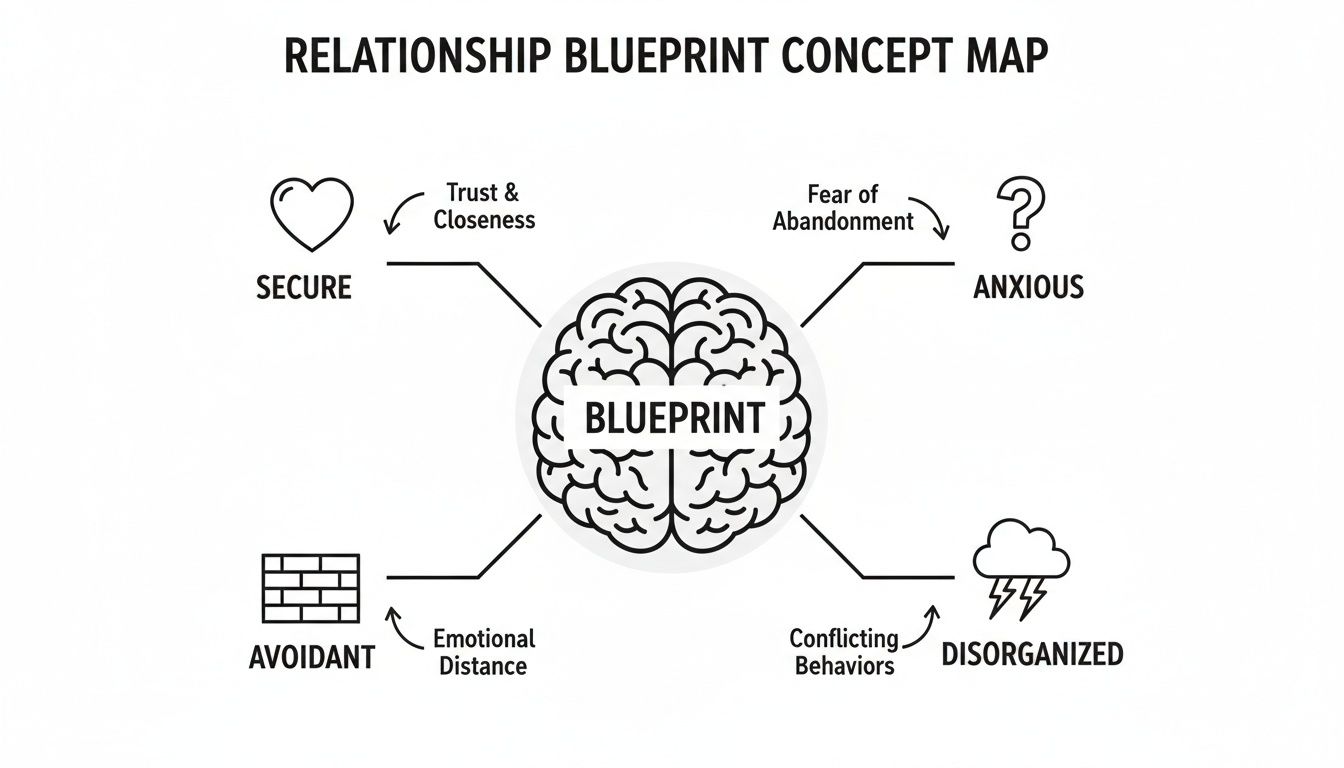
While each insecure style looks different on the surface, they all grew from the same root: a lack of consistent safety and connection. Seeing them as adaptations—not defects—is the first, most compassionate step toward understanding the dynamics you find yourself in.
The Secure Individual
Think of a securely attached person as ‘Secure Sarah.’ She’s fundamentally at ease with both closeness and her own independence. If her partner wants a night out with friends, she doesn’t spiral into panic. Her inner world is grounded in trust, not self-doubt.
Real-World Example: Sarah's partner, Tom, gets a last-minute invitation to go to a game with his friends. He texts, "Hey! The guys just invited me to the game tonight, so I'll be home late. Love you!" Instead of feeling rejected, Sarah replies, "Have so much fun! Talk tomorrow." She trusts the connection and enjoys her unexpected free evening without worry. She can tell her partner what she needs directly and kindly. "I'm feeling a bit disconnected, could we plan a date night this weekend?" comes out without a hint of anxiety or accusation. This balance comes from a deep, baked-in belief that she is worthy of love and that the people she trusts are reliable.
The Anxious-Preoccupied Individual
Now let’s meet ‘Anxious Anna.’ For Anna, the emotional world often feels like a turbulent sea of "what ifs." Something as small as a delayed text message can trigger a full-blown internal alarm system that screams, “They’re pulling away! I’m going to be abandoned!”
Real-World Example: Anna's partner is in a work meeting and hasn't replied to her text from two hours ago. Her mind immediately jumps to the worst-case scenario: "He's mad at me," or "He's losing interest." To soothe the rising panic, she might:
- Send a follow-up text like, "Is everything okay?"
- Check his social media to see if he's been active online.
- Start mentally replaying their last conversation, searching for clues of what she might have done "wrong."
For the anxious style, consistent connection can feel like oxygen. Any perceived threat of disconnection feels like a primal fear of abandonment, and that feeling can be overwhelming and all-consuming.
The Dismissive-Avoidant Individual
Next up, we have ‘Avoidant Adam.’ Adam’s core value is independence. For him, deep emotional closeness often feels less like love and more like a threat to his self-sufficiency. When a partner gets too close or expresses big emotions, he feels suffocated, and his gut reaction is to pull back and create space.
Real-World Example: Adam's partner says, "I really miss you. Let's plan a romantic weekend away." Instead of feeling happy, Adam feels a wave of pressure. His internal narrative sounds a lot like, "I'm fine on my own. I need my space." He might respond by saying, "My schedule is really packed right now," or change the subject. It’s not that he doesn’t care; it’s that his nervous system learned long ago that emotional closeness was unreliable, and that true safety could only be found in self-reliance. We dive much deeper into this pattern in our guide to understanding the dismissive attachment style.
The Fearful-Avoidant (Disorganized) Individual
Finally, there’s ‘Fearful-Avoidant Felicia,’ who lives in a painful paradox. She has a deep, desperate craving for intimacy, but at the same time, she’s utterly terrified of it. Her inner world is a constant, confusing tug-of-war between "come here" and "go away."
Real-World Example: Felicia has an amazing date and feels a powerful connection. The next day, instead of feeling excited, she's consumed by fear. She thinks, "This is too good to be true. He's going to hurt me." She might ghost him for a few days to protect herself, only to feel intense loneliness and regret, then reach back out in a moment of panic. This push-pull is almost always the result of a chaotic or frightening childhood where the source of safety (a caregiver) was also a source of fear. For Felicia, relationships feel volatile because she's constantly trying to meet two competing needs at once.
Uncovering the Roots of Your Attachment Style
Those confusing and frustrating relationship patterns you keep finding yourself in? They didn’t just show up out of nowhere. The blueprint for how you connect with others today was drafted in your earliest years, shaped entirely by the emotional world you grew up in.
From the moment you were born, your nervous system was learning what to expect from love. It was constantly trying to answer a few critical questions: Is connection safe? Are my needs okay, or are they a burden? Will the people I depend on actually show up for me? The answers you received became wired into you, forming the very core of your attachment style.
Your Brilliant Childhood Adaptation
I like to think of a child’s emotional development like a small plant. When a child receives consistent love and care—like a plant getting reliable sunlight and water—they learn to trust their environment. They grow with a deep, unspoken sense that their needs are valid and will be met. This is how secure attachment is born.
But what if that sunlight and water were unpredictable? A flood one day, a drought the next. That little plant would have to find a way to survive. It might learn to shrink and conserve its resources (becoming avoidant) or desperately stretch toward any tiny glimmer of light it could find (becoming anxious).
Your attachment style is not a flaw; it’s a brilliant adaptation. It was the smartest strategy your younger self could have created to survive the emotional environment you were in.
Seeing it this way is the first step to swapping self-judgment for real self-compassion. Your patterns aren’t a sign that you’re broken. They’re a testament to your resilience and your deep, human drive to find safety and connection, even when the conditions were tough. For many, these patterns are directly linked to the lasting impact of childhood trauma, and understanding this link can be an incredibly empowering part of healing.
Breaking Generational Patterns
These adaptations are so powerful that they often get passed down from one generation to the next without anyone even realizing it. It’s not a conscious choice. It's a legacy of insecure attachment that gets transmitted through behavior and shared nervous system responses.
The data here is staggering: approximately 85% of children end up with the same attachment style as their primary caregiver. This helps explain why so many of us find ourselves struggling with the exact same patterns we watched our parents live out. With about 25% of adults identifying as avoidant and 19% as anxious, this cycle is incredibly common. You can read more about these attachment statistics and their impact here.
Understanding this isn’t about blaming your parents, who were likely doing the best they could with the tools they inherited. It’s about relief. It shows that your struggles aren't some personal failure, but part of a much larger, inherited pattern—a pattern you now have the awareness and the power to change.
By looking at the roots of your attachment style, you start to heal the original wound. You begin to see your triggers and reactions not as chaos, but as echoes from your past. This clarity is what allows you to stop reacting on autopilot and start responding with intention, paving the way for the secure, loving connections you truly deserve.
Navigating the Anxious-Avoidant Dynamic
It’s one of the most common and painful dynamics I see in my coaching practice: the person who craves closeness is magnetically drawn to the person who fears it. This pattern, often called the anxious-avoidant trap, is a torturous cycle of pursuit and withdrawal that leaves both people feeling exhausted, misunderstood, and completely heartbroken.
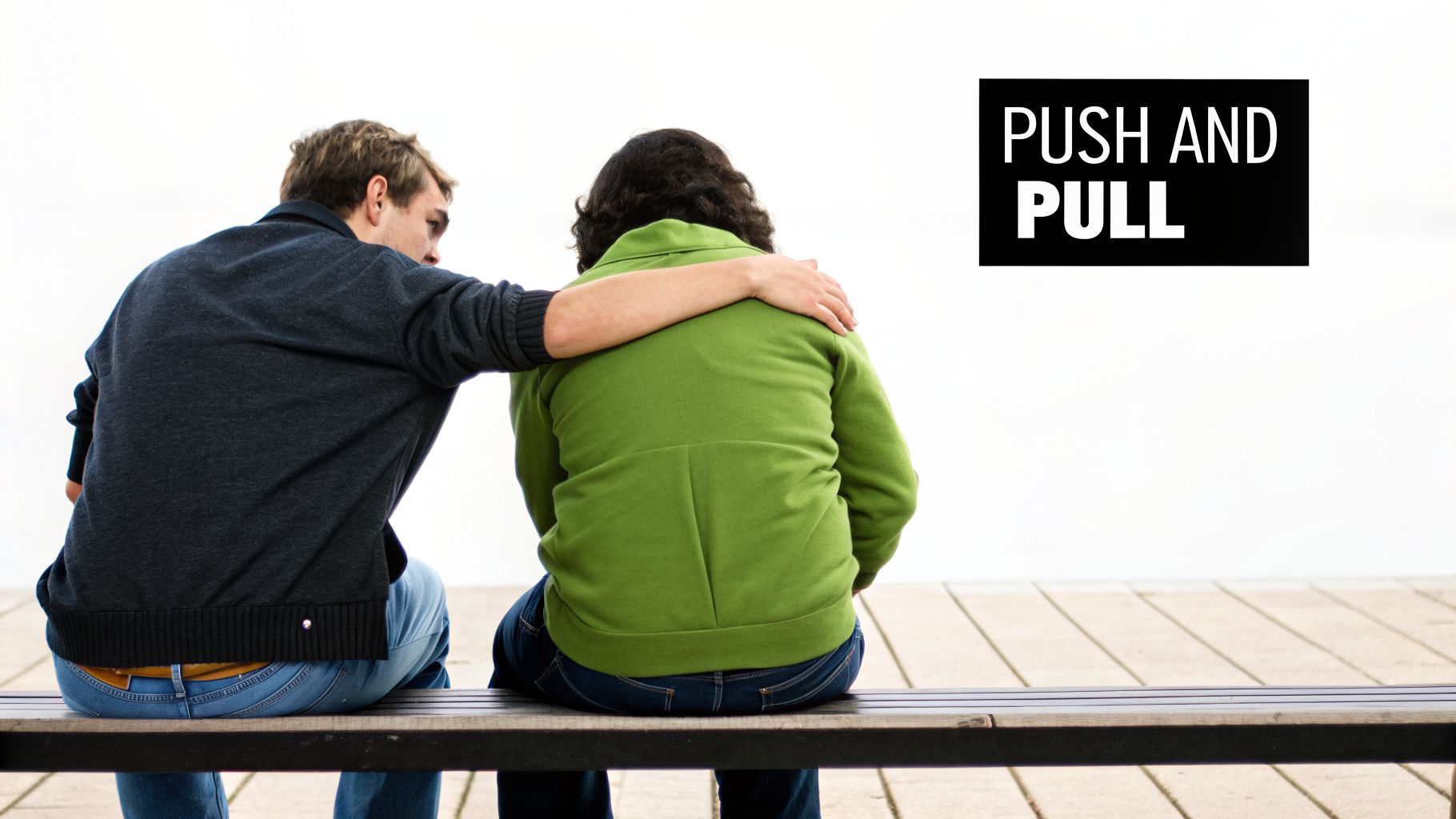
Understanding this dance is often a massive “Aha!” moment. It’s the validation you’ve been searching for—the proof that you’re not “crazy” or “too needy,” but are instead caught in a predictable loop fueled by your deepest attachment programming.
Let’s walk through a common story to see how this plays out.
A Story of Pursuit and Withdrawal
Imagine Sarah (who has an anxious attachment style) and Mark (who leans dismissive-avoidant) have been dating for a few months. Things started out feeling like magic, but now Sarah senses Mark pulling away. He’s taking hours to reply to texts and seems to dodge any talk about future plans.
For Sarah, her internal alarm system, wired to detect any hint of abandonment, goes into overdrive. This distance feels like a direct threat to the safety of the connection. Her nervous system is screaming, “Close the gap! Reconnect now or you’ll be left alone!”
So, she does what her attachment style has taught her to do: she pursues.
- She sends a follow-up text asking if everything is okay.
- She suggests they book a weekend trip, hoping to have something to look forward to together.
- She directly asks for reassurance, “You seem a little distant. Is everything okay with us?”
From her perspective, these are logical, loving actions to repair the bond.
To Mark, however, this pursuit feels like suffocating pressure. His nervous system, wired to see closeness as a threat to his independence, feels engulfed. His own alarm system goes off, but it’s screaming, “I’m being smothered! I need space to feel safe!”
So, he does what his attachment style dictates: he withdraws.
- He sees her texts but feels too overwhelmed to reply right away.
- He deflects the trip conversation, saying he’s “too busy” to think about it.
- He shuts down her bid for reassurance, telling her she’s “overthinking things.”
This is the core of the trap. The anxious partner’s attempt to get closer inadvertently triggers the avoidant partner’s greatest fear: engulfment. In turn, the avoidant partner’s withdrawal to create space triggers the anxious partner’s greatest fear: abandonment.
Each person’s survival strategy becomes the very thing that amplifies the other’s deepest wound. This painful push-and-pull is the signature of the anxious-avoidant dynamic. If this feels painfully familiar, you can find more clarity in our guide to the anxious-avoidant attachment style.
Breaking the Cycle of Disconnection
The good news is that understanding this pattern is the first, most powerful step toward breaking free.
When both people can see this dynamic not as a personal attack but as a clash of two different survival strategies, compassion can start to replace blame. You’re not enemies; you’re two people trying to feel safe using completely opposite methods.
Recognizing the cycle allows you to see the true attachment style definition in action. It’s not about who is "right" or "wrong." It’s about two nervous systems reacting to perceived threats based on very old programming. By bringing awareness to this dance, you can stop reacting on autopilot and begin to choose a different way of relating—one that fosters connection instead of disconnection. This is the key to finally stepping out of the loop and building the secure bond you both deserve.
How to Heal and Build Secure Attachment
Figuring out your attachment style is a huge first step. It’s like finally getting the blueprint to your relationship patterns. But just knowing the "why" isn't enough to change the "how." The real work begins when we take that insight and start actively healing the old wounds to build what’s called earned security.
If you've felt stuck in the same painful cycles for years, the idea of changing these deep-seated patterns can feel impossible. But I promise you, your brain is not set in stone. Thanks to something called neuroplasticity—your brain's incredible ability to form new pathways—you absolutely can change, no matter your age.
Attachment styles aren't a life sentence. While studies show 58.2% of US adults keep their secure attachment from age 25 to 45, they also reveal that 12.4% successfully move from an anxious to a secure style. This is real proof that healing happens. Discover more insights about these attachment style findings on droracle.ai.
The Foundation of Healing: Your Nervous System
At Securely Loved, our entire approach is built on two core pillars: regulating your nervous system and building a sense of safety from within. This is why traditional talk therapy sometimes falls short—it can keep you in your head, analyzing the problems, when the real change needs to happen in your body.
Your attachment patterns aren't just thoughts; they are stored in your nervous system as automatic, physical reactions. That’s where we have to start.
When you get triggered, your body is instantly flooded with stress hormones, activating your fight, flight, or freeze response. The first skill is learning how to ride these emotional waves without drowning. It’s not about stuffing your feelings down. It's about creating enough space inside to feel them without being completely taken over.
Here are a few simple but powerful practices you can start using today:
- Grounding Exercises: The next time you feel a wave of anxiety, pull your attention back to your body. Feel your feet on the floor. Notice the weight of your body in your chair. Name five things you can see, four things you can touch, three things you can hear, two you can smell, and one you can taste. This yanks your brain out of future-tripping and back into the present moment.
- Mindful Breathing: Inhale slowly through your nose for a count of four, hold it for four, and then exhale slowly through your mouth for a count of six. That longer exhale is a direct signal to your nervous system that you are safe, helping to shift you out of panic and into calm.
These aren't magic bullets, but foundational skills. By practicing them, you start proving to your body, on a biological level, that you can handle distress and find your way back to balance.
Becoming Your Own Secure Base
The second pillar of healing is learning to re-parent yourself. This means giving yourself the consistent compassion and care you might not have received when you needed it most. It’s about becoming your own secure base—a reliable source of comfort you can always turn to. For those wanting to dig deeper into the "why" behind their patterns, a private mental health assessment in the UK can provide invaluable clarity on this journey.
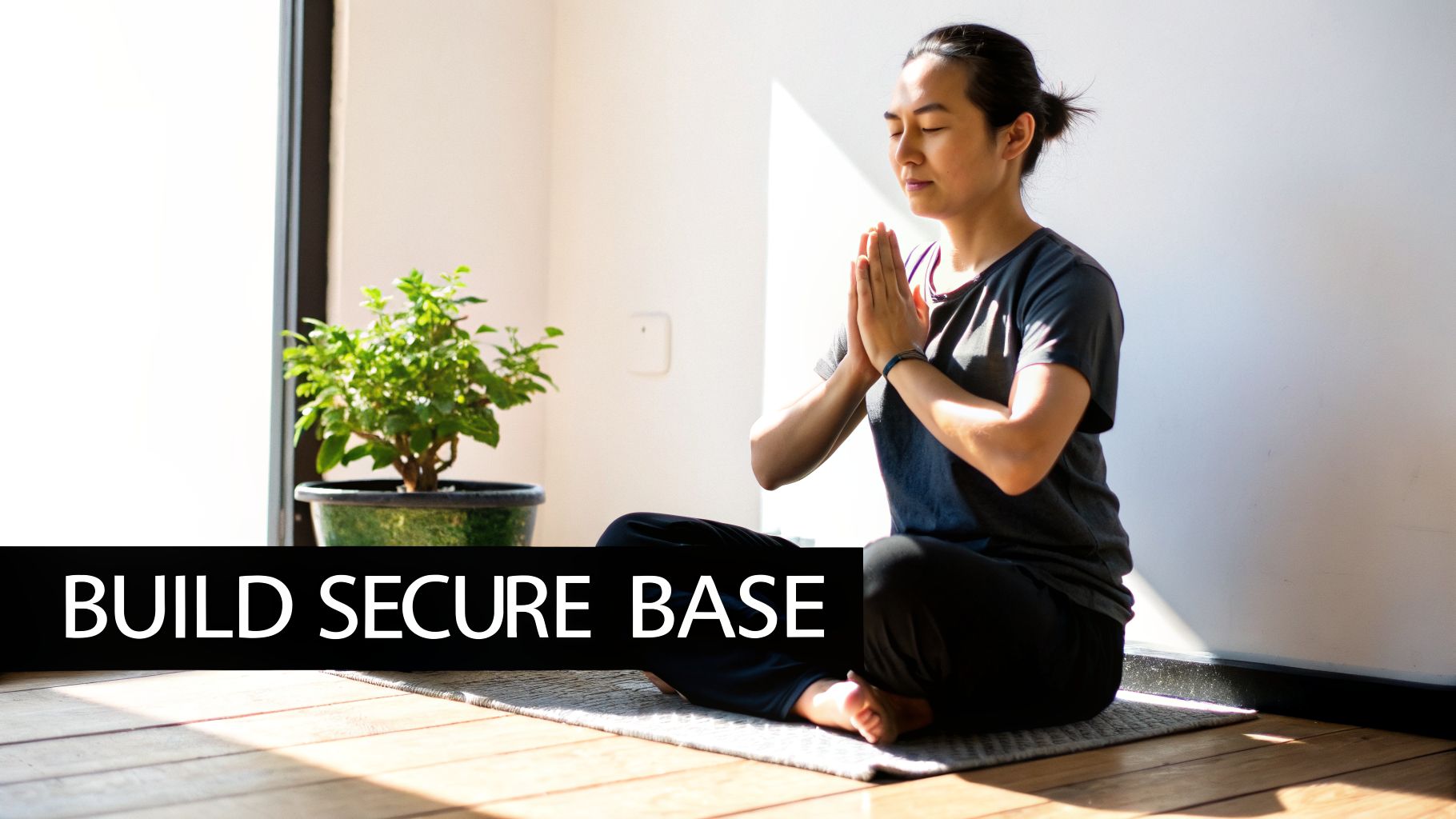
Becoming your own secure base is about learning to turn inward for safety instead of constantly searching for it in others. It's about learning to say to yourself, "I've got you," and truly believing it.
Actionable Insight: The next time you feel anxious or activated, try this. Place a hand over your heart, take a deep breath, and say to yourself, "This is a moment of suffering. Suffering is a part of life. May I be kind to myself in this moment." This simple act of self-compassion can stop a shame spiral in its tracks and begin rewiring your response to distress. You learn to validate your own feelings, celebrate your own successes, and comfort your own heartaches.
This journey from understanding your attachment style to truly feeling secure in your own skin is one of the most powerful you can take. It’s about more than just having better relationships with other people; it’s about finally, finally coming home to yourself.
As you start to unpack all this information about attachment, it's completely normal for a lot of questions to bubble up. It can feel like a lot to take in. Let's walk through some of the most common ones I hear in my coaching practice, so you can move forward with more clarity.
Can My Attachment Style Actually Change as an Adult?
I get this question all the time, and the answer is a resounding yes. Please hear this: your attachment style is not a life sentence. While it was wired in your early years, your brain has an incredible capacity to change and create new pathways. It's called neuroplasticity.
Through self-awareness, healthier relationships, and the right kind of therapeutic work, you can absolutely build what’s called an “earned secure” attachment. This isn't about erasing your past. It’s about healing those old wounds and learning, maybe for the first time, how to give yourself the safety and validation you always needed. You are creating a new blueprint for connection.
Is One Insecure Style Better or Worse Than Another?
Not at all. There is no hierarchy of pain here. It’s far more helpful to see anxious and avoidant styles as two different sides of the very same coin.
Both are brilliant survival strategies your younger self came up with to cope in a world that didn’t feel consistently safe. One style is not “better” or “worse” than the other. The real goal isn't to judge your style, but to finally understand it with a deep sense of compassion. That understanding is the key that unlocks healing.
Each insecure attachment style is simply a different survival response to a similar problem: a lack of consistent safety and attunement in childhood. The anxious style moves toward others to feel safe, while the avoidant style moves away. Both are valid attempts to get a core need met.
Can My Relationship Work if We Have Different Styles?
Yes, it's entirely possible for relationships between different attachment styles to not just survive, but truly thrive. But here's the non-negotiable part: both partners have to be committed to doing the work. Awareness is always the first step.
When you can both recognize your own triggers and understand your partner's core needs (and fears), you can start navigating disagreements without falling into the same old painful patterns. A challenging dynamic, like the classic anxious-avoidant pairing, can even become a powerful space for incredible healing—but only if you're both willing to show up with empathy and patience.
How Is This Different From Regular Talk Therapy?
This is such an important question. Many of my clients come to me after years of traditional talk therapy. They often say, "I understand my problems in my head, but I don't feel any different."
While talk therapy is valuable for changing thoughts and behaviors, it sometimes doesn't get to the root of the issue. An attachment-focused approach goes deeper, working on a somatic level. It directly addresses the survival patterns stored in your nervous system. By using body-based practices to regulate your system and build a true, felt sense of safety from the inside out, this work creates change that actually sticks. You’re not just talking about feeling safe; you’re teaching your body how to embody it.
Ready to move beyond just understanding your patterns and finally start healing them? At Securely Loved, we specialize in helping adults regulate their nervous systems, heal attachment wounds, and build the secure, connected relationships they deserve. Book a free discovery call to see how we can support you.