
What Is Nervous System Regulation and How to Achieve It
Nervous system regulation is a term you hear a lot these days, but what does it actually mean? Think of it as your body's innate wisdom—its ability to move from high-alert, heart-pounding stress back to a place of calm and connection. It’s the art of guiding your inner world back to a state of balance after life throws you a curveball.
For example, have you ever felt that jolt of anxiety when you see your boss's name pop up in an unexpected call? Or that sinking feeling in your stomach when a text from your partner feels a bit "off"? That's your nervous system shifting gears. Regulation is what helps you take a deep breath and come back to center after the call ends or the text is clarified.
Understanding Your Inner Operating System
Imagine your nervous system is your body’s internal thermostat, always working behind the scenes to keep you feeling balanced and safe. It's the "control center" that runs everything from your breathing and heartbeat to how you react in conversations and connect with the people you love.
When you feel safe, loved, and connected, your system is regulated. You can think clearly, feel present, and engage with the world from a grounded place. But when you face a threat—whether it’s a real danger or an emotional trigger like fearing your partner will leave—your system rightfully shifts gears. This isn't a flaw; it's a brilliant survival mechanism designed to protect you.
The Shift from Safety to Stress
Your nervous system is built to respond to whatever is happening around you and inside of you. I often explain this to my clients using a simple car analogy. Your system has two primary modes that are always at play:
- The "Gas Pedal" (Sympathetic Nervous System): This is your fight-or-flight response. When it gets pressed, it floods your body with adrenaline and cortisol to prepare you to face a threat. Your heart races, your muscles get tight, and your mind narrows in on the problem. Think about the energy surge you get when you're about to miss a flight.
- The "Brake Pedal" (Parasympathetic Nervous System): This is your rest-and-digest state. It’s what helps you calm down, save energy, and feel open to social connection. Your breathing slows, your body relaxes, and you feel at ease. It's the feeling of relief washing over you when you finally sit down after a long, stressful day.
Nervous system regulation is simply the flexible dance between these two states. A healthy, regulated system can hit the gas when needed (like for a deadline at work) and then gently apply the brake to return to a calm baseline once the stress has passed.
Dysregulation is what happens when your system gets stuck. It might be stuck "on," leaving you with chronic anxiety, hypervigilance, and that feeling of always waiting for the other shoe to drop. Or, it might get stuck "off," pulling you into a state of shutdown, numbness, and disconnection from yourself and others. Please remember: This isn't a personal failure. It’s an adaptive response to overwhelming stress or trauma.
Your Nervous System's Three Primary States
To make this even clearer, we can look at the nervous system through the lens of Polyvagal Theory, which gives us a beautiful map of our internal states. It helps us understand why we feel the way we do.
Here’s a quick breakdown of the three main states your nervous system can be in:
| Nervous System State | What It Feels Like Inside | A Real-World Example |
|---|---|---|
| Ventral Vagal (Safe & Social) | Calm, grounded, connected, curious, hopeful, present. | Laughing with a friend over coffee, feeling completely at ease. |
| Sympathetic (Fight or Flight) | Anxious, angry, worried, panicked, irritable, activated. | Your heart pounding after a near-miss in traffic. |
| Dorsal Vagal (Shutdown) | Numb, disconnected, frozen, hopeless, depressed, dissociated. | Feeling completely empty and drained after a huge argument. |
Seeing these states laid out can be a huge "aha" moment. It's not that you're "broken"; your body is just trying to keep you safe using the tools it has.
A huge part of this work involves gently noticing the thought patterns and behaviors that either soothe your system or send it into high alert. Learning what Cognitive Behavioral Therapy (CBT) is can offer powerful tools for understanding this mind-body connection. By recognizing these patterns without judgment, you can begin to guide your body back to a state of perceived safety, one small step at a time.
The Science of Safety and Connection
To truly understand what’s happening when your nervous system goes haywire, we need to peek under the hood at our own incredible biology. I love using Polyvagal Theory, a framework developed by Dr. Stephen Porges, because it gives us a compassionate and clear map for this inner world. It helps us stop seeing our reactions as character flaws and start seeing them for what they are: biological responses hardwired for survival.
Think of your nervous system as a ladder with three rungs. Where you are on this ladder, at any given moment, shapes how you feel, how you think, and how you connect with the world around you.
The Top of the Ladder: Safe and Social
At the very top, we have the Ventral Vagal state. This is your sweet spot—the state of safety and social engagement. When you’re here, you feel grounded, present, and genuinely connected to yourself and others.
Life feels hopeful and you feel curious and open. Your creativity is flowing, you can laugh easily, and you just feel comfortable in your own skin. This is the state where real connection is born, where we can give and receive love without that constant hum of fear in the background. Think of the warm, expansive feeling you have during a heartfelt conversation with someone you trust.
The Middle Rung: Mobilized for Action
The middle rung is the Sympathetic state, which you probably know as "fight-or-flight." This state is all about mobilization. Your body gets a flood of adrenaline and cortisol to give you a surge of energy to face down a threat.
And let's be clear, this isn't just about running from a tiger. It’s that jolt of anxiety you feel before a tough conversation. It’s the flash of anger when you feel completely misunderstood. It’s the worry that spins in your head and keeps you staring at the ceiling at 3 AM. Your heart races, your muscles get tight, and your mind narrows to focus only on the danger.
The Bottom of the Ladder: Shutdown and Disconnected
All the way at the bottom of the ladder is the Dorsal Vagal state. This is our oldest, most primitive survival response: the shutdown or "freeze" state. When fighting or fleeing feels impossible—or when it has already failed—the body slams on the emergency brake to conserve every last bit of energy.
Down here, you might feel numb, foggy, hopeless, or just empty. It’s that feeling of being completely drained and hollowed out after a big fight, or that emotional flatness that makes it hard to feel much of anything at all. This is your body’s last-ditch effort to protect you by helping you "disappear"—both from the outside world and from your own overwhelming feelings.
This diagram stacks these three states, showing the natural hierarchy from our ideal state of social connection all the way down to a protective shutdown.
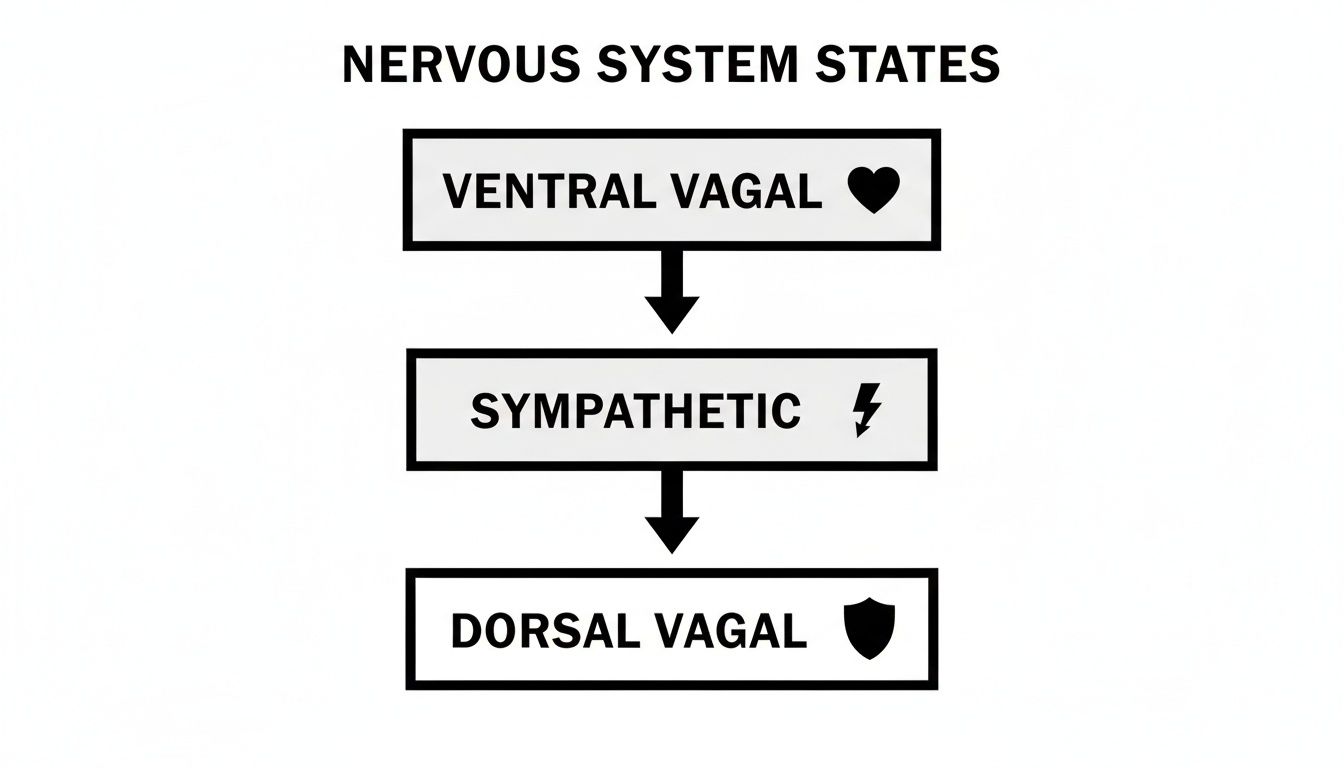
This visual shows that while our goal is to live in Ventral Vagal, our system is designed to drop down into Sympathetic or Dorsal states to keep us safe when it senses danger.
Key Insight: Understanding this ladder is everything. It helps you stop asking, "What's wrong with me?" and start asking, "What's happening in my body right now?" This tiny shift from judgment to curiosity is the very first step toward reclaiming your own inner safety.
How Attachment Patterns Live on the Ladder
Our early experiences, especially our attachment patterns, basically create a "home base" for us on a particular rung of this ladder. Your nervous system learns what to expect from the world and wires itself for that reality.
- An anxious attachment pattern can feel like living on that middle sympathetic rung, always on high alert, scanning for signs of disconnection, and mobilized by a constant current of anxiety. You might compulsively check your phone, waiting for a text back, feeling a surge of panic with every passing minute.
- An avoidant attachment pattern might mean you default to the dorsal shutdown at the bottom, disconnecting from your own feelings and the feelings of others to avoid the perceived pain of relationships. You might feel a sudden urge to be alone and "zone out" with Netflix after an intimate conversation.
- A disorganized attachment pattern often involves chaotic, unpredictable jumps between the sympathetic and dorsal states, feeling both overwhelming anxiety and debilitating numbness, sometimes all at once.
Please hear me when I say: These are not conscious choices. They are deeply ingrained survival strategies that your younger self developed to get through.
And these "glitches" in our wiring are far more common than most people realize. In 2021, data showed that in the US alone, over 180.3 million people were impacted by nervous system disorders, making it the leading cause of disability. This includes everything from tension-type headaches affecting 121.9 million people to diabetic neuropathy—proving just how profoundly our nervous system health dictates our daily life. You can read more about the US burden of nervous system disorders to see the full picture.
Understanding the science of safety is so empowering. It shows us that with the right tools, support, and practice, we can teach our nervous system that it's safe to climb back up the ladder and finally rest in a state of true, secure connection.
Recognizing the Signs of a Dysregulated System
So, how does this actually show up in your life? How can you tell if your nervous system is dysregulated? It’s rarely a single, dramatic event. More often, it’s a series of quiet, persistent whispers from your body and mind telling you that something is out of balance.
Learning to hear these whispers is the first step toward finding your way back to safety. Think of it as learning the language of your own body. These signals aren't character flaws; they are vital messages letting you know your system is overwhelmed and needs support. Let's break down what to look for.
Physical Symptoms of Dysregulation
When your body is stuck in a state of high alert or shutdown, it will find ways to tell you. These physical signs can be so confusing because they often don’t have a clear medical diagnosis, yet they can completely upend your daily life.
Common physical signs include:
- Chronic Fatigue: A deep, bone-weary exhaustion that no amount of sleep can fix. It feels like your internal battery is constantly hovering at 10%.
- Digestive Upset: Your gut is deeply connected to your emotional state. When your "rest-and-digest" system is offline, issues like chronic indigestion, bloating, or IBS symptoms are incredibly common.
- Sleep Disturbances: This can look like lying awake with racing thoughts (a sign of a revved-up sympathetic state) or waking up constantly, never feeling truly rested.
- Unexplained Aches and Tension: That persistent tightness in your neck, shoulders, and jaw that never seems to go away. Or, frequent tension headaches and migraines with no obvious trigger.
Emotional and Cognitive Signs
A dysregulated system directly hijacks your emotional world and mental clarity. It might feel like your emotions are turned up way too loud, or conversely, that the volume has been muted and you can’t feel much at all.
Recognizing that your internal state might be a sign of nervous system dysregulation—rather than a personal failing—is a profoundly validating shift. It opens the door to self-compassion, which is essential for healing.
Some emotional and cognitive red flags are:
- Heightened Anxiety or Panic: A constant, low-grade hum of worry, feeling perpetually on edge, or being hit by sudden waves of panic that seem to come from nowhere.
- Irritability and Anger: Snapping at the people you love over small things or feeling a simmering rage just below the surface that you can't shake.
- Emotional Numbness: This is a big one. Feeling disconnected, flat, or unable to access joy, excitement, or other positive feelings. It's a classic sign of the dorsal vagal "shutdown" response.
- Brain Fog or Difficulty Concentrating: That feeling like your mind is moving through thick mud. You might struggle to focus, make decisions, or remember simple things.
Relational Signs of Dysregulation
Because our nervous systems are fundamentally wired for connection, dysregulation almost always rears its head in our relationships. These patterns are often rooted in our earliest attachment experiences and can be incredibly painful to live out.
Maybe you find yourself compulsively checking your phone, waiting for a text back from a new partner, your body flooded with the sheer panic of being abandoned. Or maybe you feel completely drained and need days to recover after a simple coffee date with a friend. These are classic relational signs.
Other common patterns include:
- People-Pleasing: A deep-seated need to abandon your own needs to keep others happy, all driven by a terrifying fear of conflict or rejection. For example, saying "yes" to a project you don't have time for just to avoid disappointing your boss.
- Avoiding Conflict at All Costs: Feeling so paralyzed by the thought of a disagreement that you stay silent, even when your partner says something that hurts you.
- Pushing People Away: The moment intimacy starts to feel too close or too real, you might subconsciously create distance or pick a fight to feel safe again.
- An Intense Fear of Abandonment: A pervasive, gut-wrenching feeling that you will inevitably be left, which can cause you to cling to partners or constantly scan for signs they're pulling away.
These signs are more common than you could ever imagine. The scale of this is enormous. A 2021 study showed that over 3 billion people worldwide—that’s more than 43% of the global population—were living with a neurological condition, making it the leading cause of illness and disability. You can read more about these global neurological health findings to grasp the full scope.
If you see yourself in any of these descriptions, please know you are not alone. These are not signs that you are "broken"; they are signs of a human body that has worked incredibly hard to survive. And as you'll soon see, you have the power to guide it back to a place of balance. Our in-depth article on what is nervous system dysregulation offers even more clarity on this important topic.
Your Toolkit for Finding Calm in the Moment

It’s one thing to recognize the signs that you’re feeling dysregulated, but it’s another to know what to do about it when you're in the thick of it. This is where self-regulation comes in. It’s about building your own personal toolkit of simple, real-world practices you can pull out in those moments of overwhelm, anxiety, or total shutdown.
We can think about these tools in two ways:
- Top-Down Regulation: This is when you use your conscious mind—your thoughts and perspective—to gently guide your body back to a state of calm.
- Bottom-Up Regulation: This works the other way around. You use your body and its physical sensations to send “I am safe” signals directly to your brain, bypassing all the frantic thoughts.
Both are incredibly helpful, but when you feel too overwhelmed to even think straight, the bottom-up tools are your best friend. They offer immediate relief. Let's dive into some tangible practices you can start using right now.
Bottom-Up Techniques to Soothe Your Body
Ever feel so anxious or numb that trying to "think positive" feels like a cruel joke? That’s because the thinking part of your brain (the prefrontal cortex) can go quiet during a stress response. These bottom-up practices are a direct line to your nervous system, using your body to tell your brain, “It’s okay. We are safe.”
1. The Physiological Sigh
Backed by neuroscience, this is one of the quickest and most effective ways to slow everything down. It helps your body release carbon dioxide and kick-starts your parasympathetic (rest-and-digest) system.
- How to do it: Take a deep breath in through your nose. Then, at the very top of that breath, take another short sip of air to fill your lungs completely. Finally, let it all go with a long, slow exhale through your mouth.
- When to use it: Perfect for when you feel a wave of anxiety building—before a tough conversation or right after getting a triggering text. One or two rounds can make a world of difference.
2. The 5-4-3-2-1 Grounding Method
When your mind is racing or you feel like you're floating outside your body, this technique anchors you firmly in the present moment by engaging all your senses.
- How to do it: Pause and silently name 5 things you can see around you. Notice 4 things you can physically feel (the softness of your sweater, the chair supporting you). Listen for 3 sounds. Identify 2 smells. And finally, notice 1 thing you can taste.
- When to use it: This is a lifesaver in moments of sensory overwhelm, like a chaotic grocery store, or when you feel yourself starting to check out during a difficult talk.
3. Gentle Somatic Movement
Stress isn't just in your head; it gets stored in your body. Somatic (body-based) movements help you release that pent-up tension and finally complete the stress cycle.
- How to do it: Try just shaking your hands and arms for a minute, like you’re shaking off water. Or, gently roll your neck from side to side and stretch your arms up high. The key is to pay attention to the feeling of release in your body.
- When to use it: Do this after a long day to literally "shake off" the stress, or when you feel frozen and stuck in that shutdown state. To dive deeper, exploring practical somatic healing exercises can be a powerful way to tap into your body's own ability to heal.
Top-Down Techniques to Guide Your Mind
Once you have a little more breathing room, you can bring your conscious mind into the process. These practices use your awareness to gently shift your internal state from a place of compassion.
Mindful Observation: Simply naming what’s happening without judgment—“I’m noticing a lot of anxiety in my chest right now”—creates a tiny but powerful space between you and the feeling. It’s a reminder that you are the observer of the emotion, not the emotion itself.
Name It to Tame It: Dr. Dan Siegel taught us that when we put a name to what we’re feeling (“I feel scared,” “I am feeling angry”), we bring the logical part of our brain online. This instantly helps to calm the more reactive, emotional parts.
Self-Compassion: When you feel dysregulated, it’s so easy to start criticizing yourself for it. Instead, try placing a hand over your heart and offering yourself a little kindness. Say something like, "This is so hard right now. It makes sense that I feel this way." This is a powerful signal of internal safety.
These aren't one-and-done fixes. Think of them as skills you’re building over time. For even more ideas, you can explore other ways to regulate your nervous system in our guide. The goal isn’t to never feel dysregulated again—that's impossible. The goal is to build the confidence that no matter what comes up, you have the tools to find your way back home to yourself.
Healing Your Patterns with Therapeutic Support
 While learning to regulate yourself is a game-changer, deep-seated attachment patterns often need more than solo work to truly heal. It makes sense, right? Our nervous systems were shaped *in connection* with others, so it’s in a safe connection that they often heal the most profoundly.This is where working with a therapist can make all the difference. A skilled, trauma-informed therapist doesn’t just listen; they act as a safe, steady co-regulator. Their grounded presence becomes an anchor your own nervous system can borrow from, creating a safe space to finally explore your triggers and practice new ways of showing up in the world.
Beyond Just Talking: An Embodied Approach
Have you ever spent years in talk therapy, understanding your patterns inside and out, but still finding yourself stuck in the same painful relationship cycles? It’s incredibly frustrating, and you’re not alone. The problem is that talking often doesn’t reach the parts of the body where trauma is actually stored.
This is why an embodied approach, like the one we use at Securely Loved, is so different. We don’t just talk about feelings; we work with the nervous system from the ground up, integrating it with attachment theory to build a real, felt sense of safety inside you.
Here’s what that looks like in practice:
- Mapping Your Inner World: We work together to figure out your specific triggers and which survival state—fight, flight, or freeze—they pull you into.
- Connecting the Dots to Your Past: We gently explore how these reactions are wired from your past experiences. This isn’t about blaming or pathologizing; it’s about bringing compassion to the parts of you that learned these strategies to survive.
- Practicing in Real-Time: Within the safety of the therapeutic relationship, you can practice feeling big emotions without getting overwhelmed. This builds resilience and teaches your system, on a cellular level, that you can handle it.
For instance, a client with an anxious attachment style might feel a wave of panic when their partner asks for space. Instead of just talking about their fear of abandonment, we’d pause and notice the physical sensations—the racing heart, the tightness in their chest. Then, we’d use bottom-up tools to help their system find a bit of calm, right in that activated moment.
How Co-Regulation Heals Old Wounds
The real magic here is something called a corrective emotional experience. If you grew up with caregivers who were inconsistent or emotionally unavailable, your nervous system likely never learned what it feels like to be truly soothed by another person. Therapy can provide that missing piece.
When a therapist offers a calm, attuned presence while you explore a painful memory or a difficult feeling, your nervous system learns a new lesson: "I can be with this distress, and I will not be alone. I am safe."
This process directly heals the core wound of insecure attachment. It’s not just about learning coping skills; it’s about rewiring your brain and body for secure connection. By repeatedly experiencing safety with another person, you begin to internalize that safety. It becomes a resource you carry inside you.
The gap in this kind of care is massive. WHO reports that by 2025, while neurological conditions will affect over 40% of the world's population, only 32% of countries have national policies to address them, and a shocking 18% provide adequate funding. You can read more insights on the urgent need for neurological care to see why it's so important to find support for yourself.
For someone with an avoidant pattern who usually shuts down during conflict, therapy offers a space to slowly and safely stay present with discomfort instead of running away. This is how you build the capacity for the intimacy that has always felt just out of reach. Understanding the principles of what is trauma-informed therapy shows why this safe, attuned approach is so vital for healing.
This is the work that finally breaks the exhausting anxious-avoidant dance. It’s about building a foundation of inner security so you can finally show up in your life and relationships as your most authentic, grounded, and securely-loved self.
Your Path to Feeling Safe and Connected
If you've read this far, I want you to hear one thing loud and clear: You are not broken.
Those responses you’ve been fighting against—the anxiety, the numbness, the feeling that you're just 'too much' or 'not enough'—aren't defects. They are brilliant, protective strategies your body developed to survive when connection and safety felt out of reach.
The way forward isn’t about trying to “fix” a broken part of you. It's about learning a new language—your body's language. It's about building a relationship with yourself that’s rooted in curiosity and compassion, not judgment.
The most powerful takeaway is that change is possible for you. Your nervous system is designed for safety and connection, and even if those pathways have been dormant, they are still there, waiting to be rediscovered.
If you recognized yourself in these pages—in the racing heart, the fear of being left, or the impulse to shut down and pull away—please know you aren't alone in this. And you don’t have to figure it all out by yourself. You absolutely can learn to build the deep internal safety that makes grounded, secure, and fulfilling relationships possible.
Ready to take that next step toward feeling safe, seen, and secure? I invite you to book a free, private 15-minute connection call with me. This is a compassionate, no-pressure space for us to talk about where you are and see if the Securely Loved approach feels right for you. Your journey toward the connection you deserve starts here.
Common Questions About Nervous System Regulation
As you start to explore nervous system regulation, it's completely normal for questions to bubble up. Think of this as a quick-start guide to the questions I hear most often in my coaching practice. Getting clear on these points can make all the difference as you learn to build a foundation of safety within yourself.
How Long Does It Take to Regulate Your Nervous System?
This is a big one, and the honest answer is: there's no finish line. Nervous system regulation isn't a destination you arrive at; it's a lifelong practice of coming home to yourself.
While some tools, like a deep breathing exercise, can offer immediate relief in a tough moment, rewiring the deep-seated patterns from our past takes time. This is especially true if you’re healing from attachment trauma. Think of it less like flipping a switch and more like tending to a garden. With consistency, patience, and the right support, you slowly and intentionally cultivate a whole new internal landscape—one where you feel safe and at ease.
Can I Heal Nervous System Dysregulation on My Own?
You can absolutely make incredible progress on your own, and every single step you take is a massive win for your healing. Self-help tools build your awareness and give you a powerful toolkit for navigating the stresses of daily life. However, since our nervous systems were first shaped in relationship with others, they often heal best in relationship, too.
This is where co-regulation comes in. Working with an attachment-focused therapist provides a safe, attuned relational space that is often essential for healing relational trauma. That supportive connection literally helps your brain build new pathways for safety that are incredibly difficult, if not impossible, to forge completely alone.
Is Regulation Just About Calming Down?
This is such an important and common question. While calming down is definitely a piece of the puzzle, true regulation goes much deeper. Sometimes, "calming down" can become another way to suppress or ignore what you're actually feeling, which is really just a form of internal shutdown or freeze.
For instance, if you're feeling angry because a boundary was crossed, "calming down" might mean stuffing that anger away. True regulation, however, might involve acknowledging the anger without acting on it, using that energy to understand what you need, and then calmly communicating your boundary later. It's about building a kinder, more responsive relationship with yourself, not forcing yourself to feel a certain way. This is the heart of what it truly means to understand what is nervous system regulation.