

Attachment Therapy: Mend Your Relational Patterns
You hold it together all day. You answer emails, solve problems, care for other people, and keep moving.
Then one text goes unanswered, one hard conversation happens, or one partner pulls back, and suddenly your whole body reacts. Your mind races. Or it goes blank. You might chase reassurance, shut down, overthink, lash out, or tell yourself you do not need anyone anyway.
If that feels familiar, you are not broken. You are likely living inside an attachment pattern that once helped you survive relationships that felt confusing, inconsistent, or emotionally lonely.
Attachment therapy, when it is safe and evidence-based, can help you understand those patterns and change them. Not by forcing closeness. Not by blaming your childhood for everything. But by helping you build safety in your body, clarity in your mind, and steadiness in your relationships.
Feeling Stuck in Your Relationships? You Are Not Alone
Maybe you are the person who looks confident from the outside but feels chaotic in love. You can lead at work, parent competently, and be the one everyone relies on. But when intimacy gets real, you feel needy, guarded, reactive, or exhausted.
Does this sound familiar?
You tell yourself not to care so much, yet you keep checking your phone.
You want closeness, but when someone gets too close, you feel trapped.
You keep choosing people who are unavailable, then wonder why the same pain keeps repeating.
These patterns are learned, not chosen
Many individuals come into attachment work asking, “What is wrong with me?”
A more helpful question is, “What happened in my relationships that taught my nervous system to protect me this way?”
If you grew up with inconsistent emotional attunement, criticism, unpredictability, or caregivers who loved you but could not fully meet you, your system adapted. It learned how to scan for danger, numb out, please, perform, cling, or withdraw.
Those responses can look messy in adult relationships. They often make perfect sense once you understand the history underneath them.
Your reactions are often old survival strategies showing up in present-day relationships.
Why insight alone often does not fix it
Many people already know their pattern. They have read the books, taken the quizzes, and talked it through with friends or therapists.
Still, the same cycle returns under stress.
That is because attachment wounds are not only cognitive. They live in expectations, reflexes, body sensations, and emotional memories. If you want a fuller picture of insecure attachment, this guide on https://securelyloved.com/insecure-attachment-theory/ is a useful starting point.
Attachment-focused therapy gives language to what felt invisible. It also offers a way to practice something new. You can learn to stay present during conflict, ask for what you need without panic, and feel more grounded in connection.
Hope matters here. These patterns are thoroughly learned, but they are not permanent.
What Modern Attachment Therapy Is and What It Is Not
Modern attachment therapy should begin with one clear distinction. There is a major difference between safe, evidence-based attachment-based therapy and the coercive practices that were historically called “attachment therapy.”
What safe attachment-based therapy looks like
In a healthy clinical setting, attachment therapy is collaborative. You are not controlled, restrained, shamed, or pushed past your limits.
A therapist helps you notice patterns such as:
- Conflict loops that leave you pursuing, defending, or withdrawing
- Body cues like tightness, collapse, agitation, or numbness
- Relationship beliefs such as “I am too much,” “No one is really there,” or “I have to do this alone”
- Protective strategies that once helped, even if they now create distance
The work is trauma-informed. It respects pacing, consent, and nervous system capacity. It helps you build security rather than performing closeness.
What attachment therapy is not
The term “attachment therapy” has a disturbing history when used to describe coercive treatment methods. According to the historical record summarized in Wikipedia’s overview of attachment therapy, these practices were associated with at least six documented child fatalities since the 1990s. Those deaths were linked to coercive methods such as rebirthing, and professional bodies including the American Psychological Association condemned such approaches.
That history matters. It is not a side note.
It means any therapist using attachment language should be clear about safety, consent, and evidence. A sound attachment-based approach never uses force to create bonding. It does not claim that fear will heal fear.
A simple way to tell the difference
Use this comparison if you are trying to sort out confusing language online:
| Approach | What it relies on | What it feels like |
| — | — |
| Coercive “attachment therapy” | Control, force, compliance | Frightening, shaming, unsafe |
| Attachment-based psychotherapy | Attunement, consent, pacing | Grounding, collaborative, respectful |
A good therapist welcomes questions. They explain their process. They help you feel more choice, not less.
If a method asks you to override your body’s alarm signals in the name of healing, that is not safety.
This distinction is especially important because attachment work can be profoundly powerful. When done well, it helps repair old relational injuries through a consistent, respectful therapeutic relationship. When done poorly, it repeats the original wound.
Understanding Your Attachment Blueprint
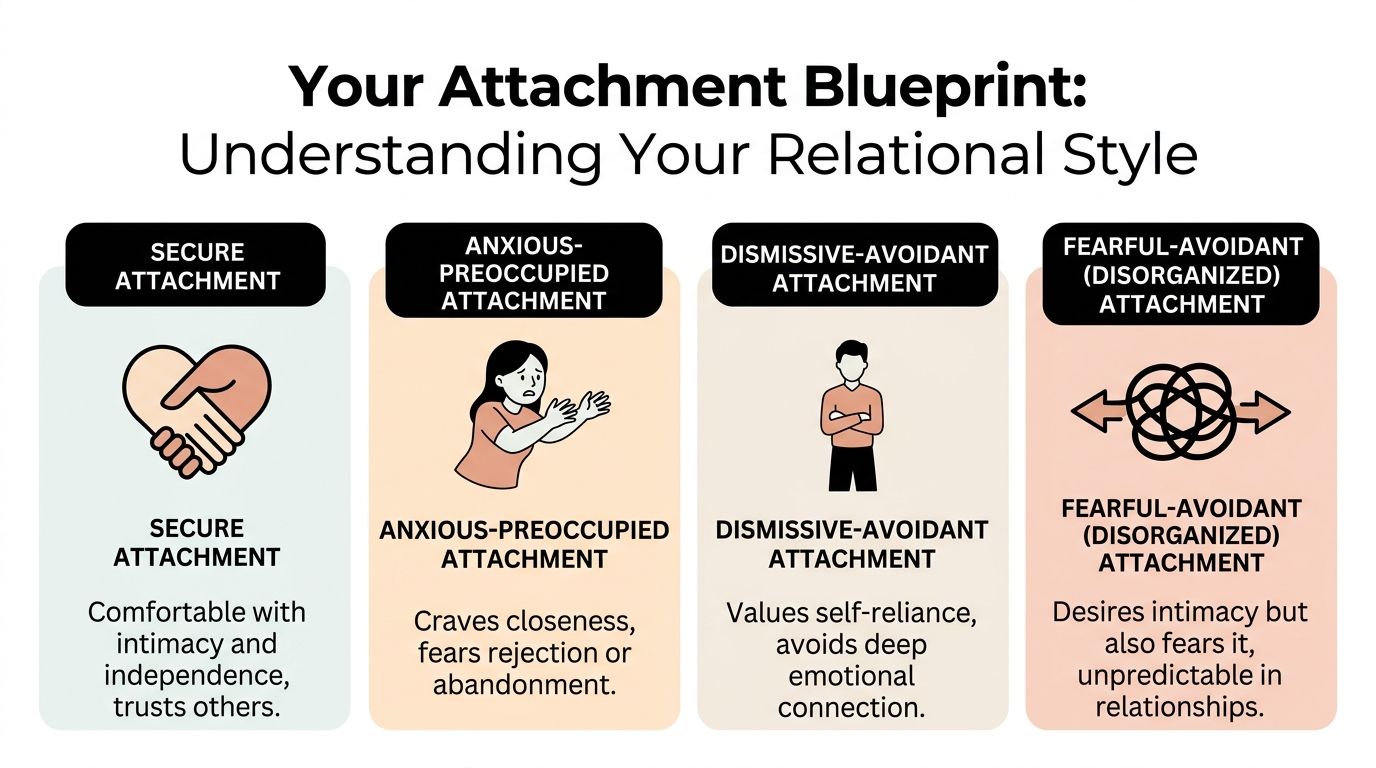
Attachment theory gives us a practical idea. Early relationships help create an internal working model, or blueprint, for what love feels like, what to expect from others, and what role you believe you must play to stay connected.
That blueprint is not destiny. But it does shape how you interpret closeness, conflict, distance, and repair.
If you want a thoughtful outside perspective on what attachment theory is and how it shapes you, that piece pairs well with this topic. You can also explore more definitions on https://securelyloved.com/attachment-style-definition/.
Secure attachment
Secure attachment does not mean perfect childhoods or conflict-free relationships.
It usually looks like this: you can depend on others without losing yourself. You can tolerate normal distance. You can ask for reassurance and also self-soothe. Repair feels possible.
Someone with a more secure blueprint might think, “This conversation is hard, but we can work through it.”
Anxious attachment
Anxious attachment often feels like having an emotional smoke detector that goes off quickly.
You may read small shifts in tone as signs of abandonment. Waiting can feel unbearable. Reassurance helps, but only briefly. Your mind may spin stories like, “They are pulling away,” or “I am about to be left.”
Common signs include:
- Over-focusing on connection and scanning for changes
- Difficulty settling after conflict or distance
- People-pleasing to keep closeness intact
Dismissive avoidant attachment
This pattern often looks strong on the outside. Inside, there may be discomfort with vulnerability, dependence, or emotional need.
A helpful metaphor is a smoke detector with the batteries removed. Rather than feeling too much alarm, you learned to mute it. You may minimize needs, prefer distance when emotions rise, or tell yourself that needing others is risky.
You might say, “I just need space,” when part of you means, “I do not know how to stay connected without feeling overwhelmed.”
Fearful avoidant or disorganized attachment
This pattern combines longing and fear. You want intimacy, but it does not feel fully safe.
That can create push-pull dynamics. You move toward someone, then panic. You want reassurance, then distrust it. You may feel emotionally flooded one moment and shut down the next.
Self-recognition is the goal here, not self-judgment.
A note on labels
These styles are not boxes to trap you in. They are maps.
Some people see themselves clearly in one pattern. Others notice a blend that shifts by relationship, life stage, or stress level. Midlife transitions, grief, betrayal, and burnout can all intensify patterns that once felt manageable.
Pathways to Healing With Attachment-Based Therapies
People often assume attachment healing happens by talking through the past until it finally makes sense. Insight helps, but attachment wounds also live in the body. They show up in breath, muscle tension, shutdown, urgency, and the speed of your reactions.
That is why effective attachment therapy often includes more than one pathway.

Emotionally Focused Therapy for relationship cycles
Emotionally Focused Therapy, or EFT, is one of the best-known attachment-based models for couples. Studies summarized in these attachment style statistics report 70-75% recovery rates for distressed couples, with 90% showing significant improvements in relationship satisfaction.
Why does EFT help so many people?
It looks beneath the argument. Instead of staying at the surface level of “You never listen” or “You always shut down,” EFT helps partners uncover the vulnerable emotions underneath. Usually one person is protesting disconnection, while the other is protecting against overwhelm, failure, or rejection.
When that pattern becomes visible, blame often softens.
Somatic and nervous system work
Some people understand their attachment style perfectly and still cannot stop reacting. Their body moves faster than their insight.
Somatic work helps slow that process down. It teaches you to notice cues of activation and shutdown before they hijack the interaction. You learn how your body signals danger, what helps you return to regulation, and how to widen your capacity for closeness.
For readers looking into body-based support, https://securelyloved.com/nervous-system-regulation-therapy/ describes one trauma-informed approach to nervous system regulation.
Other supportive methods
Different therapists use different tools depending on your needs. These may include:
- EMDR for specific relational traumas that still feel “stuck”
- Inner child work to bring compassion to younger parts of you that still expect abandonment or rejection
- Mindful relational work that helps you stay present during discomfort rather than automatically pursuing or withdrawing
A practice like Securely Loved offers attachment-focused therapy with a trauma-informed and nervous-system-centered lens, alongside educational resources such as quizzes and courses. That can be one option if you want a model that connects insight with embodied change.
What healing often looks like in real life
Healing does not always look dramatic.
It can look like pausing before sending the text you will regret. It can look like telling a partner, “I am activated and need reassurance,” instead of starting a fight. It can look like staying emotionally present without collapsing, chasing, or disappearing.
That is secure attachment in action. Not perfection. More steadiness.
Who Can Benefit from Attachment Healing?
Attachment work is not only for people in obvious crisis. Many adults seek attachment therapy because life looks successful on paper while relationships still feel painfully hard.
High-functioning professionals who cannot think their way out of the pattern
This is common. You may be disciplined, articulate, high-achieving, and self-aware. You may have done years of personal development and still find yourself stuck in the same relational loop.
You know better. But under stress, your body runs the old program.
For professionals in this position, body-based approaches can matter. A source referenced in the brief notes that somatic-focused methods showed sustained security in 72% of cases, compared with 45% for CBT alone, in the context described by Grow Therapy’s overview of attachment-based therapy. The deeper point is clear. Some people need more than cognitive strategies. They need approaches that reach the nervous system.
Midlife women navigating hormonal shifts
This is an area that gets missed far too often.
Many women notice that relationship anxiety, emotional overwhelm, irritability, or shutdown become sharper during perimenopause or menopause. Old insecurities may feel louder. Conflict tolerance can drop. The body may feel less predictable, and that can amplify attachment triggers.
If you have thought, “Why am I suddenly so reactive?” you are not imagining it.
Hormonal shifts can intensify insecure attachment symptoms. That does not mean hormones cause the attachment wound. It means they can reduce your margin for stress, making existing patterns harder to manage.
People recovering from heartbreak, divorce, or relational betrayal
Breakups often expose attachment pain with startling clarity.
Someone with anxious attachment may feel consumed by the loss and desperate for contact. Someone more avoidant may detach quickly, then crash later when the numbness fades. A disorganized pattern can swing between longing, anger, confusion, and self-blame.
Attachment healing helps you use the crisis differently. Instead of only trying to “get over it,” you begin to ask:
- What did this relationship activate in me
- What did I ignore because the familiar felt compelling
- What kind of connection feels safe and mutual
People who have tried therapy before and still feel stuck
This matters too. Not all therapy works at the level attachment wounds live.
If prior therapy gave you language but not lasting change, that does not mean you failed therapy. It may mean the method did not address the relational and bodily roots of the pattern.
A more attachment-focused approach can help when your struggle is less about information and more about embodied safety, relational trust, and emotional regulation.
What to Expect in Your Therapy Journey
Starting attachment therapy can feel tender. Many people arrive wanting support and fearing dependence at the same time.
That conflict is normal.
The first contact
A low-pressure consultation or connection call is usually not a commitment. It is a chance to get a feel for the therapist and notice how your body responds.
Do you feel rushed or settled?
Do your questions feel welcome?
Does the therapist sound curious, clear, and respectful?
Those details matter because attachment healing is relational. The fit is not a small thing. It is part of the work.
What sessions often feel like
A good attachment-focused session is not an interrogation. It is not a performance review of your childhood. It is a guided, attuned conversation that helps slow down patterns that normally happen too fast to see.
Your therapist may help you track:
- What happened externally, such as a text, silence, conflict, or disappointment
- What happened internally, including body sensations, emotions, beliefs, and impulses
- What you did next, like pursuing, pleasing, withdrawing, numbing, or attacking
- What younger meaning got activated, such as “I do not matter” or “I am alone again”
Over time, that process becomes less intellectual and more experiential. You start to catch the pattern while it is happening.
How progress is noticed
Progress in attachment therapy is not just “I feel better today.”
Often it sounds like this:
“I stayed in the conversation.”
“I said what I needed without apologizing for existing.”
“I took space without punishing anyone.”
“I noticed my panic and did not let it drive.”
Some clinicians also use structured tools to track in-session attachment patterns. The Patient Attachment Coding System, or PACS, is one validated method. As described in this PACS research article, it analyzes communication patterns such as vulnerability and avoidance to help identify shifts in a client’s internal working model and predict treatment outcomes.
That may sound technical, but the human meaning is simple. Your therapist is listening not only to what you say, but to how you reach, protect, minimize, or resist in relationship.
Healing often begins when your protective patterns are finally understood without being shamed.
How to Choose the Right Therapist and Prepare for Healing
Finding a therapist for attachment therapy is not about choosing the fanciest title. It is about finding someone whose way of working helps your system feel safe enough to change.
Questions worth asking a potential therapist
You do not need to ask everything at once. A few clear questions can tell you a lot.
How do you work with the nervous system
A therapist who understands attachment usually knows that patterns show up in the body, not only in thoughts.What is your experience with anxious, avoidant, or disorganized attachment
You want someone who recognizes push-pull dynamics, shutdown, protest behavior, and fear of dependence without pathologizing them.How do you create safety in the therapeutic relationship
Listen for answers about pacing, collaboration, consent, and attunement.What do you do when clients feel overwhelmed or disconnected in session
This reveals whether they know how to regulate and repair, not just interpret.How do you measure or recognize progress
The answer does not need to be overly clinical. It should be thoughtful and specific.
Green flags and red flags
A therapist can be highly trained and still not be the right fit for attachment healing.
Here is a practical filter:
| Green flags | Red flags |
|---|---|
| Explains their approach clearly | Hides behind jargon |
| Respects your pacing | Pushes disclosure too fast |
| Welcomes feedback | Gets defensive when questioned |
| Understands body-based regulation | Treats every issue as a thinking problem |
| Helps you make meaning without blame | Suggests your reactions are irrational |
How to prepare yourself
You do not need to be perfectly ready. You only need to be willing.
A few simple practices can help:
- Track triggers lightly by jotting down what happened, what you felt, and what you did
- Notice body cues such as tight chest, nausea, restlessness, or numbness
- Practice self-compassion when you see an old pattern. Curiosity helps more than criticism
- Set one intention for therapy, like “I want to stay present in conflict” or “I want to stop abandoning myself for connection”
This kind of preparation does not replace therapy. It makes your inner world easier to observe once the work begins.
Your Next Steps Toward Secure Connection
Attachment patterns can shape a great deal of your life. They can influence who you choose, how you handle conflict, what you fear, and what kind of love feels familiar.
They are powerful. They are not permanent.
A few grounded things you can try today
When you feel activated, do not start by demanding that yourself “calm down.” Start smaller.
Name the state
Try, “I feel anxious,” “I feel shut down,” or “Part of me is expecting rejection.”Orient to the present
Look around the room and name a few things you can see. Let your body register that you are here, now.Lengthen the exhale
A slower exhale can help signal safety to the body when panic rises.Add compassionate language
Try, “This reaction makes sense given what I have lived through, and I am learning a new way.”
These are not magic tricks. They are tiny repetitions of safety.

Build momentum, not pressure
You do not need to overhaul your life in a week.
A good next step might be taking an attachment style quiz, journaling a recent relationship trigger, or reaching out to a therapist who understands attachment and nervous system work. If you learn well through video, embedding guidance from Bev Mitelman’s @SecurelyLoved YouTube channel can also support between-session reflection and self-regulation practice.
What secure connection really means
Secure attachment is not becoming unfazed by everything. It is not never needing reassurance. It is not becoming endlessly available to people who mistreat you.
Secure connection means you can stay connected to yourself while in relationship with others.
You can notice fear without obeying it.
You can ask for what you need with more clarity.
You can choose relationships that feel mutual, not just familiar.
That kind of change is slow, profound, and very real.
If you are ready to explore attachment therapy in a compassionate, practical way, Securely Loved offers resources for learning, reflection, and next-step support, including a free 15-minute connection call to discuss goals and fit in a private setting.