

Clingy Meaning in Relationship: A Guide to Security
You send the text. Then you check your phone again.
Ten minutes later, your chest is tight. An hour later, you’re replaying your last conversation, scanning for a shift in tone, wondering if you said too much, asked for too much, needed too much. Part of you knows your reaction feels bigger than the situation. Another part of you feels scared.
That’s the pain hidden inside the phrase clingy meaning in relationship. It’s rarely just “neediness.” It’s the collision between a real longing for closeness and a nervous system that doesn’t trust connection will stay.
That Feeling of Being Too Much
You might know this feeling intimately. Your partner says they’re busy, and your body hears, “I’m leaving.” They want a quiet night alone, and your mind races toward, “They’re pulling away.” You ask for reassurance, get it, feel calmer for a moment, then the anxiety returns.
At this point, so many people start shaming themselves. “Why am I like this?” “Why can’t I just relax?” “Why do I always ruin things?”

The label clingy often lands like a verdict. But in practice, it’s more useful to see it as a signal. Something in you is reaching hard for contact, safety, certainty, or repair.
A 2022 study identified clinginess as one of the seven most common deal breakers in romantic relationships, with women more likely than men to cite it as undesirable. That matters because the behavior can strain connection. It also matters because many people who get called clingy are already carrying deep shame, and shame rarely creates change.
You are not “too much” because you need closeness. The problem starts when fear takes over the way you seek it.
Sometimes clinginess looks obvious. Repeated texting. Repeated reassurance seeking. Panic when there’s distance. Sometimes it’s quieter. Over-apologizing. Monitoring your partner’s mood. Making yourself endlessly available so they won’t leave.
Underneath all of it, there’s usually a human need that makes sense. You want to feel chosen, steady, and safe with someone you love. That need isn’t wrong. We just need a better way to care for it.
Common Signs Your Connection Anxiety is Showing
Clingy behavior usually isn’t one dramatic act. It’s a pattern. It shows up in small moments that add pressure to the relationship and leave you feeling exhausted too.
The relentless reassurance seeker
You ask, “Are we okay?” even when nothing specific happened. You reread messages for clues. If your partner sounds a little off, your mind fills in the blanks.
This can look like:
- Repeated checking: asking if they still love you, if they’re upset, or if something changed
- Text analysis: reading into punctuation, response time, or short replies
- Temporary relief: feeling better after reassurance, then needing it again soon after
If that pattern feels familiar, you may also relate to the dynamics described in this guide on anxiety in relationships.
Fear of your partner’s independence
Healthy relationships include closeness and separateness. But when connection anxiety is active, normal independence can feel threatening.
A partner going to dinner with friends may not register as “they have a life.” It can register as “I’m being replaced.” Their need for rest may feel like rejection. Their boundary may feel like disconnection.
Common examples include:
- Feeling panicky when they make solo plans
- Taking alone time personally
- Wanting frequent contact to feel calm
- Struggling to focus on your own day when they’re unavailable
Rapid relationship escalation
This one often gets missed.
Sometimes clinginess doesn’t look like obvious anxiety. It looks like urgency. You want to define the relationship quickly. You want more certainty, more contact, more commitment, and you want it now because uncertainty feels unbearable.
You may notice yourself:
- Pushing for clarity early: wanting labels or exclusivity before trust has had time to build
- Merging fast: rearranging your life around the relationship
- Needing intense closeness: feeling unsettled if the connection develops at a slower pace
If your system treats uncertainty like danger, slowing down can feel harder than speaking up.
Boundary blur
Some people labeled clingy don’t ask directly for what they need. They move around the need. They over-give, over-accommodate, and hope the partner will respond with devotion.
That can sound like, “I’m fine,” when you’re not. Or canceling your own plans so you’ll always be available. Or making your partner your only emotional anchor.
These patterns don’t mean you’re broken. They mean your attachment alarm gets loud in relationship. Once you can see the pattern clearly, you can start changing it with more compassion and less self-attack.
The Hidden Roots of Relationship Anxiety
When people search for clingy meaning in relationship, they usually want to know one thing. “Why do I act like this when I care so much?”
The answer usually isn’t simple insecurity. It’s often a mix of attachment history, nervous system activation, and sometimes unresolved relational trauma.
Anxious attachment is often underneath it
Clinginess is primarily driven by anxious attachment style, which is linked to nervous system hyperarousal. Anxiously attached individuals show chronic cortisol elevation, up to 50% higher during stress, and their amygdala can interpret neutral partner behaviors as threats, triggering protest behaviors like excessive texting, jealousy, or panic after delayed replies, as described in this overview of clingy behavior and attachment hyperarousal.
That means this pattern isn’t just in your thoughts. It lives in your body.

If you grew up with inconsistent emotional attunement, you may have learned that connection could be warm one moment and unavailable the next. As an adult, your system may stay alert for signs that love is fading, even when there’s no clear evidence.
Your body may be reacting before your mind catches up
A lot of people think, “I just need to stop overthinking.” But overthinking is often the second step, not the first.
First, your body senses possible separation. Then your chest tightens, your stomach drops, your breath shortens, and your mind rushes in to explain the alarm. That’s why logic alone often doesn’t work. Your nervous system has already hit the gas.
You may notice this sequence:
- A small cue happens: a delayed response, a distracted tone, a change in routine.
- Your body mobilizes: tension, urgency, restlessness, heat, racing heart.
- Your mind creates a story: “They’re losing interest,” “I did something wrong,” “I need to fix this now.”
- You protest: text again, seek reassurance, monitor, cling, accuse, shut down, or over-accommodate.
That sequence is protective. It’s your system trying to restore connection fast. But in adult relationships, those moves often create the very distance you fear.
Trauma and life transitions can intensify the pattern
For some people, clingy behavior is tied to heartbreak, betrayal, emotional neglect, or earlier abandonment. For others, the pattern gets louder during major life shifts.
I see this often in midlife. Hormonal changes, stress, grief, caregiving, divorce, or menopause can lower your window of tolerance. That doesn’t create attachment wounds from nowhere, but it can make old patterns flare up with surprising intensity.
A triggered attachment system often says, “Fix the relationship now.” A regulated system can pause long enough to ask, “What am I actually feeling?”
This reframe matters. If your system is acting from survival, shame won’t help. The work is to build safety where fear used to drive the relationship.
Healthy Closeness Versus Anxious Clinging
Many people with attachment wounds overcorrect. They tell themselves they shouldn’t need anyone. Or they panic that every desire for contact means they’re clingy.
That isn’t true. Healthy interdependence includes need, warmth, reliance, and repair. The difference lies in what’s driving the behavior and what the behavior creates.
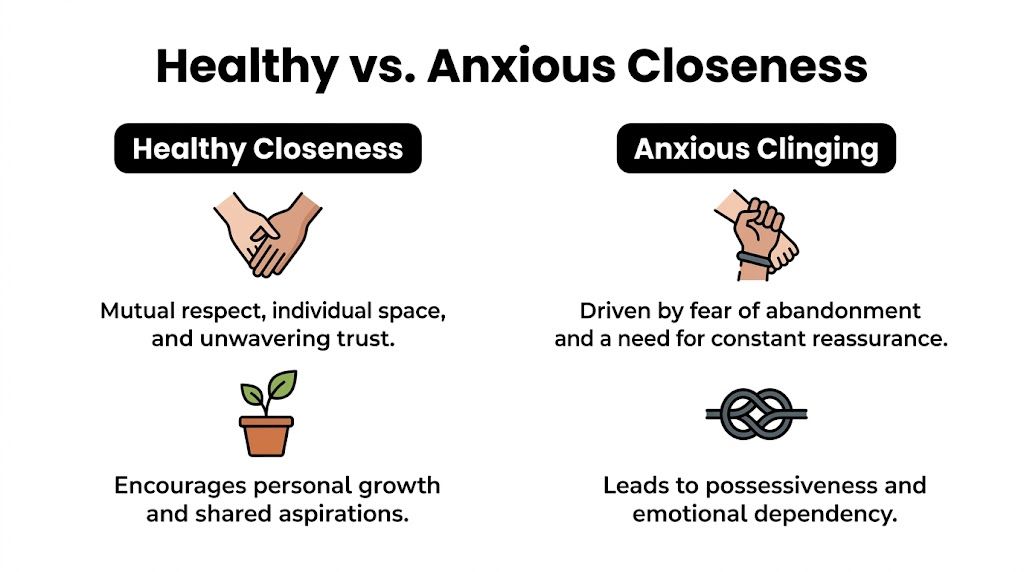
A useful way to understand clingy meaning in relationship is to compare secure closeness with fear-driven clinging.
| Healthy closeness | Anxious clinging |
|---|---|
| You can ask for comfort directly | You seek relief through repeated reassurance or protest |
| Space may feel uncomfortable, but tolerable | Space feels dangerous or unbearable |
| You keep your own identity, friendships, and rhythm | Your emotional center collapses into the relationship |
| Needs are communicated with openness | Needs come out through pressure, testing, or panic |
| Boundaries support trust | Boundaries feel like rejection |
A need is not the problem
A contrarian but important view is that clinginess can sometimes signal unmet emotional needs, not just dysfunction. Low self-esteem symptoms correlate with clinginess in 40% of anxious individuals, which points to a self-worth component that can be worked with, as explained in this discussion of clinginess and unmet emotional needs.
That means asking for affection, wanting responsiveness, and caring about emotional connection do not automatically mean you’re the problem.
Sometimes the issue is that you’re expressing a valid need through an anxious strategy.
A simple check
You can ask yourself:
- What am I needing right now: reassurance, closeness, clarity, comfort, repair?
- How am I trying to get it: directly, or through panic, pressure, and pursuit?
- What happens next: more connection, or more distance?
If you want a fuller picture of secure connection, this article on what is interdependence is a helpful companion.
Healthy love doesn’t require you to become emotionally self-sufficient. It asks you to bring your needs with honesty instead of fear-driven urgency.
Practical Strategies for Regulating Your Nervous System
Insight helps, but in the middle of activation, insight often isn’t enough. When your attachment alarm is loud, you need something more immediate and more physical.
For people who’ve already tried to “think their way out of it,” this matters. A 2023 meta-review found a 75% success rate with methods like polyvagal-informed therapy, especially for those whose traditional talk therapy didn’t fully shift attachment anxiety, according to this piece on why nervous system approaches help clingy partners.

If you want to understand the bigger framework, this resource on what is nervous system regulation can help. For now, start with what works in real life.
Use a pause before contact
When you feel the urge to send the fourth text, pause before you act.
Not because your need is bad. Because your body is likely asking for regulation first and contact second.
Try this short sequence:
- Put the phone down for one minute
- Plant both feet on the floor
- Name five things you can see
- Loosen your jaw and shoulders
- Ask, “Am I seeking connection, or trying to stop panic?”
That question alone can change the quality of your next move.
Try 4 7 8 breathing when panic spikes
When your system is mobilized, lengthening the exhale helps.
Use this rhythm:
- Inhale for 4
- Hold for 7
- Exhale for 8
- Repeat for a few rounds
Don’t force a giant breath. Gentle works better than dramatic. The goal is not perfect technique. The goal is signaling to your body that the emergency level can come down.
Create a regulation menu
People do better when they don’t have to invent a coping tool mid-trigger. Make a short list in your phone called “When I’m activated.”
Include things you’ll do, such as:
- Cold water: hold a cool glass or splash water on your face
- Movement: walk around the block, stretch, shake out your hands
- Orienting: look around the room slowly and notice that you are here, now
- Voice note to yourself: say what you’re feeling before you text your partner
- Containment: wrap in a blanket, place a hand on your chest, lean against a wall
Separate the urge from the action
This is one of the biggest shifts.
You may still feel the urge to check, ask, chase, or explain. Healing doesn’t mean the urge vanishes overnight. It means you build enough capacity to notice the urge without automatically obeying it.
A practical script can help:
“I’m having the urge to reach for reassurance. I don’t need to act from the first wave.”
That sentence creates a little space between your fear and your behavior.
Build a life that steadies you
Nervous system regulation isn’t only what you do in crisis. It’s also how you reduce fragility overall.
Look at the basics:
- Sleep support: exhaustion makes attachment anxiety louder
- Food and hydration: an underfed body is easier to trigger
- Rhythm: regular routines support a sense of predictability
- Friendship: emotional nourishment should not come from one person alone
- Pleasure and purpose: hobbies, nature, creativity, movement, faith, rest
This is especially important if you’re high-functioning in work but flooded in love. Many people look composed on the outside and still have a body that goes into alarm in close relationships.
Journal the trigger accurately
Not every journal prompt helps. Use one that interrupts the spiral.
Write these three lines:
- What happened
- What I made it mean
- What else could be true
This doesn’t dismiss your feelings. It widens the frame so your body doesn’t force one catastrophic interpretation.
Communicating Needs and Breaking the Anxious-Avoidant Cycle
Clinginess doesn’t happen in a vacuum. Often, one partner pursues harder as the other pulls back more. That push-pull pattern is powerful, and the pursuit-withdrawal cycle accounts for up to 50% of unstable relationships, according to this summary of the anxious-avoidant dynamic and clingy meaning in relationship.
If this is your pattern, the solution isn’t for one person to become emotionless and the other to become endlessly available. The work is collaborative.
Say the vulnerable thing, not the protest thing
Protest sounds like this:
- “Why are you ignoring me?”
- “You never care.”
- “Fine, do whatever you want.”
Vulnerability sounds like this:
- “I notice I get anxious when we haven’t connected.”
- “I’m feeling a little activated and could use reassurance.”
- “Can we plan a check-in so I’m not reaching in panic?”
That kind of language lowers defensiveness and gives your partner something real to respond to.
Ask for structure
Anxious systems often calm with predictability.
You don’t need constant access. You may need a clear rhythm. A good conversation might cover texting expectations, how each of you handles stress, when one of you needs space, and how repair happens after conflict.
If communication tends to go sideways, these actionable tips for better communication can help you turn a tense exchange into a more grounded one.
Know what doesn’t work
These moves usually backfire:
- Testing: withdrawing to see if they chase you
- Flooding: sending long emotional texts while dysregulated
- Mind reading: assuming distance means loss of love
- Demanding immediacy: insisting every discomfort be solved on the spot
Clarity creates safety faster than accusation does.
If your partner is more avoidant, they also need to participate. Space without reassurance often intensifies the cycle. Reassurance without boundaries creates resentment. The middle path is warm, clear, and consistent.
When to Seek Support for Lasting Security
Self-awareness helps. Practice helps. Sometimes that’s enough to create meaningful change.
Sometimes it isn’t.
You may benefit from support if you keep repeating the same relationship pattern, feel overwhelmed by triggers you understand intellectually but can’t regulate physically, or notice that your body reacts as if every bit of distance is an emergency. That’s especially true if you’ve done years of insight-based work and still feel stuck in the same loop.
A good next step doesn’t have to be therapy only. Some people start by learning more about relational healing, boundaries, and identity work through adjacent supports like transformation life coaching, then decide they want deeper attachment-focused care.
The key is finding support that understands this pattern as more than a communication issue. If the root is attachment trauma, nervous system dysregulation, heartbreak, or hormonal transition, surface advice often won’t reach it.
You don’t need more shame. You need a process that helps your body experience safety, not just your mind understand the concept of it.
And you don’t have to wait until a relationship is falling apart to get help. Support works best when you treat these patterns as worthy of care now.
If this article felt personal, Securely Loved offers trauma-informed, attachment-focused support for adults who feel stuck in anxious, avoidant, or disorganized relationship patterns. You can explore the attachment style quiz, browse courses and resources, or book a free 15-minute connection call to talk through your goals in a compassionate, private setting.