
Dating an Avoidant Man A Practical Guide for 2026
Dating a man with an avoidant attachment style can feel like an emotional whiplash. One moment, you’re experiencing this incredible, all-in connection, and the next, you’re left with a confusing, sudden distance. If you’re nodding along, I want you to know: you are not imagining this hot-and-cold cycle. It’s a real, predictable pattern rooted in his fear of intimacy, and it has absolutely nothing to do with your worth.
Understanding this dynamic is the first step toward getting off the emotional rollercoaster and reclaiming your peace.
The Hot and Cold Cycle: What It Looks Like
The relationship probably started with a bang. He was charming, attentive, and pursued you with an intensity that made you feel completely seen and cherished. This is the “hot” phase. It feels powerful, exciting, and full of promise. He might share vulnerable parts of himself, making you believe you’ve finally found that deep, soulful connection you’ve been looking for.
Then, just as you start to relax and feel secure, the shift happens. He pulls away. The texts slow down, the emotional vulnerability disappears, and he becomes distant. This is the “cold” phase, and it’s deeply bewildering.
You’re left wondering what you did wrong, replaying every last conversation in your head. But the truth is, his withdrawal is almost never about you. For someone with an avoidant style, that initial intense connection triggers a deep-seated, subconscious fear.
The closer you get, the louder his internal alarm bells scream. For him, intimacy is unconsciously tangled up with a loss of self, a threat to the independence he has always relied on to feel safe. His distance is a defense mechanism—a desperate attempt to reclaim his sense of autonomy.
This cycle is so common that you can almost map it out on a timeline. The intense beginning, the gradual pullback, and the eventual crisis point where the dynamic becomes unsustainable.
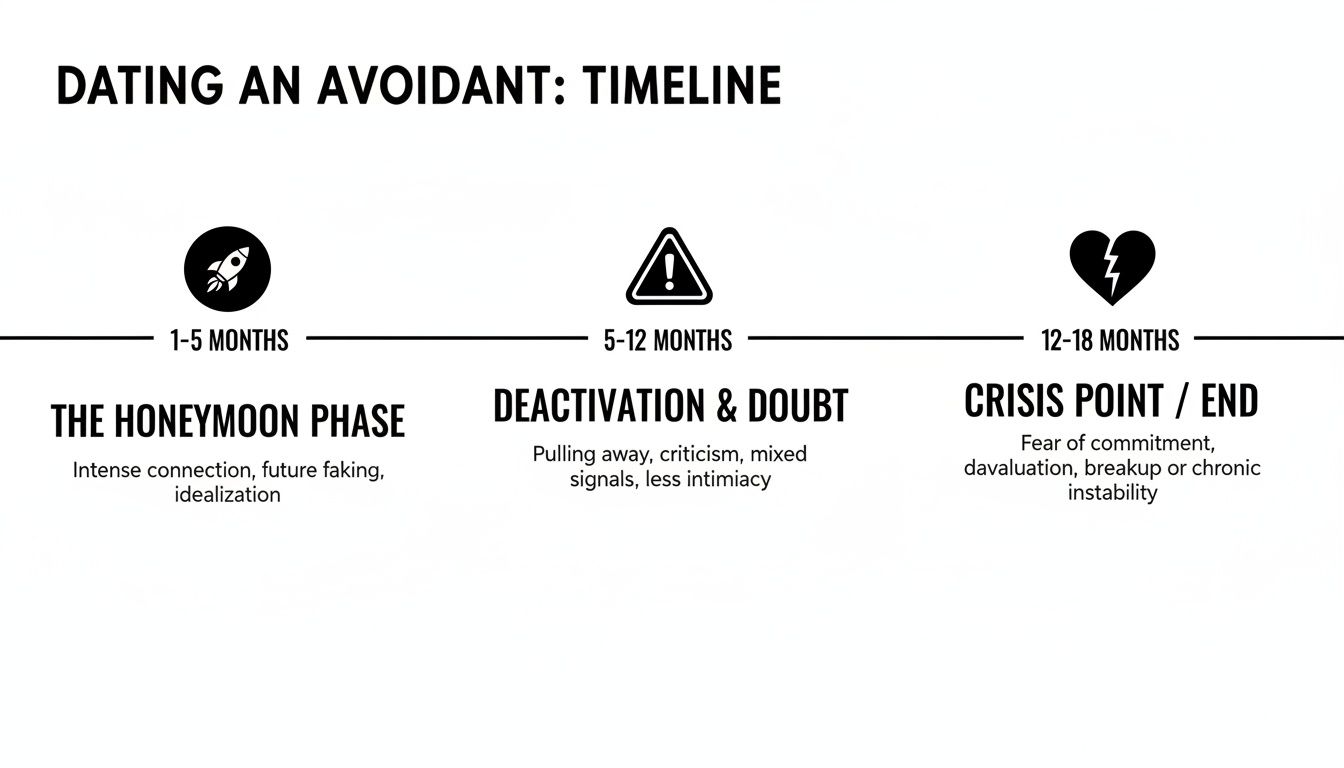
As you can see, the relationship often hits a breaking point right after the honeymoon phase, which is when these avoidant patterns really start to show.
The table below breaks down what this first year can look like, mapping out his behavior against what you're likely feeling.
Avoidant Dating Pattern: The First Year
| Timeframe | His Behavior (Avoidant) | Your Likely Experience (Anxious/Secure) |
|---|---|---|
| Months 1-5 | Intense pursuit & connection. He’s charming, vulnerable, and makes you feel like the only one. | Euphoric and hopeful. You feel seen, cherished, and believe you've found a deep connection. |
| Months 5-9 | The "flicker." He starts to pull back, becomes less communicative, and needs more "space." | Confused and anxious. You start to question yourself and wonder what went wrong. |
| Months 9-12+ | Consistent distancing. He creates emotional and physical distance, avoids conflict, and deactivates. | Hurt and exhausted. You feel like you're walking on eggshells, constantly seeking reassurance. |
This timeline isn't just a coincidence; it's backed by how avoidant individuals often experience the stages of love.
Why The Honeymoon Phase Has a Ticking Clock
Relationships with an avoidant partner often feel incredible at first but hit a major wall around the 5 to 12-month mark. This is the critical window where the initial dopamine-fueled excitement fades, but before a deeper, more stable bond has had a chance to form.
Avoidant individuals tend to experience love in distinct phases. The first 1-5 months are driven by the novelty and excitement of the honeymoon period. A truly stable, secure attachment, however, often takes 12-18 months to develop. Many relationships crumble in that gap between 5 and 12 months because the avoidant person subconsciously uses the end of the honeymoon phase as a "doomsday clock" to pull away before true intimacy can take hold.
This push-pull dynamic quickly becomes a painful, frustrating loop. His withdrawal triggers your anxiety, which makes you pursue him for reassurance. Your pursuit then confirms his fears of being suffocated, causing him to pull back even further. This is the classic, torturous dance of the anxious-avoidant relationship cycle.
Recognizing this pattern for what it is—a dynamic, not a defect in you—is the most important first step. It’s not your fault. You are not "too much." You are simply caught in a cycle with someone whose capacity for closeness is limited by old wounds. Once you see it clearly, you can start to step out of the reactive loop and choose a different path for yourself.
Decoding the Roots of Avoidant Attachment
If the hot-and-cold cycle is the symptom, then avoidant attachment is almost always the root cause. Understanding why your partner pulls away is the single most powerful step you can take to stop personalizing his behavior and start responding from a place of security, not anxiety.
When you're dating an avoidant man, it's so easy to believe his distance is a direct reflection of his feelings for you. But what if it isn’t? What if his withdrawal has almost nothing to do with you and everything to do with a deeply ingrained protective strategy he learned long ago?
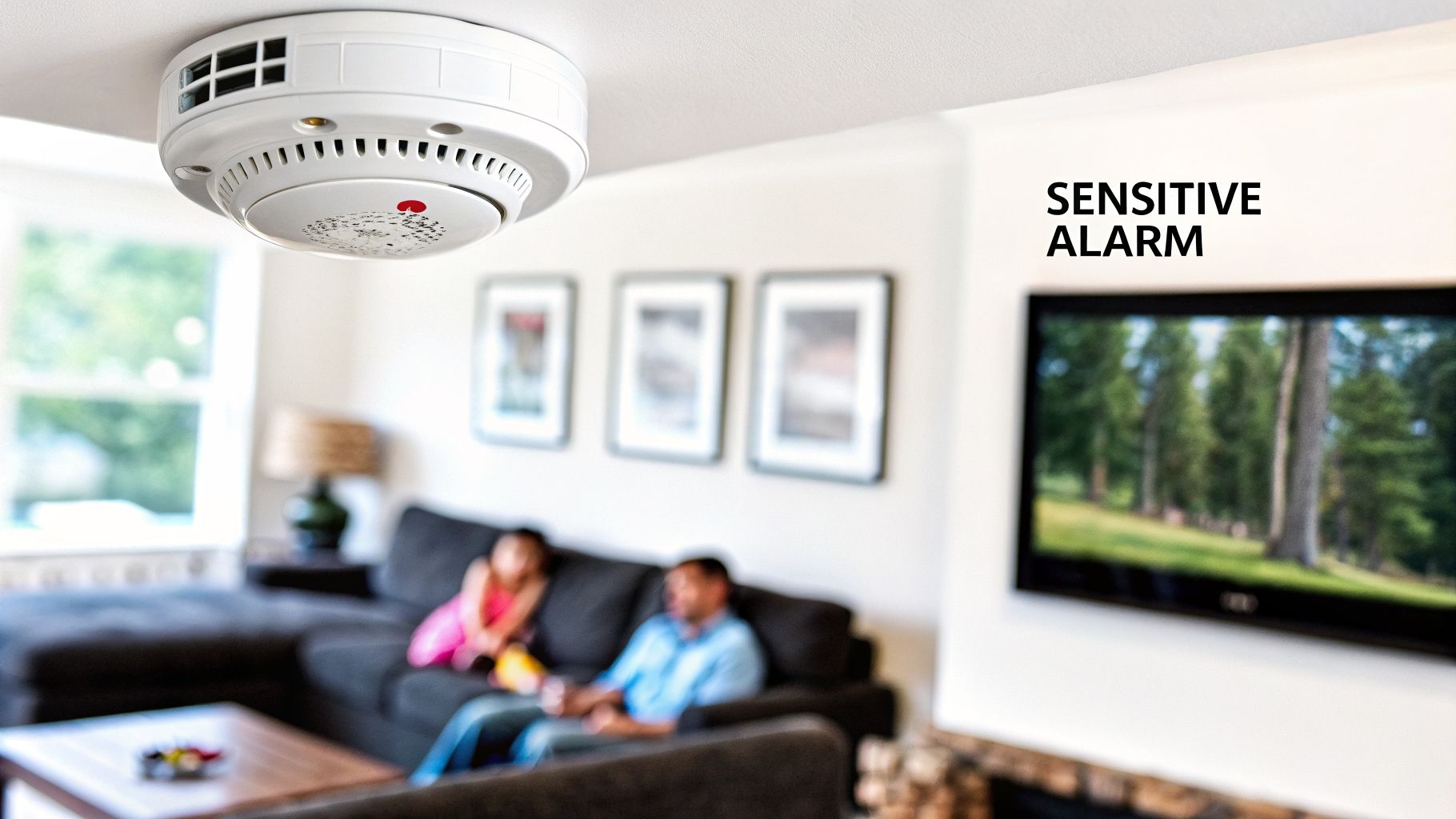
The Sensitive Smoke Alarm Analogy
I want you to imagine the nervous system of an avoidant person is like a highly sensitive smoke alarm. In a securely attached person, that alarm goes off when it’s supposed to—when there’s a real fire, a real danger. But an avoidant person’s alarm is calibrated completely differently.
Because of past experiences, it’s become so sensitive that it goes off not just for fire, but for a little steam from the shower or a piece of burnt toast. In this relationship, emotional closeness and vulnerability are the steam. They aren't a real threat, but his internal alarm system screams that they are, blaring warnings of impending danger.
What's the "danger"? It's the perceived threat of losing his independence, of being engulfed, or of repeating a painful past experience where relying on someone led to deep disappointment. His retreat is an automatic, physiological response to silence the alarm and get back to what feels safe—and for him, safety is self-reliance.
"Closeness is punished with distance instead of being rewarded with more closeness. This is a classic avoidant pattern. For someone with this attachment style, feelings of intimacy can feel vaguely overwhelming. The only option is to shut people out to stop the overwhelm." — Bev Mitelman, M.A., Securely Loved
His withdrawal isn't a logical choice he’s making to hurt you; it's a deeply programmed survival mechanism. Just like you can't reason with a smoke alarm while it’s blaring, you can't argue him out of this reflexive, deep-seated need for space.
Why Self-Reliance Becomes a Shield
This protective shield is almost always forged in childhood. Our attachment styles are shaped by our very first relationships with our caregivers. If a child's emotional needs are consistently unmet, dismissed, or even punished, they learn a powerful lesson: dependency is unsafe, and self-reliance is survival.
This kind of environment teaches a child to downplay their own needs and suppress their feelings. They learn very quickly that showing vulnerability doesn't lead to comfort, but to being ignored or rejected.
- Emotional Neglect: If a child cried and no one came, they learned that expressing needs is pointless. It only leads to feeling more alone.
- Parental Overwhelm: If a parent was too stressed, preoccupied, or self-absorbed to offer emotional support, the child learned to stop asking for it.
- Pressure to be Independent: Some children are praised for being "so good" or "so easy," which reinforces the idea that not having needs is what earns them love and approval.
As an adult, this programming translates into a man who equates independence with safety and intimacy with profound risk. He isn't being cold-hearted when he pulls away; he's reverting to the only strategy he has ever known to feel secure. He learned a long, long time ago that the only person he can truly count on is himself.
Understanding this is the key to depersonalizing his behavior. When he says, "I need space," it's not a coded message for "I don't like you anymore." It is a literal expression of his internal state: his alarm is going off, and he needs to retreat to his baseline of self-sufficiency to feel safe again. This compassionate understanding is the foundation for navigating your relationship in a much healthier, more effective way.
Spotting Avoidant Behavior: Real-World Examples
It can be so confusing. You're trying to figure out if he's genuinely avoidant or just not that interested. He might say all the right things, and yet, your intuition is screaming that something is off kilter.
That's because avoidant attachment doesn't usually show up as a clear, outright rejection. Instead, it’s a string of subtle, confusing behaviors designed to create just enough emotional distance to keep him feeling safe, all while keeping the idea of the relationship alive.
These aren't just quirky personality traits. They are deep-seated strategies to keep real intimacy from getting too close. Learning to spot these specific actions and patterns is the first step in turning that vague unease into a clear understanding of the dynamic you're really in.
The Future That Never Arrives
One of the most common signs you’re dating an avoidant man is his incredible talent for painting a beautiful future that somehow never gets a date on the calendar. He'll talk about "someday" with a passion that feels so real and reassuring.
- He’ll say: "Someday, we should totally travel through Italy together."
- He’ll say: "I can see us having a place like this one day."
- He’ll say: "When things calm down at work, we’ll spend a lot more time together."
These statements give you a little hit of hope, a dose of reassurance that you're on the right track. But watch what happens when you try to turn "someday" into "next month." He’ll likely get vague, change the subject, or suddenly be "too busy." This is a classic tactic to keep you hooked on the potential of what you could be, without him ever having to commit to the reality of what you are right now.
Ambiguity Is His Armor
To a man with an avoidant attachment style, clarity and commitment can feel like a trap. To protect his feeling of freedom, he’ll often use vague, ambiguous language that lets him keep his options open and avoid being pinned down. This becomes especially obvious when you try to define the relationship (the DTR talk) or bring up your feelings.
For an avoidant partner, intense closeness can feel overwhelming—like enemy territory. When those feelings bubble up, their only defense is to shut down and push you away to protect themselves. This often looks like sudden emotional withdrawal or a swift dismissal of the relationship's importance.
This "enemy territory" mindset is exactly why they rely on vague phrases. It's a way to keep you at arm's length, preventing you from getting close enough to set off all their internal alarms.
Pay close attention to how he answers questions about where you two stand. It's in these moments that the difference between an avoidant pattern and a secure one becomes crystal clear.
Communication Breakdown: Avoidant vs. Secure Language
| Situation | What an Avoidant Partner Might Say | What a Secure Partner Might Say |
|---|---|---|
| Defining the Relationship | "Let's just see where things go." | "I really enjoy my time with you and I'd like to be exclusive." |
| Making Future Plans | "I'll let you know closer to the date." | "That sounds great. Let's look at our calendars for next month." |
| After an Argument | "I just need to be alone." (with no return time) | "I need some space to cool down, but can we talk about this tonight?" |
See the difference? One side keeps things open-ended and non-committal, while the other offers clarity and reassurance. It's not about the words themselves, but the underlying need for either distance or connection.
He Can't Handle Your Emotions
An avoidant man often has a hard time with his own feelings, so he's definitely going to be uncomfortable with yours—especially the big, messy ones like sadness, fear, or anxiety. When you get vulnerable, you might notice him literally shut down, either physically or emotionally.
Real-world example: You've had a really hard week and you start to tear up while telling him about it. Instead of pulling you in for a hug or asking what's wrong, he freezes. He might stare at the TV, give you an awkward little pat on the shoulder, or say something minimizing like, "It's not that big of a deal."
His discomfort isn't a judgment on you or your feelings. It’s a direct reflection of his own inability to process and hold space for that kind of emotional intensity. Your vulnerability is a mirror, showing him the very emotional depth he works so hard to avoid in himself.
Communicating Your Needs Without Pushing Him Away
When you’re with an avoidant man, asking for what you need can feel like trying to catch smoke. One minute he’s there, the next he’s gone, and you’re left wondering what you did wrong. It feels like you have only two options: swallow your needs and feel resentful, or speak up and risk him pulling away completely.
But there’s a third way. It’s not about playing games or becoming someone you’re not. It’s about learning to speak a language that doesn’t send his nervous system into high alert, allowing him to actually hear you instead of just hearing a threat. It’s about building a bridge, not a wall.
It All Starts with “I Feel”
The biggest mistake I see clients make is starting a tough conversation with the word “you.”
- "You never text me back."
- "Why are you being so distant?"
- "You always shut down when things get serious."
For an avoidant partner, this language sounds like an accusation. It immediately feels like criticism and blame, and his lifelong defense mechanism is to retreat and create distance to feel safe again.
The key is to flip the script. Instead of pointing the finger at his behavior, you’re going to share your own internal world by using “I feel” statements. This isn't a manipulation tactic; it's about taking ownership of your feelings and sharing them vulnerably.
When we express our needs from a place of vulnerability and ownership ("I feel…"), we invite our partner into a conversation. When we lead with an accusation ("You did…"), we are starting a battle.
This small shift can completely change the energy of a conversation, moving it from a battleground to a space of mutual understanding.
Practical Scripts for Hard Conversations
Let’s get practical. Here are a few ways to reframe your common frustrations so he can actually hear your heart.
The Scenario: He’s gone quiet for a few days, and your anxiety is through the roof.
- What you want to scream: "Why are you ignoring me?! You’re acting so cold and distant!"
- What you can say instead: "I've been feeling a little lonely and disconnected since we haven't talked in a few days. I really value our connection, and I’d love to just hear how you’re doing."
See the difference? You’re sharing your feeling (lonely), stating something positive (you value the connection), and making a soft request. There’s no blame here.
The Scenario: You try to bring up the future, and he immediately deflects or shuts down.
- What you want to ask: "Do you even care about this relationship? You never want to talk about where we’re going!"
- What you can say instead: "When we avoid talking about the future, I start to feel anxious and insecure about where we stand. It would mean so much to me if we could find some time to talk about it, whenever you feel ready."
You’re explaining the impact of the situation on you and framing the conversation as a team effort. Giving him that sense of control with “when you feel ready” is crucial—it honors his need for space while still honoring your need for clarity.
Lead With the Security You Want to Create
Beyond any script, the most powerful thing you can do is model the security you want to receive. If you crave a calm, respectful, and secure dynamic, you have to be the one to bring that energy to the table—especially when your anxiety is flaring up.
When he pulls away, your instinct might be to chase, to send a flood of texts, or to demand an answer. Instead, take a deep breath. Give him the space he’s asking for, but do it from a place of confidence, not fear. Show him through your actions that you are a safe harbor, not a stormy sea.
When he learns that closeness with you doesn't mean pressure and that you can hold your own emotional center, he starts to unlearn the idea that relationships are a trap. It's so important to not only lead with this secure energy but also to actively work on your own communication habits. If you're finding this part difficult, learning more about how to stop poor communication skills in relationships can give you the tools to create a much healthier dynamic for both of you.
This isn't about playing games. It’s about you becoming the securely attached anchor in the relationship, which in turn creates a space where he feels safe enough to drop his own anchor, too.
Your Self-Care Toolkit for Staying Grounded
Dating someone with an avoidant attachment style is draining, especially if you lean more anxious. I see this constantly in my coaching practice: a painful, exhausting cycle that therapists often call the "anxious-avoidant trap." His need for space triggers your fear of abandonment, so you pursue him for reassurance. Your pursuit then validates his fear of being smothered, and he pulls away even more.
This constant push and pull will leave you feeling completely depleted, dysregulated, and second-guessing your own worth. The most powerful thing you can do to stop this dance is to shift the focus from trying to manage him to learning how to anchor yourself. Your stability has to come from within.
The Anxious-Avoidant Trap: A Real-World Look
Imagine this: He hasn't texted you all day. Your mind starts racing. Was it something I said last night? Is he losing interest? Maybe I should just send a quick, funny meme to see if he responds.
This is the anxious brain in action, seeking reassurance to calm the fear of abandonment. But when you send that text, his avoidant alarm bells go off. He thinks, I just need some time to myself after a long day, and now she needs something from me. It's too much. He puts his phone down, needing more space than ever. His silence then confirms your worst fear, and the cycle spirals.
- Your fear of abandonment drives you to seek connection.
- His fear of engulfment drives him to seek distance.
The tragic part is that each person’s way of coping directly triggers the other's deepest wound.
The only way to stop the dance is to learn a new step. By regulating your own nervous system, you take back your power and create the internal stability you've been seeking from him.
Actionable Tip: Regulate Your Nervous System First
When that wave of anxiety hits, your body is in a state of high alert—fight or flight. The goal isn't to pretend you don't feel it, but to gently soothe your nervous system and guide it back to a place of calm. This is where grounding exercises become your secret weapon.
These are simple, trauma-informed practices that pull you out of the anxious storm in your head and back into the safety of the present moment. They send a powerful signal to your brain that says, "I am safe, right here, right now," no matter what he is or isn't doing. If you want to dive deeper, our guide to grounding techniques for trauma is packed with practical strategies.
Here are a few you can try the next time you feel that panic rising:
- The 5-4-3-2-1 Method: Pause. Name 5 things you can see (your laptop, a plant, a cup of tea), 4 things you can physically feel (the chair under you, the fabric of your shirt), 3 things you can hear (traffic outside, your own breathing), 2 things you can smell (coffee, a candle), and 1 thing you can taste. This sensory checklist yanks your focus back to your immediate surroundings.
- Mindful Breathing: Put one hand over your heart and the other on your belly. Breathe in slowly for a count of four, hold it for four, and then exhale for a count of six. That slightly longer exhale is key to calming your nervous system. Do this three times before reaching for your phone.
- Self-Soothing Touch: Gently cross your arms over your chest and tap your shoulders or upper arms in a rhythmic, alternating pattern (it's often called a butterfly hug). This bilateral stimulation is incredibly calming for a dysregulated system.
Actionable Tip: Build a Life You Love (That Has Nothing to Do with Him)
One of the biggest traps when dating an avoidant man is accidentally making the relationship the entire center of your world. When your happiness and self-worth are tied to his approval, his natural need for distance will always feel like a personal catastrophe.
The antidote? Build a rich, vibrant, and deeply fulfilling life that is 100% yours. The relationship should be a wonderful addition to your life, not the whole story.
- Reconnect with your passions. Did you used to love that Tuesday night pottery class? Sign up again. Have you always wanted to learn to salsa? Find a beginner's workshop. Pour your energy back into the hobbies, friendships, and goals that make you feel alive.
- Nurture your real support system. Instead of texting him again, call the friend who always makes you laugh or makes you feel seen. Make plans with people who fill your cup and remind you of what secure love feels like.
- Prioritize your own well-being. This is non-negotiable. It covers everything from moving your body and eating well to getting enough sleep and making time for pure, simple joy.
Remember, taking care of yourself isn't selfish; it's essential. Exploring some essential self-care practices can give you a roadmap for maintaining your inner balance. When you are truly fulfilled by your own life, your dependency on his validation shrinks. Not only does this skyrocket your own confidence, but it naturally creates the space and safety he needs to move toward you on his own terms.
When to Stay vs. When to Go: An Honest Look
This is probably one of the toughest, most personal decisions you’ll ever have to make. I work with so many people in my coaching practice who find themselves at this painful crossroads, wondering if they should keep investing in a relationship with an avoidant man or if it’s time to walk away.
There’s no magic formula here. The answer comes from looking at the reality of the patterns—his and yours—with clear, compassionate eyes. This isn’t about blaming him or trying to "fix" him. The only person you can ever truly change is yourself.
The real question you need to ask is this: Is he showing a real, self-motivated desire to meet you in the middle?
Green Flags: Signs He Is Genuinely Trying
Progress isn't a miraculous overnight transformation. It’s the small, consistent efforts that matter. These green flags don't guarantee a fairy-tale ending, but they do show that he’s aware of his patterns and is actively trying to choose connection, even when his nervous system is screaming at him to run.
Here are a few signs of real growth to look for:
- He owns his behavior. Instead of blaming you, you hear him say things like, "I know I pull away when things get intense, and I'm trying to work on that," or "I get that it's hard for you when I need to be alone." This self-awareness is the foundation for any real change.
- He tries to stay present, even when it's hard. During a tough conversation, you might see him physically fighting the urge to shut down or leave the room. He might take a deep breath and stay, even if he gets quiet. That’s a huge win.
- He initiates repair after he distances. After he takes his space, he comes back to you without you having to chase him down. He might start the conversation by saying something like, "I was feeling really overwhelmed and needed to reset, but I've missed you."
Red Flags: When It’s Time to Choose Yourself
On the other hand, there are some very clear red flags that the dynamic is not only stuck but is actively chipping away at your well-being. These behaviors show a fundamental lack of respect for your needs and a refusal to take any responsibility for his role in the relationship.
Choosing to leave when you see these patterns isn't failure. It's an act of profound self-respect and love.
Prioritizing your own emotional safety is the bedrock of building a secure attachment. Sometimes, the most secure and loving choice you can make is to walk away from a dynamic that consistently makes you feel anxious, invisible, and alone.
Get brutally honest with yourself. Are these patterns showing up over and over again?
- He completely stonewalls any relationship talk. Every time you try to bring up your needs or the dynamic between you, you’re met with a wall of silence, anger, or he turns it all around on you.
- He consistently gaslights you. He denies your reality, telling you that you’re “too needy” or “too sensitive,” and makes you feel like your feelings are the problem. There is zero accountability.
- He remains chronically unavailable. No matter how gently or clearly you communicate your needs, he stays distant. You're left in a perpetual state of hoping, waiting, and feeling uncertain.
In the end, the decision boils down to how this relationship makes you feel over time. If you feel exhausted, constantly on edge, and like you’re abandoning yourself to keep the peace, the emotional cost has become too high. A true partnership is meant to support you, not demand that you disappear.
Common Questions About Dating an Avoidant Man
When you're dating an avoidant man, your mind can feel like a maze of unanswered questions. This dynamic can be incredibly confusing and lonely, but getting clear on what's really going on is the first step to finding your peace. Here are some of the most common questions I hear in my practice, answered with the honesty you deserve.
Can an Avoidant Man Truly Change?
The short answer is yes, change is absolutely possible. But here’s the crucial part: it has to be his choice. An avoidant man can learn to build security, but it's a deep, personal journey he must commit to, usually with the help of a professional who understands attachment.
Your job is not to fix him. Trying to do so will only drain you and push him further away. The most powerful thing you can do is to be a living example of security through your own actions and hold firm to your personal boundaries. Look for slow, steady, and consistent effort from him over time—not a magical overnight personality transplant.
Does My Anxious Behavior Make Him Avoidant?
Your anxious behaviors—like needing constant reassurance or getting upset when he pulls away—definitely trigger his need for space. But they didn't create his avoidant attachment style. This is the classic, painful push-pull dynamic where your fear of abandonment activates his fear of being engulfed, and vice-versa.
The most effective thing you can do is turn the focus back to yourself and your own anxiety. When you learn to soothe your own nervous system and build a rock-solid sense of security within yourself, you naturally stop chasing. This creates the breathing room a healthier dynamic needs to even have a chance of growing.
The question isn't whether it's "worth it" to stay with an avoidant partner. The real question is: Does this relationship consistently leave me feeling drained, anxious, and lonely, or is there mutual respect and a genuine effort toward growth?
Ultimately, your emotional well-being has to be your non-negotiable. If your partner is self-aware, respects your need for connection even when he needs space, and makes a real, consistent effort to meet you in the middle, the relationship might be worth nurturing.
But if it constantly chips away at your mental health, walking away is a profound act of self-love and self-preservation.
At Securely Loved, we specialize in helping people break free from these painful relationship cycles. If you're ready to heal your attachment patterns and build the secure, fulfilling connection you truly deserve, we invite you to book a free 15-minute connection call with our team.