

Heal Disorganized Attachment in Relationships
You text them because you miss them. Then the moment they respond warmly, your chest tightens and you want to disappear.
You finally meet someone kind, steady, available. Instead of feeling relieved, you feel suspicious, restless, or numb. You start scanning for what’s wrong. You pick a fight, go quiet, pull away, or tell yourself you’re better off alone. Then when distance appears, panic floods in and you want closeness again.
I’ve seen this in my practice many times, and if this is your pattern, you’re not crazy, needy, dramatic, or impossible to love. You’re likely dealing with disorganized attachment in relationships, a pattern that creates a painful inner contradiction. Part of you longs for safety, closeness, and deep connection. Another part expects closeness to hurt, trap, shame, or destabilize you.
That internal split can make love feel like an unwinnable war. You reach for connection and brace for impact at the same time.
This pattern is more common than many people realize. Prevalence studies suggest disorganized attachment affects 20 to 40% of the general adult population, and it often develops when caregivers were both a source of comfort and fear, as described in this overview of disorganized attachment in relationships.
The Unwinnable War Inside You
A lot of people with this pattern don’t walk into therapy saying, “I have disorganized attachment.” They say things like, “I ruin good relationships,” or “I don’t trust people who are nice to me,” or “I’m exhausted by how much I want love and how scared I am of it.”

One woman I worked with described dating as “begging for water with one hand and pushing the glass away with the other.” That’s the feeling. You want the text back immediately, but when it comes, you resent needing it. You want someone to stay, but when they do, you feel exposed. You want honesty, but when a partner sees your vulnerable places, you may shut down, get reactive, or leave first.
What this conflict often looks like
- You crave reassurance, then feel ashamed for needing it.
- You want commitment, then feel trapped when it becomes real.
- You pull people close, then become cold, critical, or unreachable.
- You fear abandonment, but you also fear being known too intimately.
Practical rule: If your behavior feels contradictory, look for the protection underneath it.
This isn’t random. It’s a survival pattern. At some point, your system learned that closeness could soothe you and overwhelm you. So now love doesn’t register as only love. It can also register as risk.
Why people miss it
Disorganized attachment can hide under competence. Many high-functioning adults look calm in public, succeed at work, care intensely for others, and still feel chaotic in intimacy. They may overthink texts, freeze during conflict, distrust tenderness, or swing between intense longing and emotional shutdown.
In practice, this is often the moment that brings relief. Not because the pain disappears, but because the pattern finally has a name. Once you can name it, you can work with it.
You don’t need more shame. You need a map.
What is Disorganized Attachment The Fear Without a Solution
You’re lying next to someone who cares about you. They reach for your hand, and your chest tightens instead of settling. Part of you wants to melt into the contact. Another part wants to pull away, go numb, or start a fight so you can get some distance.
That split is the heart of disorganized attachment.
Disorganized attachment develops when the nervous system learns that the person you are wired to seek for comfort also feels unsafe, unpredictable, overwhelming, or shaming. For a child, there is no clean solution to that problem. The body drives connection for survival, while also preparing for protection.
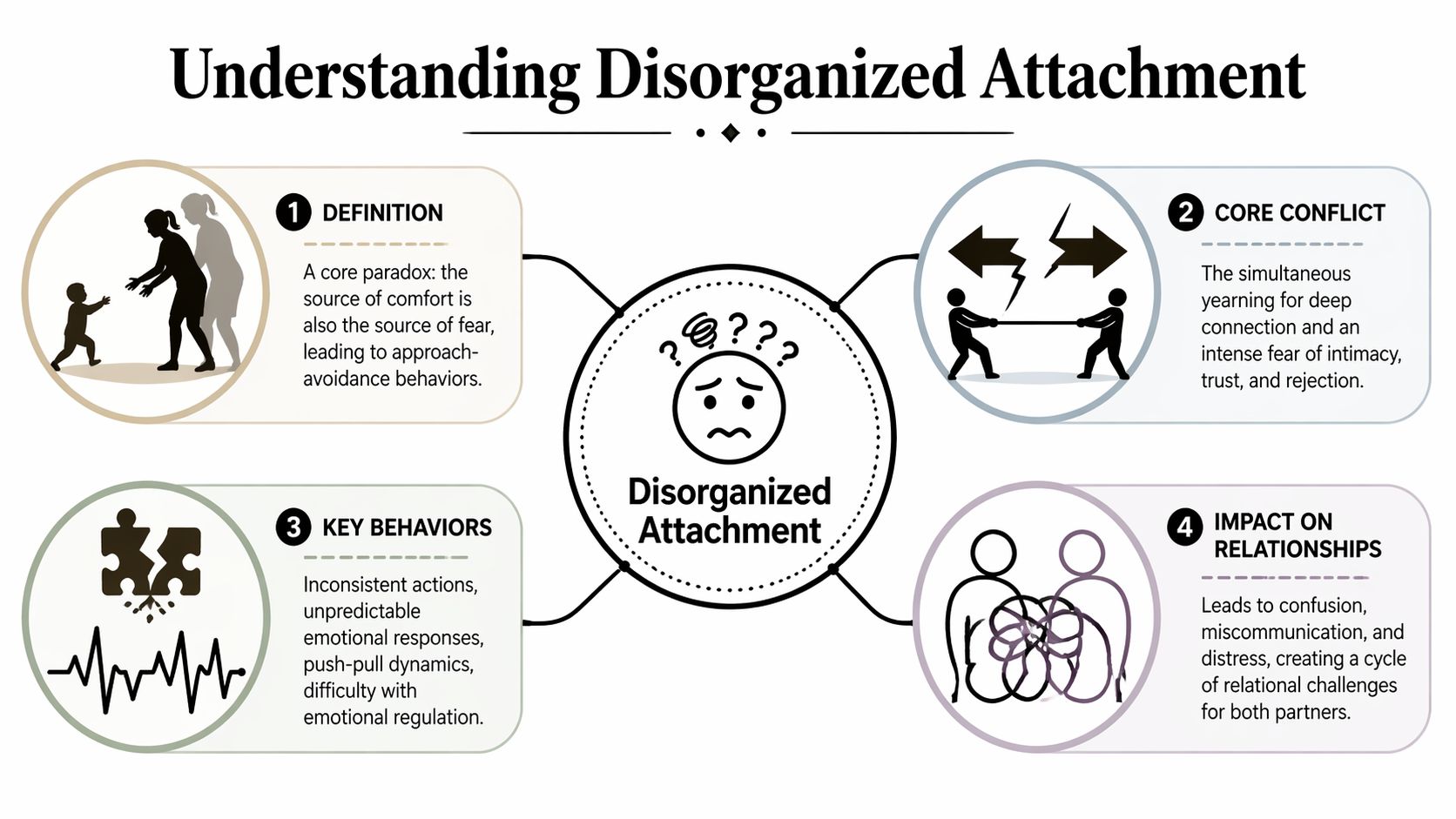
Your internal smoke detector goes off when intimacy appears. At the same time, another part of you moves toward the very person who might calm you. I’ve seen this in my practice again and again. Clients often say, “I want closeness more than anything, and the second I get it, I feel trapped or suspicious.”
That reaction can seem irrational from the outside. In the nervous system, it makes perfect sense.
The core paradox
Early on, the body is looking for patterns. If comfort comes with fear, affection comes with volatility, or need is met with ridicule, the system does not learn one simple rule. It learns conflicting rules that fire at the same time.
- Comfort can switch into danger
- Need can bring shame
- Love can feel unstable
- Closeness can cost you yourself
This is why disorganized attachment often feels less predictable than an anxious or avoidant pattern alone. The issue is not indecision in the ordinary sense. It is a nervous system caught between attachment and self-protection.
How it differs from anxious and avoidant attachment
Anxious attachment usually moves toward connection. Avoidant attachment usually moves toward distance.
Disorganized attachment can do both, often in quick succession. A person may reach, check, cling, and protest, then suddenly numb out, deflect, go quiet, or disappear. In clinical terms, the system is toggling between different survival responses rather than staying with one organized strategy. If you are not familiar with those body-based reactions, this guide to fight, flight, freeze, and fawn responses in relationships can help connect the dots.
I want to be clear about the trade-off here. These responses protected you at some point. They may have helped you stay attached to caregivers you depended on while also reducing exposure to hurt. In adult love, the same protections can create the very instability you are trying to prevent.
Fear without a reliable answer creates contradiction, not consistency.
Why this matters in adult love
Adults with this pattern are often painfully self-aware. They know the intensity of their reaction does not fit the moment, yet their body is already bracing. A caring partner says, “I’m here,” and the system still scans for threat. A small misunderstanding can feel loaded. A tender weekend can be followed by an urge to detach, criticize, control, or leave before the bond gets deeper.
I’ve seen many clients mistake this for being “too much,” commitment-phobic, or bad at relationships. The pattern is more specific than that. Their nervous system has learned that intimacy can bring comfort and danger in the same breath.
Common signs
- Mixed signals that confuse you as much as anyone else
- Sudden shifts between longing, fear, shutdown, or irritability
- Distrust of calm when a relationship starts to feel steady
- Strong reactions to perceived rejection, inconsistency, or criticism
- Difficulty resting into closeness even when the relationship is healthy
When people understand this pattern through a nervous-system-first lens, shame usually softens. You are not broken, and you are not making it up. Different protective parts of you are trying to keep you safe in very different ways.
How Disorganized Attachment Shows Up in Your Relationships
This pattern rarely shows up as one clean symptom. It shows up as a sequence. A text goes unanswered. Your mind races. You tell yourself not to care. Then you care intensely. Then you decide the relationship is unsafe. Then you reach out anyway. Then you hate that you did.
That’s the push-pull cycle.
The push-pull cycle in real life
You might spend all day wanting to hear from your partner, then answer with one-word texts once they reply. You may ask for more closeness, then feel flooded when they give it. You may test whether they care, then resent them for not responding exactly the right way.
From the inside, this often feels like survival. From the outside, it can look inconsistent, confusing, or volatile.
| The Disorganized Attachment Push-Pull Cycle | ||
|---|---|---|
| PULL Behaviors Seeking Connection | PUSH Behaviors Fearing Intimacy | |
| Reaching out repeatedly | Going silent for hours or days | |
| Wanting reassurance | Dismissing reassurance when it comes | |
| Moving toward vulnerability | Deflecting, joking, or shutting down | |
| Seeking physical closeness | Pulling away after tenderness | |
| Wanting clarity about the relationship | Threatening to leave or emotionally checking out |
Common relationship scenarios
Early dating feels electric, then alarming
At first, intensity can feel like chemistry. Fast bonding, constant messaging, instant disclosure. Then as the relationship becomes more real, fear arrives. You start overanalyzing tone, replaying conversations, or looking for signs that it won’t last.
Sometimes people with this pattern feel drawn to unavailable or inconsistent partners because uncertainty feels familiar. Stability can feel flat, suspicious, or hard to trust.
Good relationships get self-sabotaged
I’ve seen clients end relationships not because the partner was unkind, but because the kindness itself brought up grief, panic, or disbelief. They’d say, “Nothing is wrong, and that makes me want to run.”
Self-sabotage often looks like this:
- Starting conflict after moments of closeness
- Withholding warmth to regain a sense of control
- Scanning for flaws when things feel stable
- Leaving preemptively so you won’t be left first
When your body equates love with danger, peace can feel foreign before it feels healing.
Conflict becomes bigger than the issue
A small disappointment can trigger a much older fear. Your partner being tired may feel like rejection. A delayed reply may feel like abandonment. A request for space may feel like proof you’re too much.
That doesn’t mean your feelings are fake. It means the present moment is often carrying old emotional weight.
If you recognize yourself in fight, flight, freeze, or people-pleasing responses, this guide on fight flight freeze fawn responses can help you make sense of what your body is doing under stress.
It doesn’t only affect romance
Disorganized attachment in relationships can show up in friendships and work too.
At work, you may crave approval from a boss, then feel resentful when they rely on you. In friendships, you may overshare quickly, then disappear when you feel exposed. In family relationships, you may feel fiercely loyal and guarded at the same time.
What a partner often experiences
Partners often say, “I never know which version of them I’m going to get.” They may feel adored one day and shut out the next. They may become overly careful, trying not to trigger you, or start doubting their own perceptions.
That doesn’t make either person bad. It means the relationship needs more than insight. It needs structure, regulation, and repair.
If you want a deeper walk-through of these patterns in action, embed a teaching video from Bev Mitelman’s YouTube channel, @SecurelyLoved, here that covers fearful-avoidant or disorganized push-pull dynamics.
The Roots of Disorganized Attachment in Your Nervous System
A client once said to me, “I know my partner loves me. So why does my body act like I’m in danger?” That question gets to the heart of this pattern.
The answer usually sits below conscious thought. It lives in the nervous system.

Disorganized attachment is not only a relationship pattern. It is also a body pattern. I have seen this in my practice again and again. Someone can want closeness intensely and still tense, shut down, lash out, or detach the moment connection feels uncertain.
Your body learned the rules early
Children adapt to the environment they have, not the one they should have had. If care felt warm one moment and unsettling the next, the nervous system learned that closeness could bring comfort and threat at the same time.
That kind of conditioning does not require constant chaos. A caregiver who was loving but unpredictable, emotionally absent, frightening when stressed, or shaming during vulnerable moments can leave a child without a stable map for safety. The child’s body starts preparing for rupture before the mind has words for what is happening.
In adults, that often shows up as a set of automatic expectations:
- Stay on guard
- Scan for changes
- Reach for connection
- Brace for pain when it arrives
These responses make sense. They helped you survive an environment where safety was inconsistent.
Why your reactions can feel bigger than the moment
Your nervous system works like an alarm that was set in a home where danger could appear without warning. It learned speed, not nuance. Later, ordinary relationship stress can trigger the same emergency response.
I have seen a gentle check-in from a partner spark panic. I have seen a neutral facial expression register as rejection. I have seen a minor disagreement lead to numbness, anger, tears, or a sudden urge to disappear.
This is why insight alone often falls short. You may know, logically, that your partner is not your parent. Your body may still react as if old danger has returned.
Clinical reality: Many people with disorganized attachment are not confused about what happened in the conversation. They are overwhelmed by what happened inside their body during it.
Survival responses often run the relationship before you do
Under stress, the nervous system tends to choose one of several protective strategies. In intimacy, those strategies can look highly personal, but they are often automatic.
- Fight can show up as sharp criticism, defensiveness, testing, or intense protest
- Flight can look like withdrawing, staying busy, intellectualizing, or ending the conversation fast
- Freeze can feel like going blank, losing words, dissociating, or becoming unable to respond
- Fawn can sound like over-apologizing, over-explaining, or giving up your limits to keep the bond intact
For many people, learning about how nervous system regulation works brings real relief. The issue is not lack of effort. The issue is that the body has been rehearsing protection for a long time.
Why a nervous-system-first approach matters
Talk therapy can be highly helpful. It can give language, context, and self-understanding. But there is a trade-off. If therapy stays only at the level of insight, clients often leave with excellent explanations and the same body-level reactions.
Healing usually requires more than understanding the story. It requires helping the nervous system experience safety in small, repeatable doses. That is one reason many people benefit from trauma-informed therapy, where pacing, consent, activation, and repair are treated as part of the work, not as side issues.
In my practice, lasting change tends to happen when people stop judging the response and start working with it. The question shifts from “Why am I like this?” to “What is my body protecting me from, and how can I help it learn that this moment is different?”
Finding Your Path to Secure Attachment
Healing disorganized attachment in relationships doesn’t happen by forcing yourself to “just trust” or by choosing a nicer partner and hoping your body catches up. It happens when your system has repeated experiences of safety, choice, and repair.
I tell clients this often. You are not trying to become less feeling. You are trying to become less flooded, less fragmented, and more able to stay connected to yourself when closeness activates old fear.
Two patterns often need different support
Research has identified distinct disorganized attachment classes, including an Oscillating type with high-affect, contradictory behaviors and an Impoverished type with more dismissive traits. Both are associated with major difficulties in functioning and relationships, which is one reason targeted, trauma-informed care matters, as described in this adult attachment research.
In practice, I often see something similar.
The oscillating presentation
This person usually knows they feel a lot. They may protest, pursue, panic, overthink, and then push away. Their healing often involves slowing activation, building tolerance for steadiness, and learning how to stay with vulnerability without escalating.
The impoverished presentation
This person may look more shut down, detached, skeptical, or emotionally flat until they’re suddenly overwhelmed. Their healing often involves reconnecting to body cues, identifying needs, and learning that distance isn’t the only available protection.
What helps and what usually doesn’t
Some approaches create movement. Others keep people stuck.
What tends to help
- Body-based regulation practices that teach the system how to settle without shutting down.
- Attachment-focused therapy that works directly with relational triggers, not just symptoms.
- Consistent pacing so healing doesn’t become another overwhelming experience.
- Small moments of safe vulnerability that build capacity over time.
What usually doesn’t help on its own
- Endless analysis without body awareness
- Forcing exposure to intimacy before regulation skills exist
- Using relationships as the only source of safety
- Mistaking intensity for connection
Healing often starts with doing less in the moment of activation, not more.
A practical nervous-system-first toolkit
These are the kinds of tools I’ve seen make a real difference when used consistently.
Track activation before the spiral
Instead of waiting until you’re in a full shutdown or panic state, learn your earlier signals. Tight jaw. Urge to send a long text. Numb chest. Restlessness. Sudden certainty that the relationship is doomed.
Write down your own cues. If you can catch the pattern earlier, you have more choice.
Use orienting before discussing the relationship
Before a hard conversation, look around the room slowly. Notice color, light, texture, sound. Let your eyes land on something neutral or pleasant. This helps the body register that the current environment isn’t the original danger.
Shorten the distance between feeling and naming
Try simple phrases:
- I feel myself pulling away
- I want reassurance, but I’m also getting flooded
- I need ten minutes to regulate so I can stay present
- Part of me wants closeness and part of me is scared
This is very different from acting out the state.
Practice contained vulnerability
Don’t start with your deepest wound. Start with something small and true. “I felt anxious when I didn’t hear from you.” “I get scared after good weekends together.” “I’m noticing I want to shut down.”
Secure attachment grows from repeated tolerable experiences, not dramatic breakthroughs.
Professional support matters
For many people, this work goes better with guidance. Attachment-focused, trauma-informed therapy can help you identify your triggers, build regulation skills, process relational wounds, and practice new responses in a safe therapeutic relationship.
One option is attachment trauma therapy, which focuses on healing insecure patterns through nervous system regulation and attachment repair. Other modalities that can be useful include EMDR, somatic therapies, and couples work when both partners are willing.
Signs healing is actually happening
Healing rarely looks like “I never get triggered again.” It looks more like this:
- You notice the trigger sooner
- You recover faster
- You ask for space without disappearing
- You ask for reassurance without collapsing into shame
- You can stay in the room, in the conversation, and in your body
That is secure functioning taking root. Not perfection. Capacity.
Supporting a Partner with Disorganized Attachment
If you love someone with this pattern, you may feel whiplash. One day they’re warm, intimately connected, and open. The next day they’re distant, suspicious, reactive, or gone quiet. You may spend a lot of energy trying to be patient, say the right thing, or avoid making it worse.
That effort makes sense. It can also wear you down.

A perspective that’s often missing from attachment content is that the disorganized partner can become an unsafe partner when their responses are erratic and boundaries are poor, which is why support must include co-regulation without self-abandonment, as discussed in this article on the often-overlooked reality of disorganized attachment.
Your job is not to fix them
You cannot heal someone else’s attachment wound through perfect reassurance. If you try, you’ll likely become over-responsible, resentful, and depleted.
What helps more is becoming a steady person with clear edges.
What that looks like
- Stay predictable. If you need space, say when you’ll reconnect.
- Name what you see without attacking. “I notice you asked for closeness and now you seem flooded.”
- Don’t chase every withdrawal. Anxious pursuit can intensify the cycle.
- Don’t accept harmful behavior in the name of compassion. Fear explains behavior. It doesn’t excuse cruelty.
Support without boundaries becomes enabling. Boundaries without warmth become threat.
How to co-regulate without burning out
Co-regulation means your steadiness can help another nervous system settle. It does not mean managing their emotions for them.
Try this:
- Lower the intensity of your own voice and pace. A regulated tone matters more than a perfect script.
- Keep sentences short. Flooded people can’t process long explanations well.
- Offer one grounded choice. “We can pause and talk in twenty minutes, or sit in silence for a minute first.”
- Return responsibility kindly. “I care about you, and I need us to talk without insults.”
What not to do
The most common mistakes I see are understandable.
- Overexplaining when they’re already overwhelmed
- Taking the push personally and retaliating
- Becoming the rescuer who absorbs every emotional wave
- Abandoning your own limits to keep the peace
Loving someone with disorganized attachment may require more patience, but it should not require losing your center.
If your partner is willing to work on the pattern, the relationship can become much safer. If they aren’t, your clarity matters just as much as your compassion.
How Securely Loved Guides Your Healing Journey
Disorganized attachment in relationships can improve. I’ve seen people move from chaos and shutdown into much more stable, honest, grounded connection. Not because they became different people overnight, but because they learned how to work with the nervous system underneath the pattern.
At Securely Loved, the approach centers on what many people missed in earlier therapy. Insight matters, but insight alone often isn’t enough when the body still expects danger. The work focuses on attachment wounds, emotional regulation, relational patterns, and building internal safety so closeness doesn’t feel so threatening.
For adults who grew up with inconsistent attunement, this kind of support can be especially useful during stressful transitions like heartbreak, divorce, caregiving strain, or midlife hormonal shifts. Those seasons often intensify old attachment responses. What looked manageable before can suddenly feel raw again.
The next right step doesn’t need to be dramatic. It may be taking an attachment style quiz, learning how your nervous system responds under stress, starting therapy with an attachment-focused practitioner, or booking a brief consultation to see whether the fit feels safe enough to begin.
If you’ve tried years of talking about your patterns without feeling them shift in your body, a nervous-system-first approach may be the missing piece. Healing usually isn’t about trying harder. It’s about giving your system a different experience often enough that new pathways begin to feel possible.
You’re not too much. You’re not beyond help. And you’re not failing at love.
Your system adapted. It can also heal.
If this article felt uncomfortably familiar, Securely Loved offers a gentle next step. You can explore resources, take the attachment style quiz, or book a free 15-minute connection call to talk through what’s been happening in your relationships and what kind of support might fit.