
Understanding the Freeze Trauma Response and How to Heal
The freeze trauma response isn't a choice. It's not a character flaw or a sign of weakness. It's a deeply ingrained survival instinct where your entire system—body and mind—hits the pause button when faced with a threat so overwhelming that fighting or fleeing feels impossible.
Understanding the Freeze Trauma Response
Think of it like this: your nervous system is constantly running in the background, keeping you safe. But when a danger alert comes through that’s too big for the system to handle, it essentially short-circuits. Everything just hangs. You can't move, you can't think, you can't speak. You're just… stuck.
This state is what experts call tonic immobility—a temporary paralysis when we feel completely trapped. This isn't laziness or you just "giving up." It's an ancient, hardwired strategy from the most primal part of our brain, designed to help us survive an inescapable threat by essentially "playing dead."
An Intelligent Adaptation, Not a Personal Failure
The freeze response is incredibly common, especially for those of us who felt unsafe or experienced trauma in our early years. When a child can't fight back against a threat (like an unstable parent) or run away from it, their nervous system quickly learns that becoming very, very still might be the only path to survival.
This survival map gets carried right into our adult lives. It can get triggered by situations that are emotionally overwhelming, not just physically dangerous, leaving us feeling frozen during a conflict with a partner or shutting down when we feel criticized at work.
Instead of judging yourself for freezing, it's so important to reframe it as a testament to your resilience. It was an intelligent adaptation that helped a younger version of you survive. Seeing it this way is the first step toward working with your nervous system with compassion, not fighting against it.
The Freeze Response at a Glance
This response has a very specific signature that sets it apart from other survival states. Seeing these characteristics laid out can be incredibly validating if you've ever felt confusingly numb or stuck in stressful moments.
| Characteristic | Description in the Freeze Response |
|---|---|
| Physical State | Immobility, numbness, feeling heavy or stuck, shallow breathing, disconnected from the body. |
| Emotional State | Feeling detached, empty, numb, or dissociated. A sense of unreality or watching life from a distance. |
| Mental State | Difficulty thinking, making decisions, brain fog, feeling 'blank' or unable to access thoughts or words. |
| Core Purpose | To 'play dead' and become 'unseen' by a threat when fighting or fleeing is not possible. |
Recognizing these signs in yourself is a powerful step. It moves the experience from "What's wrong with me?" to "Oh, my body is trying to protect me." This shift in perspective is where healing begins.
Recognizing the Hidden Signs of Freeze in Daily Life
The freeze response doesn't just show up in big, life-threatening moments. It's a much quieter, more subtle force that can weave its way into your everyday life, often hiding in plain sight as something else entirely. It’s that invisible wall that makes a simple to-do list feel like climbing a mountain or turns a conversation into a minefield.
Recognizing these hidden signs is the first real step toward getting your power back. It’s the moment you realize you aren't broken, lazy, or flawed—your nervous system is just trying to protect you in the only way it knows how. It’s not always a dramatic, obvious shutdown. More often, it’s a quiet, internal paralysis that looks like something else.
From Procrastination to Paralysis
Think about that big project at work you keep putting off. For some people, procrastination is just about delaying an unpleasant task. But for someone in a freeze response, it’s a state of genuine paralysis. The pressure to perform, the deep-seated fear of getting it wrong, or the dread of criticism can be enough to trigger a complete nervous system shutdown.
You might find yourself just staring at a blank screen for hours, physically unable to type a single word. It’s not laziness; it feels more like your brain has gone completely offline. Your body might feel heavy, lethargic, and the mental energy it would take to even start feels impossible to muster. This is your body perceiving the task as a threat and slamming on the emergency brakes.
Real-World Example: Imagine you need to send an important email to your boss. You know what to write, but every time you open the draft, your mind goes blank, your fingers feel heavy, and you end up scrolling through social media for an hour instead. This isn't a lack of discipline; it's a freeze response triggered by the fear of judgment.
This can lock you into a really painful cycle. The longer you're stuck, the more the pressure builds, which only reinforces the freeze response. It becomes a self-fulfilling prophecy where the fear of failing leads to the very inaction that makes that feared outcome more likely.
When Words Disappear in Relationships
Another place the freeze response loves to show up is in our most intimate relationships, especially during conflict. Have you ever been in a heated conversation with your partner, knowing exactly what you want to say, yet your mind goes completely blank? The words are right there, but your throat feels tight and you can’t get them out.
This is a classic sign of the freeze trauma response in action. For anyone with an insecure attachment style, conflict can feel like a direct threat to your safety and the security of the bond. The fear of being abandoned or criticized becomes so overwhelming that your nervous system defaults to its most primitive survival strategy: become still and silent so you don't make things worse.
This is incredibly frustrating for both you and your partner. They might see you as withdrawn, uncaring, or accuse you of "stonewalling," but internally, you're screaming and feel completely powerless. Your silence isn't a weapon; it's a shield. It's an automatic, unconscious response from a part of you that learned long ago that the safest way to survive a threat was to become as small and invisible as possible.
Zoning Out and Social Disconnection
The freeze response can also look a lot like being 'checked out' or disconnected from reality. You might be in a meeting, at a party, or just having coffee with a friend when you suddenly realize you haven't heard a single word they’ve said for the last five minutes. You feel foggy and disconnected, like you’re watching your own life from behind a pane of glass.
This ‘zoning out’ is so much more than simple daydreaming. It’s a mild form of dissociation, a key feature of the freeze response. Your mind is detaching from the present moment to escape feelings or sensations that have become too overwhelming.
- Social Gatherings: You might feel numb in a crowd, finding it almost impossible to follow conversations or feel a real connection with anyone.
- Difficult Conversations: Instead of feeling the emotions of the moment—sadness, anger, fear—you might just feel a profound emptiness or a sense of unreality.
- Daily Routines: You might find yourself on "autopilot," just going through the motions of your day without any real presence or engagement.
Identifying these patterns—the paralysis, the silence, the zoning out—is the crucial 'aha' moment. It helps you shift from a place of self-blame ("What's wrong with me?") to one of self-compassion ("Oh, my body is trying to keep me safe."). This is where the path to understanding, and finally healing, these deep-rooted survival patterns truly begins.
How Freeze Differs From Fight, Flight, and Fawn
To really understand the freeze trauma response, it helps to see how it stacks up against its more famous siblings: fight, flight, and fawn. All four are automatic survival tools. Your nervous system picks one in a fraction of a second—long before your thinking mind can weigh in—based on what it believes will keep you safest.
Think about a conversation that suddenly gets heated and starts to feel like a fight. Each response is a different road your body might take to survive that moment.
The “Go” Responses: Fight and Flight
Fight and flight are what we call mobilized responses. They’re fueled by your sympathetic nervous system, which dumps adrenaline and cortisol into your system. It’s like a shot of high-octane fuel, giving you the energy to either face the threat or run from it.
- The Fight Response: This is your inner warrior stepping forward. It’s that impulse to get louder, lean in, and win the argument. Your jaw might clench, your fists might tighten—your body is gearing up for a confrontation, ready to overpower the danger.
- The Flight Response: This is your inner escape artist. It's that sudden, overwhelming urge to find an excuse and bolt from the room. You feel restless and anxious, with your body primed to get away and create distance from whatever feels threatening.
Both of these are active, high-energy states. They’re all about action. Your system is essentially screaming, “I can either beat this or outrun it!”
The “Please” Response: Fawn
The fawn response is a bit more complicated. It’s the instinct to appease the threat in order to calm the situation down and dodge the conflict.
In that tense conversation, fawning would be immediately starting to agree with the other person to make things okay again. You might even abandon your own feelings or point of view. Suddenly, your whole focus shifts to their needs and emotions, hoping that if you just make them happy, the danger will pass.
Real-World Example: Your boss criticizes your work in a meeting. Instead of defending your choices (fight) or avoiding them later (flight), you immediately start apologizing profusely and promising to do whatever it takes to fix it, even if you don't agree with the criticism. This is fawning.
The “Stop” Response: Freeze
And that brings us back to the freeze trauma response, which is in a category all its own. While fight, flight, and fawn all involve doing something, freeze is defined by the complete opposite. It’s a state of immobilization.
If fight is leaning in and flight is running away, freeze is when you simply can’t move at all. Your mind goes blank. The words you were about to say disappear. Your body feels heavy, stuck, almost paralyzed. You're there, but you're also gone.
This response comes from the oldest part of our nervous system—the dorsal vagal branch—which hits the emergency brake when a threat feels too big to fight or escape. It’s the human version of an animal playing dead. It’s your body’s last-ditch effort to survive by shutting down completely.
This is why freeze can show up in such confusing ways in our daily lives.
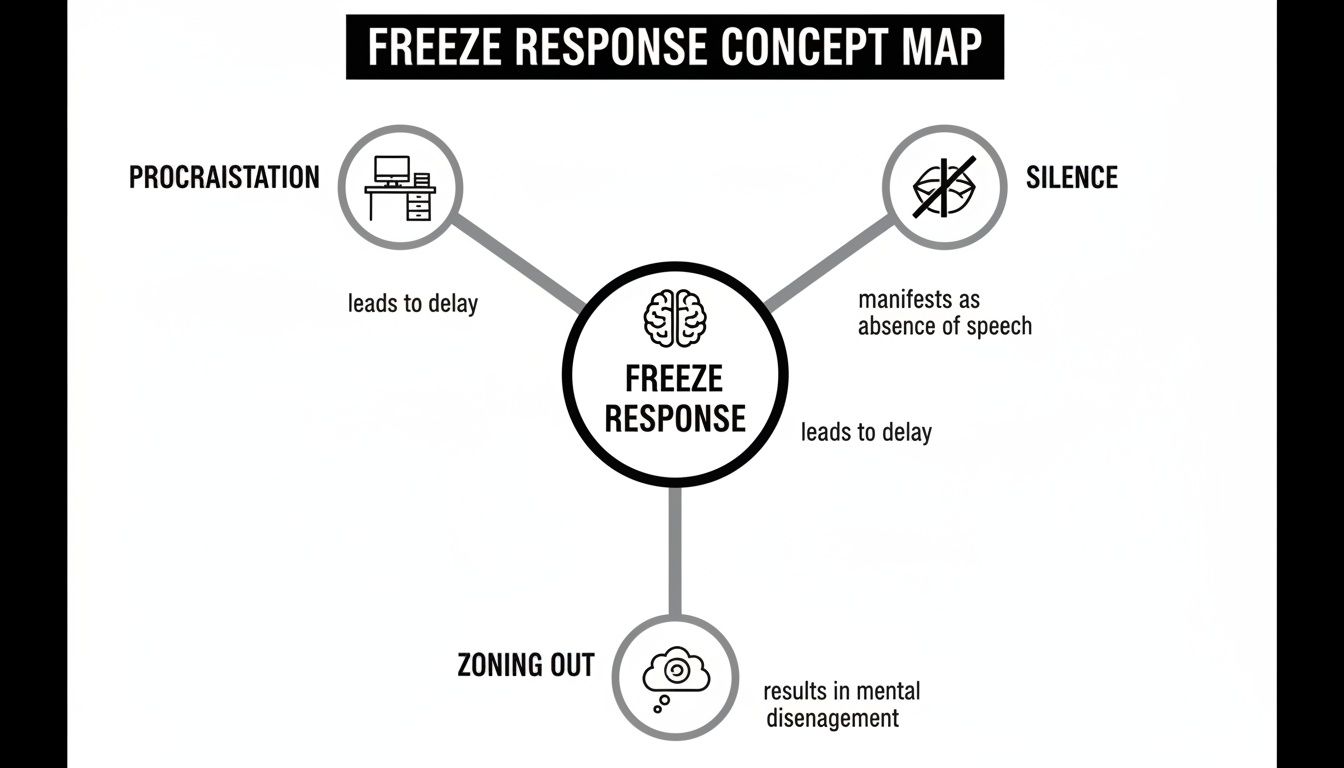
As you can see, that core shutdown in the brain leads to things we often mistake for personality flaws—like chronic procrastination, going silent in conflict, or "zoning out." We think it's us, but it's actually our nervous system.
Seeing these responses side-by-side helps clarify what's really going on inside.
Comparing the Four Trauma Responses
| Response | Nervous System State | Core Purpose | Common Internal Experience |
|---|---|---|---|
| Fight | Sympathetic (Mobilized) | Confront the threat | Anger, rage, feeling powerful or defensive |
| Flight | Sympathetic (Mobilized) | Escape the threat | Anxiety, panic, restlessness, feeling trapped |
| Freeze | Dorsal Vagal (Immobilized) | Hide from the threat | Numbness, emptiness, dissociation, feeling stuck |
| Fawn | Sympathetic & Dorsal | Appease the threat | Fear of abandonment, loss of self, shame |
Understanding where your body goes in moments of stress is the first step toward healing. It’s not about judging the response, but about recognizing it for what it is: a survival strategy.
To go deeper, you can explore the four primary trauma responses in our detailed guide.
Of all the places the freeze trauma response wreaks havoc, it’s most heartbreaking in our relationships. It’s that invisible wall that goes up, creating distance, confusion, and painful cycles of disconnection right where we’re supposed to find safety and love. These patterns can feel so personal, like a failing on your part, but they’re often just the echo of a nervous system that learned to shut down to survive.
This isn’t about pointing fingers at you or your partner. It’s about understanding the survival mechanism at play. When your go-to response is freeze, your system doesn’t see emotional closeness or even a minor disagreement as a chance to connect. It sees a threat. The shutdown that follows can leave both of you feeling utterly alone, even when you’re in the same room.
When Silence Is a Shield, Not a Weapon
Think about a tense conversation with your partner. The energy shifts, voices might get a little raised, and then—you’re gone. You go completely quiet. To your partner, it looks like you’re being cold, punishing them with the silent treatment, or just checking out. They feel shut out, abandoned, and that feeling often makes them push even harder for a reaction.
But inside, you’re living a totally different reality. You haven’t chosen silence; you’re trapped by it. Your nervous system has hit the emergency brake, flagging the conflict as an "inescapable danger," and your thinking brain has gone offline. You might feel paralyzed, like you can’t grasp a single thought or find one word to explain what’s happening, no matter how much you want to.
Real-World Example: Your partner brings up an issue about money, and you feel a wave of panic. Instead of talking about it, you just stare at them, unable to form a sentence. They get frustrated and say, "Why won't you just talk to me?" but your brain feels like it's full of static. This is freeze.
This creates a devastating cycle. Your partner reads your freeze as abandonment, which triggers their own deep-seated fears. They try harder to connect, but to your overwhelmed system, their pursuit feels like an attack, pushing you deeper into the freeze. In the end, you both feel profoundly unseen and hurt.
The Slow Fade and the Boundaries You Can’t Set
The freeze response doesn’t just sabotage romantic partnerships; it quietly erodes friendships, too. Imagine you have a friend who consistently makes you feel small or overlooked. The healthy thing to do would be to set a boundary and say, “Hey, when you do that, it doesn’t feel good to me.” But if your system defaults to freeze, that kind of direct confrontation can feel as terrifying as stepping in front of a speeding train.
So, instead of speaking up, the freeze response offers a different path: just fade away.
- You take longer and longer to answer their texts.
- You find yourself making excuses for why you can’t hang out.
- You become less available, bit by bit, until the friendship just… dissolves.
This isn’t a mean-spirited case of ghosting; it’s a protection strategy. Your nervous system has weighed the options and decided the potential conflict from setting a boundary is a bigger threat than losing the friendship. The sad part is that you don’t get your needs met, and your friend is left hurt and confused, with no idea what they did wrong.
The Anxious-Avoidant-Freeze Trap
These patterns get especially tangled when you look at them through the lens of attachment theory. The freeze response is often a silent third partner in the classic "anxious-avoidant" relationship, fueling that painful, magnetic push-and-pull dance.
Here's how that cycle often plays out:
- The Anxious Partner Pursues: Feeling a pang of insecurity, they push for reassurance and closeness to feel safe. To their partner, this can feel like pressure.
- The Avoidant Partner Freezes: That pressure triggers the avoidant partner’s fear of being consumed, activating their freeze trauma response. They shut down and pull away emotionally to get some space.
- The Anxious Partner Panics: The withdrawal confirms the anxious partner’s deepest fear: abandonment. Their anxiety skyrockets, and they pursue connection even more frantically, desperate to close the distance.
This loop can repeat for years, locking both people in a dynamic where neither person feels safe or truly known. The person who freezes isn’t the bad guy; their body is just doing what it learned to do to survive what feels like an overwhelming emotional threat. Seeing this pattern with compassion is the very first step toward breaking the cycle and learning a new, safer way to connect with each other.
Actionable Steps to Gently Thaw Your Nervous System
When you're trying to heal a freeze trauma response, you can't just force your way out. I see so many people try to "snap out of it" or get frustrated with themselves for being stuck. All that does is scream more danger at your nervous system, making that feeling of paralysis even worse.
The way forward is through gentleness. It’s about sending tiny, consistent signals of safety from the inside out, slowly teaching your body that the threat is over and it's okay to come back online. This isn't about complicated theories; it's a real-world toolkit of body-based (somatic) practices you can use the moment you feel yourself starting to shut down.
Think of these as your keys to gently thawing that frozen state and taking back your sense of self.
Orienting Your Way Back to the Present
When you're stuck in freeze, you're not really here. Your brain is trapped in a memory of a past threat. The very first step in thawing is to gently guide your awareness back to the safety of the here and now. A beautiful practice for this is called orienting.
Instead of trying to fight the numbness, just let your eyes slowly wander around the space you're in. Without any judgment, just softly name the things you see.
- "There's a blue lamp on the table."
- "I can see the sunlight coming through the window."
- "That's a green plant on my bookshelf."
- "I see the pattern on the rug."
- "I can see my hands resting in my lap."
This simple act communicates directly with the survival part of your brain, proving to it that you are in a safe, familiar place. It pulls your focus away from the internal alarm bells and anchors you in the physical reality of right now, where you are not in danger.
Actionable Tip: The next time you feel yourself "zoning out" in a conversation or meeting, try this. Slowly turn your head and silently name five things you can see (your computer, a pen, a window) and three things you can hear (the hum of the air conditioner, a distant car, your own breathing). This can gently pull you back to the present.
Engaging Your Senses to Signal Safety
The freeze response works by disconnecting you from your body. To reverse this, we can use simple sensory input to gently invite your awareness back into your physical self. Your senses are like direct phone lines to your nervous system.
Here are a few simple ways to do this:
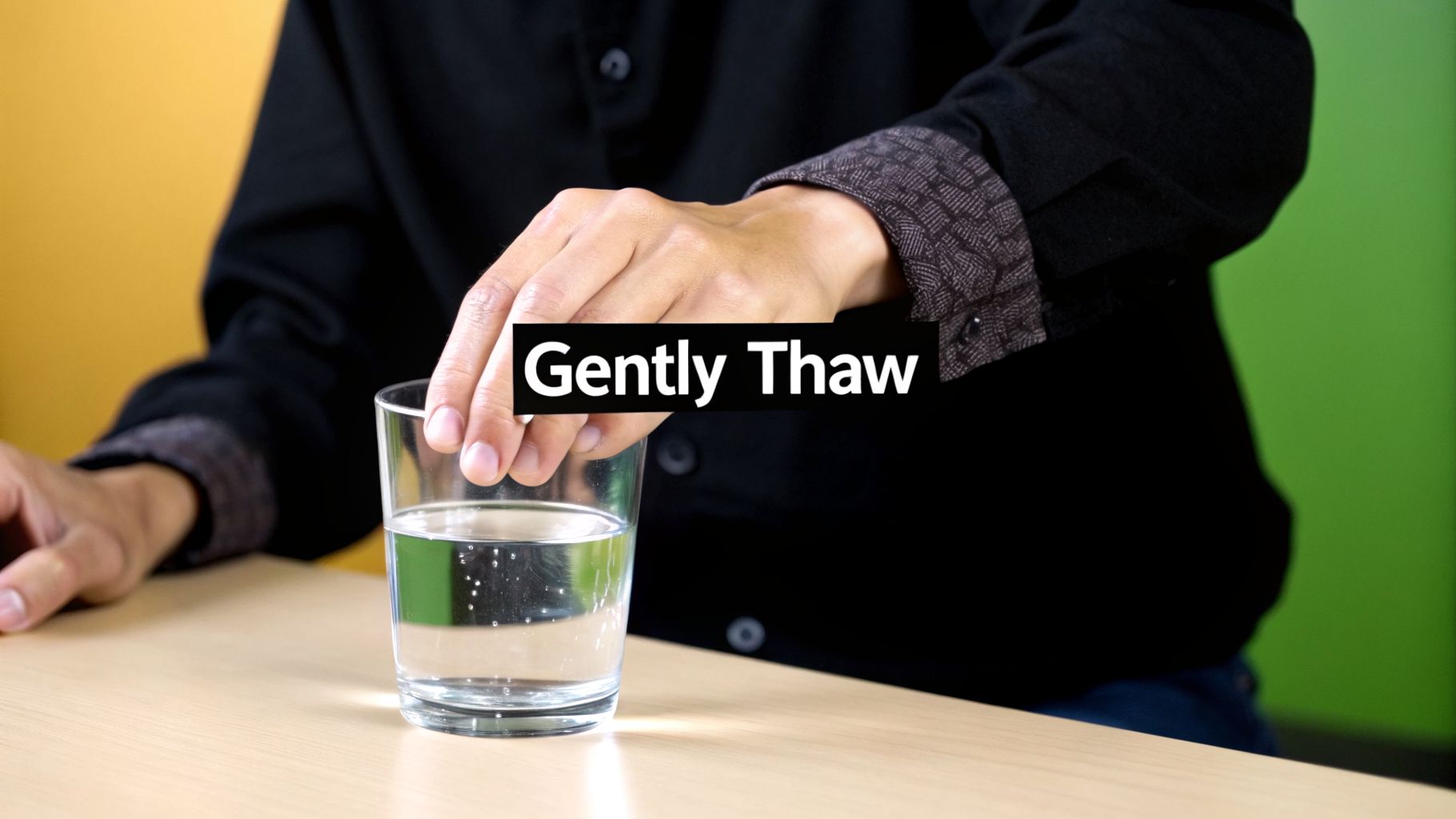
- Touch: Grab a cold glass of water and really focus on the feeling of the condensation and the coolness on your hand. Or, wrap yourself in a heavy, soft blanket and just notice the gentle, comforting pressure on your body.
- Scent: Keep a little bottle of a calming essential oil, like lavender or chamomile, on your desk or in your bag. When you feel that frozen feeling creep in, open it and take a gentle sniff, focusing only on that aroma.
- Taste: Slowly sip a warm cup of herbal tea. Pay close attention to the warmth and the flavor as it travels from your mouth down into your body.
- Sound: Put on a piece of calm, instrumental music or find a recording of nature sounds. See if you can notice how the vibrations of the sound feel in your body.
Each of these is a small anchor to the present moment, a quiet message to your body that it’s safe enough to feel again. If you're new to this kind of awareness, learning how to meditate for beginners can be a wonderful place to start building this muscle.
Introducing Gentle Micro-Movements
When you're truly frozen, even the idea of a big movement can feel overwhelming. The secret is to start so small that your brain doesn’t even register it as a threat. We call these micro-movements, and they are designed to gently reawaken your body without setting off more fear.
- Start with Your Fingers and Toes: Don't even look at them. Just bring your awareness to your toes. See if you can wiggle just one. Then maybe another. Do the same with your fingers—slowly, gently curling and uncurling them.
- Gently Rock or Sway: If it feels okay, you can introduce a very slow, gentle rocking motion from side to side or forward and back. This motion mimics the soothing we experience as infants and can be incredibly calming for the nervous system.
- Slowly Turn Your Head: Let your head turn very, very slowly from one side to the other, almost like you're scanning the horizon for safety. This movement directly engages the vagus nerve, a key player in helping you feel calm and regulated.
These small, intentional movements are powerful signals to your brain that you have control over your body and are no longer paralyzed. For more structured support in learning these techniques, exploring nervous system regulation therapy can be an incredibly helpful part of your healing journey.
Navigating the Path to Lasting Trauma Healing
While the self-help strategies we’ve talked about are powerful, sometimes they can only take you so far. When a freeze trauma response is deeply wired into your nervous system from past experiences, true, lasting healing often requires a guide.
Deciding to seek professional support isn’t a sign that you’ve failed or that you're weak. It’s a courageous act of choosing yourself and a deep commitment to your own well-being. It’s you saying, "I deserve to feel better than this."
Sometimes, the weight of the freeze response just becomes too much to carry on your own. Knowing when to ask for help is a crucial part of the journey.
When to Seek Professional Support
It might be time to reach out to a professional if you’re noticing your freeze patterns are constantly:
- Damaging Your Relationships: You feel stuck in painful cycles of disconnection. Maybe you shut down completely during arguments or find yourself pushing away the very people you want to be close to.
- Sabotaging Your Career: You feel paralyzed by procrastination, terrified of taking risks, or you feel like your fear of being seen is holding you back from what you’re truly capable of.
- Limiting Your Life: You live with a constant sense of numbness, detachment, or a quiet dread that stops you from feeling real joy, presence, or connection in your day-to-day life.
If any of this feels painfully familiar, it’s a clear sign that the underlying trauma wounds need more than just coping tools—they need the safety of a therapeutic relationship to truly heal.
Healing Attachment Wounds with Co-Regulation
Working with a trauma-informed attachment specialist offers a path that goes deeper than just managing symptoms. The real goal isn't just to stop freezing; it’s to heal the root attachment wounds that are fueling the freeze trauma response in the first place. This is where co-regulation becomes so important.
Co-regulation is the process of using the safety and attunement of a therapeutic relationship to help your nervous system experience what true safety feels like—often for the very first time. It’s a biological process of “borrowing” the therapist’s regulated state to help calm your own.
A therapist helps create a safe space where your nervous system can finally learn that it doesn’t have to shut down to survive big feelings. For many, a key part of this is learning to manage the body's stress hormones; exploring things like how to reduce cortisol levels naturally can be an empowering piece of the puzzle. Through this steady, supportive presence, you begin to build an internal sense of safety and resilience. This is what allows you to move from just surviving to actually thriving. You can learn more about how this works by exploring our approach to trauma therapy for adults.
Healing isn’t about erasing your past. It’s about building new neural pathways for security and connection, right here in the present. If you feel ready to see what this kind of support could look like for you, I invite you to book a complimentary, no-pressure connection call. It’s just a quiet space for you to be heard and to explore if this is the right next step on your journey.
Your Questions on the Freeze Response, Answered
As you start to understand the freeze trauma response, it's natural for questions to pop up. It’s a topic that can bring up a lot of confusion. Let’s walk through some of the most common questions I hear, so you can get the clarity you need.
Is the Freeze Response Just Laziness?
Not at all. This is a crucial distinction. Laziness or procrastination is often a conscious choice to put something off. The freeze response, on the other hand, is a completely involuntary, biological reaction.
When your nervous system senses a threat—which can be anything from a looming deadline to the fear of a difficult conversation—it can hit the emergency brake and shut down to keep you "safe." It's not a choice. It’s a deep, primal survival instinct that leaves you feeling paralyzed and stuck, which is the opposite of a lazy, relaxed state. This isn't a character flaw; it's your body's wiring trying to protect you.
Can I Heal My Freeze Response on My Own?
While self-awareness and learning tools to regulate your nervous system are incredibly empowering first steps, the deepest healing from a freeze response almost always happens within a safe, co-regulating relationship.
Because the freeze pattern is so often wired into our earliest experiences with caregivers, trying to heal it in complete isolation can feel like trying to learn a new language without ever hearing it spoken.
Working with a trauma-informed professional provides a secure space where your nervous system can finally learn what genuine safety with another person feels like. This process of co-regulation helps build new neural pathways that are incredibly difficult to create on your own.
How Can I Support My Partner When They Freeze?
The single most important thing you can do is become a signal of safety, not another source of threat. When you see your partner shutting down, your own system might want to panic or push for a solution, but that pressure will only make the freeze response stronger.
Instead, take a breath. Lower your voice, soften your facial expression, and slow everything down. Acknowledge what's happening without judgment. You could say something like, “I can see this is a lot right now. Let’s just pause for ten minutes. I’m right here.”
Resist the urge to demand an answer or fix the problem in that moment. Your calm, steady presence is the most powerful resource you can offer. It sends a message to their nervous system that it's safe to come back online, in their own time.
At Securely Loved, Bev Mitelman helps you move beyond just coping with these patterns to truly heal the attachment wounds that drive them. If you’re ready to build a foundation of internal safety and create secure, fulfilling relationships, explore how we can support you at https://www.securelyloved.com.