

Healing from a Breakup: A Practical Guide to Moving Forward and Thriving
Healing from a breakup isn't about forgetting the past. It’s a process of coming home to yourself—of reclaiming your sense of self and safety after it's been shaken. This journey is about learning to understand your own emotional world, regulate your nervous system, and intentionally rebuild a life where you feel whole and secure, all on your own.
Why Breakups Feel Like a Personal Earthquake
The end of a relationship often feels less like a speed bump and more like the ground has completely fallen out from under you. One day you have a partner, a routine, a shared language, and a future you were building together. The next, it's just… gone. This isn't just sadness. It's a profound disruption that can make you question everything.
This intense, gut-wrenching reaction isn't a sign of weakness. It's biology. From an attachment perspective, our primary partner comes to represent safety and security. When that connection is suddenly severed, your nervous system can register it as a genuine threat to your survival, kicking you straight into a primal fight-or-flight response.
That’s why the pain feels so incredibly physical—the tightness in your chest, the rock in your stomach, the inability to sleep or eat. Your body is grieving the loss of a key attachment figure, the very person who helped co-regulate your nervous system.
Your Brain on Heartbreak
The experience of heartbreak is so powerful you can literally see it on a brain scan. Studies have shown that the pain of social rejection lights up the exact same regions of the brain as physical pain. This is your brain’s way of screaming that this wound is real and demands your attention.
It’s why the well-meaning advice to "just get over it" feels not just impossible, but insulting. You're not just dealing with hurt feelings; you're navigating a total system crash.
- A Disrupted Identity: You have to figure out who "I" is after being part of a "we" for so long.
- A Shattered Routine: All the little daily rituals, from morning coffee texts to your shared Netflix queue, are suddenly erased.
- An Ambiguous Future: The future you had meticulously planned is gone, leaving a terrifying, empty space.
If you’re feeling completely overwhelmed by it all, please know this is a deeply human experience. Research across 96 countries found that most people go through about three major breakups by age 30. Interestingly, the same study noted that while women often report higher levels of initial emotional and physical pain, they also tend to recover more fully, emerging emotionally stronger on the other side. You can read more about the study on romantic splits to understand why.
Your overwhelming feelings are a valid and predictable response to a significant loss. Healing from a breakup starts with giving yourself permission to feel the full impact of this earthquake without judgment.
Understanding this from an attachment-aware perspective is the first real step forward. It shifts the focus from what's "wrong" with you for feeling so shattered to what's happening inside you on a biological level. This knowledge is power. It's what allows you to move from a state of crisis to one of intentional, compassionate healing. This guide will walk you through tangible strategies to help you navigate this process and find your footing again.
Why You’re Reacting This Way: A Look at Your Attachment Style
Your reaction to a breakup isn’t random. It’s not because you’re “too sensitive” or “crazy.” More often than not, it’s a script that was written for you a long time ago by your attachment style—the blueprint for connection you developed in your very first relationships.
Understanding your pattern isn't about blaming your parents or yourself. It’s about finally getting a roadmap to why this hurts so damn much and how to find your way out.
When a relationship ends, your internal alarm system, the one designed to keep you safe through connection, starts blaring. The ways you try to cope are usually the exact same strategies you learned as a child to handle distress. Recognizing these patterns is the first step to stop reacting on autopilot and start responding with intention.
The Anxious Attachment Response
If you have an anxious attachment style, a breakup can feel like a primal threat. The core fear of being abandoned kicks into overdrive, and the internal alarm bells are absolutely deafening. This usually triggers a series of what we call "protest behaviors"—desperate attempts to reconnect with your ex at all costs.
This might look like:
- An overwhelming urge to reach out, sending a flood of texts, making call after call, or writing long, pleading emails.
- Bargaining, promising you’ll change anything and everything if they’ll just come back.
- Obsessively replaying every last conversation, searching for clues that it’s not really over.
Here’s what this looks like in real life: Sarah found herself checking her ex's social media dozens of times a day, convinced a new photo or status was a secret sign he missed her. She’d draft these long, emotional texts explaining everything she'd do differently, deleting them, only to send them later in a moment of pure panic. Her entire world narrowed to a single mission: get the connection back to quiet the storm inside her.
The thing to remember is that these behaviors are a desperate attempt to regulate an overwhelmed nervous system. Your primary source of comfort has been ripped away, and your system is screaming to get it back.
The Avoidant Attachment Response
Now, if you lean more avoidant, your breakup reaction might look like the complete opposite on the surface. The pain is just as real, but your go-to instinct is to shut down, numb out, and retreat into self-reliance. For you, the core fear isn't abandonment—it’s being trapped or controlled by overwhelming emotions.
Common avoidant behaviors often include:
- Suppressing your feelings. You might tell yourself (and everyone else) that you’re "fine" and it "wasn't a big deal."
- Diving into distractions. You immediately throw yourself into work, a new intense hobby, or casual dating to avoid sitting with the grief.
- Devaluing the relationship. You start focusing on your ex’s flaws or all the problems you had to convince yourself you’re better off alone.
Here’s what this looks like in real life: After his girlfriend ended things, Mark immediately took on a massive project at work, staying late every single night. When friends asked how he was, he’d just shrug. “It is what it is. I’m focused on my career right now.” He felt a huge sense of relief from not having to "check in" or manage someone else's feelings, even though a profound loneliness would creep in when things got quiet.
The Disorganized Attachment Response
A disorganized attachment style (sometimes called fearful-avoidant) is a painful mix of both anxious and avoidant tendencies. This pattern is often rooted in some kind of relational trauma, which creates a deep internal conflict: you desperately want connection, but you're also terrified of it. A breakup can light up both of those fears at the exact same time.
This creates a chaotic push-pull dynamic, both inside and out.
- You might swing from one extreme to the other—one day desperately texting your ex (anxious), the next day feeling disgusted and blocking their number (avoidant).
- You can feel totally frozen. The conflicting urges to pull them close and push them away leave you feeling paralyzed, unable to move forward but terrified of going back.
- The breakup can feel catastrophic, confirming your deepest fears that you’re unlovable or that relationships are fundamentally unsafe.
Before we move on, it's helpful to see these patterns side-by-side. Remember, we're all a mix of these styles, but one usually feels more like "home" when we're under stress.
How Your Attachment Style Shapes Your Breakup Response
| Attachment Style | Common Feelings | Typical Behaviors |
|---|---|---|
| Anxious | Panic, desperation, fear of abandonment, obsession, feeling incomplete. | Protest behaviors: constant texting/calling, pleading, bargaining, social media stalking. |
| Avoidant | Numbness, relief, emptiness, suppressed sadness, loneliness. | Emotional shutdown, diving into work/hobbies, devaluing the ex, hyper-independence. |
| Disorganized | Confusion, chaos, fear, feeling overwhelmed, hopelessness. | Swinging between anxious and avoidant behaviors; push-pull dynamics, feeling frozen. |
| Secure | Sadness, grief, disappointment, but an underlying sense of self-worth. | Grieving openly, seeking support from friends, maintaining boundaries, self-soothing. |
Seeing your patterns laid out like this isn't about boxing yourself in. It's about giving yourself compassion and understanding why you react the way you do. This is the crucial first step to breaking those painful cycles and finally starting to heal.
How to Regain Calm When You Feel Overwhelmed
Right after a breakup, your nervous system is probably screaming. This isn’t the moment for deep emotional analysis or making big life decisions. It’s about survival—pure and simple. It’s about finding ways to bring your body back from that panicked edge and feel even a little bit safe again.
When you're in that state of total overwhelm, generic advice like “just relax” is not only useless, it feels insulting. Your body is in a genuine state of alarm, reacting to the loss of your primary person as if it’s a real, physical threat. To get calm, you have to speak its language—not with logic, but with physical, sensory input.
The Power of the Physiological Sigh
Forget just "taking a deep breath." Neurobiology research gives us a much more effective tool for instantly calming your nervous system: the physiological sigh. It’s a specific breathing pattern that rapidly offloads carbon dioxide, sending a powerful signal to your brain and body that it's safe to stand down from high alert.
Here’s how you do it:
- Take a sharp, deep inhale through your nose.
- Before you exhale, sneak in a second, shorter inhale to pack your lungs completely.
- Then, let out a long, slow, complete exhale through your mouth—make it longer than both inhales combined.
Doing this just one to three times can create a noticeable shift. Seriously. It’s an incredibly powerful tool you can use anytime a wave of panic hits, whether you’re stuck in a meeting or just trying to fall asleep.
The goal isn’t to stop the waves of emotion from coming, but to learn how to surf them. These small, body-based actions are your surfboard—they give you the stability you need to stay afloat when the feelings feel overwhelming.
When the emotional chaos of a breakup feels like too much, learning how to cope with anxiety and depression can offer vital strategies for finding your footing again. These moments of dysregulation are a totally normal part of healing, but having a plan makes all the difference.
This infographic breaks down how different attachment styles can show up in these overwhelming moments.
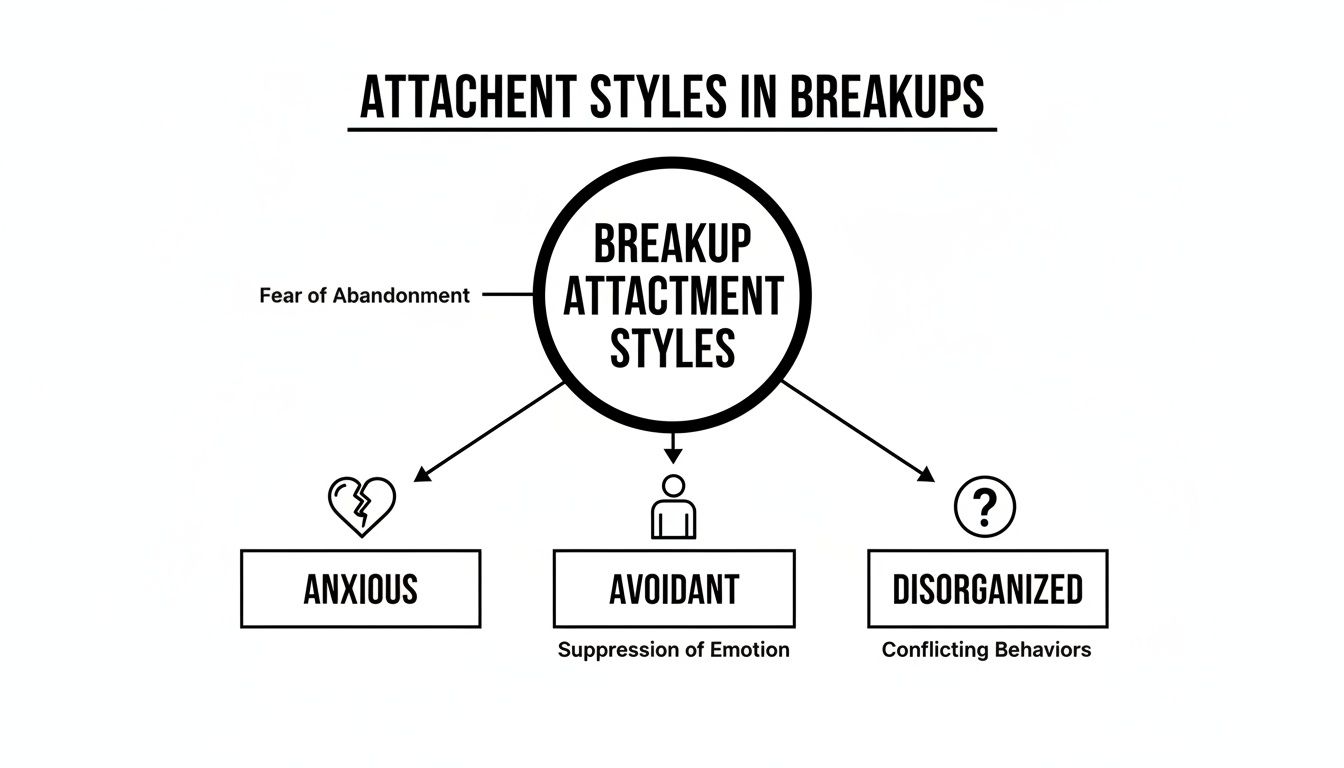
Knowing your own pattern helps you anticipate what might trigger you and choose the calming strategies that will actually work for you.
Create Your Self-Soothing Toolkit
A self-soothing toolkit is your personal first-aid kit for your nervous system. It’s a real, tangible collection of items you put together to ground you and offer comfort when you feel yourself spiraling. This isn't about distracting yourself; it's about active, intentional self-care.
Your toolkit should hit on multiple senses to pull you back into the present moment. Here are some ideas to get you started:
- Touch: A weighted blanket for that deep, calming pressure. A ridiculously soft piece of fabric. Your dog or cat to cuddle. Physical sensation can be incredibly grounding.
- Sound: Make a few different playlists. Maybe one for when you just need to cry it out (your "Shattered" playlist), another for when you feel that hot surge of anger ("Scorned"), and a third for when you’re ready to feel powerful ("Rise"). Music can meet you right where you are, no judgment.
- Smell: A specific essential oil like lavender or bergamot. A candle with a scent that reminds you of a happy time. Even the lotion your grandma used to wear. Scent has a direct line to the brain's emotional control center.
- Taste: A warm cup of non-caffeinated herbal tea, like chamomile. A single piece of really good dark chocolate that you can let melt in your mouth.
- Sight: A photo of a place you love. A favorite piece of art. Or just looking out the window and really noticing the details of a tree.
The most important part? You have to assemble this stuff before you need it. When a wave of panic or despair is crashing over you, you won't have the brainpower to think. Having your toolkit ready means you can just reach for something you know brings you a small bit of comfort, helping you ride out the storm without getting swept away.
Creating Boundaries to Protect Your Healing
Healing properly after a breakup isn’t just about sitting with your feelings. It's about building a safe container for those feelings to be processed without constant interruption.
Think of your emotional energy as a bank account that’s just been completely drained. Boundaries are the security system you install to stop the withdrawals and start making deposits again.
This isn’t about punishing your ex or making things awkward for your friends. It’s an act of radical self-preservation. Without boundaries, you're leaving the door wide open for emotional triggers, setbacks, and drama that keep you chained to the past.
It all comes down to setting limits—with your ex, with well-meaning friends, and especially with yourself. You're reclaiming your own mental and emotional real estate so you can finally heal in peace.
The Digital Minefield
Right after a breakup, your phone and social media can feel less like a comfort and more like a war zone. Every notification, story view, or tagged photo can send a jolt of anxiety or a wave of false hope right through your nervous system.
Getting a handle on this digital space is absolutely non-negotiable.
This is where you have to get comfortable with the mute, unfollow, or even block buttons. I know it can feel harsh or dramatic, but it’s one of the kindest things you can do for yourself right now. You’re not just stopping yourself from seeing their updates; you’re removing the constant, nagging temptation to check in on them.
Real-world example: After her breakup, Chloe kept her ex on Instagram but muted his posts and stories. She told herself it was "mature." But she found herself constantly checking the "Viewers" on her own stories to see if he'd watched. Each time he did, it sent a wave of false hope. Each time he didn't, it felt like a fresh rejection. The "soft" boundary wasn't working. Finally, she removed him as a follower. It felt extreme, but the relief was immediate. The temptation was just gone.
A digital boundary isn’t an act of anger; it’s an act of clarity. You are telling your brain, "This chapter is closing, and we need space to write the next one."
Navigating Mutual Friends and Social Circles
Well-meaning friends can sometimes become accidental messengers of pain. They might drop "updates" you never asked for or try to pressure you into attending a social event where you know your ex will be. Protecting your peace requires some clear, kind communication.
You don't owe anyone a long-winded explanation. A simple, firm script is all you need.
- For the friend giving unwanted updates: "I really appreciate you thinking of me, but for my own healing, I'd prefer not to hear about what [Ex's Name] is up to right now. Can we talk about something else?"
- For the friend pushing you to socialize: "Thank you so much for the invitation. I'm not quite ready for group hangouts where they might be, but I'd love to see you one-on-one soon."
These aren't rude requests. They are respectful statements of your needs. Your real friends will get it.
The Most Important Boundaries Are Internal
Let's be honest: the hardest boundaries to enforce are usually the ones we need to set with ourselves. Your mind will naturally want to drift back to familiar territory—replaying conversations, obsessing over what went wrong, or putting on the rose-colored glasses to remember only the good times.
Setting internal boundaries is an active, moment-to-moment practice. It’s about making a conscious choice to redirect your thoughts when they start spiraling.
What Internal Boundaries Look Like in Practice:
- No Rereading Old Texts: Just delete them. Or at the very least, archive them. When you feel the urge to scroll through old messages, you're usually just chasing a ghost of a feeling, and it only pulls you back under.
- Limit Your Ruminating Time: If you catch yourself obsessing, set a timer for 10 minutes. Let yourself feel it all—the anger, the sadness, the confusion. But when that timer goes off, you have to get up and physically change your environment. Go for a walk, blast a specific playlist, or call a friend to talk about anything else.
- Stop Trying to Figure Them Out: You will drive yourself crazy trying to analyze their motives or understand their actions. You can't control their journey. The only person you can focus on right now is you. Let go of the need to know "why."
As you heal, learning to set strong boundaries and rebuild your sense of self are the most important skills you can develop. You can find some amazing evidence-based ways to build confidence and set healthy boundaries that will not only get you through this breakup but will serve you in every relationship to come—starting with the one you have with yourself.
Rebuilding Your Identity and Rediscovering Yourself

After the initial storm of heartbreak passes, a quieter, almost more unsettling feeling can creep in. You look in the mirror and think, who am I now? When you’ve been part of a "we" for so long, the "I" can feel blurry, unfamiliar, and honestly, a little scary.
This isn’t about erasing the person you were in the relationship. It's about consciously redesigning a life that feels authentic to you today. Think of this painful void not as an emptiness, but as a blank canvas. It’s a chance to reconnect with parts of yourself you may have shelved and to explore new interests that are entirely your own. The goal here is to become the secure, central figure in your own life again.
This is how you turn pain into purpose. Research shows that people who successfully navigate breakup distress often develop greater romantic competence and resilience. Leaning into this journey isn't just about getting over someone; it's about building a more self-aware you. You can read more about these findings on post-breakup growth.
Reconnecting With Your Pre-Relationship Self
Before this relationship, who were you? What did you love to do just for you? It's completely normal for our individual hobbies to fall by the wayside in the beautiful compromise of partnership. Now's the time to do an audit of your own joy.
Actionable Insight: Make a list called "Things I Used to Love." Don't filter it. Did you love thrift shopping? Sketching in parks? Playing guitar badly but loudly? Write it all down. Then, pick the easiest one on the list and schedule 30 minutes this week to do it. The goal isn't to reignite a passion, it's just to make contact with an older version of yourself.
This isn’t about forcing yourself to have fun. It’s a gentle reintroduction. If you used to love painting, you don’t need to produce a masterpiece. Just buy a small watercolor set and spend ten minutes playing with color. The simple act is a powerful statement: My interests matter. I matter.
Reclaiming your identity is about remembering that you were a whole person before the relationship, and you are a whole person now.
Strengthening Your Social Fabric
Let's be honest—when we're deep in a relationship, friendships can sometimes take a backseat. This is the perfect moment to reinvest in the people who’ve been your constants all along. Your friends are a vital mirror, reflecting back the parts of you that you might have forgotten.
Instead of just sending a "how are you?" text, get intentional.
- Schedule dedicated one-on-one time. Suggest a specific activity you know a friend loves. It shows you’re thinking of them as an individual, not just as a crisis contact.
- Be vulnerable. Let your trusted friends in on how you’re really doing. That authentic connection is one of the most powerful antidotes to the loneliness of a breakup.
- Reestablish old rituals. Did your group used to have a weekly trivia night or a monthly book club? Take the initiative to get it back on the calendar.
These connections aren’t just a support system; they are a fundamental part of your identity, reminding you of who you are outside of a romantic context.
Designing a Life That Is Authentically Yours
This is where the healing process gets genuinely creative. For the first time in a while, you have the total freedom to design your days, your space, and your future exactly as you see fit. Embrace this autonomy.
Start with the small, daily routines. Do you want to start your mornings with 20 minutes of quiet reading instead of doom-scrolling? Do you want to rearrange your entire living room just because you can? These small acts of personal control are incredibly empowering.
Real-world example: After her breakup, Maya realized she'd hated the bland beige her ex insisted on for their apartment walls. The first weekend she was alone, she went out and bought a gallon of deep teal paint. Spending the day painting her living room wasn't just about changing the color; it was a physical act of reclaiming her space and making it her own.
It all boils down to one question: "Without having to consider anyone else, what do I truly want?"
Then, take one small, brave step in that direction.
Your Breakup Questions, Answered
When you're navigating the messy, painful aftermath of a breakup, your mind can feel like a whirlwind of confusing questions. It's completely normal to feel lost or like you're going in circles. Let's tackle some of the most common questions I hear, grounding our answers in what we know about attachment and the nervous system.
The goal here isn't to give you rigid rules, but to offer some clarity and reassurance. You're finding your footing again, and that takes time.
How Long Does This Hurt? The Real Answer.
This is the big one, isn't it? Everyone wants to know when the pain will stop. And the most honest, human answer is: there's no set timeline.
Healing isn't a race with a clear finish line. Some weeks, you'll feel like you're flying, making incredible progress. Then a random song on the radio or a memory popping up on your phone can send you spiraling right back into the thick of it. That's not a failure. It's just part of the process.
The real goal isn't to erase the person or the memories. It’s about letting the intense emotional charge fade until those memories no longer control your day. You'll know you're healing when you can think of a happy moment with your ex, feel a gentle flicker of gratitude for the good times, and then simply let it go without falling apart. It becomes a chapter in your story, not the whole book.
Healing is measured less by the days on the calendar and more by the intentional steps you take. It's about processing your feelings, holding your boundaries, and slowly, carefully rebuilding that secure relationship with yourself. Focus on your progress, not perfection.
Every time you choose to soothe your own anxiety instead of sending that "I miss you" text, you are healing. Every time you reach out to a friend and reinvest in that connection, you are healing. It's the quality of the work you're putting in, not the time that passes.
Is It Normal To Still Love My Ex?
Yes. A thousand times, yes. This is one of the most confusing—and completely valid—parts of a breakup. Love doesn't come with an on/off switch. Your heart often can't keep up with what your logical brain knows is for the best.
Here's a truth you need to let sink in: you can still love someone deeply while also recognizing that the relationship was unhealthy, unsustainable, or just plain wrong for you.
Holding both of those feelings at once doesn't make you weak or confused. It makes you human.
Maybe you miss the easy comfort of your Sunday morning routine, even while knowing that the constant anxiety you felt during the week was slowly breaking you down. That’s okay. Honoring the love you shared is a way of honoring a significant part of your life. Trying to force yourself into feeling hate or indifference will only create more internal conflict and slow you down.
Allow yourself to feel that love without judgment. It acknowledges the depth of the connection you had, while still giving you the space you need to move toward a future that truly serves you.
When Is It Time To Get Professional Help?
Grieving a relationship is a natural, necessary process. But sometimes, the pain can become so heavy that it starts to get in the way of your life. Reaching out for professional help isn't a sign of weakness; it's a sign of profound strength and self-awareness.
It might be time to consider talking to a therapist if you notice:
- The grief feels completely debilitating. You're struggling for a prolonged period with basic daily tasks—getting to work, taking care of yourself, or even eating.
- You've become totally isolated. You've pulled away from friends and family and feel like you have absolutely no one to turn to.
- You're leaning on unhealthy coping habits. This could be anything from excessive drinking and substance use to other risky behaviors you're using to numb the pain.
- You feel completely stuck in a loop. Months have gone by, and despite your best efforts, you feel like you're making zero progress, trapped in the same painful emotional cycle.
A good therapist, especially one who understands attachment theory, can offer a safe, non-judgmental space to unpack all of this. They can give you specialized tools to help regulate your nervous system, make sense of your attachment patterns, and build a rock-solid foundation for healthier, more secure relationships down the road.
Navigating heartbreak is one of the toughest things we do in life, but you absolutely do not have to do it alone. At Securely Loved, we specialize in helping individuals heal from relationship trauma by understanding their attachment patterns and learning to regulate their nervous system. If you’re ready to move from pain to clarity and build a life rooted in internal safety and connection, we invite you to book a free 15-minute online connection call to see if our approach is the right fit for you. Learn more and schedule your call with Securely Loved.