
How to Handle Heartbreak: Heal Attachment Wounds & Regain Security
Handling heartbreak is about so much more than just getting over someone. It’s about learning to calm your body’s survival response and rebuild a true sense of inner safety. To do that, we have to first understand why it hurts so badly, regulate our nervous system, and gently start rewriting the stories that keep us stuck in the pain.
Why Heartbreak Feels Like a Physical Injury
That crushing weight on your chest, the exhaustion that feels bone-deep, the constant pit in your stomach—it’s not just in your head. If you’ve ever felt physically sick after a breakup, that's because your body was telling you the truth. Heartbreak is a full-body event, and really getting this is the first step toward healing with self-compassion.
Your physical symptoms aren't an overreaction. They are a direct, biological result of your nervous system responding to a profound loss. When you lose a significant attachment figure, your brain can interpret it as a life-or-death threat, triggering the exact same survival mechanisms you'd experience if you were facing real physical danger.
The Science Behind Your Physical Pain
Your body gets flooded with stress hormones, mainly cortisol and adrenaline. This "fight-or-flight" response is incredibly helpful for escaping a tiger, but it becomes destructive when it’s switched on for days or weeks, which is exactly what happens in the aftermath of a breakup.
This constant state of high alert is what causes those very real, tangible physical symptoms:
- Exhaustion: Your body is burning an immense amount of energy just to stay on high alert, leaving you feeling completely drained and unable to function.
- Digestive Issues: To prepare for a threat, your body diverts blood away from your digestive system. This is what causes that nausea, lack of appetite, or constant upset stomach.
- Aches and Pains: Chronic muscle tension and inflammation from all that stress can lead to headaches, backaches, and a feeling of general soreness.
- A Weakened Immune System: Sustained high cortisol levels suppress your immune function, which is why it’s so common to get sick after a major emotional upheaval.
If you want to go deeper into the emotional science behind this, you might find it helpful to understand more about why breakups hurt so much from an attachment perspective.
Broken Heart Syndrome Is a Real Thing
In extreme cases, the emotional shock of a breakup can actually trigger a condition called takotsubo cardiomyopathy, or "broken heart syndrome." This is when a part of the heart temporarily enlarges and doesn’t pump properly, leading to symptoms that look and feel just like a heart attack, such as chest pain and shortness of breath.
This phenomenon is a powerful reminder of the undeniable link between our emotional and physical health. It validates that the pain you're feeling is real, it's measurable, and it deserves to be treated with the same care and attention you would give a physical injury.
The intense emotional stress from a breakup hits your body hard, much like a physical wound. Experts have even linked this kind of distress to a higher risk of heart-related problems down the road. Why? Because chronic stress keeps cortisol levels high, which can inflame arteries. A 2023 report from the World Heart Federation highlighted that chronic stress from life events, including relationship loss, contributes to a significant rise in chronic illnesses.
For those of us whose attachment history has already created a more sensitive nervous system, these physical responses can feel even more amplified. Please remember: your body isn't broken. It's reacting exactly as it was programmed to in the face of what it perceives as abandonment and loss. By acknowledging this, you can stop judging your pain and finally start tending to it.
How Your Attachment Style Shapes Your Breakup Experience
Ever wondered why you and a friend can go through a breakup and react in completely opposite ways? One of you might be caught in a tidal wave of panic, while the other goes quiet and seems to shut down entirely. This has nothing to do with strength or weakness. More often than not, it comes down to your attachment style—the blueprint you developed in childhood for how to connect with other people.
Understanding your attachment style is like getting a roadmap to your own reactions during a breakup. It helps you see that your feelings aren't just random, chaotic, or "wrong." They're actually predictable patterns that are deeply wired into your nervous system, rooted in your earliest experiences with love and safety.
When a relationship ends, the intense emotional pain isn't just in your head. It kicks off a massive stress response in your body, leading to very real physical symptoms.
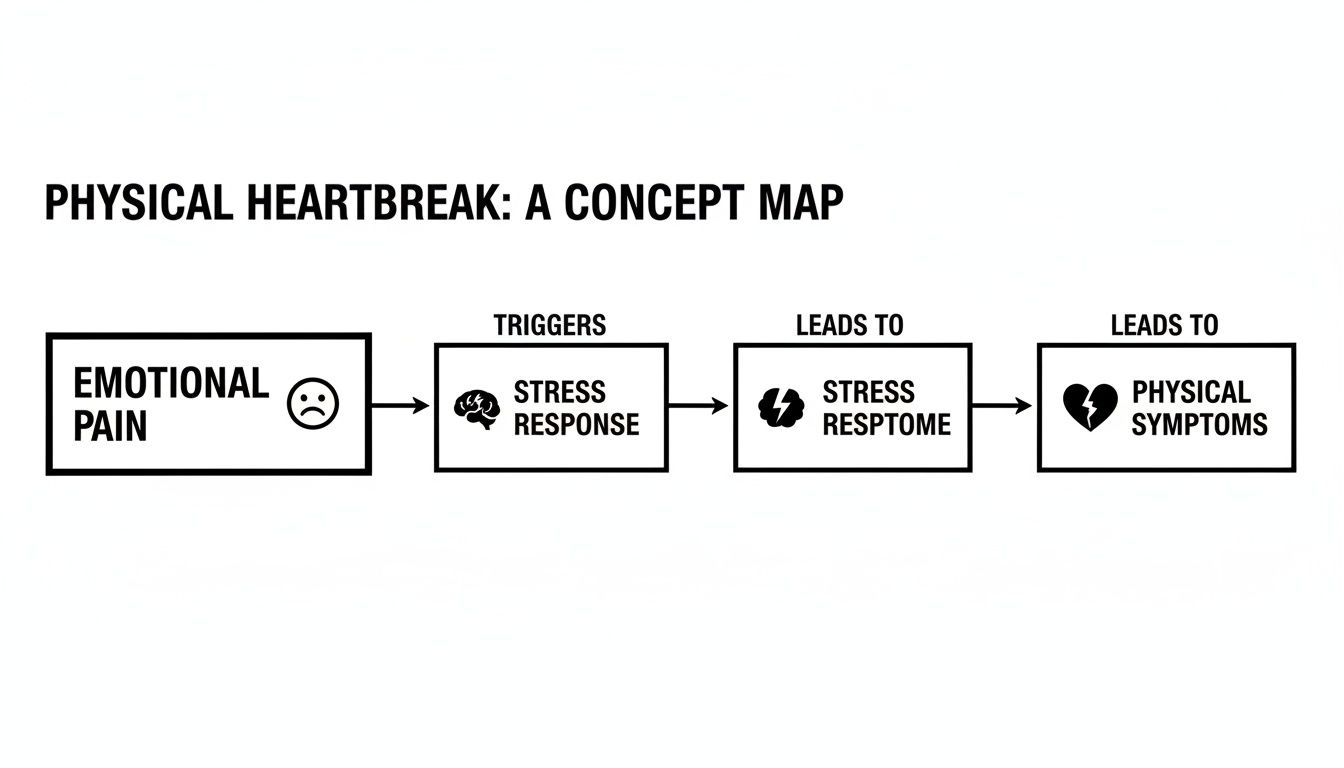
This cascade from emotional distress to physical discomfort is universal. But how you try to manage that pain is where your specific attachment style comes into play.
Your attachment programming dictates how you instinctively react when faced with the perceived threat of disconnection. Below is a quick summary of how this often shows up.
Your Attachment Style's Reaction to Heartbreak
| Attachment Style | Common Internal Experience | Typical Outward Behavior |
|---|---|---|
| Anxious | Panic, obsessive thoughts about the ex, intense fear of abandonment, a desperate need for reunion to feel safe. | "Protest behaviors": repeated calling/texting, checking social media, seeking constant reassurance from others. |
| Avoidant | A mix of relief and buried sadness. A deep belief that "I'm safer alone." Pain is suppressed and often surfaces much later. | Deactivating emotions, focusing on work or new activities, appearing to "move on" quickly, physically and emotionally withdrawing. |
| Disorganized | Internal chaos. A confusing mix of craving closeness and being terrified of it. Feels like being trapped between two opposing needs. | Swinging between anxious and avoidant behaviors. A push-pull dynamic of trying to reconnect one moment and pushing away the next. |
Seeing these behaviors laid out can be an incredibly validating experience. It's not about judgment; it's about understanding the "why" behind your actions so you can begin to heal.
Anxious Attachment and Heartbreak
For someone with an anxious attachment style, a breakup can feel like a genuine, life-or-death emergency. The loss of your partner activates a deep, primal fear of abandonment, sending your nervous system into overdrive. It's a gut-wrenching feeling of, "I cannot survive without them."
This isn't an exaggeration—your body is literally responding as if its primary source of safety and regulation has been ripped away.
- What it feels like inside: Your mind is likely flooded with obsessive thoughts about your ex. You replay every single conversation, searching for clues on how to "fix" it. The uncertainty is excruciating, and you feel a desperate, all-consuming need to get back together just to calm the storm.
- What it looks like on the outside: This internal panic often explodes into what we call "protest behaviors." This could be repeatedly calling or texting, compulsively checking their social media, or constantly asking friends for reassurance. You're essentially trying to re-establish the connection your nervous system is screaming it needs to survive.
A client of mine, Sarah, found herself driving past her ex's house nearly every day after their breakup. She wasn't trying to be intrusive or "crazy"; her system was so dysregulated by the loss that she was subconsciously looking for any sign of him to get a temporary hit of relief from her overwhelming anxiety.
Avoidant Attachment and Heartbreak
If you have an avoidant attachment style, your response to a breakup probably looks very different on the surface. You might even feel a confusing sense of relief and an immediate urge to move on. This is a powerful protective mechanism your nervous system learned a long time ago: "Relationships are suffocating. I am safer and better off on my own."
But this doesn't mean you aren't hurting. The pain is absolutely there; it's just buried under layers of suppression and self-sufficiency.
The core wound for the avoidant is a deep-seated loneliness and a belief that they cannot truly rely on anyone. The breakup confirms this belief, leading them to retreat further into self-sufficiency as a defense against future hurt.
The pain has a tendency to bubble up later, often when you least expect it. You might be hit with a sudden, crushing wave of sadness months after the fact, or find yourself feeling empty and disconnected in your next relationship. Your go-to strategy is to deactivate your attachment needs, but those needs never really disappear—they just go underground.
If you're reading this and aren't sure where you fall, it can be a game-changer to learn more and ask yourself: what attachment style am I?
Disorganized Attachment and Heartbreak
For those with a disorganized attachment style (also known as fearful-avoidant), a breakup can feel like pure chaos. This style often forms when a childhood caregiver was a source of both comfort and fear. As an adult, this leaves your nervous system stuck in an impossible bind: you desperately crave closeness but are also terrified by it.
After a breakup, you might find yourself swinging wildly between anxious and avoidant responses. One moment, you're desperately texting your ex, pleading to get back together. The next, you're blocking their number and vowing to never trust anyone again. It’s an exhausting push-pull dynamic that feels deeply confusing, both for you and for everyone around you.
Identifying these patterns isn't about slapping a label on yourself or finding someone to blame. It's about creating that powerful "aha" moment—connecting your present pain to your past—and illuminating a clear, compassionate path toward real healing.
Calm Your Body First With Nervous System Regulation
When you're reeling from heartbreak, well-meaning friends might tell you to "think positive" or "just get over it." But if you're feeling panicked, anxious, or completely numb, you know it's not that simple.
You can't talk your way out of a feeling that's taken root deep in your body. That's because heartbreak isn't just an emotional event; it puts your entire nervous system into survival mode.
Before you can even begin to process the “why” or reframe your thoughts, you have to help your body feel safe again. This is where nervous system regulation comes in. Think of it as starting from the bottom-up—calming the body first to help soothe the mind. These simple, physical practices can offer immediate relief from those overwhelming waves of anxiety and dread.

Why You Can't "Think" Your Way Out of Heartbreak
Trying to rationalize your feelings during the acute pain of a breakup is like trying to reason with a smoke alarm. When your body is screaming "DANGER!" because the loss of connection feels like a threat to your survival, the logical part of your brain (the prefrontal cortex) basically goes offline.
Your primitive brain takes over, focused on one thing: getting you through this perceived threat. This is why you feel so hijacked by your emotions. The key isn't to fight this state, but to gently guide your body out of it.
Ground Yourself with the Orienting Exercise
When panic starts to rise, your focus often collapses inward, trapping you in a terrifying loop of "what ifs" and worst-case scenarios. The orienting exercise is a powerful way to break that cycle by intentionally shifting your attention outward to your physical environment.
It’s a non-verbal cue to your brain that says, "You are safe right here, right now."
Here’s how to do it anywhere, anytime:
- Get comfortable. Sit or stand with both feet planted firmly on the floor.
- Slowly scan your surroundings. Let your eyes and head drift slowly around the room. Don't force anything; just gently notice what you see.
- Name what you see. Silently or softly, name the objects you notice without any judgment. "There's a green lamp. I see light coming through the window. There's a blue rug on the floor."
- Find something neutral or pleasant. Allow your gaze to rest on something that feels calm or even just mildly interesting. Maybe it's the texture of a wooden table or the way a plant catches the light.
- Check in with your body. As you do this, notice any tiny shifts inside. You might feel a slight release in your chest or a deepening of your breath. That's a sign your nervous system is starting to downshift from fight-or-flight.
I once worked with a client who felt a panic attack coming on in a grocery store. Instead of fleeing, she stood in an aisle and slowly oriented to the colors of the cereal boxes. Within a minute, she felt her heart rate slow down, which gave her enough calm to finish her shopping and drive home safely.
Reset Your System with the Physiological Sigh
This simple breathing technique is one of the fastest ways I know to actively calm your nervous system. Research from Stanford University shows it's incredibly effective at off-loading carbon dioxide and slowing your heart rate almost instantly.
Here’s the pattern:
- Take a deep inhale through your nose.
- At the very top of that breath, take another short, sharp inhale to fully inflate your lungs.
- Exhale very slowly through your mouth, making the exhale longer than both inhales combined.
Doing this just one to three times can create a noticeable shift in your state. You are manually triggering your parasympathetic nervous system, the part of you responsible for "rest and digest."
Gentle Movements to Release Trapped Energy
When you're in a stress response, your body is primed for action—to fight or to run. If that energy has nowhere to go, it gets stuck, leading to feelings of agitation, restlessness, or even feeling frozen and numb. Gentle, mindful movement can help release it.
- Shake it out: Stand up and gently shake your hands, then your arms, then your whole body. Imagine you're physically shaking off all the excess stress and tension.
- Gentle rocking: Sit in a chair and gently rock back and forth or side to side. This repetitive, rhythmic motion is incredibly soothing for the nervous system, mimicking the comfort we received as infants.
- Cross-body tapping: Gently tap your left shoulder with your right hand, then your right shoulder with your left hand. Alternate back and forth. This bilateral stimulation helps the two hemispheres of your brain communicate and process difficult emotions.
These aren't just distractions; they are direct, physiological interventions. You are actively participating in your own healing by sending your body signals of safety and calm, moment by moment.
The power of these techniques is real. For instance, in attachment-focused therapy, we see tangible results, with some clients reducing their anxiety by 40-60% just by learning and implementing these polyvagal-informed practices. When you learn how to handle heartbreak by calming your body first, you're addressing the pain at its root.
If you'd like to explore more of these techniques, we have a full guide on ways to regulate your nervous system. Just for today, remember: healing starts with the body. You’ve got this.
It’s Time to Reclaim Your Story (And Your Peace)
When a relationship ends, it’s not just the person you lose. You also have to contend with the brutal inner critic that loves to show up, whispering all those painful stories of “not being good enough” or “I must have done something wrong.” I see it in my coaching practice all the time.
After you’ve done the work of calming your body, the next step is to gently, but firmly, start rewriting that internal script. This isn't about pretending the pain isn’t there. It’s about refusing to let self-blame have the last word. It’s about taking back the pen.

The loneliness that comes with heartbreak is a heavy, physical thing. It’s not just in your head. A huge 142-country survey recently found that nearly 24% of adults feel lonely, and that number is climbing. This is why practices like therapeutic journaling are so crucial—studies have shown they can cut those feelings of loneliness by 25%.
Journaling isn't just about venting; it's a powerful way to connect with yourself, to become your own secure base when you feel like your world has crumbled. If you're interested in the data, you can read more about the study on global loneliness trends.
Giving Your Pain a Voice: Journaling Prompts to Shift Your Perspective
Journaling gives you a safe container to hold all the messy, complicated feelings without judgment. It’s your space to challenge the stories that keep you stuck and start building a kinder inner voice.
Instead of just replaying what happened, try these prompts. They’re designed to get you out of the loop and into a new perspective:
- Write a letter to your younger self. Go back to a time when you felt rejected or not good enough as a kid. What did that little you need to hear? Write a letter giving yourself the validation, comfort, and safety you never received.
- What are the "stories" you're telling yourself? Get them out of your head and onto paper. List all the negative thoughts on repeat (e.g., "I'm unlovable," "I'll always end up alone"). Now, for each one, ask yourself: "Is this 100% true? What's a more compassionate, balanced way to see this?"
- What needs went unmet in the relationship? This isn’t about blaming your ex. It's about getting radically honest with yourself. Did you need more emotional safety? Consistent affection? To feel like a priority? Naming these unmet needs is how you learn what to ask for next time.
- List three things you learned about yourself. Even the most painful endings are powerful teachers. Did you discover how resilient you are? Did you finally learn what your non-negotiables are? Acknowledge your own growth here.
This isn't about finding who's to blame; it's about reclaiming your power. You're shifting from being a character in a painful story to becoming its compassionate author.
Setting Boundaries to Protect Your Healing
Think of boundaries not as walls to keep people out, but as a fence to protect the garden of your healing. You need to tend to it, and that means keeping out the things (and people) that might trample your progress.
Setting boundaries with an ex is one of the most vital acts of self-care you can do right now, especially when our phones make it so easy for them to pop back into your life.
Practical Scripts for When They Reach Out
It’s not a matter of if they will reach out, but when. Having a few pre-planned, firm, and kind responses ready can save you from getting sucked back into the emotional vortex.
If they text you "I miss you" or "Thinking of you":
- The Direct Route: "I appreciate you saying that, but I need space to heal right now. Please don't contact me."
- The Softer Route: "It's good to hear from you, but in order for me to move on, I can't be in contact right now. I wish you the best."
If they ask "Can we just talk?":
- "I'm not in a place where I can have that conversation right now. I'm focusing on my healing and need to protect my energy."
The single most important thing is to honor your need for space. You don't owe anyone a conversation that sets your healing back.
And yes, that means unfollowing or muting them on social media. It isn't petty; it's a non-negotiable act of creating a digital sanctuary for yourself. This is how you create the space you need to fall back in love with the one person you'll be with forever: you.
Knowing When to Seek Professional Support
The self-help tools and regulation exercises we’ve talked about are powerful. But sometimes, the wound of heartbreak cuts so deep that you just can’t tend to it on your own.
Recognizing when you need a guide to help you navigate your own heart isn’t a sign of weakness. It’s an act of courage and profound self-respect.
Knowing how to handle heartbreak is also about knowing when to ask for help. This is especially true when a breakup rips open old attachment wounds, leaving you feeling completely overwhelmed and stuck in those same painful, familiar patterns.
Clear Signs It's Time for Support
If you’re wondering whether it’s time to reach out, there are some clear signals that your nervous system is overwhelmed and could use professional support. This isn't about being "broken"—it's about needing a different kind of tool for a specific kind of wound.
Pay attention if you're experiencing any of these:
- You can't function day-to-day. You’re struggling to work, care for yourself, or even get through basic daily routines.
- The emotional overwhelm is constant. The anxiety, sadness, or anger feels relentless, and none of the regulation techniques are bringing any lasting relief.
- You're turning to unhealthy coping mechanisms. You find yourself relying on alcohol, food, overworking, or other behaviors just to numb the pain.
- You feel stuck in a painful loop. You’re trapped in obsessive thoughts about your ex or a deep sense of hopelessness that just won't lift.
- This feels like a pattern. You’re realizing this breakup feels just like the last one, and you’re tired of repeating the same story.
For example, a client I worked with knew it was time for help when she noticed she was calling in sick to work multiple days a week. It wasn't because she was physically ill, but because the anxiety in her chest was so intense she couldn't get out of bed. That was her sign that self-help wasn't enough anymore.
Why a Somatic, Trauma-Informed Approach Works
Not all therapy is created equal, especially when you’re healing attachment trauma triggered by heartbreak. Traditional talk therapy can be great for gaining insight, but it often falls short when the root of the pain is stored in your body.
You simply can't talk your nervous system out of a survival response.
This is where a somatic, body-based approach makes all the difference.
A somatic practitioner helps you work from the bottom-up. You gently release the trapped survival energy from your nervous system before trying to reframe the story in your mind. It’s about creating real, felt safety inside your own skin.
When you're looking for professional support, understanding frameworks like trauma-informed care can be incredibly validating. This approach recognizes that your reactions aren't a flaw—they are a completely logical response to your past experiences.
At Securely Loved, this is the heart of our work. We help you connect with the physical sensations of your attachment patterns, teaching you how to regulate your nervous system so you can finally process the pain without it completely overwhelming you.
It’s a method that creates deep, lasting change because it addresses the wound where it lives—in your body. Seeking this kind of support isn't a failure. It’s the next brave step on your path to building a truly secure and love-filled future.
Building Your Secure and Hopeful Future
Healing from heartbreak isn’t just about closing a painful chapter; it’s about learning how to write a better one. All of this hard work has equipped you with incredible self-knowledge—you now have a compass pointing you toward what you need to feel safe and secure.
This isn’t just data. It’s wisdom. It’s the key to consciously building a future filled with secure connections, starting with the one you have with yourself.

You’ve done the tough work of calming your body and rewriting old stories. Now, it's time to turn that inner work into outer action and step forward with confidence. This painful experience can be the very catalyst for your most profound growth.
Re-Engaging With Your World on Your Terms
After a period of quiet healing, gently re-entering the world can feel both exciting and a little scary. The goal here is to move with intention, not pressure. This isn't about jumping back into the dating pool; it’s about rediscovering joy and connection outside the context of a relationship.
Start small. Reconnect with people and hobbies that genuinely fill you up. One of my clients signed up for a pottery class she’d always dreamed of taking. The simple, tactile act of working with clay was a grounding, somatic experience that helped her feel creative and present in her own body again.
Remember, building a new future often requires honoring the past. For some, part of this process might involve memorializing a lost loved one in a way that feels meaningful. Acknowledging what's been lost allows you to move forward with a clearer heart.
Spotting Green Flags in New Connections
Your heartbreak has given you a powerful gift: a finely tuned radar for what doesn’t feel right. Now, let’s calibrate it to spot what does. As you begin to meet new people—whether friends or potential partners—I want you to shift your focus from looking for red flags to actively seeking green flags.
Green flags are signs of emotional maturity, safety, and respect. They feel like a calm, easy breath, not a chaotic rollercoaster.
Here’s what to look for in the real world:
- They respect your boundaries without question. You say you need a night to yourself, and their response is, "Okay, enjoy your evening! Let me know when you might be free." There’s no pushing, pouting, or guilt.
- They show emotional consistency. Their mood and interest in you don’t swing wildly from one day to the next. You have a steady sense of where you stand with them.
- They can talk about their feelings and past experiences without blaming everyone else, playing the victim, or making excuses. They take ownership.
- They show genuine curiosity about you. They ask thoughtful questions and actually listen to your answers, even remembering the small details later.
A secure connection feels like ease, not effort. It's marked by reciprocity, respect, and the freedom to be your authentic self without fear of judgment. This is the new standard you deserve.
This isn’t about finding a “perfect” person. It's about recognizing the qualities that create the foundation for a healthy, secure relationship—the very thing you are now capable of building within yourself.
This journey, from heartbreak to hope, is the ultimate act of coming home to you.
Your Burning Questions About Heartbreak, Answered
When you're in the thick of heartbreak, it can feel like you're navigating a disorienting fog. The same questions tend to swirl around, making it hard to find your footing. Let's walk through some of the most common ones I hear, and get you some clear, compassionate answers to help you find your way forward.
How Long Will It Take to Get Over This?
This is the one question everyone asks, and the honest-to-god truth is: there’s no magic number. Your healing journey is deeply personal—it’s shaped by your own attachment history, the specific dynamics of the relationship you lost, and the support you have around you.
Instead of staring at a calendar and waiting for the pain to stop, I want you to focus on something else entirely. Focus on the small, gentle, healing choices you can make today. Healing isn't a race to a finish line. It’s messy. You'll have days where you feel lighter, followed by days where the grief feels heavy again. That's not a setback; it's part of the process. Real progress is measured in your growing ability to offer yourself compassion, not in how fast you can numb the pain.
Should I Stay Friends With My Ex?
I know the idea of friendship can feel like a soft landing, a way to keep a connection you cherish. But for most people, especially if you lean toward an anxious attachment style, a period of no-contact is essential. I cannot stress this enough.
This isn't about punishing your ex or being dramatic. It’s about giving your own nervous system the space it desperately needs to calm down and begin to untangle itself from the connection. You need to re-establish your own emotional baseline without their presence. A real friendship might be possible way down the road—months, or even years, from now. But that can only happen after you feel truly whole, secure, and independent on your own. For now, your peace has to be the priority.
Why Do I Feel So Sick and Have No Appetite?
That gut-wrenching, sick feeling and total loss of appetite? It’s not in your head. It’s a very real, physical response to extreme emotional distress. Heartbreak can send your body straight into a "fight-or-flight" state.
When this happens, your sympathetic nervous system basically sounds an alarm, pulling all of your body's energy away from anything it deems "non-essential" for immediate survival—and that includes digestion. This is what leads to that awful nausea, stomach pain, and inability to even think about food. It's a powerful reminder that your body and heart are deeply connected. Gently using the nervous system regulation tools we've talked about is how you'll guide your body back to its "rest-and-digest" state. This shows just how vital it is to learn how to handle heartbreak by tending to your physical self first.