

How to Heal Codependency: Your Trauma-Informed Plan
You may be the person everyone depends on. You get things done at work, you remember the birthdays, you hold the emotional weather of the room, and you can sense tension before anyone says a word. From the outside, that can look like competence and generosity. On the inside, it often feels like exhaustion, resentment, anxiety, and a quiet fear that if you stop managing everything, something important will fall apart.
That pattern is often called codependency. I want to say this clearly. It isn't a sign that you're broken. It's usually a sign that your nervous system learned very early that staying connected required hyperawareness, overfunctioning, self-abandonment, or emotional caretaking.
If you're searching for how to heal codependency, real healing goes deeper than “just set boundaries” or “love yourself more.” Those ideas matter, but they rarely stick when your body still reads closeness, conflict, or disappointment as danger. Lasting change happens when you understand the attachment wound underneath the behavior and build enough internal safety to respond differently.
Redefining Codependency From Survival Tactic to Self-Awareness
A lot of people first recognize codependency in ordinary moments. You say yes when you mean no. You replay a text message for an hour, trying to make sure you didn't upset anyone. You feel responsible for a partner's mood, a parent's stress, a coworker's frustration, or a friend's choices. Then you judge yourself for being “too much” or “not strong enough.”
I don't see that as weakness. I see a nervous system that got very skilled at reading other people in order to stay safe.
For many adults, codependency began as adaptation. If love felt inconsistent, you may have learned to become easy, needed, impressive, helpful, or emotionally available on command. If a caregiver was unpredictable, you may have learned that anticipating needs was safer than having needs. Those strategies can help a child survive. They become painful when an adult keeps using them in relationships that require mutuality instead of self-erasure.
A useful shift happens when you stop asking, “What's wrong with me?” and start asking, “What did this pattern help me survive?”
Practical rule: Shame slows healing. Accurate self-understanding speeds it up.
Codependency is also far more common than many people realize. A survey of college students found that 85% of men and 76% of women met the “high to middle” classification for codependency, which underscores how widespread these patterns are and how strongly they connect to early experiences and social conditioning, according to the Claudia Black Young Adult Center.
What codependency often looks like in real life
- In dating: You focus on being chosen instead of noticing whether the relationship feels safe, reciprocal, and honest.
- In family relationships: You become the emotional manager, the peacekeeper, or the one who absorbs everyone else's distress.
- At work: You overdeliver, rescue struggling colleagues, and feel guilty resting because productivity has become tied to worth.
- With yourself: You know how to care for everyone else, but you lose access to your own preferences, limits, and signals.
Sometimes people confuse codependency with kindness. They aren't the same thing. Healthy care allows two people to exist fully. Codependency often involves disappearing parts of yourself in order to preserve connection.
A more compassionate definition
Codependency is a relationship pattern where your sense of safety, worth, or stability becomes overly organized around another person's needs, emotions, approval, or behavior.
That doesn't make you selfish to change it. It makes you honest.
If enabling has been part of your pattern, this reflection on why codependents enable others can help you understand the protective logic underneath behaviors you may now want to outgrow.
Tracing the Roots of Your Codependency to Your Attachment Style
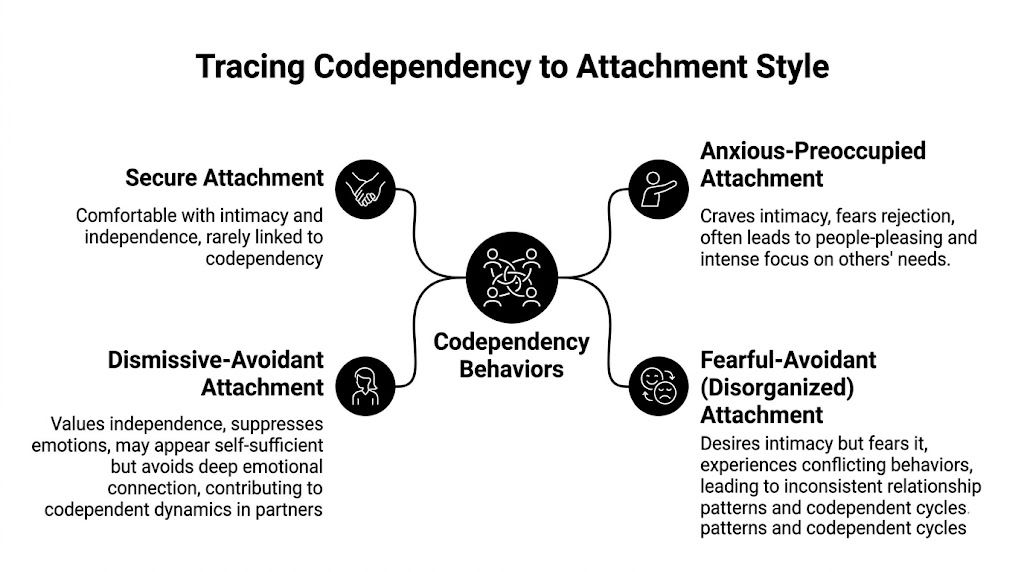
Most advice about codependency treats everyone the same. That misses something important. An anxious person and an avoidant person can both look codependent, but the fear driving the behavior is often different. That's why one-size-fits-all advice doesn't always land.
Current codependency content often fails to differentiate healing approaches based on attachment style. Recognizing that gap matters because anxiously attached people often need interventions centered on nervous system safety, while avoidantly attached people may need more emotional tolerance training, as noted in this Headspace article on therapy for codependency.
Anxious attachment and codependency
If you lean anxious, codependency often shows up as overgiving, overexplaining, monitoring, and trying to secure closeness before it slips away. You may feel a strong urge to repair conflict immediately. Silence can feel loaded. Distance can feel like rejection, even when nothing explicit has happened.
In practice, that can sound like this:
“If I can just be more supportive, less needy, more understanding, maybe they won't leave.”
Anxious codependency usually isn't about being dramatic. It's often about trying to prevent abandonment before it happens.
Avoidant attachment and codependency
Avoidant patterns can confuse people because they don't always look clingy. But avoidant codependency still organizes around control, distance, and relational safety. You might become the capable one, the helper, the advisor, or the person who gives practical support while staying cut off from your own vulnerability.
That can sound like:
“I don't need much. I just need everyone else to be okay so nothing messy lands on me.”
Here, caretaking can become a way to manage intimacy. You stay engaged, but from a controlled distance. You may be excellent at solving problems and less comfortable being emotionally known.
Disorganized attachment and mixed signals
If your attachment pattern feels conflicted, you may cycle between pursuit and withdrawal. You want closeness, but closeness also feels dangerous. You may open up fully, then feel exposed and pull away. Or you may choose relationships that keep activating both longing and fear.
This pattern can create especially painful codependent loops because your system is trying to answer two opposite needs at once: “Come closer” and “Please don't hurt me.”
Gentle questions to help you identify your pattern
You don't need to diagnose yourself. You do need enough honesty to notice what happens inside you.
Ask yourself:
- When someone is upset with me, what do I do first? Chase, explain, shut down, fix, or disappear?
- What feels more threatening? Being abandoned, being controlled, being exposed, or being misunderstood?
- When I help people, what am I hoping to secure? Love, stability, appreciation, distance, or predictability?
- What happens in my body during conflict? Tight chest, numbness, urgency, collapse, irritation, or confusion?
- Do I know what I need before I ask what everyone else needs?
A short framework can help:
| Attachment pattern | Common codependent expression | Healing focus |
|---|---|---|
| Anxious | People-pleasing, reassurance seeking, overfunctioning | Internal safety, tolerating uncertainty |
| Avoidant | Caretaking without vulnerability, control, emotional distance | Emotional access, receiving support |
| Disorganized | Push-pull dynamics, mixed signals, intense bonding and retreat | Stabilization, pacing, relational consistency |
If you want a deeper language for what you're noticing, this guide to attachment style definition can give you a clearer starting point.
What this changes in your healing
Once you understand your attachment blueprint, the work becomes more precise. An anxious system doesn't need more self-criticism for “being too attached.” It needs safety, pacing, and clear limits. An avoidant system doesn't need more pressure to open up on demand. It needs room to feel without losing autonomy.
That's one reason generic codependency advice often falls flat. The behavior is visible. The attachment wound underneath it is where the real healing begins.
Your Daily Toolkit for Building Internal Safety
Traditional codependency advice often jumps straight to behavior. Say no. Stop rescuing. Set a boundary. Speak up. Those are good goals, but they can feel impossible when your body is already in alarm.
A critical gap in most codependency recovery models is the lack of focus on the autonomic nervous system. Codependent behaviors often trigger a chronic fight-or-flight response, yet few resources teach the somatic downregulation techniques needed to feel safe enough to change these patterns, as described in this Pharmacy Times overview of codependency healing.

If you've ever known what you “should” say but couldn't get the words out, this is why. Your body was protecting you.
Start with state, not insight
When you're activated, insight isn't the first task. Regulation is. You don't need to win an argument with your fear. You need to help your body feel less under threat.
Use this sequence when you feel the urge to people-please, chase, overexplain, or fix.
Pause the action
Don't send the text yet. Don't volunteer immediately. Don't rush to smooth over tension. Interrupting the automatic move gives your system a chance to update.
Orient to the present
Look around the room slowly. Name five neutral things you can see. Let your eyes land on corners, edges, light, texture. This helps your body register that the current moment is not the same as the earlier environment where you learned these patterns.
Lengthen the exhale
A long exhale often helps signal safety more effectively than trying to force a “calm” feeling. Try a gentle inhale, then a slower exhale. Keep it easy rather than perfect.
Name the body sensation
Say to yourself, “Tight throat.” “Heat in my face.” “Buzzing in my chest.” This builds emotional literacy through sensation, not just thought.
Add one sentence of permission
“I am allowed to pause.”
“I don't have to earn safety by fixing this.”
“Discomfort doesn't mean danger.”
You don't need to feel completely calm before you act differently. You do need enough safety to choose instead of react.
A simple daily practice that works in ordinary life
Healing doesn't only happen in major conversations. It happens in tiny repetitions that teach your body a new baseline.
Try this brief daily rhythm:
- Morning check-in: Before you look at your phone, ask, “What is my body doing right now?” Keep it physical. Heavy, buzzy, tense, flat, steady.
- Midday reset: Put both feet on the floor and press down for a few breaths. Let the chair support your back. Feel that you are held.
- Evening debrief: Ask, “Where did I override myself today?” Then ask, “What would honoring myself have looked like?”
This isn't performative self-care. It's how you rebuild self-trust.
Somatic tools for specific codependent triggers
Some tools work better for certain moments than others.
When you're afraid someone is pulling away
Place one hand on your chest and one on your abdomen. Let your body feel contact. Then say, “Their distance is information. It is not proof that I am unlovable.”
When you feel responsible for someone's mood
Gently uncurl your hands and relax your jaw. Many people move into fixing mode while their body is bracing. Releasing the brace can soften the compulsion to manage.
When guilt hits after saying no
Walk slowly and feel each footstep. Guilt often surges after a boundary because your nervous system associates self-protection with danger. Movement can help discharge activation.
When you can't tell what you feel
Use contrast instead of precision. Ask, “Do I feel more open or closed? More heavy or light? More pulled in or more settled?” That's often easier than trying to find the perfect emotion word.
For more body-based support, these grounding techniques for trauma can help you practice regulation in a way that feels concrete rather than abstract.
What doesn't usually work
A few common approaches tend to backfire:
- Forcing positivity: Telling yourself to “just relax” often increases shame when your body won't comply.
- Overanalyzing: Insight matters, but excessive mental looping can become another way to avoid feeling.
- Waiting until crisis: If you only regulate when things are falling apart, your body never gets enough repetition to learn a new pattern.
The daily toolkit matters because codependency isn't only a thought habit. It's often a state of bodily vigilance. When internal safety grows, healthier choices stop feeling like betrayal.
The Art of Setting Boundaries Without Guilt
My clients don't struggle to understand boundaries intellectually. They struggle in the ten minutes before setting one and the two hours after. That's where the panic, guilt, second-guessing, and urge to take it all back usually show up.
That response is common. In early recovery, guilt relapse after setting a boundary occurs in 60 to 70% of cases without consistent practice. With weekly practice and support, boundary adherence can improve by 75% within 12 weeks, according to Insight Recovery Treatment Center.

What that tells me is not that boundaries are bad for you. It tells me your body may read them as risky because they interrupt an old relational contract.
What a boundary is and what it isn't
A boundary is not a punishment. It isn't a performance of strength. It isn't a way to control another person.
A boundary is a clear statement of what you will do, allow, participate in, or step back from in order to protect your wellbeing and remain honest in the relationship.
That means healthy boundaries are usually:
- Specific: “I can't talk about this while voices are raised.”
- Behavioral: “If the conversation becomes insulting, I'll end the call.”
- Simple: Not overexplained, argued, or padded with apology.
- Repeatable: Something you can actually maintain.
Scripts you can borrow
You don't need a perfect script. You need language you can say while your body is activated.
At work
A coworker asks for help when your plate is already full.
“I can't take that on today. If it can wait, I can revisit it later this week.”
Your manager messages after hours.
“I saw this. I'll respond during working hours tomorrow.”
With family
A parent expects emotional access on demand.
“I'm not available for this conversation right now. I can talk when I'm more grounded.”
A relative pressures you for details.
“I'm keeping that private, but I appreciate your concern.”
In a romantic relationship
Your partner wants immediate resolution while you're flooded.
“I want to stay connected, and I need a pause so I don't say this from panic. Let's come back to it when I can be more present.”
Someone repeatedly leans on you without reciprocity.
“I care about you, and I can't be your only source of support for this.”
Boundary reminder: If you have to overexplain your boundary so the other person will approve of it, you're still negotiating for permission.
Handling the boundary hangover
After you set a boundary, you may feel shaky, cruel, selfish, or convinced you've done something wrong. I often call this a boundary hangover. It doesn't mean the boundary was unkind. It means your system is adjusting.
Try this response plan:
- Name it accurately: “This is guilt, not evidence.”
- Keep the boundary in place: Don't rush in to soften it before you've had time to settle.
- Avoid over-repairing: A follow-up apology often reopens the dynamic you were trying to change.
- Return to the body: Drink water, move slowly, place your feet on the floor, and let the activation pass.
If saying no is especially hard for you, this guide on how to say no without feeling guilty offers practical language you can adapt for everyday situations.
Trade-offs you should expect
Boundary work changes relationships. Sometimes they improve because there's finally clarity. Sometimes the relationship gets uncomfortable because your old role was convenient for someone else.
That's painful, but it's also useful information.
Here is a simple comparison:
| Old pattern | New boundary-based pattern |
|---|---|
| You prevent disappointment | You allow others to have feelings |
| You overfunction | You let responsibility stay where it belongs |
| You get temporary approval | You build long-term self-respect |
| You feel close through rescuing | You build closeness through honesty |
When you're learning how to heal codependency, this is one of the deepest shifts. You stop measuring love by how much you can carry. You start measuring health by how real the relationship allows you to be.
How Professional Support Can Accelerate Your Healing
Self-help can open the door. It can give language to what you've lived. It can help you identify patterns and practice new responses. But many people hit a wall when the material makes sense and their relationships still don't change.
That doesn't mean you're failing. It often means the work has moved beyond insight and into attachment injury, trauma response, and relational nervous system learning. Those layers usually heal faster, and more gently, with support.
Why traditional talk therapy sometimes falls short
Talk therapy can be valuable. But if the approach stays mostly cognitive, you may end up understanding your childhood and still feeling hijacked in present-day relationships. You know the pattern. You can explain it beautifully. Then your partner is distant, your mother is demanding, or your boss is disappointed, and your body reacts before your thinking brain can catch up.
For codependency, I generally look for approaches that can work with both story and state. That often includes:
- Attachment-focused therapy: Helps you identify the relational blueprint underneath your reactions.
- EMDR: Can support the reprocessing of earlier experiences that still feel unresolved in the body.
- Somatic therapies: Help you track activation, protect your limits, and experience new responses instead of only talking about them.
- Group support: Reduces shame and helps you recognize that your pattern is relational, not personal failure.
What to look for in a therapist
Finding the right therapist matters more than finding the trendiest modality. A good fit should help you feel challenged without feeling steamrolled.
Use questions like these in a consultation:
- How do you understand codependency? Listen for answers that include trauma, attachment, and nervous system patterns, not just “poor boundaries.”
- How do you work when clients become dysregulated? You want someone who can help you slow down and regulate, not just analyze.
- Do you tailor treatment based on attachment style? Anxious and avoidant patterns usually need different pacing.
- How do you help clients practice change between sessions? Good work should translate into daily life.
- What happens if I intellectualize everything? A seasoned practitioner will recognize this as a protective strategy, not resistance.
The right therapist won't just tell you to have boundaries. They'll help you notice what happens in your body when you try.
The value of peer support
Co-Dependents Anonymous, or CoDA, was founded in 1986 and adapted the 12-step model to address codependency, becoming a cornerstone of recovery for millions through a structured, peer-supported path to healing dysfunctional relational patterns, according to this EBSCO overview of codependency.
Support groups can be powerful because they interrupt isolation. You hear your own inner logic reflected in other people. Shame loses some of its grip when your pattern is witnessed without ridicule.
For some people, a mix works best:
| Support type | What it often helps with |
|---|---|
| Individual therapy | Attachment wounds, trauma processing, tailored change |
| CoDA or peer group | Accountability, shared language, reduced shame |
| Skills-based resources | Scripts, worksheets, daily practice structure |
If you're exploring options beyond crisis support and want a broader sense of what growth-oriented therapeutic work can look like, this overview of personal growth counseling offers a useful frame for evaluating whether a practitioner's style matches the kind of change you're seeking.
What support should feel like
Good support doesn't make you dependent on the therapist. It helps you become more resourced, more discerning, and more able to stay with yourself in difficult moments. You should feel more honest over time, not more polished. More grounded, not just more self-aware. More capable of receiving love without overperforming for it.
That's the kind of help that accelerates healing because it doesn't just name the wound. It gives you an experience different enough to begin repairing it.
Navigating Setbacks on Your Lifelong Healing Journey
Setbacks don't mean you went backward. They usually mean a familiar trigger touched an older survival response. If you fall into overexplaining, rescuing, chasing, numbing, or abandoning yourself again, that isn't proof that your work didn't count. It's information.
The fantasy is that healing will make you untriggered. What's truly better is how healing helps you notice sooner, recover faster, and relate to yourself with less shame when old patterns reappear.

What a setback often looks like
It may be subtle. You say yes too quickly. You start monitoring someone's mood. You lose sleep after a difficult conversation. You agree to something that doesn't feel right and then feel resentful. Or you choose a familiar dynamic because your body still confuses intensity with connection.
None of that requires self-attack. It requires interruption and repair.
A compassionate setback plan
When you notice an old pattern, try this sequence.
Pause the shame spiral
Don't turn awareness into a weapon. “I'm doing it again” is enough. You don't need “I'll never change.”
Find the trigger
Ask, “What felt threatening?” Rejection, conflict, disapproval, uncertainty, being needed, being ignored, closeness?
Name the protective strategy
Were you pleasing, fixing, withdrawing, controlling, performing, or collapsing? Your pattern was trying to help, even if it caused pain.
Repair one thing quickly
Send the clarifying text. Restate the boundary. Admit you overrode yourself. Cancel the commitment you made from guilt if you still can.
Return to your body
Regulation turns insight into learning. Without it, the setback becomes another stress loop.
Healing asks for repetition, not perfection.
Signs your healing is working
Progress often looks quieter than people expect.
- You notice your activation earlier.
- You recover from conflict with less collapse or chasing.
- You can disappoint someone without abandoning yourself.
- You ask what you feel before asking what everyone else feels.
- You become less available for chaotic dynamics, even if part of you still feels drawn to them.
Those shifts matter because they reflect growing self-trust.
The long view
Codependent patterns often formed over years. It makes sense that unwinding them is not a straight line. You may need different tools in different seasons. A breakup may bring one layer to the surface. Midlife changes may bring another. Family contact may activate a younger version of you than romantic conflict does.
That doesn't mean you're starting over each time. It means the healing is getting more honest.
If you remember one thing, let it be this. You are not trying to become less caring. You are learning to care without self-erasure, to love without overfunctioning, and to stay connected without leaving yourself behind. That is a profound shift. It changes not only your relationships, but your relationship with your own body, needs, and voice.
If you're ready for deeper support, Securely Loved offers attachment-focused, trauma-informed help for adults who feel stuck in codependent patterns, emotional overwhelm, and repeating relationship cycles. You can explore resources, learn more about nervous system regulation and attachment healing, or book a free 15-minute connection call to see whether the support feels like a fit.