

Therapy for Relationship Anxiety to Build Secure Connections
Do you find yourself rereading your partner's texts, searching for a hidden meaning? Do you mentally brace for the end of the relationship, even when things are going great? First, take a breath. You're not alone. The constant hum of worry that can hijack a romantic connection is a deeply human struggle. Choosing to seek therapy for relationship anxiety is a powerful, proactive step toward finding the peace and security in love that you deserve.
Feeling Anxious in Love Is More Common Than You Think
Does the smallest shift in your partner’s tone send you into a spiral? For example, they say "I'm tired" and your brain immediately translates it to "They're tired of me." Do you catch yourself planning for the breakup, almost as a defense mechanism, even when the relationship is strong? These feelings are incredibly familiar to so many of us, turning what should be a source of joy into a minefield of stress.
This constant state of high alert isn’t a personal failing; it’s a pattern. And more often than not, these intense feelings aren’t really about your current partner or the text they just sent. Instead, they're echoes of older, deeper patterns your nervous system learned a long, long time ago.
It's Not Just in Your Head
Relationship anxiety is a full-body experience. It's the tightness in your chest when you see them talking to someone attractive, the racing heart when they don't pick up the phone, the pit in your stomach when a text goes unanswered for an hour too long. These physical sensations are your nervous system screaming "threat!"—even if that threat is purely emotional.
While modern life certainly doesn't help, the roots of this anxiety often go way back. Relationship issues are now a primary reason people seek mental health support, with research showing just how much our romantic lives impact our well-being. One study found that over one-third (34%) of Americans point to their romantic relationships as the biggest source of their mental health struggles. A staggering 77% say that bad experiences with past partners directly impact how they show up in their current ones, proving just how much old wounds follow us around.
The core truth is this: your anxiety is valid. It’s a signal from a part of you that is trying to keep you safe. It’s just using old strategies that might have been necessary in the past but are no longer serving you today.
Understanding Your Unique Patterns
A truly compassionate and effective therapist won't just help you manage the symptoms; they'll help you get to the source. For so many people, the first huge "aha!" moment comes from understanding their own unique relationship patterns, which often stem from their attachment style. Taking an attachment style test can be an incredibly eye-opening first step in seeing these underlying dynamics more clearly.
Consider this guide your roadmap. We’re going to explore why you feel this way and what you can actually do about it. We'll move beyond the surface-level advice to give you a clear path toward healing. With the right support, you can learn to create a profound sense of safety within yourself and finally build the secure, loving connection you've always craved.
Ever been in therapy, talking for hours about why you get so anxious, only to feel that same old panic rise up the next time your partner seems distant? You’re not just imagining it, and you're certainly not alone. It's a frustratingly common experience, and it points to a big gap in some traditional talk therapies when it comes to tackling deep-rooted anxiety.
Talking about your fears is a great starting point, but it often isn't enough to really move the needle.
Think of it this way: say you have a lifelong fear of public speaking. You could sit on a therapist's couch for months dissecting the fear—maybe you were laughed at in school. You could become an expert on your own phobia, understanding it inside and out.
But none of that actually prepares you for the feeling of standing in front of a crowd. To truly feel confident, you have to practice. You need to feel your feet on the ground, hear your own voice stay steady, and have the real, lived experience of it going well. Therapy for relationship anxiety works the exact same way.
Moving Beyond Just Talk
The reason talking alone often falls short is pretty simple: relationship anxiety isn't just a thought in your head. It's a full-body experience that lives in your nervous system. That tightness in your chest, the knot in your stomach, that sudden, overwhelming urge to either demand reassurance or shut down completely—those are physical responses. Logic can't just switch them off.
These reactions are driven by parts of your brain that don't speak the language of reason. They operate on instinct and survival maps drawn in your past.
Trying to talk your nervous system out of a panic response is like trying to reason with a smoke detector that’s blaring. The smoke detector doesn't understand your calm words; it only knows it senses danger and will keep screaming until the "threat" is gone.
This is exactly why the type of therapy you choose is so incredibly important.
Top-Down vs. Bottom-Up Healing
To truly heal, we need an approach that speaks to both the mind and the body. You can think of it as combining two different, but equally essential, pathways to healing:
Top-Down (The Mind): This is your classic "talk therapy." It starts with your conscious thoughts, like "I'm worried they're losing interest." The idea is to work from the "top" (your cognitive brain) to influence your feelings and physical reactions down "bottom." It’s fantastic for gaining clarity and perspective.
Bottom-Up (The Body): This approach flips the script. It starts with the physical sensations, like that knot in your stomach. It works directly with the nervous system (the "bottom") to calm your thoughts and emotions (the "top"). This gets right to the physiological root of the anxiety.
When you're dealing with something as deep-seated as relationship anxiety, relying only on a top-down method can feel like you’re in a constant fight with your own body. You might know you’re safe, but you don't feel safe. Lasting, meaningful change happens when we bring both together, teaching your mind and body to finally trust each other and create a genuine sense of security from the inside out.
Therapeutic Approaches That Actually Heal Anxiety
Once you realize that just talking about your anxiety isn't making it go away, the next question is usually a hopeful one: "So, what actually works?"
The answer lies in therapies that go beyond surface-level chats to get to the real root of your fears—the physical and emotional patterns driving them. Think of it this way: these are the approaches that teach you how to actually feel safe in relationships, not just stand on the sidelines talking about your fear.
Modern, effective therapy for relationship anxiety doesn't just focus on your thoughts; it integrates your mind and your body. It respects the logical part of you that wants to understand why you feel this way, while also speaking directly to the nervous system where all that panic and unease is actually stored.
Let's dive into some of the most powerful ways to create that deep, lasting sense of safety you've been searching for.
The decision tree below maps out two main paths in therapy. One is the more traditional "mind-first" route (talk therapy), and the other is an integrated approach that brings the mind and body together.
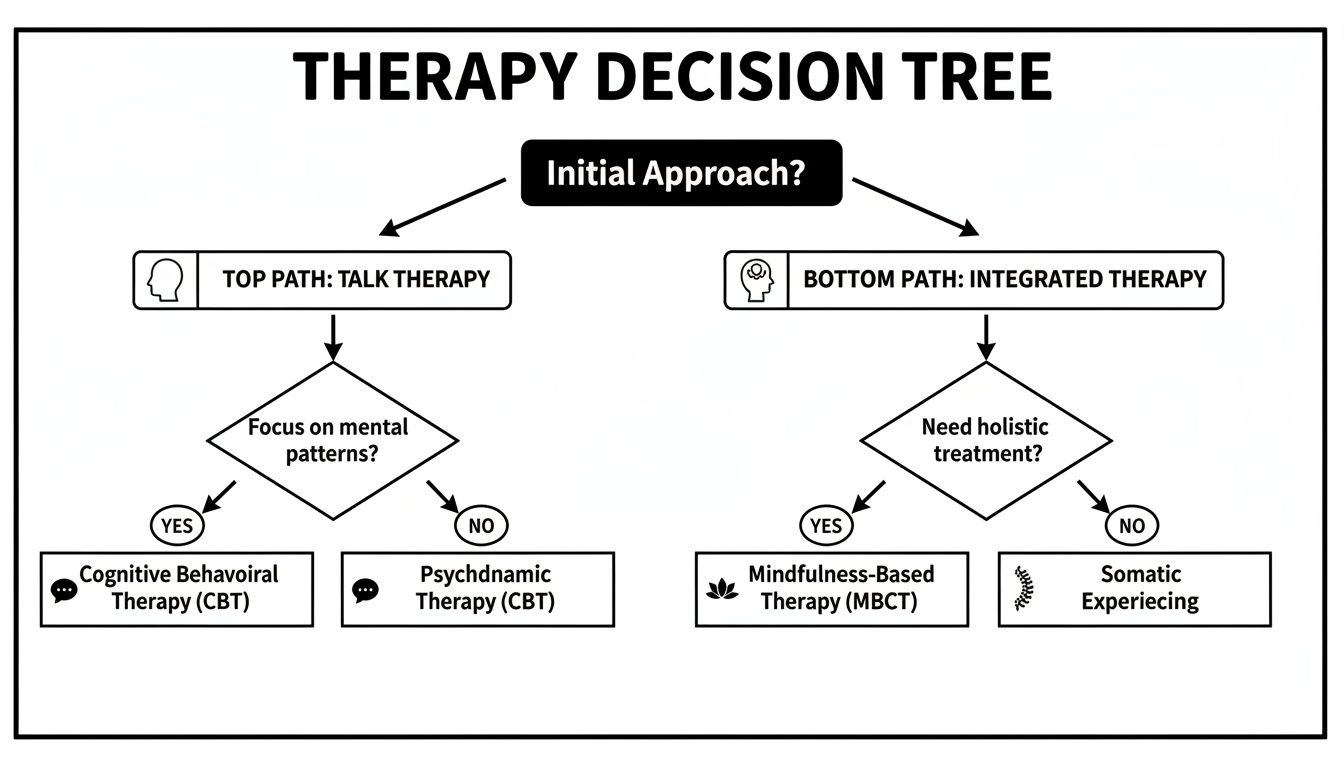
As you can see, for something as deep-seated as relationship anxiety, an approach that addresses both your thought patterns and your body's reactions is usually where the most profound healing happens.
Emotionally Focused Therapy (EFT)
At its core, Emotionally Focused Therapy (EFT) is all about understanding the dance of connection and disconnection in a relationship. It’s built on a simple truth: humans are wired for attachment. When we feel emotionally cut off from our partners, we panic.
Instead of getting stuck on surface-level fights ("You never do the dishes!"), EFT goes deeper to find out what's really going on underneath. It helps you and your partner see the painful cycle you're trapped in.
Here's a real-world example:
Imagine you get anxious when your partner needs some space. Your anxiety makes you text them repeatedly for reassurance. This makes them feel smothered and pull away even more. This triggers your deepest fear of abandonment, making you feel even more desperate and anxious. It's a vicious cycle.
EFT helps you stop the dance and name the real fear: "When you go quiet, the story I tell myself is that I've done something wrong and you're leaving me. It's terrifying."
Your partner can then respond to that raw fear, not the texting behavior. They might say, "Wow, I didn't know it felt that big. I promise we're okay, I just get overwhelmed and need time to process." This single exchange breaks the cycle and starts rebuilding a secure, emotional bond.
Somatic Experiencing (SE)
Somatic Experiencing (SE) is a game-changer because it works directly with your nervous system. It’s a body-based approach designed to help release trapped survival energy from past events that felt overwhelming. For relationship anxiety, this is incredibly powerful.
SE helps you notice the physical sensations of anxiety—that tight chest, clenched jaw, or churning stomach—without getting swept away by them.
A therapist guides you to gently "touch into" those feelings and then guides you back to a place of safety and calm in your body. This process, called pendulation, slowly and safely expands your nervous system's ability to handle stress without shutting down or freaking out.
Here's a real-world example:
Let's say your partner’s phone buzzes with a text from an unknown number, and you feel an instant jolt of panic. In an SE session, your therapist might ask, "Where do you feel that panic in your body right now?" You might point to a hot, tight feeling in your chest.
Instead of analyzing why you feel jealous, the therapist would help you find a part of your body that feels neutral or even good—maybe your feet feel solid on the floor. You'd focus there for a moment before gently bringing your awareness back to the tightness. Over time, this teaches your body that it can feel the beginning of a panic response and return to safety, releasing the charge instead of letting it spiral.
Internal Family Systems (IFS)
Internal Family Systems (IFS) offers a beautifully compassionate way to understand your inner world. It sees your mind as naturally made up of different "parts," each with its own feelings, beliefs, and agendas.
The revolutionary part? There are no "bad" parts. Every single part is trying to help you, even if its methods are causing chaos. IFS helps you get to know these parts from your core Self—that calm, confident, wise center that everyone has.
With IFS, you stop fighting with the anxious part of you and start having a conversation with it. You learn what it's afraid of and what it needs to feel safe.
Here's a real-world example:
Maybe a part of you gets intensely critical of your partner for being five minutes late. Then, another "people-pleaser" part jumps in, feeling immense guilt and trying to smooth things over. An IFS therapist helps you step back and get curious about that critical part.
You might discover this part is a fierce protector that learned long ago that if it spots flaws in others first, you won't be surprised or hurt when they inevitably let you down. By understanding its protective mission, you can offer it compassion from your Self, letting it know you're safe now and it doesn't have to work so hard. This unburdens the part, allowing it to relax its extreme role.
Eye Movement Desensitization and Reprocessing (EMDR)
While many people know EMDR for treating major trauma, it’s also incredibly effective for relationship anxiety that’s tied to painful past experiences—like a sudden breakup, being cheated on, or a deeply shaming childhood memory.
EMDR uses bilateral stimulation (like eye movements or tapping) to help your brain process and file away distressing memories. It doesn't erase what happened, but it "unsticks" it, so the memory no longer triggers an intense emotional and physical reaction in the present. It helps your brain re-categorize the memory as something that happened, not something that is still happening.
Which Therapy Is Right for Your Relationship Anxiety?
Choosing the right approach can feel overwhelming, but it's really about finding the best fit for your specific challenges. The table below breaks down these modalities to help you see which one might resonate most with you.
| Therapy Modality | Core Focus | Best For Addressing… |
|---|---|---|
| Emotionally Focused Therapy (EFT) | Improving emotional connection and communication patterns between partners. | Feeling stuck in repeating arguments; communication breakdowns; feeling emotionally distant from your partner. |
| Somatic Experiencing (SE) | Releasing trapped trauma from the nervous system and increasing your body's capacity for resilience. | Physical anxiety symptoms (panic attacks, racing heart, stomach issues); feeling constantly on edge or hypervigilant. |
| Internal Family Systems (IFS) | Understanding and healing the different "parts" of you (e.g., the anxious part, the critical part). | Intense inner conflict; self-sabotaging behaviors; feeling like you're at war with yourself. |
| EMDR | Processing and integrating past painful memories that fuel present-day anxiety and triggers. | Relationship anxiety rooted in specific past events like infidelity, abandonment, or a painful breakup. |
Each of these therapies offers a unique doorway into healing. The key is that they all go beyond just talking, helping you create change on a deeper, more embodied level.
These integrated, body-aware therapies are especially powerful when you do the work with a partner. In fact, research consistently shows that couples therapy is a remarkably effective tool. One large-scale review confirmed that the average person in couples therapy is better off than 70-80% of those who don't seek help, and a whopping 75% of couples see real, tangible improvement. You can dive into the research supporting couples therapy on pmc.ncbi.nlm.nih.gov.
Choosing a path that feels right for you is the first step toward becoming one of them.
Building an Unshakeable Sense of Inner Security

Good therapy for relationship anxiety isn’t just about learning tricks to calm down when you’re panicking. It's about building an entirely new foundation inside yourself—an unshakeable sense of inner security that’s yours to keep, whether you’re in a relationship or not. This work is the difference between living on high alert and feeling grounded in your own skin.
Think of it like building your own internal lighthouse. For so long, you’ve probably felt like a tiny boat, tossed around by the waves of your partner’s moods, their texts (or lack thereof), and their need for space. Every wave of uncertainty feels like it could capsize you. Therapy helps you build that lighthouse on solid ground within you, a beacon to keep you steady no matter how stormy the relational seas get.
From Survival Mode to a Regulated State
At its core, relationship anxiety is your nervous system stuck in survival mode. It’s constantly scanning for threats—a shift in their tone, a delayed reply—and sounding the alarm. Therapy is the process of gently guiding your nervous system out of this hypervigilant state.
This isn't about ignoring real issues. It’s about building the capacity to respond to them with clarity instead of reacting from a place of old panic. You learn to tell the difference between a genuine threat to your connection and a triggered fear from your past. The result is profound: you start to feel safe in your own skin, first and foremost.
Instead of looking to your partner to be your source of safety, you become your own secure base. This shift changes everything, allowing you to show up in your relationship with generosity and confidence, not fear and need.
For example, a partner needing a night alone might have once sent you spiraling into rejection fears. After doing this work, you can notice that initial pang of anxiety, soothe that part of yourself by saying "This feeling is a familiar echo, not a current fact," and trust that their need for space isn’t a commentary on your worth or the relationship’s stability.
Sometimes, at the root of this intense anxiety is a phenomenon called Rejection Sensitive Dysphoria (RSD), which is an extreme emotional sensitivity to perceived criticism or rejection. Understanding this can be a crucial piece of building that inner lighthouse.
Earning Your Secure Attachment
One of the most powerful outcomes of this journey is achieving what we call earned secure attachment. This is a life-changing concept for anyone who didn't consistently get the safety and attunement they needed growing up, which often leads to anxious, avoidant, or disorganized patterns in adulthood.
It means that through self-awareness and healing, you can develop the internal resources of a securely attached person. You learn to give yourself the validation, comfort, and reassurance you’ve always looked to others to provide.
This isn’t just some abstract idea; it shows up in real, everyday ways.
- You stop over-analyzing everything. You can read a text like "Ok, sounds good" and not spend the next hour wondering if they're mad at you.
- You communicate your needs clearly and calmly. Instead of hinting or getting passive-aggressive, you can say, "I'm feeling a little disconnected. Could we have some quality time this weekend?"
- You can tolerate discomfort. If your partner is in a bad mood, you learn you don't have to fix it right now just to stop your own panic. You can give them space.
- Your self-worth becomes stable. It’s no longer tied to whether they "liked" your last social media post or how enthusiastic they were about your day.
Earning your security is about reparenting the parts of you that are still stuck in old fears. You become the steady, loving presence you always needed, which transforms not just your romantic life but every single relationship you have—especially the one with yourself.
Navigating Relationship Anxiety During Midlife
Midlife can feel like a personal earthquake, shaking the very foundations of who we are. For so many women, this chapter also ushers in perimenopause and menopause, which can unexpectedly crank up the volume on relationship anxiety. It’s a whirlwind of change, and it’s completely normal to feel a bit lost in it.
These hormonal shifts aren’t just about hot flashes or night sweats; they have a very real impact on your brain and nervous system. As estrogen and progesterone fluctuate, they can mess with the neurotransmitters that keep your mood stable, like serotonin and dopamine. This biological rollercoaster can leave you feeling more on edge, making your nervous system much more reactive than you’re used to.
Hormones or Attachment Wounds?
Suddenly, old anxieties you thought you’d handled can feel sharper and more intense than ever. Your partner needing some space, which might have been a minor blip on the radar before, now feels like a gut-wrenching rejection. You might find yourself questioning the stability of a relationship you’ve been in for years, seized by a sense of panic that seems to come from nowhere.
This is where it gets confusing. It’s so common to ask yourself, "Is this just my anxiety, or are my hormones making me feel crazy?"
The honest answer? It's almost always both.
Hormonal dysregulation acts like an amplifier for your pre-existing attachment patterns. It doesn't create new wounds, but it sure can pour gasoline on the old ones, making them feel urgent and overwhelming all over again.
This is why finding a skilled therapist who truly gets this intersection is so important. They can help you untangle what’s biological from what’s psychological, creating a roadmap for healing that actually makes sense. This kind of integrated approach means you’re not just chasing symptoms—you’re addressing the whole picture.
A More Complete Path to Feeling Stable
Specialized therapy for relationship anxiety during midlife understands that you can't separate your emotional health from your physical health. It creates a safe container to explore both the impact of your hormones and the deeper attachment fears that have been stirred up.
This kind of support focuses on:
- Nervous System Co-regulation: Learning real, tangible techniques like box breathing or placing a hand on your heart to soothe your system when a hormonal surge triggers that all-too-familiar anxiety.
- Pattern Identification: Getting clear on the difference between a hormonally-fueled reaction and a legitimate concern in your relationship. (This is a game-changer!)
- Building Internal Safety: Reconnecting with your own sense of self and stability, especially when everything inside and out feels like it's changing.
By looking at the biological, psychological, and relational pieces of the puzzle, this holistic approach offers a much more effective and compassionate way forward. It helps you navigate this powerful life transition not as a victim of your hormones, but as an empowered woman learning to create a new, more resilient sense of stability from the inside out.
How to Find the Right Therapist for You
Taking that first step to find a therapist can feel like the hardest part of the whole journey. I get it. It’s a vulnerable move, but it’s also one of the most empowering things you can do for yourself. The key is finding the right person—someone who truly understands the deep-down wiring of attachment and the nervous system. This is what makes your investment of time, energy, and money truly worth it.
You're not just looking for any therapist; you're looking for a specialist. And you’re not alone. The global couples counseling market was valued at $11.6 billion in 2023 and is expected to hit $19.79 billion by 2028. This boom shows just how many people are realizing they need expert help, which makes it even more important to find a practitioner with the right training to guide you. You can learn more about the impact of couples counseling on couplesanalytics.com.
Your Therapist Search Checklist
When you start looking, think of yourself as vetting a specialist, not just a general practitioner. You're looking for specific skills that go way beyond traditional talk therapy. This is your non-negotiable checklist to make sure you find someone who can help with the deep-seated patterns of relationship anxiety.
Your ideal therapist should have experience or certification in:
- Attachment Theory: They should be able to talk fluently about anxious, avoidant, and secure attachment styles and, more importantly, how these patterns actually show up in your adult relationships.
- Somatic (Body-Based) Methods: Look for training in approaches like Somatic Experiencing, Sensorimotor Psychotherapy, or anything that explicitly works with the body and nervous system. This is where the real shifts happen.
- Trauma-Informed Care: This is absolutely critical. A trauma-informed therapist understands that past overwhelming experiences get stored in the body and create the very triggers you're struggling with today.
Finding the right fit is less like a formal interview and more like a chemistry check. You need to feel a real sense of safety and "click" with this person. Trust your gut—it knows when you feel truly seen and understood.
Questions to Ask on a Consultation Call
Most therapists offer a free 15-minute consultation call. This is your moment to be an informed consumer. Don’t be shy about asking direct questions that get to the heart of their approach. A confident, skilled therapist will welcome your curiosity and have clear answers for you.
Here are a few powerful questions to have in your back pocket:
- How do you specifically work with relationship anxiety and attachment patterns in your practice?
- Can you explain how you bring the body and the nervous system into our sessions, beyond just talking about feelings?
- What's your experience with modalities like Somatic Experiencing, IFS, or EMDR for healing attachment wounds?
- How do you help your clients tell the difference between their anxiety and their intuition in a relationship?
Listen closely to their answers. They should feel clear, confident, and aligned with the mind-body work we've been talking about. If they seem vague or quickly pivot back to purely cognitive methods, they probably aren't the right fit for this specific, deep work.
Preparing for Your First Session
Once you've found someone who feels like a good match, remember that the goal of the first session is simple: to start building a safe connection. You don't need to show up with your entire life story perfectly mapped out.
Just come ready to share a little bit about:
- What brought you to therapy now. For example, "My partner and I had a small disagreement last week, and I spiraled for three days. I knew I couldn't live like that anymore."
- A brief idea of the patterns you keep noticing in your relationships.
- What you hope to get out of this. In a perfect world, how would you like to feel?
The therapist’s job is to guide the session, so don't feel pressured. Your only job is to show up, just as you are. This first step isn't about finding a quick fix; it's about finding a skilled, compassionate guide who can walk alongside you on the path to building real, lasting inner security.
Common Questions About Relationship Anxiety Therapy
It's completely normal to have questions as you think about starting this journey. Stepping into therapy is a brave move, and feeling prepared can make all the difference. Here are some real, straightforward answers to the things people wonder about most.
How Long Does This Therapy Take?
Honestly, the timeline is different for everyone. It really depends on your personal history, what you want to achieve, and how deep your attachment patterns go. Some people feel a significant shift in just a few months, while others find that longer-term work is what creates deep, lasting change.
The goal here isn't a quick fix. We're focused on building genuine internal safety so the healing is sustainable. You'll feel the progress week by week as you become more regulated and feel more secure in yourself and your connections, rather than just waiting for some final destination.
Can I Do This Therapy if I Am Single?
Absolutely. In fact, working on relationship anxiety when you're single can be incredibly empowering. It gives you this amazing opportunity to focus completely on your own patterns without the immediate triggers and dynamics of an active partnership getting in the way.
This is a powerful time to heal old wounds, really understand your attachment style, and build a strong foundation of safety within yourself. When you do this work now, you're preparing to walk into your next relationship from a place of confidence, clarity, and self-trust.
How Do I Know if It Is Anxiety or a Gut Feeling?
This is one of the most important things you will learn to figure out in therapy, and it's a game-changer. A true gut feeling—your intuition—usually feels calm and clear, like a quiet knowing in your body, even if the message itself is a tough one to hear.
Anxiety, on the other hand, almost always feels chaotic, frantic, and loud. It’s that storm of looping, catastrophic thoughts and a sense of rising panic. For instance, anxiety screams, "HE'S GOING TO LEAVE YOU!" while intuition calmly whispers, "Something about this situation doesn't feel right."
Therapy helps you regulate your nervous system so the overwhelming 'noise' of anxiety starts to quiet down. As all that static fades, you can finally hear the clear, steady 'signal' of your own inner wisdom. You learn to trust yourself again.
Ready to move from anxiety to security? At Securely Loved, we specialize in helping you heal the root causes of relationship anxiety through a compassionate, body-based approach. Book your free 15-minute connection call today to discover how you can build the lasting inner peace you deserve.
Powered by Outrank tool