
Secure Relationships: dismissive attachment style explained
A dismissive attachment style isn’t a personality flaw—it’s a powerful survival strategy. Think of it as an emotional fortress, built brick by brick to protect someone from the real or perceived dangers of needing another person. Those with this style often look incredibly independent, self-sufficient, and maybe even a little aloof.
What Is the Dismissive Attachment Style?
Imagine a little kid who learns, very early on, that when they cry out for comfort or connection, no one consistently shows up. To cope with the disappointment and hurt, they simply learn to stop asking. This is the heart of the dismissive attachment style: a relational pattern marked by a high degree of independence and a deep-seated avoidance of true emotional intimacy.
Individuals with this pattern tend to have a positive view of themselves but a less-than-positive view of others when it comes to being reliable. They’ve learned through experience that depending on someone else usually leads to being let down or feeling overwhelmed. So, they’ve adopted a strategy of what we call compulsive self-reliance.
This isn't just a preference for "me time." It's a deep, often unconscious drive to handle everything alone as a way to maintain a feeling of safety and control.
The Paradox of Needing No One
Herein lies the central struggle of this attachment style: the universal human need for connection is at war with a powerful, learned fear of the vulnerability that real intimacy demands. On the surface, someone with a dismissive pattern might be the most confident, stoic person you know. They’re the friend who never asks for help or the partner who explains feelings away with logic.
But underneath that self-sufficient exterior is a hidden vulnerability. That emotional fortress they've so carefully constructed does a great job of keeping out pain, but it also blocks out love, comfort, and genuine connection. It’s an adaptation born from early life experiences where expressing needs led to being ignored, dismissed, or neglected.
Key Insight: The dismissive attachment style is a logical adaptation to an environment that failed to consistently support emotional needs. Seeing it this way helps build the self-compassion that is absolutely essential for healing.
To give you a clearer picture, here’s a quick snapshot of what this pattern often looks like.
Dismissive Attachment At a Glance
| Characteristic | What It Looks Like in Practice |
|---|---|
| High Self-Reliance | Insisting "I'm fine" and handling problems alone, even when struggling. |
| Emotional Distancing | Using work, hobbies, or other distractions to create space from a partner. |
| Fear of Intimacy | Feeling suffocated, trapped, or overwhelmed when a relationship gets serious. |
| Intellectualizing Feelings | Rationalizing or analyzing emotions instead of feeling them. Dismissing a partner's feelings as "dramatic" or "irrational." |
| Negative View of Others | A core belief that others are unreliable, "needy," or will inevitably disappoint. |
This isn't just a personality quirk; it's a way of moving through the world that was learned for protection.
How It Shows Up in Real Life
This isn’t some rare phenomenon. Research suggests that the dismissive-avoidant attachment pattern is quite common. In large-scale studies in the U.S., approximately 25% of adults show these relational patterns. Interestingly, the studies also point to a slight gender difference, with about 27% of men and 23% of women falling into the dismissive-avoidant category. You can learn more about these attachment statistics and how common they are.
In day-to-day life, this might look like:
- Real-World Example: Your partner has a tough day at work. You ask, "Want to talk about it?" and they say, "No, it's fine, I've got it handled," then immediately turn on the TV or get lost in their phone.
- Feeling panicked or wanting to run when a partner tries to get too emotionally close.
- Real-World Example: You say "I love you," and your partner changes the subject or tells a joke. It’s not that they don’t feel it; it's that expressing it feels deeply uncomfortable and vulnerable.
- Holding an underlying belief that they are "different" from other people, who just seem too "needy."
Understanding this pattern is the very first step. It allows you to start gently dismantling the fortress, not with a sledgehammer, but with compassion—and learn to finally experience the safety and warmth of a truly secure connection.
Where Does Emotional Distancing Come From?
No one wakes up one day and decides to be distant. Dismissive attachment isn't a choice; it’s a learned survival skill. It's a sophisticated suit of armor your nervous system built, usually in childhood, because showing your feelings or needing someone felt unsafe, pointless, or was just flat-out ignored. The need to keep people at arm's length is almost always rooted in early life experiences that taught you one core lesson: self-reliance is the only way to stay safe.
Picture this: a child cries out for comfort, but all they hear back is, “You’re fine, stop being so dramatic,” or worse, just silence. Or maybe their parents were good at providing food and shelter but were emotionally checked out or drowning in their own problems. In that kind of environment, a child learns very quickly that depending on others doesn’t work, and expressing emotion gets you nowhere. To protect themselves from the sting of being let down again and again, they start to push their own needs down.
This isn't a conscious strategy. It’s a deep, automatic adaptation happening in the nervous system. The brain essentially learns to power down the attachment system—that natural, human drive to connect and seek comfort—because turning it on is far less painful than reaching out and being met with nothing.
The Blueprint for "I Don't Need Anyone"
This early conditioning writes a script for all future relationships. The foundational belief becomes, “I have to do it all myself if I want to be okay.” This isn't arrogance. It’s a survival strategy that was wired in a long, long time ago.
The dismissive attachment style is a brilliant, albeit costly, solution to an impossible childhood problem. It’s a testament to a child's resilience in finding a way to feel safe in an environment that didn't offer consistent emotional security.
Some of the most common family dynamics that create this pattern include:
- Emotional Neglect: Caregivers were consistently MIA when it came to a child's feelings.
- An Overemphasis on Independence: The family culture celebrated and praised being self-sufficient while subtly shaming vulnerability or asking for help.
- A "Needy" Caregiver: The child had to become the parent to their own parent, learning that their needs were a burden and must be suppressed at all costs.
These experiences program the brain to see true intimacy as a threat to your independence. The moment someone gets too close, the old alarm bells start ringing, triggering an intense urge to pull away and retreat into the familiar safety of being alone. And what's interesting is that this pattern seems to be on the rise. A major meta-analysis found that dismissing attachment styles grew significantly from 11.93% in 1988 to 18.62% in 2011. This points to a larger cultural shift, especially in younger generations, toward more avoidant behaviors. You can read the full research findings on attachment pattern shifts for more context.
When you can see this emotional distancing for what it is—a learned defense, not a character flaw—you can start to show yourself (or your partner) the compassion that’s necessary for healing. It’s about recognizing the protective job these walls once had, and that’s the very first step toward gently learning how to let them down.
How Dismissive Attachment Appears in Your Relationships

It’s one thing to understand the theory behind a dismissive attachment style, but it’s another thing entirely to see it show up in your own life. This pattern doesn’t announce itself with a giant sign that says, “I’m terrified of intimacy.” Instead, it reveals itself through subtle, often confusing behaviors that all have one goal: keeping emotional distance.
In a relationship, this might look like your partner always putting their job, solo hobbies, or friends ahead of one-on-one time with you. It’s not that they don’t care about you. It’s that those other activities feel much safer and less emotionally demanding than the vulnerability that true partnership requires.
Deactivating Strategies: The Tools for Creating Distance
People with a dismissive attachment style use what we call “deactivating strategies.” Think of these as unconscious tactics they use to turn down the volume on their own need for connection. When you start getting too close, their internal alarm system goes off, and these strategies kick in to push you away.
For a partner, this can be absolutely baffling. A classic example I see all the time is when a relationship is going beautifully and starts to deepen. Right then, the dismissive partner will suddenly start nitpicking. They’ll zero in on your "flaws"—the way you chew, a phrase you use, anything—to create an internal excuse to pull back. It’s their nervous system slamming on the brakes.
Other common deactivating strategies look like this:
- Emotional Shutdowns: During a tough conversation, instead of staying with the feeling, they might go completely silent, leave the room, or try to debate the logic of the situation. This isn’t about not caring; it’s a self-protective move to stop themselves from feeling emotionally flooded.
- Insisting on “No Labels”: They might shy away from defining the relationship, making future plans, or using terms like "boyfriend" or "girlfriend." To them, commitment equals a loss of independence, and independence equals survival.
- Fantasizing About a “Perfect” Partner: They might privately hold on to an idea of an imaginary, flawless partner. This keeps them from fully investing in you, the real person in front of them, because it’s safer to long for a fantasy than to risk intimacy with a reality.
A core sign of dismissive attachment is finding reasons to end a relationship just as it deepens. The closeness you crave feels like a threat to their survival system, triggering an instinct to flee.
The Anxious-Avoidant Trap
One of the most common and painful dynamics I see in my coaching practice is the anxious-avoidant trap. This is what happens when someone who needs space (dismissive) partners with someone who craves closeness (anxious). One person is constantly seeking reassurance, while the other is constantly seeking independence.
It creates a torturous push-pull cycle. The anxious partner pursues connection, which feels threatening to the dismissive partner, causing them to withdraw. The more the dismissive partner pulls away, the more the anxious partner panics and pursues, which only makes the dismissive partner retreat further. It’s a toxic dance where both people’s deepest fears are constantly triggered. If this sounds painfully familiar, it’s worth learning more about the anxious-avoidant attachment style to get the full picture of this dynamic.
The Hidden Costs of Suppressing Your Emotions
Keeping your feelings locked down might feel like the safest, most logical way to stay in control. But I see it in my coaching practice all the time—this strategy comes at an incredibly high price. For someone with a dismissive attachment style, pushing down emotions isn’t just a habit; it’s a full-time, exhausting job for your nervous system.
Holding back what you truly feel isn’t a passive act. It’s an active process of constant management that quietly drains your energy and traps you in a state of chronic, low-grade stress.
Think of it like holding a beach ball underwater. It takes a massive amount of focus and strength to keep it submerged. The second you get distracted, it bursts to the surface, right? That’s exactly what emotional suppression does inside your body—it creates this constant, humming pressure that you have to manage 24/7.
This isn’t just some psychological theory; it has real, measurable effects on your body. Research has shown that insecure attachment patterns, including the dismissive style, are tied to serious physiological consequences. People with avoidant patterns often have higher autonomic nervous system activity and can even show signs of poorer immune function. Plus, both anxious and avoidant styles are linked to higher levels of cortisol—the stress hormone—during relationship conflicts. This means the very act of trying to connect with a partner triggers a physical stress response. You can read more about the science behind this and how it impacts long-term health.
The Internal Disconnect
The psychological cost is just as steep. When you build an emotional fortress to avoid getting hurt, you accidentally guarantee a different kind of pain: profound loneliness. By consistently denying your own feelings, you start to feel disconnected not just from others, but from the person you actually are.
This creates a painful, empty void inside. You can be in a crowded room or even a long-term relationship and feel completely and utterly alone because, in truth, nobody really knows you.
The paradox of the dismissive attachment style is that the strategies you use to feel safe—self-reliance and emotional distance—are the very things that lead to chronic loneliness and a sense of being fundamentally misunderstood.
In day-to-day life, this internal disconnect often shows up as:
- Persistent Loneliness: A deep, aching sense of isolation, even when you’re with other people.
- Heightened Anxiety: That constant, low hum of anxiety as your nervous system works overtime to keep your feelings from surfacing.
- Symptoms of Depression: A general flatness, a lack of joy, and a feeling of emptiness that comes from living a life cut off from genuine emotion.
The safety you think you’re creating is an illusion. While that fortress might protect you from the sharp sting of rejection, it also locks you out of ever experiencing the warmth of real connection, the joy of being seen, and the simple peace that comes from just being yourself.
Your Action Plan for Earning Secure Attachment
Knowing you have a dismissive attachment style is one thing; actually changing it is another. This is where the real work begins. It’s time to move from theory into the practical, tangible steps of building a new foundation of safety and connection in your life. Don't worry, the goal isn’t to tear down your entire fortress overnight. It’s about gently building a door.
This process is about shifting from compulsive self-reliance to healthy independence. You can still be strong and capable, but you’ll also learn to let support in. And the work doesn’t start with other people—it starts with creating safety inside your own body first.
Start with Small, Tolerable Steps
If you try to unwire a deeply ingrained pattern by flooding yourself with connection and emotion, your nervous system will do what it has always done: slam on the brakes and retreat. It's a protective mechanism, and it's doing its job. That's why we don't do that.
Instead, we use a concept called titration, which just means processing things in small, manageable doses. The work is about slowly, gently increasing your tolerance for what feels uncomfortable.
- Actionable Insight: The next time you feel that familiar urge to pull away from a partner or friend, get curious. What happens in your body? Do your shoulders tense up? Does your stomach clench? You don’t need to change a thing. Just notice. This simple act of noticing is the first step to rewiring your response.
- Actionable Insight: The next time you feel that impulse to shut down a conversation or leave a situation that feels a little too close, challenge yourself. Can you stay for just 60 seconds longer? This tiny act starts to teach your nervous system that you can handle a little more closeness than it thinks.
The old strategy of emotional suppression comes at a high cost—it keeps your stress response constantly switched on. These new micro-practices are the first step to reversing that cycle.
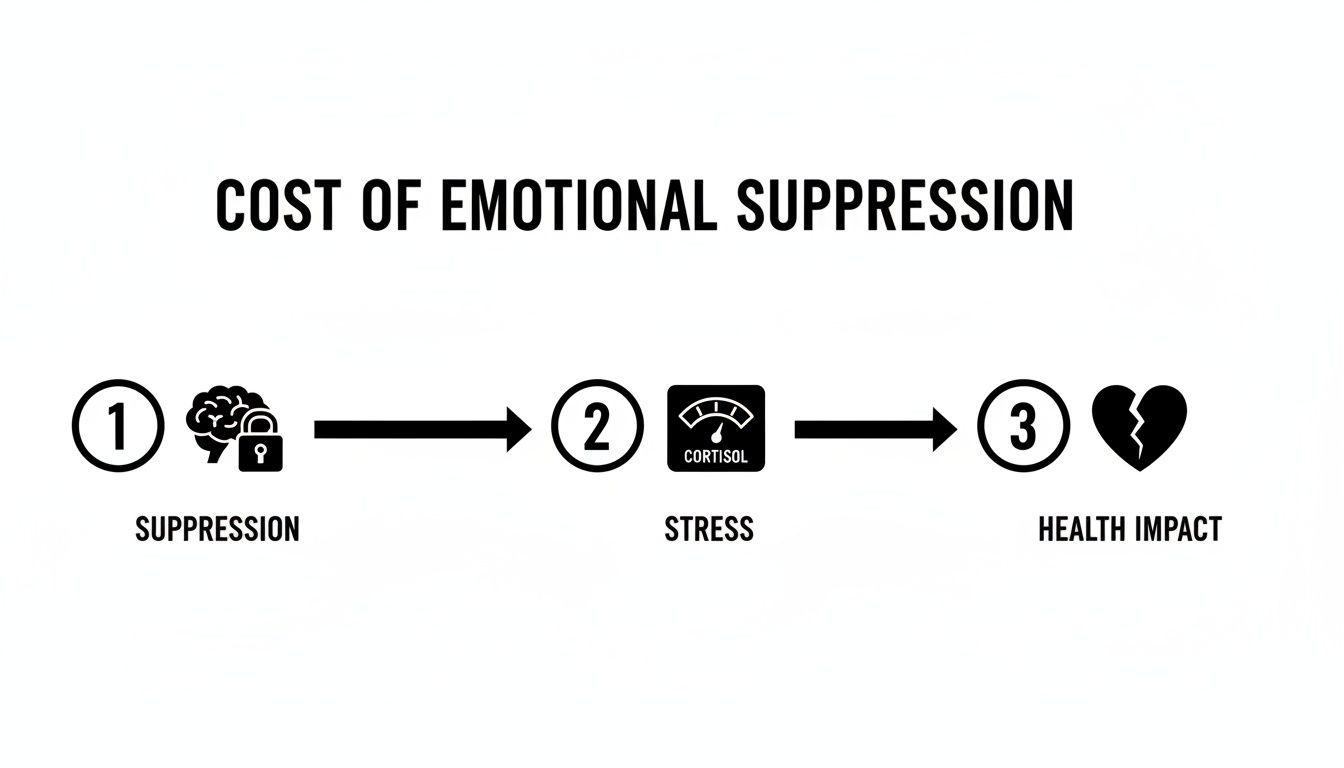
As you can see, there’s a direct line from locking your feelings away to creating real, physiological stress in your body. Learning new skills isn’t just about your relationships; it’s vital for your own well-being.
Learn to Communicate Your Needs
One of the biggest hurdles for someone with a dismissive style is asking for space without torpedoing the relationship. You probably worry that saying, “I need time alone,” will sound like, “I don’t care about you,” and you’d rather do anything than deal with the conflict that might follow.
Learning a few simple, clear communication scripts can be a total game-changer. They help you honor your need for independence while also reassuring your partner that you’re not abandoning them.
Key Takeaway: You don’t have to pick between your personal space and your relationship. The goal is to learn how to have both.
Here’s a script you can make your own:
- "I’m feeling a bit overwhelmed and just need some time to myself to process. I really care about you, and I want to be present for this conversation. Can we check back in an hour?"
This little script does three crucial things: it validates your partner, clearly states your need, and gives a concrete time to reconnect. It builds a bridge instead of a wall.
This is all about building a new vocabulary for your relationships—one that includes both connection and autonomy. If you want to dive deeper into these kinds of techniques, our guide on emotional regulation skills for adults has more practical tools you can start using today.
When Professional Support Is Your Next Best Step
While trying to figure things out on your own is a huge first step, sometimes you need a guide to help you find your way out of the woods. If you have a dismissive attachment style, the very idea of asking for help can feel completely foreign—even wrong. But it's often the bravest and most effective step you can take.
Healing doesn’t have to be a solo mission.
Trying to change these deep, ingrained patterns all by yourself can feel like trying to see your own blind spots. You might find yourself stuck in the same painful relationship cycles or battling a quiet, persistent loneliness, no matter how hard you try to break free.
These are all signs that it’s time to bring in some professional support.
Why An Attachment-Focused Approach Is A Game-Changer
Working with someone who specializes in attachment isn't just about talking through your past. It’s about getting to experience what a safe, co-regulating relationship actually feels like—a space where you can practice being vulnerable without the constant fear of being judged, crowded, or dismissed. This is where the real work, the real healing, begins.
For many people with a dismissive style, traditional talk therapy can sometimes just feed the habit of intellectualizing feelings instead of actually feeling them. That’s why body-based and trauma-informed methods, like the ones we use at Securely Loved, are often so much more effective. They work directly with your nervous system to build a foundation of safety from the inside out. For a deeper, lasting shift, understanding approaches like transformational coaching can also be a powerful tool for personal growth.
The goal of professional support isn’t to force you into closeness; it’s to help you build the internal security needed to make connection feel like a choice, not a threat.
If you’re ready to move beyond just surviving and start building relationships where you feel both safe and truly seen, getting the right guidance can make all the difference. Our guide on attachment therapy for adults explains this process in a lot more detail.
If you recognize yourself in these patterns and feel like you’re ready for a real change, we invite you to book a free, private connection call. It's a completely no-pressure space to talk about your goals and see if our approach feels like the right fit for you.
A Few Common Questions, Answered
Can Someone with a Dismissive Attachment Style Actually Fall in Love?
Absolutely. People with a dismissive attachment style feel love and want connection just as deeply as anyone else. The real challenge isn’t about their capacity to love—it’s about the overwhelming fear of vulnerability that comes hand-in-hand with true intimacy.
For them, falling in love can feel like a threat. The closeness and dependency that a loving relationship requires can trigger their most deeply ingrained protective strategies. This is why they might pull away, not because they don't have feelings, but because their nervous system is screaming that this level of closeness jeopardizes the independence they've always relied on for safety.
Am I the Reason My Partner Is Dismissive?
Let me be very clear: no, you are not to blame. Your partner's attachment pattern was wired into their nervous system based on their earliest life experiences, long before you ever came into the picture.
While certain dynamics in your relationship can definitely trigger their defensive behaviors—like shutting down or creating distance—you did not create the underlying wound. The most powerful thing you can do is shift the focus from trying to "fix" them to understanding your own attachment needs. From there, you can learn to communicate those needs clearly and create a safe harbor for connection to grow.
A Gentle Reminder: You can't do the work for your partner. Your role is to create a secure environment by modeling healthy communication and firm, loving boundaries. This empowers both of you to show up differently.
How Long Does It Take to Heal a Dismissive Attachment Style?
Healing is a profoundly personal journey, and there’s no finish line or universal timeline. The process is really about carving out new neural pathways in the brain—pathways that learn to associate connection with safety instead of threat.
With consistent and compassionate effort, practicing self-regulation and trying out new ways of relating can bring noticeable shifts pretty quickly. You might start responding differently in moments that used to trigger you. But deep, lasting change takes time, patience, and a whole lot of self-compassion. The goal here is steady progress, not overnight perfection. Partnering with an attachment-focused specialist can provide the guidance and support to make that journey feel much less overwhelming.
At Securely Loved, this is the exact work we do. We specialize in guiding people out of painful patterns of emotional distancing and into the secure, deeply connected relationships they've always deserved.
If you're ready to take that first step, we're here to walk alongside you.
Book your free, private 15-minute connection call today and let's explore how we can help you create lasting change.