

Limitations of Cognitive Behavioral Therapy and What to Do Next
While CBT is often talked about as the “gold standard” in therapy, one of its biggest secrets is that it just doesn't work for everyone. If you’ve ever felt like you were failing at therapy, especially after hearing how effective CBT is supposed to be, you are not alone. For many people, particularly those with deep-seated relational wounds or developmental trauma, an approach focused only on thoughts can feel like it’s just scratching the surface, leaving them stuck and wondering why they didn’t get the lasting relief they were promised.
Why CBT Isn't Always the Whole Answer
Cognitive Behavioral Therapy (CBT) is often the first-line recommendation in mental health for a reason. Its premise is clear and straightforward: if you can identify and change your unhelpful thought patterns, you can change how you feel and what you do. It’s almost like trying to install a software update on your logical mind to debug faulty code.
And for some, this is incredibly effective. But if you’ve diligently filled out thought records, challenged every cognitive distortion you could find, and still feel like you’re spinning your wheels, there's a good reason for it. A major limitation of CBT is its intense focus on the mind’s “software” while often completely missing the "hardware"—your body’s nervous system, your earliest attachment patterns, and the trauma stored physically within you.
The Numbers Don't Lie
Even though CBT is one of the most studied therapies out there, a closer look at the research tells a more complicated story. The data shows its effectiveness is far from a sure thing.
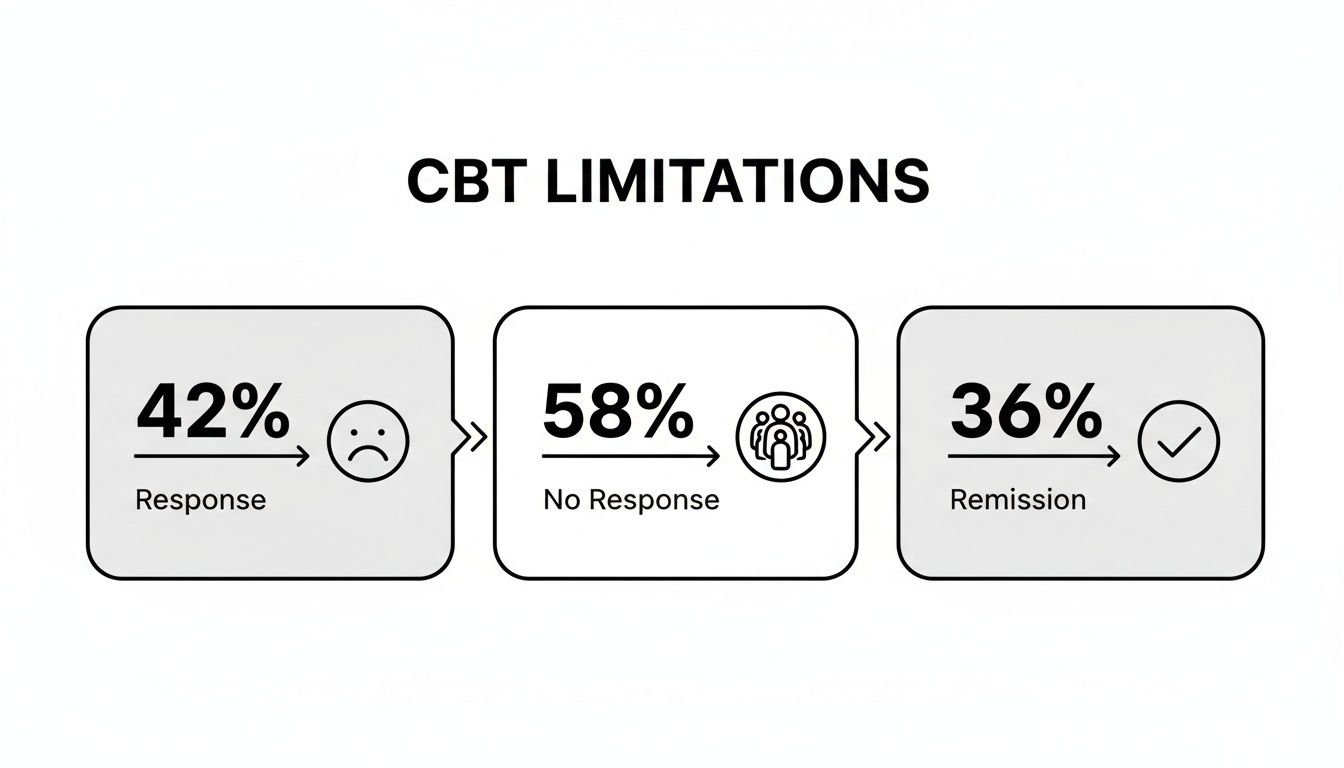
These numbers can feel a bit jarring, but they are so important. They show that for many, CBT alone isn't enough to create deep, meaningful change.
A massive meta-analysis of CBT success rates covering over 52,000 patients revealed that only 42% of people receiving CBT actually respond to it. That means nearly six out of ten people don't see a significant improvement.
The numbers for a full recovery are even more telling.
The same research shows that only 36% of patients achieve full remission of their symptoms. This isn't a personal failure. It’s a clear sign that the tool might not be the right fit for the job.
Let's look at that data side-by-side to really understand what it means.
CBT Effectiveness at a Glance
This table breaks down the overall success rates of CBT based on large-scale research, giving a quick, data-informed snapshot of its limitations.
| Metric | CBT Group | Control Group | Implication for Healing |
|---|---|---|---|
| Response Rate | 42% | N/A | A majority (58%) do not experience a significant reduction in symptoms. |
| Remission Rate | 36% | N/A | Nearly two-thirds do not fully recover or become symptom-free. |
Seeing these statistics laid out so clearly highlights that if CBT didn't "work" for you, you're actually in the majority. This gap often points to something much deeper going on.
Lasting healing often requires more than just changing your thoughts, especially if your struggles are rooted in:
- Attachment Wounds: The early life experiences that wired your brain for connection and shaped your internal sense of safety (or lack thereof).
- Nervous System Dysregulation: A body that is stuck on high alert (fight-or-flight) or in a state of shutdown and collapse (freeze).
- Somatic Memory: Stress and trauma that get physically stored in the body, showing up as chronic tension, pain, or other unexplained physical symptoms.
If traditional talk therapy hasn't brought you the deep healing you're searching for, it’s a powerful signal. It’s your system’s way of telling you that it needs an approach that goes beyond just the mind and learns to speak the language of the body.
When the Problem Is in Your Body, Not Just Your Mind
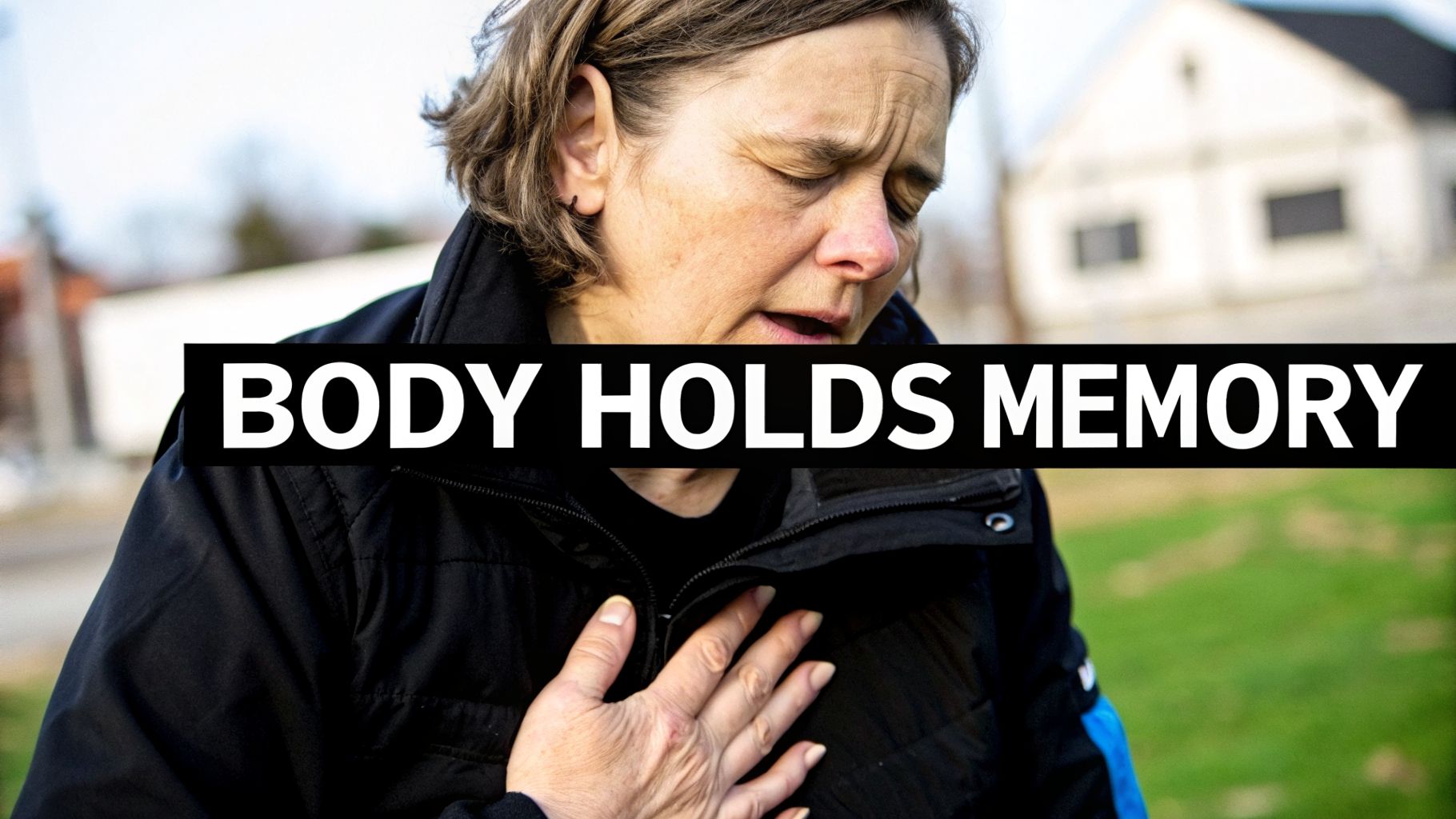
Here's one of the biggest gaps in cognitive behavioral therapy: it focuses almost entirely on your thoughts, often leaving your body’s experience out of the conversation. It’s a bit like trying to fix a sputtering car engine by just polishing the dashboard. It might look a little better on the surface, but the real issue is still humming away underneath.
For so many people I work with, especially those wrestling with chronic anxiety, panic, or the long shadow of trauma, the problem isn’t just a "thinking error." It’s a dysregulated nervous system that's screaming for help. Our bodies hold on to our histories, creating a deep physical memory that logic alone can’t touch.
This is exactly why you can know, with every ounce of your intellect, that you are safe—but still feel a tidal wave of panic wash over you. Your thinking mind might be on board, but your body is running a completely different program, one that’s still wired for threat and survival.
Your Body Holds the Score
The idea that “the body holds the score” isn’t just a pretty phrase; it’s a physiological reality. Your nervous system is the hardware that runs your emotional software. When that hardware gets stuck in overdrive from past stress or trauma, no amount of positive self-talk will fully silence the alarm bells.
Imagine your logical brain is the captain of a ship, giving calm, clear orders. But your nervous system is the terrified crew in the engine room, frantically pulling levers because they still see an iceberg that melted years ago. The captain’s reassurances of "We're safe now!" are completely drowned out by the chaos below deck.
This disconnect shows up in physical ways that CBT often struggles to address:
- That persistent knot in your stomach before a social gathering, even when you tell yourself it’s going to be fine.
- Chronic tension in your shoulders and jaw that won't release, no matter how much you try to "think" yourself into relaxing.
- A racing heart that kicks in during a simple work presentation, even though you know you’re completely prepared.
- That frozen or numb feeling when conflict arises, even if you’ve rehearsed exactly what you want to say.
These aren’t just random symptoms. They are powerful signals from your body, telling you that your nervous system is stuck in a state of fight, flight, or freeze. This is your body’s "felt sense" of danger, and it operates much faster and more powerfully than conscious thought.
The Limits of Logic on a Dysregulated System
This is where another one of CBT's core limitations becomes crystal clear. The therapy is built on a powerful premise: changing your thoughts will change your feelings. But when your nervous system is dysregulated, your feelings are being generated by deep-seated survival physiology, not just your thoughts about a situation.
You simply can't talk your body out of a state it learned to adopt to protect you. For example, a client of mine could logically understand their fear of abandonment was irrational, yet their body still flooded with the raw terror of a child left alone every time their partner was late coming home. CBT helped manage the anxious thoughts that followed that feeling, but it couldn’t reach the primal fear held in the body itself.
Your body is not a passive container for your mind; it is an active participant in your emotional life. When therapy only addresses what you think and ignores what you physically feel, it leaves a huge piece of the healing puzzle unsolved.
This gap is especially true for anyone with a history of trauma, where the body's memory of an event is often far more potent than the story we tell about it. For issues rooted this deeply in our physical experience, healing requires more than just cognitive tweaks. For these deeply held patterns, other approaches are essential. Techniques designed for moving trauma through the body, for example, offer a way to heal that goes beyond just talking. They focus on helping the body finally complete its stress responses and release stored survival energy—something talk therapy on its own can't always do.
How CBT Overlooks Deep Attachment Wounds

We've talked about how CBT can sometimes miss the body’s wisdom, but there’s another huge piece of the puzzle it often overlooks: deep attachment wounds. If you feel like you’re stuck in the same painful, repeating relationship patterns, this might be the very reason why simply trying to change your thoughts hasn't been enough.
Here's the thing: attachment patterns aren't just "bad habits" or a list of negative thoughts you can reframe. They are the deeply ingrained blueprints for connection that got wired into your nervous system from your very first relationships with caregivers. These patterns are what drive your instincts around connection, intimacy, and how you react to feeling abandoned or rejected.
The Grammar of Your Emotional World
I like to use an analogy here. Think of CBT as a tool that teaches you new vocabulary. It's incredibly useful for giving you different words to describe your experiences and helping you build a more positive inner monologue.
But attachment-focused work? That helps you understand the entire emotional grammar you learned as a kid. This grammar is the unconscious rulebook that dictates how you build your relational "sentences" and read the emotional cues you get from others. A deeper understanding of how Attachment Theory shapes these patterns can show us why CBT’s focus on thoughts might not get to the root of the problem.
You can learn all the positive words in the world, but if your underlying grammar is wired for fear, you'll still end up constructing sentences of anxiety and disconnection.
When Logic Fails to Soothe Primal Fears
Let’s look at a real-world example I see all the time. Imagine someone with an anxious attachment style, which often comes from having a caregiver whose love and attention felt inconsistent or unreliable.
As an adult, this person might be in a loving, committed relationship. Using their CBT tools, they can logically list all the reasons their partner is trustworthy. They can challenge the "cognitive distortion" that their partner is going to leave them.
But when a text goes unanswered for a few hours, their body doesn't listen to that logic. A primal panic floods their system. Their heart races, their stomach clenches, and their mind spins with catastrophic thoughts of being abandoned. This isn't just a thinking error; it’s an attachment wound getting poked.
This physical and emotional reaction is the voice of a younger part of you, a part that learned early on that disconnection is dangerous. CBT tools often fail to soothe these primal fears because they aren't originating from a logical error but from a deeply held bodily memory of potential abandonment.
This is a classic example of where the limitations of cognitive behavioral therapy show up when dealing with attachment trauma. The problem isn’t a lack of logic; it's a dysregulated nervous system running a script that was written a long, long time ago.
To truly heal these wounds, the work has to go deeper than the thinking mind. It needs experiential approaches that work directly with the emotional and physical states tied to your attachment patterns. This kind of work helps you build a new, secure foundation from the inside out.
- It builds internal safety: Instead of just telling yourself you're safe, you learn to actually feel safe in your own body, even when you're alone or things feel uncertain.
- It rewires the core relational template: Through a safe therapeutic relationship, you get to have a new experience of connection—one that is consistent, attuned, and reliable. This new experience starts to update the old, painful blueprint.
- It processes stored emotional pain: It creates the space to gently touch on and release the grief, fear, and anger from past relational hurts that are still stuck in your body.
If you recognize these patterns in yourself, it may be a sign that you need more than just cognitive strategies. You might benefit from learning how to specifically address these early wounds through trauma therapy for adults to finally break free from those repeating cycles.
Practical Barriers: When CBT Meets Real Life
Beyond the big-picture gaps around the body and our attachment needs, many people find that CBT just doesn't work in the real world. These challenges often have nothing to do with how much you want to heal and everything to do with the therapy's rigid structure crashing into the messy reality of your life.
If you’ve ever felt like you failed at CBT, I want you to hear this: it probably wasn't you. It may simply have been a poor fit for your circumstances.
The Homework Dilemma
One of the most common hurdles is the heavy focus on homework and structured exercises. CBT often asks you to fill out thought records, schedule activities, and practice new behaviors. While these tools can be powerful, they demand a ton of mental energy, time, and consistency—three things that are often in short supply when you're already overwhelmed.
Imagine you're a single parent juggling work and kids, already running on fumes. The idea of completing a detailed thought log every night can feel less like a lifeline and more like another exhausting chore. The pressure to "do the homework right" can even create a whole new layer of anxiety and a feeling of failure if you can't keep up.
For someone in a deep depressive episode, just getting out of bed can feel like climbing a mountain. In that state, the cognitive demands of CBT can feel completely impossible. It creates a painful catch-22: you need the energy to do the work that’s supposed to give you more energy.
When your nervous system is dysregulated or stuck in survival mode, your brain's capacity for planning, organizing, and self-monitoring is severely limited. Asking someone in that state to engage in complex cognitive exercises is like asking someone with a broken leg to start a running program.
When "Reframing" Just Feels Like Gaslighting
Another practical limitation of cognitive behavioral therapy is its intense focus on the individual. The core idea is that changing your internal thoughts will make you feel better. But what happens when the source of your pain is external, systemic, and very, very real?
This is where CBT can start to feel incredibly invalidating. Let’s look at a few examples:
- Systemic Issues: A person of color is feeling anxious because of ongoing microaggressions and systemic racism. Their fear isn't a "cognitive distortion"; it's a completely realistic response to a legitimate threat. Being told to simply "reframe" those thoughts can feel like a form of gaslighting, one that ignores the genuine injustice of their environment.
- Chronic Stress & Burnout: A caregiver for a chronically ill parent is dealing with total exhaustion and burnout. Their distress isn't caused by negative thinking patterns but by the relentless, real-world demands of their situation. There’s no thought they can change to magically create more time in the day or more energy in their body.
In these situations, the problem isn’t the person’s mindset; it's their environment. While CBT might offer some coping skills for the emotional fallout, it completely misses the root of the problem. This mismatch can leave you feeling like your very real struggles are being dismissed as simple thinking errors, which is not only invalidating but can seriously get in the way of true healing.
Signs CBT Might Not Be Enough for You
So, you’ve been showing up to therapy, doing the worksheets, and challenging your thoughts. You’re doing everything you’re “supposed” to do. But if you’re being really honest with yourself, you still feel stuck.
This isn’t about CBT failing or you doing something wrong. It’s about recognizing when the tool you’re using might not be the right one for the job. Sometimes, the clues aren't loud alarm bells; they're quiet, nagging feelings that something deeper is being missed. If you’ve diligently worked through CBT but still feel like something is fundamentally “off,” that’s a powerful signal. Your experience is valid, and it might be pointing you toward a different kind of healing work.
You Understand It Logically, but Your Body Has a Different Opinion
This is one of the biggest signs I see in my practice. You can talk yourself through the logic perfectly. You know, intellectually, that your fear is irrational or that you are safe now. You can list all the reasons why you shouldn't be anxious.
And yet… your heart still hammers in your chest. Your stomach is in knots, and a wave of panic washes over you anyway. This is a classic disconnect between your thinking mind and your body's survival responses. It’s a telltale sign that the issue isn't just a "thinking error" but a deeply wired, physiological pattern in your nervous system. Your body is running a program that logic alone simply can’t shut down.
Your Relationships Feel Like a Broken Record
Do you find yourself caught in the same painful relationship dynamics, over and over again? Maybe you keep attracting partners who are emotionally unavailable, or you find yourself reacting with intense panic or shutting down completely the second you feel a hint of disconnection.
Even if you use CBT to challenge your thoughts about the situation, the pattern repeats. This is often a blazing sign of an unresolved attachment wound. These aren't just bad habits; they are primal survival strategies wired into you from your earliest experiences with caregivers. No amount of thought-reframing can soothe the terrified inner part of you that learned love was unsafe or that you had to earn it.
When you find yourself replaying the same relational script despite intellectually wanting a different outcome, it’s a clear signal that the healing needs to happen at the attachment level, not just the cognitive one.
You’ve Become an Expert at Analyzing Your Feelings, Not Feeling Them
Have you gotten really good at dissecting your own emotions? You can label them, trace them back to a specific thought, and pinpoint the cognitive distortion like a pro. The problem is, you feel like you're watching your life from the outside, living in your head instead of your heart.
This is a subtle but incredibly important sign. It suggests you’ve learned to use your intellect as a shield against the vulnerability of actually feeling. You might even feel a persistent sense of numbness or emptiness, even when good things happen. True, lasting healing involves learning how to safely feel and move through emotions in your body, not just analyzing them from a distance.
To put it simply, standard CBT and deeper, body-based therapies are targeting completely different things. This table breaks down the core differences in their approach.
CBT vs. Attachment-Informed Therapy: A Comparison
| Therapeutic Focus | Standard CBT | Attachment-Informed & Somatic Therapy |
|---|---|---|
| Primary Target | Negative thoughts and behaviors | Nervous system dysregulation and attachment patterns |
| Main Goal | Changing cognitive distortions | Building internal safety and rewiring relational templates |
| View of the Body | A source of symptoms to manage | A source of wisdom and a gateway to healing |
| Approach to Emotion | Analyzing and reframing | Feeling and processing emotions in a safe context |
If these signs are hitting close to home, please hear this: it’s not a failure. It’s simply an invitation to go deeper and find the path that can meet you where you truly are.
If you’ve been reading along and nodding, seeing your own story in the limits of CBT, you might be feeling a mix of relief and maybe a little bit of dread. I want you to hear this loud and clear: feeling stuck after trying CBT isn’t a dead end. It’s actually an invitation to go deeper.
It's the first step toward a kind of healing that actually lasts—one that honors your whole experience. This is where we shift from just managing thoughts to fundamentally rewiring your internal sense of safety. It's about moving from intellectual ideas to real, felt change in your body.
Learning Your Body's Language
So often, real healing starts when we turn our attention inward, away from the constant chatter in our heads and toward the quiet wisdom of our bodies. This is exactly why approaches like trauma-informed care and nervous system regulation are so essential. They work on a simple, but profound, principle: your body holds the map to your healing.
Think of it this way: you’ve been trying to reason with your nervous system using logic, a language it doesn't really speak. Now it's time to learn its native tongue—the language of sensation.
This doesn't have to be some huge, intimidating practice. It starts small.
- Practice Mindful Check-ins: A few times a day, just pause. Notice one physical sensation in your body without trying to change it. Is your jaw tight? Are your hands warm? Is there a knot in your stomach? Just notice. That's it.
- Introduce Gentle Movement: When you feel that wave of anxiety or overwhelm, try gently shaking out your hands and feet. Or do a slow, deliberate stretch. This helps your body release stored stress energy that just talking can't touch.
- Focus on Your Breath: Put a hand on your belly. Feel it gently rise and fall with each breath. This is a direct, non-verbal way to tell your nervous system, "You're safe right now."
These simple acts start to "rewire" your internal alarm system. They teach it that you can be a safe place for yourself, even when difficult feelings show up. This is the foundation for all the deeper work.
Rewiring Your Relational Blueprint
The other huge piece of the puzzle is directly looking at your attachment patterns. If CBT felt like it barely scratched the surface of your relationship struggles, it's because the real issue wasn't just your thoughts—it was your entire relational blueprint. This is where attachment-focused therapy comes in.
This kind of therapy helps you finally understand why you react the way you do in relationships. More importantly, it gives you new, felt experiences to build security from the inside out. It's less about analyzing your past and more about feeling safe in the present, often within the therapeutic relationship itself. This is where you can finally give those younger, wounded parts of you the attuned connection they were always missing. For a deeper look at what this involves, our guide on trauma therapy for adults breaks down how this process works.
Sustainable healing isn't about getting rid of all your triggers or negative thoughts. It’s about building a nervous system that’s resilient enough to handle them and creating an internal sense of security so deep that your old patterns no longer run the show.
Actionable First Steps on Your New Path
Feeling like you can actually take the next step is everything. This isn't about starting another overwhelming self-improvement marathon. It's about taking one small, gentle step toward a more whole and integrated kind of healing.
- Find a Specialist: Look for a therapist who specifically mentions things like "attachment-focused," "somatic," or "nervous system regulation" on their website. These are the keywords that tell you they work beyond just the cognitive level.
- Explore Your Attachment Style: Just understanding your own relational patterns is incredibly powerful. There are lots of resources and quizzes online that can give you a starting point for figuring out if you lean anxious, avoidant, or disorganized.
- Start a "Body-First" Practice: Commit to one tiny somatic practice every day. It could be a 5-minute guided meditation that focuses on body sensations, or simply noticing the feeling of your feet on the floor the next time you feel a spike of anxiety.
This journey is a hopeful one. It's a return trip to yourself—to your body, your emotional history, and your built-in capacity for secure, loving connection. This is where the real, lasting change happens.
A Few Common Questions About CBT's Limits
It can feel so confusing when you try a therapy like CBT—one that everyone seems to recommend—and it just doesn't land for you. If you’re feeling a bit lost, let’s clear things up. Here are some straightforward answers to the questions I hear most often.
If CBT Has So Many Limitations, Why Is It Recommended So Often?
This is such an important question. CBT gets recommended frequently because its structured, step-by-step nature makes it easy to study and measure in clinical trials. It’s often short-term, which is a big plus for insurance companies and healthcare systems looking for a clear, predictable process.
But here’s the thing: “well-researched” doesn’t automatically mean “right for you.” The very things that make CBT easy to study—its focus on present-day thoughts and behaviors—are also what create its biggest blind spots. It often misses the deeper, more complex issues rooted in your past, like developmental trauma or attachment wounds, which need a much more relational approach than just managing thoughts.
Can I Combine CBT With Attachment-Focused or Somatic Therapy?
Absolutely. In fact, for deep and lasting healing, an integrated approach is often the most powerful way forward. Think of it like this: you can use CBT skills to stay afloat, like challenging a wave of catastrophic thinking when your anxiety spikes.
At the same time, you can work with an attachment or somatic therapist to heal the underlying nervous system patterns and relational wounds that are causing the waves in the first place. They aren't mutually exclusive; one addresses the symptom, and the other gets to the root.
True healing often involves a "both/and" approach. You can use cognitive tools to stay afloat in the day-to-day while doing the deeper work of learning to swim in the emotional waters of your past.
I Tried CBT and It Didn’t Work for Me. Does This Mean I'm Unfixable?
Not at all. Please hear me when I say this: your experience is incredibly common, and it does not mean you've failed or are beyond help. Honestly, you're in the majority of people for whom CBT isn't the whole answer.
If CBT didn’t give you the relief you were hoping for, it’s not a failure—it's a powerful clue. It’s your system’s way of telling you that the problem isn't just about your current thoughts. It’s a signpost pointing you toward the real source of your struggles, which likely lies deeper in your attachment history and nervous system. See it as valuable information guiding you toward a path that will actually work for you.
At Securely Loved, we specialize in the deeper work that goes beyond surface-level thought management. If you recognize yourself in these limitations and are ready for a path that addresses attachment wounds and regulates your nervous system, we invite you to learn more. Book a free 15-minute connection call to see if our approach is the right fit for you at https://www.securelyloved.com.