
Why Do Breakups Hurt So Much and How Can You Start Healing
If you’ve ever been through a breakup, you know the pain can be so intense it feels physical. It’s not just “in your head,” and you’re definitely not being “too dramatic.” The simple truth is that your brain registers the end of a significant relationship with the same severity as a physical injury.
This isn’t an exaggeration. That feeling of your world shattering is a very real, very primal survival response.
The Real Reason Your Heartbreak Feels So Intense

When a partnership ends, the agony you feel is a biological alarm bell. From an evolutionary standpoint, human connection has always been non-negotiable for our safety and survival. Losing that primary bond signals a major threat to your brain’s core need for attachment, sending your entire system into a state of high alert.
It’s so much more than just a fleeting sadness. It’s a complex storm of neurological, hormonal, and psychological events all happening at once. You feel like your world has imploded because, in a way, it has. The reality you carefully built with your partner—the inside jokes, the shared routines, the future plans—has collapsed.
You’re left to grapple not only with losing a person but also with losing a part of your own identity that was tied to them.
Your Body and Brain on a Breakup
The pain is legitimate and measurable. Functional MRI studies show that the very same brain regions that light up when you experience physical pain are activated during a romantic rejection. This is exactly why a broken heart can genuinely feel like a physical wound. Your mind and body are completely intertwined in this process, creating a powerful, full-body experience of loss.
To really get why your breakup feels so all-consuming, it helps to see the different forces at play. It isn't just one thing, but a combination of powerful factors that create such intense distress.
The pain of a breakup is not a failure on your part. It is the sound of your attachment system doing exactly what it was designed to do—signal an emergency when a primary bond is severed.
We can break down this overwhelming experience into four key areas. Recognizing these distinct pillars is the first step toward understanding what’s happening inside of you and, eventually, finding a clear path toward healing.
Let’s look at what’s really going on under the surface.
The Four Pillars of Breakup Pain
| The Scientific Reason | What This Feels Like For You |
|---|---|
| Brain Chemistry Withdrawal | Obsessive thoughts about your ex, an intense craving to reconnect, and a general feeling of emptiness or depression. |
| Attachment System Distress | A deep sense of panic, abandonment, or profound loneliness; it feels like your fundamental safety is threatened. |
| Identity Disruption | Feeling lost and unsure of who you are without your partner; questioning your worth, future, and purpose. |
| Nervous System Dysregulation | Physical symptoms like exhaustion, anxiety, trouble sleeping, an upset stomach, or feeling constantly on edge. |
Each of these pillars contributes to the unique and profound pain of heartbreak. By understanding them, you can start to see your experience not as a sign of weakness, but as a normal human response to a significant loss.
Your Brain in Withdrawal: The Science of a Broken Heart
Have you ever found yourself completely unable to stop thinking about your ex, almost to the point of obsession? Do you feel a raw, gut-wrenching craving to call them, even when every logical part of you is screaming not to? This isn't a sign that you're weak or "crazy"—it's a sign that you're in withdrawal. To really understand why breakups hurt so much, we have to look at the powerful chemical storm happening inside your brain.
During a happy, connected relationship, your brain swims in a delicious cocktail of feel-good chemicals. The two big players are dopamine, the "reward" chemical tied to pleasure and motivation, and oxytocin, the "bonding hormone" that makes us feel attached and trusting. Together, they create a powerful neurological sense of safety, deep connection, and joy.
When that relationship ends, it’s like someone turns off the chemical spigot. Your brain, which had gotten used to this constant, comforting flow, is suddenly thrown into a state of intense deficit. The result is a withdrawal that feels shockingly similar to what happens when someone quits an addictive substance. And this isn't just a metaphor—brain imaging studies prove it. The craving you feel for your ex lights up the exact same parts of the brain as a craving for a drug.
The Alarm Bells Are Ringing
As your brain desperately scrambles for its lost dopamine and oxytocin fix, another part of your emotional center goes into total overdrive: the amygdala. You can think of your amygdala as your brain's primal alarm system or smoke detector. Its one and only job is to scan for threats and keep you safe.
From an evolutionary standpoint, being bonded to a partner meant survival. Being cast out of the tribe or losing your mate was a literal life-or-death emergency. So, when your primary attachment figure is suddenly gone, your amygdala pulls the fire alarm, flooding your body with stress hormones like cortisol and adrenaline.
This biological panic is exactly why you feel so anxious, on edge, and completely unable to relax. Your body has been thrown into fight-or-flight mode, convinced it’s in mortal danger even when you’re physically safe in your own home. It’s a primal feature, not a personal flaw.
This neurological state is what creates that cascade of painful, all-consuming experiences so common after a breakup:
- Obsessive Thoughts: Your brain's reward system is frantically trying to get its next hit of dopamine, which it learned to associate with your ex. This is what drives those relentless, looping thoughts—replaying memories, dissecting what you could have done differently, and fantasizing about getting them back.
- Intense Cravings: That powerful urge to see them, hear their voice, or just check their social media is your brain trying to get back to the source of its former comfort and pleasure.
- Physical Pain: Research shows that the brain regions that activate during physical pain also light up during social rejection. That feeling of a "broken heart" isn't just in your head; your brain is processing it as genuine pain.
- Heightened Anxiety: With your amygdala on high alert 24/7, you might experience panic attacks, sleepless nights, and a constant, humming feeling of dread in your chest.
Understanding this process is the first, most crucial step toward feeling like you have some control again. Your brain isn't broken; it's reacting exactly the way it's wired to. But when those obsessive thoughts become completely overwhelming, it’s critical to have strategies to break the cycle. For anyone who feels stuck in that loop, you can learn more about how to stop thinking about your ex in our detailed guide.
Reclaiming Your Brain
Simply knowing that your brain is in a state of withdrawal can be incredibly validating. It explains why "just getting over it" is a useless and frustrating piece of advice. The intense, chaotic emotions you're feeling are rooted in deep biological and evolutionary drives for connection. You’re not failing; you’re human.
The good news? Your brain is also incredibly resilient. Just as it adapted to being in a relationship, it can and will adapt to being without one. The healing process is all about teaching your brain that you are safe now and creating new, healthy sources of dopamine and self-regulation that don't depend on your former partner. This is where nervous system regulation and self-soothing become your most important tools.
When you recognize the science behind your pain, you can start to shift from feeling like a victim of your emotions to an informed participant in your own recovery. You can begin to see the cravings and anxieties not as a sign that you need your ex back, but as a signal that your brain needs care, patience, and new ways to feel good again.
How Your Attachment Style Dictates Your Breakup Pain
While withdrawal explains the universal chemical storm of a breakup, it doesn’t quite get to the heart of why some people seem to navigate it so differently. Have you ever looked at a friend who bounced back in a few months and wondered, “What’s wrong with me?” as you’re still completely shattered a year later?
The answer, almost always, comes down to your attachment style.
Think of your attachment style as the internal blueprint you carry for connection, safety, and relationships. It was formed in your earliest years through your experiences with caregivers, and it now dictates how you instinctively respond to love, intimacy, and—most importantly—loss. This isn’t about blaming your past; it’s about understanding the survival strategies you learned to get your most fundamental needs met.
This simple visual shows the painful progression your brain goes through when a relationship ends, and how your specific attachment patterns filter that experience.
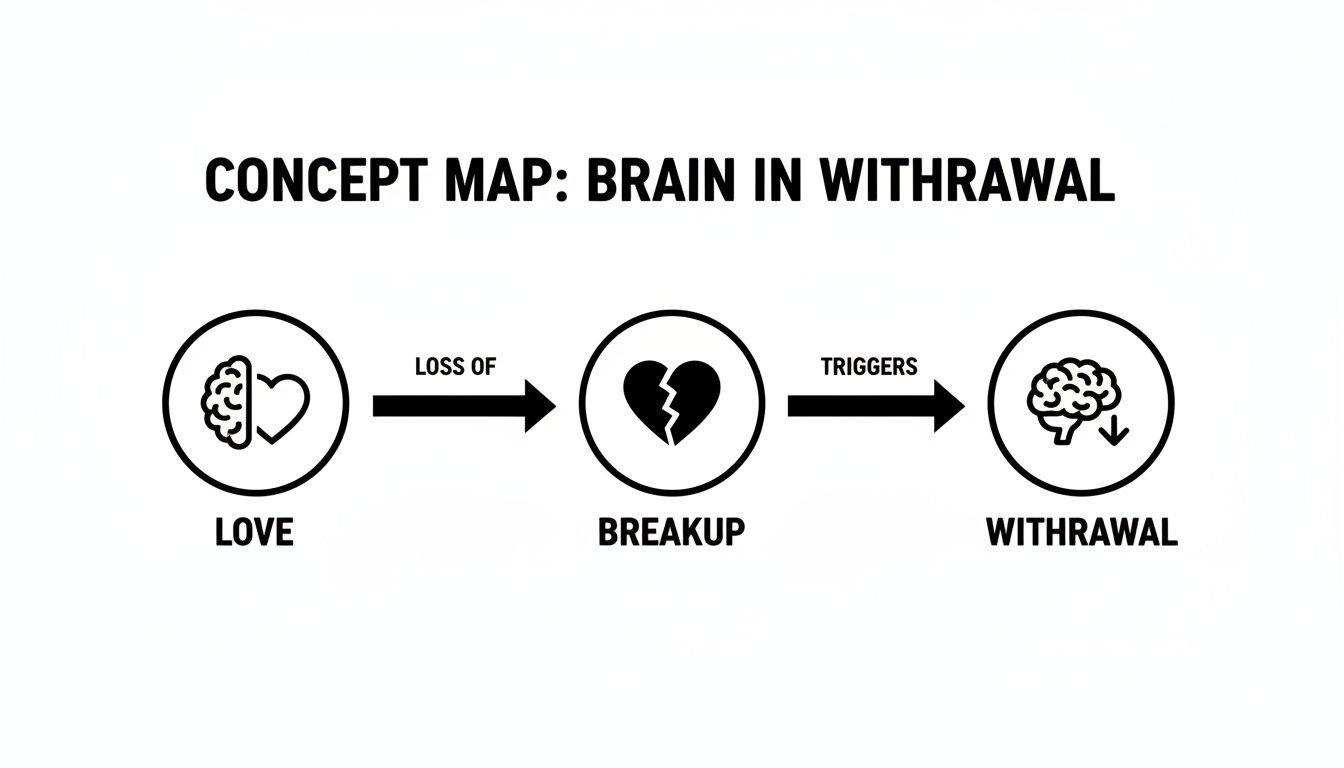
When you lose that love, your brain goes into withdrawal. But how you experience that withdrawal is entirely shaped by your attachment wiring. Knowing your style is the key to finally understanding your specific brand of breakup pain.
Anxious Attachment: The Fear of Abandonment Realized
If you have an anxious attachment style, a breakup isn't just a loss—it’s the brutal confirmation of your deepest fear: that you aren’t enough and will always be abandoned. Your entire nervous system is wired to seek closeness and reassurance to feel safe. When that person is suddenly gone, it triggers an overwhelming, primal panic.
This isn’t just sadness; it feels like an existential threat. You might find yourself trapped in a desperate cycle of calling, texting, and checking their social media. Each attempt is a frantic bid to close that gap and quiet the terrifying feeling of being left utterly alone.
For someone with an anxious attachment, a breakup activates a core wound that says, "I knew it. Everyone always leaves." This belief sends the nervous system into a state of high alert, making it nearly impossible to self-soothe.
Avoidant Attachment: The Fear of Failure and Suffocation
For those with an avoidant attachment style, the pain of a breakup often looks different on the surface but is just as intense underneath. Your survival strategy was to become fiercely self-reliant, having learned early on that needing someone else felt dangerous or like a setup for disappointment.
A real-world example is the person who seems completely fine post-breakup, immediately diving headfirst into work or new hobbies. They might even express relief. But this is often followed by a delayed tsunami of grief and shame. The full weight of the loss crushes them months later when the numbness finally wears off and they’re alone with their feelings.
Disorganized Attachment: The Chaos of Fear and Longing
A disorganized attachment style, sometimes called fearful-avoidant, is by far the most complex. It’s a painful, chaotic mix of both anxious and avoidant patterns. You desperately crave intimacy but are also deeply terrified of it, often because your early experiences with connection were unpredictable, confusing, or frightening.
A breakup throws you into an internal war. One moment, you’re desperate to get your ex back (your anxious side taking over). The next, you’re pushing them away, convinced they are the source of all your pain (your avoidant side activating). A relatable example is sending a long, pleading text, only to block their number an hour later in a wave of fear and self-protection. This exhausting push-pull is exactly why breakups hurt so much when this style is running the show.
Secure Attachment: A Model for Healing
Let me be clear: people with a secure attachment style are not immune to pain. They grieve, they hurt, and they miss their partner deeply. The critical difference is their unshakable, underlying belief that they are worthy of love and capable of handling distress.
They can hold both truths at once: "This hurts more than anything," and "I will be okay." They’re more able to lean on their support systems, self-soothe in healthy ways, and trust that the pain will pass without it completely destroying their sense of self. They provide a powerful model for what is possible for all of us. To go deeper into how your personal history shapes your experience of loss, I recommend reading about Understanding Attachment Styles in Relationships.
The most important thing to remember is that an insecure attachment style is a learned strategy, not a life sentence. Once you identify your pattern, you can finally understand the "why" behind your pain and start learning the tools to build the internal security you’ve always deserved.
Curious about your own pattern? Discovering your personal blueprint is the first step toward breaking the cycle. You can get personalized, valuable insight by taking the free Securely Loved attachment style quiz.
The Hidden Stressors That Make a Breakup So Much Harder
A breakup is never just a breakup. The pain doesn't happen in a neat little box, separate from the rest of your life. While the core of heartbreak is universal, other life stressors can pile on, turning an already difficult experience into something that feels completely unbearable.
It’s easy to feel like you’re failing or not "strong enough" to handle it, but what’s often overlooked are the external pressures and internal beliefs that are fanning the flames. These aren't just minor details; they are huge factors that can make your healing journey feel impossibly steep.
When Your Life Stage and Heartbreak Collide
A breakup in your 20s hits differently than one in your 40s or 50s. For instance, I often work with women navigating a split during perimenopause or menopause, and it can feel like a truly overwhelming emotional tsunami. Their bodies are already dealing with hormonal shifts that trigger anxiety, mood swings, and sleep issues. When you drop the intense stress of a breakup on top of that, your nervous system's ability to cope is stretched to its absolute limit. It’s not that you’re “weak”—your system is literally fighting a war on two fronts.
The same is true for anyone dealing with other major life pressures alongside a split:
- Career Demands: Trying to show up for a huge presentation at work when you can barely stop crying in the bathroom.
- Financial Stress: The raw fear of having to move or manage bills alone on top of the emotional loss.
- Caring for Others: Being a parent and feeling like you have to hold it all together for your kids, with zero space to grieve.
These things deplete your resilience and make the pain of the breakup that much more intense.
The High-Achiever’s Collapse
For many high-functioning and successful people, a relationship isn't just a relationship—it's another area of life to succeed in. If you've built your identity around being competent and getting things right, the “failure” of a relationship can feel absolutely catastrophic. It doesn’t just hurt your heart; it can shake the very foundation of your self-worth.
You might find yourself caught in the loop of, "How can I run a company but be so bad at love?" This question shows just how tangled the relationship was with your core sense of accomplishment.
The end of the partnership is no longer just a heartbreak. It’s perceived as a deep, personal failure that threatens to invalidate all of your other successes. This creates a crushing and often isolating pressure, making it so hard to grieve without drowning in self-criticism.
Your Body Really Is Keeping the Score
Do you feel bone-tired no matter how much you rest? Is brain fog making it hard to think straight? Are you suddenly dealing with stomach aches or constant headaches? These are not random symptoms. This is your body screaming for relief.
When your brain registers a threat—like the profound loss of abandonment—your nervous system gets stuck in a state of high alert. This isn't just a feeling; this sustained fight-or-flight response has real, physical consequences.
- Exhaustion: Your body is burning through an incredible amount of energy just to stay on high alert.
- Brain Fog: High levels of the stress hormone cortisol can directly impact your memory and ability to concentrate.
- Digestive Issues: The gut-brain connection is incredibly sensitive to stress, leading to anything from stomach pain and nausea to a total loss of appetite.
Recognizing this powerful mind-body link is a cornerstone of how we approach healing at Securely Loved. That ache in your chest isn't just a metaphor—it's a physiological reality. To truly heal, we have to find ways to calm your body, not just try to reason with your thoughts.
Practical Steps to Calm Your Nervous System and Heal

Knowing why a breakup hurts so much is a relief. It validates the pain. But that knowledge alone isn’t going to stop the 3 a.m. panic or the gut-wrenching urge to check their social media. This is where we have to shift from understanding the ‘why’ to practicing the ‘how’.
To really start healing, you have to learn to speak your body's language. Right now, your nervous system is stuck on high alert, screaming that you’re in danger. Trying to “think” your way out of this primal panic is like trying to reason with a smoke alarm—it doesn’t work. The only way through is by using your body to send safety signals back to your brain, calming the alarm from the inside out.
These aren’t just distractions. These are real, tangible tools to get you out of the passenger seat of your pain and into the driver’s seat of your own healing.
Ground Yourself in This Moment
When your mind is racing with thoughts of your ex, it’s stuck in the past (replaying every memory) or the future (terrified of being alone). Grounding techniques pull your attention, forcefully if needed, back into the present moment. They remind your body that right here, right now, you are actually safe.
Here's a simple but incredibly powerful exercise you can do anywhere, anytime that overwhelming feeling hits:
The 5-4-3-2-1 Grounding Method:
- Notice 5 things you can see: Look around you and name them, either in your head or out loud. “I see the lamp. I see my blue socks. I see the crack in the ceiling, the spine of a book, a dust bunny.” Be specific.
- Notice 4 things you can feel: Bring your focus to the physical sensations on and in your body. “I feel the soft fabric of my sweater. I feel the hard floor under my feet, the cool air on my skin, the tension in my shoulders.”
- Notice 3 things you can hear: Listen. What sounds are in your environment right now? “I hear the hum of the refrigerator. I hear a distant siren. I hear the sound of my own breathing.”
- Notice 2 things you can smell: This might take a moment. Inhale deeply. “I can smell my coffee. I can smell the laundry detergent on my shirt.”
- Notice 1 thing you can taste: What is the lingering taste in your mouth? “I can taste the mint from my toothpaste.”
This simple act breaks the obsessive thought loop. It reorients your entire system to the safety of the here and now.
Use Your Breath to Shut Down Panic
Your breath is the most powerful, immediate tool you have to change how you feel. When you’re anxious, your breathing becomes shallow and quick, which just tells your brain there’s more danger. By consciously slowing your breath down, you can directly turn off your body's fight-or-flight alarm.
Breathing techniques work by stimulating the vagus nerve—the main “brake pedal” for your body’s stress response. A long exhale is a direct command to your body: slow down, you are safe.
Try this technique, known as the physiological sigh. Research shows it's one of the fastest ways to lower stress.
- Take a deep breath in through your nose.
- When your lungs feel full, take another quick, sharp sip of air in on top of that.
- Then, let out one long, slow, complete exhale through your mouth.
- Repeat this 2-3 times. You’ll feel the shift.
The Power of Self-Soothing Touch
When you’re grieving a relationship, you’re also grieving the loss of physical touch, of being held, of co-regulation. Your body literally misses the feeling of being comforted by another person. The good news is, you can start to give this safety to yourself.
A simple but profound exercise is the Butterfly Hug.
- Cross your arms over your chest, placing your hands on your opposite shoulders or upper arms.
- Gently tap your arms, alternating left and right, in a slow, steady rhythm. Think of the flapping of a butterfly's wings.
- Breathe slowly as you do this for a minute or two.
This movement is a form of bilateral stimulation, which helps your brain process overwhelming emotions and make sense of difficult experiences. It’s a way of telling your body, “I am here. I am holding you. You are safe with me.” For more ways to find calm amidst the storm, explore our detailed guide on ways to regulate your nervous system.
The intense emotional rollercoaster of a breakup takes a massive toll on your body, creating more stress that can drag out the healing process. Learning how to manage this physical impact is essential, and you can discover more about how to reduce stress naturally to support your body's recovery.
Every time you use one of these techniques, you are casting a vote for your own stability. You are actively rebuilding a sense of safety within yourself, proving to your brain and body that you can and will be okay, one moment at a time. This is the foundation of becoming securely loved—first and foremost, by yourself.
Knowing When You Need More Than Self-Help
Self-help tools are incredibly powerful, but there are times when the weight of a breakup is just too heavy to carry on your own. It’s so important to know the difference between the deep, necessary grief of heartbreak and being dangerously stuck in a cycle of pain that you can’t get out of.
Knowing when to reach out for professional support isn’t a sign of weakness—it’s an act of profound self-care. It’s you, looking out for you.
Red Flags That Signal You Need More Support
While the emotional intensity of a breakup is completely normal, there are specific red flags that tell you it’s time for more structured support. If several weeks or months have passed and the pain isn’t shifting, take a moment to honestly check in with yourself.
Are you experiencing any of these?
- Inability to function: You’re consistently struggling with the basics, like getting out of bed, showing up for work, or taking care of yourself and your family.
- Persistent hopelessness: The initial shock is gone, but it’s been replaced with a constant feeling of despair. You might have a nagging belief that you’ll never feel happy again.
- No signs of improvement: The pain isn't easing at all. In fact, it might even feel like it’s getting worse, and none of the self-help strategies you’ve tried are even touching the sides.
- Worsening physical symptoms: Your sleep is a mess, you have zero appetite, or you’re living with a constant, unmanageable hum of anxiety in your body.
If these resonate with you, it's a clear signal that the breakup has likely torn open much older, deeper wounds that need specialized attention. This is exactly where a more targeted approach becomes essential for true healing.
How Attachment-Focused Coaching Is Different
Traditional therapy can be incredibly helpful, but I hear from so many people that it doesn't quite get to the primal, body-level distress that a breakup triggers. This is especially true if you feel like the split has unearthed a lifetime of feeling "not good enough" or a deep-seated fear of being abandoned.
This is where Securely Loved offers a different path. Our trauma-informed, attachment-focused coaching is specifically designed for this exact scenario. It's not just about talking about your feelings; it's about getting to the root of why you feel this way by looking at your nervous system and your attachment history.
We focus on the "why" behind your specific pain. Is it an anxious attachment pattern creating panic? Is it an avoidant pattern creating shame and shutdown? When we identify the real source, we can apply targeted strategies that actually work.
Instead of just coping with the pain, we work to heal the underlying patterns that made this breakup so devastating in the first place. We combine nervous system regulation techniques with a deep understanding of attachment science to help you build the internal safety you may have never had.
This approach is for you if you feel like your breakup has revealed deeper issues that other methods just haven't been able to solve.
If you’re tired of feeling stuck and ready to explore a path to genuine healing, I invite you to book a free 15-minute connection call with me, Bev Mitelman. It’s just a simple, no-pressure conversation to see if this kind of dedicated support is the right next step for you.
Your Breakup Recovery Questions, Answered
As you start to move through the initial shock and pain of a breakup, a million questions probably start swirling in your head. It’s completely normal to want a roadmap when you’re navigating such a painful and confusing time. I get these questions all the time in my coaching practice, so let’s get into some of the most common ones.
How Long Does It Really Take to Get Over a Breakup?
I’m going to be honest with you: there’s no magic number. Anyone who gives you a specific timeline is doing you a real disservice. How long it takes to heal comes down to so many things—your attachment history, how the relationship ended, the support system you have around you.
Instead of staring at the calendar, I want you to focus on your progress, no matter how small.
Are the obsessive thoughts a little quieter this week than last week? Were you able to calm your anxiety down a bit faster today than you could last month?
Healing isn’t a linear race to a finish line called "cured." It's a gradual, messy process of building self-trust and internal safety, one small moment at a time. Celebrate the small wins; they are the true markers of your progress.
Should I Try to Be Friends With My Ex?
For anyone with an anxious or disorganized attachment style, trying to be friends with an ex is like trying to quit sugar while working in a candy store. It just keeps that agonizing withdrawal cycle going. More often than not, staying in contact is a disguised attempt to get your attachment needs met, which stops your nervous system from ever truly calming down and resetting.
Think of the no-contact rule not as a punishment, but as a necessary boundary you set for yourself. It gives your brain and body the space they desperately need to detach emotionally. Once you feel genuinely whole and secure on your own, you can think about friendship from a place of real choice—not from a place of desperate need.
What Is the First Step to a Healthier Next Relationship?
The most powerful first step has absolutely nothing to do with finding a “better” partner. It starts and ends with becoming a more secure version of yourself.
This journey begins when you get radically honest about your own attachment patterns and the core wounds they stem from. Then, you start practicing the small self-regulation techniques we talked about in this guide. Each time you soothe your own anxiety instead of reaching for your phone for external validation, you’re laying another brick in the foundation of your own inner security.
This is the work. This is what will ultimately allow you to attract and build the genuinely healthy, lasting partnership you deserve.
At Securely Loved, we specialize in guiding individuals through this exact process—from understanding your attachment patterns to building the inner security that transforms how you experience relationships. If you're ready to break the cycle and cultivate a truly secure love, first with yourself and then with others, visit https://www.securelyloved.com to learn more.