
How to Stop Self Sabotaging Relationships: A Practical Guide
If you're trying to stop self-sabotaging your relationships, the very first step is a mindset shift. It's time to stop telling yourself, "I'm broken" or "I'm just bad at relationships."
Instead, I want you to try on a new perspective: "I am trying to protect myself."
These behaviors aren't character flaws. They're deeply ingrained protective instincts, often running on an old "operating system"—your attachment style—that learned a long time ago that getting close to someone could be dangerous.
Why You Unconsciously Push Love Away
Does this sound familiar? You meet someone amazing. The connection feels real, things are getting closer… and then, right on cue, you start picking fights, pulling away emotionally, or suddenly finding a million little things wrong with them.
This isn't you being difficult. It's a subconscious survival mechanism kicking into high gear.
Deep down, this response is an echo of old wounds. It could be from a gut-wrenching heartbreak or even inconsistent emotional support from your childhood. Whatever the origin, your nervous system learned a powerful lesson: vulnerability can lead to pain. Now, it’s working overtime to "protect" you by keeping you from getting too close to anyone ever again.
The Protective Instinct in Action
I see this all the time in my practice. A client, let's call her Sarah, is a high-achiever who crushes it in her career. But as her new relationship gets more serious, she starts to panic. The closer her partner gets, the more she nitpicks his habits, questions his every move, and creates distance.
On the outside, it looks like she's blowing up a good thing. But internally, her brain is screaming, "This is getting too real! Push him away now before he has a chance to hurt you like the last one did."
It's not a logical choice. It’s an automatic, protective reaction wired into her brain from past experiences.
The key shift is this: Your behavior isn't about destroying love, but about desperately avoiding a pain you've already felt. It's a misguided attempt by your psyche to keep you safe.
This is why shame is so unhelpful here. When you understand the root cause, you can approach the pattern with curiosity instead of judgment.
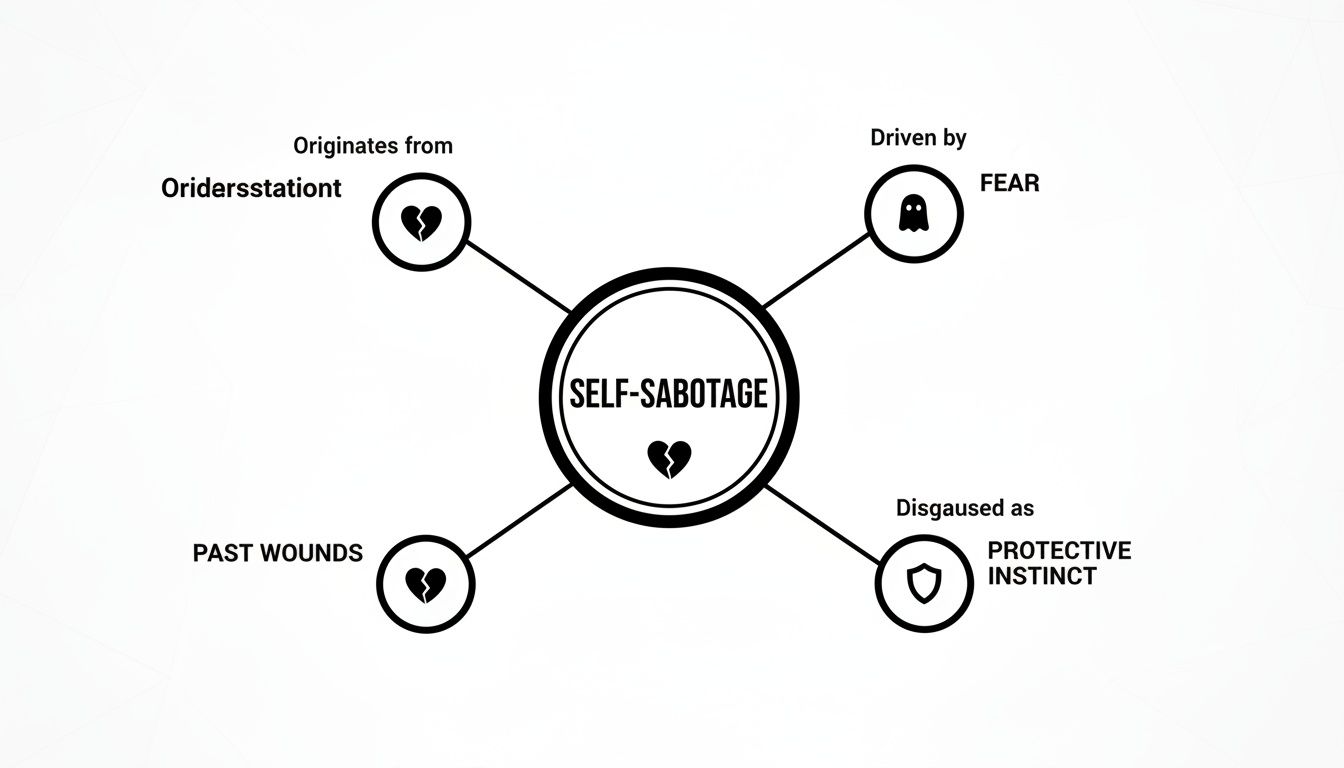
As the visual shows, what we call "sabotage" is really a defense mechanism. It's a shield, not a weapon. Seeing it this way is the first step to putting the shield down.
Fear Is the Driving Force
Research backs this up. A 2019 study looking into self-sabotaging behaviors found that the fear of vulnerability was one of the most powerful triggers. This fear, born from past hurts, leads people to unconsciously create conflict or shut down to avoid the potential pain of being left or rejected.
This often plays out in a confusing push-pull dynamic that leaves both you and your partner feeling drained and confused. You crave closeness, but the moment it arrives, you push it away.
To really stop self-sabotaging, you have to get to know your unique relational blueprint, or what we call your attachment style. Think of it as the programming that dictates your reactions in relationships. Most sabotaging behaviors stem from one of three insecure attachment styles.
Common Sabotaging Behaviors and Their Hidden Fears
I created this table to help you connect the dots between your actions and your deepest fears. See if you recognize yourself in any of these patterns.
| Sabotaging Behavior | What It Looks Like | The Underlying Fear (Often Unconscious) |
|---|---|---|
| Nitpicking/Finding Faults | Constantly criticizing your partner for small things, focusing on their flaws, creating a list of "cons." | "If I find a reason to leave first, they can't surprise me by leaving me." (Fear of Abandonment) |
| Emotional Withdrawal | Shutting down during conflicts, becoming distant, avoiding deep conversations, "stonewalling." | "If I don't let them in, they can't reject the real me." (Fear of Intimacy/Rejection) |
| Picking Fights | Starting arguments over minor issues, provoking your partner, creating drama when things feel calm. | "If things are chaotic, at least it feels familiar. Calm feels unsafe and vulnerable." (Fear of Being Blindsided) |
| Testing the Relationship | Pushing boundaries to see if they'll leave, making ultimatums, creating "tests" for your partner to pass. | "I need to know for sure that you won't abandon me, so I'll push you to your limit." (Fear of Abandonment) |
| Accusatory Behavior | Assuming the worst, accusing them of cheating or lying without evidence, seeking constant reassurance. | "I was hurt before, so I'm expecting you to hurt me too. I need to find the proof." (Fear of Betrayal) |
Recognizing your specific pattern is a huge step. It’s not about blaming yourself; it’s about understanding the "why" so you can finally change the "what."
The three primary insecure styles driving these patterns are:
- Anxious Attachment: You have a deep-seated fear of abandonment and are always searching for reassurance that you won't be left.
- Avoidant Attachment: You fear being engulfed by intimacy and create distance to feel safe and in control.
- Disorganized Attachment: A painful mix of both. You crave connection but are also terrified of it, leading to a confusing "come here, go away" dance.
Once you identify your attachment style, your reactions stop feeling so random. You start to see them for what they are: predictable patterns learned a long, long time ago. This awareness is the most critical first step toward rewriting your story and building the secure, loving partnership you truly deserve.
Tracing Your Sabotage Blueprint to Its Roots
That frustrating cycle of picking fights, finding faults, or pulling away right when things get good? It isn't random. It’s a learned response, and the script was written a long, long time ago. If we want to truly understand how to stop self-sabotaging relationships, we have to look at how your relational "blueprint" was first drafted in childhood.
Think of your early life as a training ground for love. The emotional availability of your caregivers literally taught your nervous system what to expect from intimacy. If their presence was inconsistent or their affection was unpredictable, your young mind learned a powerful lesson: connection is unreliable and maybe even a little dangerous.
This creates a subconscious blueprint that guides your adult relationships. You aren't consciously choosing to sabotage love; you're unconsciously replaying a pattern that once helped you survive an uncertain emotional world. These early experiences wire our attachment system, and when that system is insecure, it primes us for sabotage.
The Three Insecure Attachment Styles
Your specific brand of self-sabotage is almost always linked directly to your attachment style. When you can identify which one feels most familiar, you can start to predict your own reactions and, most importantly, choose a different path.
Anxious Attachment: This style often develops when a caregiver's love and attention felt hit-or-miss. As a child, you might have felt you had to work incredibly hard just to get your needs met. Now, as an adult, this shows up as a deep fear of abandonment and a constant, exhausting need for reassurance.
Avoidant Attachment: This pattern typically forms when caregivers were emotionally distant or dismissive of your needs. You learned early on that your feelings might be ignored or seen as a burden, so you adapted by becoming fiercely self-reliant. Intimacy now feels threatening, like it might swallow you whole, so you create distance to feel safe again.
Disorganized Attachment: This is the most complex style, often rooted in a childhood where the very source of your comfort was also a source of fear. As an adult, you crave closeness but are also terrified by it. This leads to a confusing push-pull dynamic where you desperately want connection but sabotage it the moment it gets real.
These patterns were learned. That’s the good news. It means they can be unlearned.
From Blueprint to Behavior: Real-World Examples
Let’s look at how these blueprints actually play out. These aren't just theories; they are the lived experiences I see in my clients every single day.
Someone with an anxious attachment style might see a partner’s delayed text message not as a simple delay, but as proof of impending abandonment. The fear becomes so intense that they react by sending a flood of messages, desperate for reassurance. This can overwhelm their partner—a painful self-fulfilling prophecy of pushing them away.
On the other hand, a person with an avoidant style might feel completely smothered when a partner wants to spend a whole weekend together. To them, this level of closeness feels like a total loss of independence. Their reaction is to create space—suddenly becoming "busy," emotionally distant, or critical—which effectively sabotages the very intimacy they secretly crave.
Your reactions are not a reflection of your worth but a direct echo of your attachment history. These patterns are deeply wired, but they are not your destiny.
Understanding this link is everything. Research has shown time and again how much our early attachment experiences influence our adult relationships. One study even found that for over 70% of people who self-sabotage, the behavior could be traced right back to insecure attachment patterns formed in childhood.
Unlearning the Patterns
Just recognizing the roots of your behavior is a massive first step toward changing it. So many people carry the weight of these early experiences for years, often without ever realizing where it all comes from. You can learn more about the common signs of unresolved childhood trauma in adults in our dedicated article.
The goal isn't to blame your past. It’s about understanding its influence so you can finally reclaim your present. Exploring options like professional mental and emotional wellness services can give you a solid, supportive foundation for addressing these deep-seated patterns. With awareness and the right tools, you absolutely can begin to dismantle the old blueprint and build a new one based on security and trust.
Calm Your Nervous System Before You React
When you feel that all-too-familiar urge to pick a fight, pull away, or fire off a reactive text, it's rarely a logical choice. It’s an automatic, lightning-fast signal from your nervous system screaming, “DANGER!” This is your body’s ancient survival programming—fight, flight, or freeze—getting tripped up and mistaking emotional vulnerability for a life-or-death threat.
You can't just talk yourself out of these moments. To stop self-sabotaging, you have to learn the language of your body. A foundational piece of this work is learning How to calm nervous system when it’s activated. By working with your physiology first, you create a crucial pause between the trigger and your usual reaction.
This space is where all the change happens. Instead of being hijacked by panic, you give your thinking brain a chance to come back online so you can make a conscious choice. Here are three simple, body-based exercises you can use the moment you feel that old pattern bubbling up.
Soothe With the Voo Sound
Your vagus nerve is a huge player in how you handle stress. Think of it as the emergency brake for your nervous system. When it’s toned, it slows your heart rate and pulls you back into a state of calm. Humming, singing, or making a deep "Voo" sound creates a gentle vibration that stimulates this nerve and tells your body it's safe.
- How to do it: Take a slow breath in through your nose. As you exhale, make a deep, long "Vooooo" sound, like the start of the word "voice." Really feel the vibration in your throat, chest, and stomach. Repeat this 5-10 times.
- When to use it: You’re in a tense conversation and feel your chest tighten. Your mind is racing, trying to predict what they’ll say next. Excuse yourself to the bathroom and do this for 60 seconds. It can dial down the intensity just enough for you to respond, not react.
Reconnect With a Grounding Exercise
When you get triggered, it can feel like you’re lost in a storm of past hurts and future fears. Grounding is the anchor that pulls you out of that emotional chaos and back into the safety of the present moment. It uses your five senses to remind your brain where you actually are.
You cannot be in a state of panic and in a state of present-moment awareness at the same time. Grounding gives your brain a new, safer focus.
This simple shift is one of the most powerful ways to interrupt a sabotage cycle before it even starts. It breaks the automatic reaction and gives you a moment to just breathe.
A Simple Grounding Technique
- Find Your Feet: Whether you're standing or sitting, press your feet firmly into the floor. Feel how solid the ground is beneath you.
- Name 5 Things You See: Look around and silently name five objects. Notice their color, shape, and any details you missed before.
- Name 4 Things You Feel: Bring your attention to physical sensations. The texture of your jeans, the chair supporting you, the air on your skin, a ring on your finger.
- Name 3 Things You Hear: Listen for the subtle sounds. The hum of the fridge, a distant siren, your own breath.
- Name 2 Things You Smell: What scents are in the air right now? Old coffee, hand lotion, maybe nothing at all. Just notice.
- Name 1 Thing You Taste: Is there any lingering taste in your mouth? Your morning tea, toothpaste, or something else.
- When to use it: Your partner says something that hits your abandonment fear, and you feel that overwhelming urge to send a novel-length accusatory text. Stop. Before you even touch your phone, walk through this exercise. It can give you the clarity you need to wait until you're truly calm.
Offer Self-Compassion With a Hand on Your Heart
This practice is about giving yourself the comfort and safety you’re desperately searching for in moments of distress. Placing a hand over your heart isn't just a gesture; it's a powerful self-soothing act that helps release oxytocin, the "bonding" hormone, which has a naturally calming effect on the nervous system. You can explore a more detailed list of these tools in our guide on ways to regulate your nervous system.
- How to do it: Place one or both hands over your heart. Close your eyes if that feels good. Take a few deep breaths and just notice the warmth and gentle pressure from your hands. You can silently say to yourself, "This is a hard moment. I'm here for myself."
- When to use it: You've just ended a difficult phone call and feel a wave of shame or anxiety wash over you. Instead of spiraling, place a hand on your heart. It’s a way of offering yourself immediate comfort and reminding your body that you are your own safe place.
Rewrite Your Relationship Script with New Communication

Once you’ve started learning to soothe your own nervous system, the next layer is changing how you actually talk to your partner. So much of self-sabotage comes from what I call a “skill deficit”—you’re falling back on old, painful patterns because no one ever taught you a new way. You explode or shut down simply because you don't have the right tools to express what's really going on inside.
This is where we shift from calming your internal world to changing your external interactions. You can't build the emotional safety you crave if you don't know how to ask for it. It all comes down to learning how to state your needs without blame, set boundaries with respect, and work through conflict without hitting the eject button.
Essentially, you're trading knee-jerk reactions for connection-building responses.
From Accusation to Vulnerable Request
At the heart of most sabotaging communication are two things: criticism and blame. These are just defensive moves your nervous system uses to protect you, but all they do is push your partner away. The real skill is learning to shift your language from what your partner is doing wrong to what you are feeling and needing.
This is the difference between launching an attack and extending an invitation.
Let’s look at how this plays out in real life. Notice how the "before" sounds like a fight waiting to happen, while the "after" opens the door for real understanding.
Before (Criticism): "You never listen to me! You're always on your phone."
- The Hidden Message: "I feel unimportant and invisible to you."
- The Likely Result: Your partner immediately gets defensive, shuts down, or fires back with a complaint of their own. The connection is broken.
After (Vulnerable Request): "I'm feeling a little unheard right now, and I’d love to have your full attention for a few minutes. Is now a good time to talk without any distractions?"
- The Clear Message: "I feel a certain way, I need a specific thing from you, and I respect your time."
- The Likely Result: Your partner is so much more likely to put their phone down and listen. Why? Because you haven't attacked their character; you've shared your heart.
Setting Boundaries Without Building Walls
For many people I work with, especially those with more avoidant tendencies, the word "boundary" sounds like a threat. It feels like a way to push people away. But healthy boundaries aren't walls; they're more like gates. They teach others how to love you respectfully so you can feel safe enough to truly let them in.
Self-sabotage often looks like one of two extremes: either having no boundaries at all (which leads to resentment) or building massive, impenetrable walls (which leads to isolation).
A healthy boundary isn't an ultimatum or a threat. It's just a clear, calm statement about what you need to feel safe and respected in the relationship.
- Weak Boundary (Sabotage): Your partner makes plans for both of you without asking. You say nothing, but you silently fume. Later, you pick a fight over something totally unrelated.
- Healthy Boundary (Security): "I absolutely love spending time with you, and I also really need to feel in charge of my own schedule. In the future, could you please check with me before committing us to plans? It really helps me feel seen and respected."
Shifting your communication isn’t about becoming a different person. It’s about finally giving your true, vulnerable self a voice that others can actually hear and respond to with love.
This kind of open, honest communication directly fights back against the quiet sabotage that so often stems from low self-worth. An international survey from 2021 found that a staggering 60% of people admitted to relationship neglect—letting issues fester—because of deep-seated self-criticism and feeling helpless. They avoided conflict because it just confirmed their inner belief that they weren't worthy of being heard. You can learn more about how open communication boosts relationship longevity by up to 65% in this insightful article from Happiness.com.
By learning to speak your needs clearly and kindly, you actively challenge that old, damaging pattern. You are declaring, through your actions, that you are worthy of being heard. Every time you use an "I feel" statement or set a gentle boundary, you're rewriting your relationship script and taking one more step toward ending self-sabotage for good.
Making It Stick: Your Commitment to Lasting Change
You've done the deep dive. You’ve looked at the roots of your relationship patterns, you've practiced calming your nervous system, and you've started speaking a new language of needs and boundaries. This is the real work.
So, how do you take all these new skills and weave them into your daily life? How do you make this a practice that actually sticks, leading to the secure, lasting love you deserve?
Breaking free from self-sabotage isn't a one-and-done deal or a single "aha" moment. It’s a commitment. It’s about showing up for yourself, day after day, until these new ways of being feel less like a chore and more like second nature. It's about building your relationships on a foundation of safety and trust, not fear.
Your brain actually loves old, familiar patterns—even the painful ones. So when you start doing things differently, expect a little resistance from your nervous system. That’s totally normal. The key is to meet that resistance with compassionate consistency. Every time you pause before sending that reactive text, use an "I feel" statement, or simply place a hand on your heart to self-soothe, you're carving a new neural pathway. You’re teaching your brain, little by little, that you can handle vulnerability and that connection can actually be safe.
Bringing It All Together for Sustainable Healing
The path to stop self-sabotaging isn't about mastering just one thing. It's about creating a whole supportive ecosystem for yourself that honors your mind, body, and heart. As a Certified Relationship & Attachment Trauma Practitioner, I've seen firsthand how this integrated approach helps high-achieving individuals finally break cycles that years of traditional talk therapy couldn't quite touch.
That's because self-sabotage isn't just a "thinking" problem. It’s a full-body experience, rooted deep in your nervous system. To create real change, we have to address every level:
- Self-Awareness (The Mind): This is your foundation. Keep getting curious about your triggers. Notice when your attachment style is running the show and connect the dots between your reactions today and your experiences from the past.
- Nervous System Regulation (The Body): This is your in-the-moment toolkit. It’s about using somatic practices—like grounding or conscious breathing—to manage the physical storm of anxiety before it hijacks your behavior.
- Secure Communication (The Relationship): This is where you put all that inner work into practice. It means bravely using your new skills to express what you need, hold your boundaries, and repair conflicts in a way that actually builds connection.
This isn’t about being perfect. It’s about making progress. The goal is to replace old, automatic reactions with new, conscious choices, one moment at a time.
A "win" might be noticing the intense urge to snoop through your partner's phone. But instead of acting on it, you feel the anxiety flare in your chest, you place a hand on your heart to soothe yourself, and then you choose to talk to your partner about the insecurity you’re feeling. That single choice is a massive act of rewiring.
In the video above, I share a simple yet powerful exercise that can help you get started on this path of embodied change. Having tools like this ready to go is crucial for making a different choice when you feel that old trigger pull.
Staying Committed to Your Journey
Walking this path takes courage. It means turning toward the parts of yourself you’ve spent a lifetime avoiding. It requires you to take radical responsibility for your own healing while also holding so much compassion for why these patterns showed up in the first place.
This whole process is really just a practice of self-love. It’s showing up for yourself, especially when it's hard.
Here are a few ways to stay committed:
- Do a Daily Check-in: Just take five minutes each day to ask yourself, "What's my emotional weather like right now?" Are you feeling activated, calm, anxious? This simple act builds awareness of your body's internal state, which is the key to regulating it.
- Celebrate the Small Wins: Did you pause before reacting? Did you state a boundary, even if your voice shook? Acknowledge it. Celebrate it. This is how you teach your brain that the new way is the better way.
- Find Your People: Surround yourself with people who get it and support your growth. This could mean having real, honest conversations with trusted friends or getting professional guidance from someone trained in attachment and trauma.
Taking the Next Courageous Step
If you've been trying to figure this out on your own and feel like you're just spinning your wheels, that isn't a sign of failure. It's a sign you might need a guide. These patterns run deep, and having a safe space to unpack them can change everything.
This is your invitation to take that next step. If you're a high-achieving individual who feels stuck in the same painful relationship dynamics and you're ready for a deeper, more embodied approach to healing, I'm here to help.
I offer a free 15-minute online connection call to explore what you're going through and see how we can work together to build the secure, loving relationships you truly want. It’s a completely no-pressure chat to see if this feels like the right support for you.
Your Questions, Answered
As you start this work, you’re going to have a lot of questions. That’s a good thing—it means you’re paying attention. Below are a few of the most common questions that come up in my coaching practice as people start to heal their attachment patterns and build healthier connections.
Can I Stop Self-Sabotaging on My Own?
Yes, you can absolutely make incredible progress on your own. The self-awareness and regulation tools in this guide are powerful, and consistent practice really does create new neural pathways. I’ve seen it happen.
But if your patterns feel deeply tangled up in past trauma or you keep hitting the same wall over and over, that’s when professional guidance can be a game-changer. It’s not about needing a "fix." Think of it as hiring an expert guide to help you navigate tricky internal territory so you can get to your destination faster and with more support.
How Do I Respond if My Partner Says I Am the Saboteur?
Oof. Hearing that kind of feedback can send your nervous system into a tailspin. Your first instinct might be to get defensive or shut down completely.
Before you say a word, your only job is to get yourself regulated. Take a few deep breaths, place a hand on your heart, or use one of the grounding techniques we talked about earlier. Once you feel your feet back on the ground, you can respond from a place of curiosity, not reactivity.
You could try saying something like, "That's really hard for me to hear, but I want to understand. Can you give me a specific example of what I do that feels like sabotage to you?"
This simple shift turns a potential fight into a conversation. It opens the door to understanding their experience without you having to take on all the blame. Use their feedback as data for self-reflection, not a reason for self-criticism. The most empowering thing you can do is focus on what you can control: your side of the dynamic.
How Long Does It Take to Stop Self-Sabotaging Relationships?
There’s no magic finish line here. For many of us, we're unlearning patterns that have been with us for a lifetime. The process is completely unique to you. Some people I work with notice small but powerful shifts within a few weeks of putting new tools into practice. For others, it’s a journey of many months or even years.
The most important thing is to focus on progress, not perfection. Lasting change is built one small, compassionate step at a time. Celebrate the small victories, because they are actually huge. Things like:
- Noticing the urge to pull away and choosing to stay present for five more minutes.
- Successfully using an "I feel" statement during a tense conversation.
- Pausing to soothe your anxiety instead of sending that reactive text you’ll regret later.
Each one of these moments is a win. Each one is rewiring your brain for the security you deserve.
If you're ready for personalized support to understand your patterns and finally experience the safety and connection you deserve, the team at Securely Loved is here to help. Book a free, no-pressure 15-minute connection call to see how our attachment-focused approach can support your healing journey.