
How to Improve Self Awareness with Attachment Styles
If you’ve ever found yourself stuck in the same frustrating relationship dynamic—constantly seeking reassurance, or completely shutting down during conflict—you’ve probably tried to “figure out” why it keeps happening. You analyze past conversations, you read the books, maybe you've even spent years in therapy talking about your patterns.
And yet, nothing really changes.
This isn't a personal failing. It’s a sign that the real issue isn't something you can think your way out of. The reason you feel stuck is often a profound disconnect between your mind and your body, especially if you have an insecure attachment style.
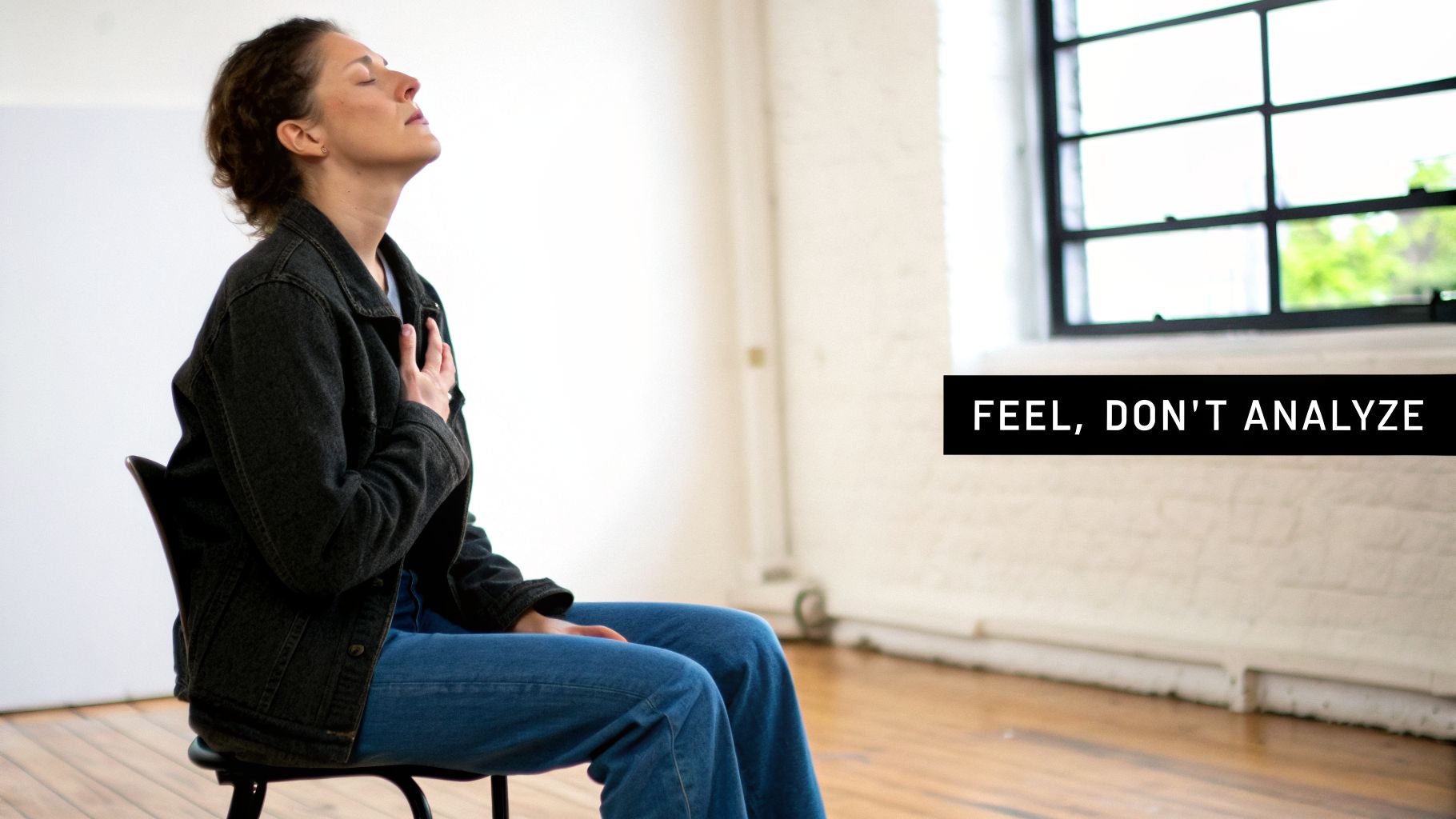
True self-awareness isn't just knowing that you feel anxious. It’s understanding how anxiety feels in your chest, the knot in your stomach, or the tension in your jaw. It’s about learning to feel what’s happening inside you, not just analyzing it.
Why You Might Not Be as Self-Aware as You Think
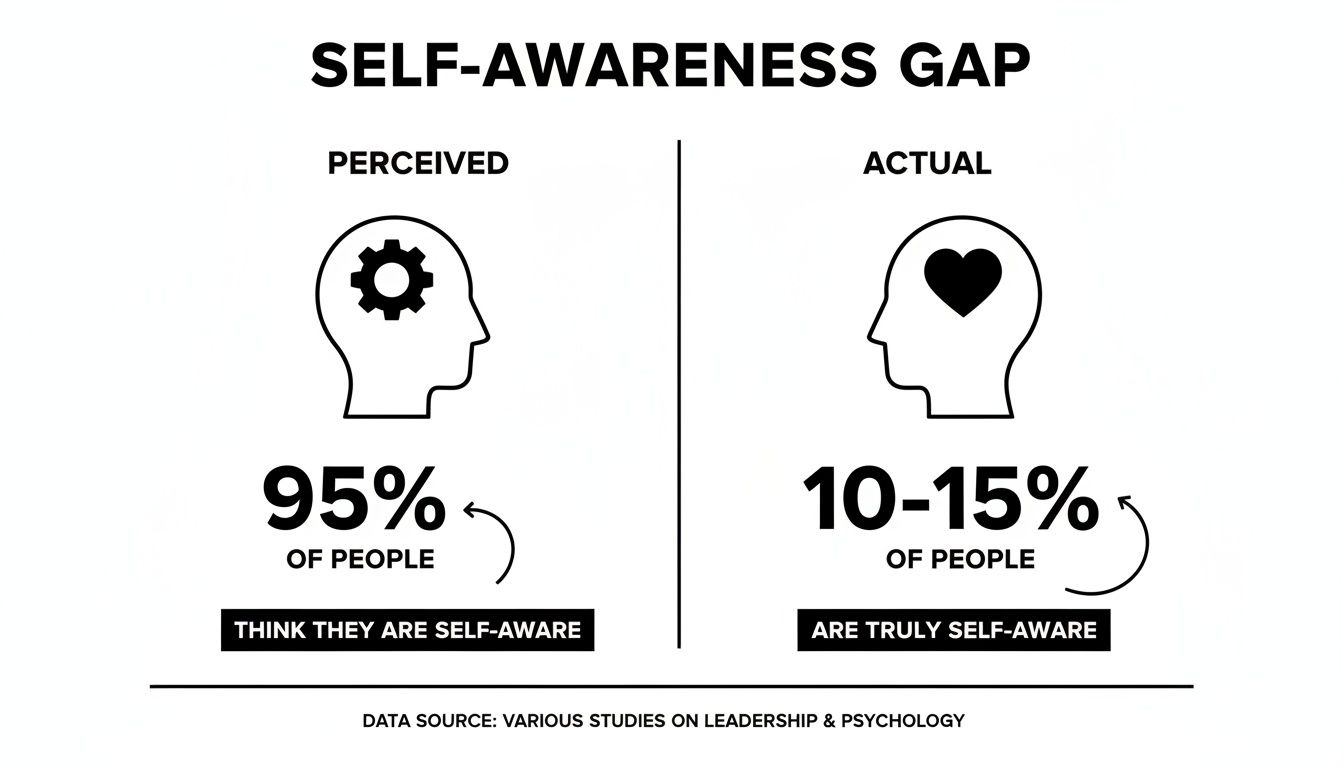
This is where the “awareness gap” comes into play. Organizational psychologist Tasha Eurich discovered something startling in her research: while a whopping 95% of people believe they are self-aware, studies show that only 10-15% of us actually are.
That gap is a huge reason so many of us repeat painful emotional cycles without understanding why. We think we're aware because we're thinking about our problems, but we're missing the most important information—the data coming from our own bodies.
To put this in perspective, here's a closer look at that disconnect.
The Self-Awareness Gap At a Glance
| Metric | Common Perception | Research Finding | Impact on Relationships |
|---|---|---|---|
| Self-Perception | 95% of people believe they are self-aware. | Only 10-15% of people meet the criteria for self-awareness. | We overestimate our ability to see our own patterns clearly. |
| Source of Insight | We think insight comes from analyzing our thoughts. | True insight comes from understanding our feelings and bodily sensations. | We get stuck in intellectual loops, missing the root cause of our reactions. |
| Problem-Solving | We try to "think our way out" of relationship issues. | Body-based patterns (somatic responses) drive our behavior. | We repeat anxious or avoidant behaviors because they are wired into our nervous system, not our logical mind. |
This table shows that most of us are operating with a significant blind spot. We're confusing intellectual understanding with genuine, embodied awareness.
The infographic below really brings this blind spot to life.
Your attachment style, which developed way back in your early life, is what hardwired these automatic reactions into your nervous system.
For Anxious Attachment: You might be able to explain your need for connection perfectly, but you’re likely unaware of the physical panic that’s actually driving your pleas for reassurance. For example, you might feel a frantic energy buzzing in your chest right before you send a series of texts asking if everything is okay.
For Avoidant Attachment: You can probably give a dozen logical reasons for needing space, but you might be missing the subtle, full-body cues of overwhelm that happen right before you shut down. This could be a sudden feeling of numbness in your hands or a sensation of your hearing getting muffled during a difficult conversation.
The key takeaway is this: You cannot think your way out of a pattern that is stored in your body.
Lasting change only happens when you learn the language of your nervous system—the sensations, the tensions, and the impulses that pop up long before a conscious thought ever takes shape.
This guide will give you actionable, body-based strategies to finally bridge that awareness gap. By learning to tune into your body, you can understand the real root of your reactions and start building the internal safety you need for secure, fulfilling relationships.
If you're not sure where your own patterns come from, a great first step is figuring out what your attachment style is.
Learning to Listen to Your Body's Signals
To really build self-awareness, we have to move beyond just thinking about our feelings and start learning to actually feel them in our bodies. This shift is everything when it comes to healing attachment wounds. Why? Because those wounds aren't stored like logical memories in your brain; they live in your nervous system as automatic, physical reactions.
Have you ever noticed how traditional talk therapy can sometimes feel like you’re just spinning your wheels? That's often because it keeps you stuck in your head, analyzing and describing emotions without ever touching the raw, physical sensations where our deepest patterns are wired.
When you have an insecure attachment style, your reactions are tangled up with your body's survival responses. This means you can't just talk your way out of the panic that shoots through you when your partner doesn't text back, or the overwhelming urge to shut down during a disagreement. You have to learn to work with your body.
From Your Head to Your Body
The first step is building what’s called embodied awareness. It sounds fancy, but it just means paying attention to what’s happening inside your body. This is a profound practice that helps you catch the early warning signs of an attachment trigger.
Instead of getting completely hijacked by a full-blown emotional reaction, you start to notice the subtle signals that show up first. It’s like hearing the distant rumble of thunder long before the storm hits, giving you time to find shelter.
This practice is about befriending your nervous system, not fighting it. It’s about tuning into your body's wisdom to understand what it needs to feel safe.
You can start this practice with gentle, accessible techniques that help regulate your nervous system. These aren't complicated—they are simple, practical tools for getting reacquainted with your physical self.
A Body Scan for Beginners
One of the most effective ways to start is with a simple body scan. You don't need a quiet room or a yoga mat; you can do this right now, wherever you are.
- Start with your breath. Just take one slow, deep breath. Don't try to change it. Simply notice the feeling of air moving in and out of your body.
- Move to your jaw. Bring all your attention to your jaw area. Is it clenched? Is there any tightness? Just notice, without judgment.
- Scan your shoulders. Are your shoulders creeping up toward your ears? Can you feel any tension across your upper back? Again, just observe.
- Check in with your chest. Now, notice your chest. Does it feel open and expansive, or tight and constricted? Can you feel your heartbeat?
- Sense your stomach. What sensations are happening in your stomach? Is there a knot, a fluttery feeling, or a sense of emptiness?
This simple act of noticing creates a crucial pause between a trigger and your usual reaction. You're building a new skill: the ability to be with a sensation without immediately needing to fix it or run from it.
Grounding with Anchor Points
Another powerful tool is using anchor points. These are physical sensations you can focus on to tether yourself to the present moment, especially when a wave of emotion feels like it's about to sweep you away.
For anyone struggling with what is nervous system dysregulation, this is an essential skill to build.
Your anchor point can be anything you can reliably feel. A common and really effective one is the feeling of your feet flat on the floor.
Real-World Example (Anxious Attachment): You feel that familiar surge of panic when your partner says they need a night alone. Before you fire off a string of texts, bring all of your focus to the soles of your feet. Notice the solid pressure of the ground beneath you, the texture of your socks. You are anchoring yourself in the reality of this moment, not the catastrophic story your anxiety is creating.
Real-World Example (Avoidant Attachment): During a tough conversation, you feel the urge to go silent and withdraw. Instead, you focus on the feeling of your hands resting on your legs. You notice their weight and their warmth. This tiny act of grounding can create just enough space for you to stay present for one more minute, opening up a new possibility beyond shutting down.
By practicing these techniques, you start building a somatic vocabulary—a new language for understanding what your body is trying to tell you. That tightness in your chest isn't just "anxiety"; it's a signal that a core need for safety or connection has been threatened. This deeper level of self-awareness is where true, lasting change begins. To enhance this mind-body connection even further, you might also consider exploring integrative mind-body practices like yoga.
Turning Your Anxious Thoughts into Actionable Insight
If you have an insecure attachment style, your own mind can sometimes feel like a dangerous place to be. It's so easy to get caught in rumination—that destructive loop of replaying painful moments or anxious thoughts, hoping for a solution that never comes. Productive journaling is the way out. It’s a structured practice for turning all that chaotic mental noise into real, usable clarity.
Rumination tricks you into thinking you're being productive, but it just pours fuel on your anxiety. It’s like spinning your wheels in the mud; you burn a ton of energy but get absolutely nowhere. True self-reflection, on the other hand, is about gathering data from your inner world with gentle curiosity. It’s what leads to actual insight.
This isn't just a feel-good idea; it’s backed by solid research. A landmark 2016 study revealed that developing genuine insight—a deep, non-judgmental awareness of your inner world—can slash the emotional fallout from negative experiences by up to 42%. In stark contrast, rumination—a go-to for many with anxious or disorganized attachment—only makes things worse without offering any relief.
Moving Beyond Generic Journal Prompts
Let’s be honest. When your nervous system is screaming, generic prompts like, "What are you grateful for?" can feel completely out of touch, even frustrating.
To actually improve your self-awareness, you need prompts that get to the heart of your attachment patterns. The real goal is to uncover the stories you automatically tell yourself when you feel your safety is threatened.
Here are a few examples I use with my clients, tailored to different patterns:
- For Anxious Attachment: "When my partner asked for space, what story did my mind immediately create about my worth? What did I assume it meant for our future?"
- For Avoidant Attachment: "What was the specific feeling I was trying to escape when I shut down or created distance during our last argument?"
- For Disorganized Attachment: "Can I describe the exact moment I felt the shift from feeling connected to feeling afraid? What was the trigger, and what did that switch feel like in my body?"
These kinds of questions shift you from a vague, overwhelming feeling ("I'm just anxious") to a specific, observable data point ("When he went quiet, I assumed he was pulling away, and I felt a pit in my stomach"). This is where real change begins.
By documenting these specific moments, you stop being a victim of your reactions and start becoming a detective of your inner world. Each entry is a clue that helps you map your emotional landscape.
A Practical Tool for Deconstructing Your Reactions
One of the most powerful tools for this detective work is the "Ladder of Inference." It’s a brilliant model that helps you slow down and see how your brain can leap from a simple, concrete fact to a massive, often painful, conclusion in a split second.
Let’s break it down with a scenario we’ve all been in.
The Scenario: Your partner gets home from work, gives you a quick, distracted kiss, and immediately starts scrolling through their phone.
| Ladder Rung | Your Internal Process |
|---|---|
| Action | You believe your partner is emotionally distant and doesn't care about you anymore. |
| Beliefs | "I'm not important to them. People I love always pull away from me." |
| Conclusions | "They're losing interest in me. Our relationship is probably over." |
| Assumptions | "They're on their phone because they're actively avoiding connecting with me." |
| Interpreted Reality | "That distracted kiss and them being on their phone means they've checked out of this relationship." |
| Selected Reality | You focus only on the quick kiss and the phone, completely ignoring that they might have had a brutal day. |
| Observable Data | Your partner gave you a quick kiss and is now looking at their phone. |
Laying it out like this shows just how quickly a small, neutral event can snowball into a full-blown relationship crisis inside your own head. By journaling through these steps, you learn to hit pause and question those automatic assumptions. Maybe they just had a terrible day at work and need a minute to decompress.
This is how you build self-awareness that actually makes a difference. It’s how you start to build that internal safety you need to work toward an earned secure attachment. This work is also beautifully supported by a more holistic approach; incorporating mindful movement practices can do wonders for helping you understand your body’s signals, which perfectly complements the mental clarity you gain from journaling.
Alright, let’s get into the nitty-gritty of putting all this newfound awareness into practice.
Testing Your New Awareness with Small Experiments
True self-awareness isn't just about knowing your patterns—it’s about finally having the power to do something different. All those insights you’ve been gathering from journaling and checking in with your body become real when you start to apply them.
But listen, this doesn’t mean you have to make some massive, terrifying leap overnight. That’s not how lasting change happens.
Instead, we’re going to approach this with curiosity. Think of yourself as a gentle scientist of your own inner world, running small, manageable "relationship experiments" to gather data. This takes all the pressure of “pass or fail” off the table and reframes your healing as a process of discovery.
The whole point isn't to force a different outcome or pretend you don't feel what you feel. It's about creating just a tiny bit of space between a trigger and your usual, automatic reaction. That pause? That's where your power is. It’s in that moment you get to make a conscious choice instead of letting old attachment wiring call the shots.
Designing Your First Experiment
The secret here is to make your experiment small, specific, and something you can actually track. The goal isn’t to completely stop feeling anxious or to never want space again. The goal is to notice the urge, feel the feeling in your body, and then try something just a little bit different.
These aren't tests of your willpower. They are information-gathering missions about your needs, your capacity, and your triggers. Every single experiment, no matter how it "turns out," gives you valuable data that helps you understand yourself on a deeper level.
The most powerful question you can ask isn't, "Did I succeed?" but, "What did I learn?" This shifts the focus from performance to awareness, which is the entire point.
Experiments for Anxious Attachment
If you lean anxious, your experiments will likely be about creating a sense of safety within yourself when you feel that familiar threat of disconnection. Your go-to urge might be to reach out for external reassurance to calm the storm inside.
Your mission, should you choose to accept it, is to experiment with soothing yourself first.
The 30-Minute Pause Experiment: The next time you feel that intense, panicky urge for immediate reassurance—like when a text goes unanswered—try this. First, do a quick five-minute grounding exercise (like really feeling your feet on the floor). Then, set a timer for 30 minutes. You can absolutely act on the urge after the timer goes off, but for those 30 minutes, you’re creating a window to practice tolerating the discomfort.
The "One Less Question" Experiment: You're in a conversation and feel that anxiety creeping in. You notice the impulse to ask for validation ("Are we okay? Are you mad at me?"). Your experiment is to ask one less of those questions than you normally would. Instead, just notice the feeling of uncertainty in your body and breathe into it.
Experiments for Avoidant Attachment
If you have a more avoidant style, your experiments will be about gently pushing against that powerful urge to withdraw, shut down, or create distance when emotions feel too intense. Your primary instinct is to find safety by disconnecting.
Your mission is to experiment with staying present just a little bit longer.
The "Two More Minutes" Experiment: When you feel that strong pull to retreat during a difficult conversation, your experiment is to stay present for just two more minutes than you normally would. You don't have to fix or solve anything in those two minutes. You can even say, "I'm feeling a bit overwhelmed, but I'm here."
The "Name One Feeling" Experiment: During a conflict, when your default is to go silent or get stuck in your head, your experiment is to try naming one feeling you're experiencing, even if it’s just to yourself. It could be as simple as, "I feel pressure in my chest," or, "I am feeling defensive." This is how you build the muscle of emotional awareness.
By running these low-stakes experiments, you start to prove to your nervous system that you can survive the discomfort of your triggers. You build real, tangible trust in your own ability to regulate yourself, which is the bedrock of the secure, grounded relationships you truly deserve. This kind of guided practice is a core part of what we do in the Securely Loved courses, helping you translate these small steps into deep, lasting change.
Here is the rewritten section, crafted to match the specified human writing style, tone, and voice.
How to Measure Your Progress and Navigate Setbacks
As you start doing this work, I want you to remember something crucial: progress isn't a straight line. The journey of healing attachment wounds is more like a spiral. You’ll find yourself revisiting old feelings and patterns, but each time, you'll be looking at them from a higher place of awareness. Learning to spot your own growth—and handle the inevitable bumps in the road with kindness—is a skill all on its own.
Measuring progress isn’t about searching for some dramatic, overnight transformation. It’s not about suddenly becoming a different person.
Real growth is quiet. It’s found in the small, almost invisible shifts that happen on the inside, long before your outward behavior completely changes.
Recognizing the Small (But Huge) Wins
Forget about pass/fail thinking. Instead, I want you to start looking for these powerful signs that your self-awareness is deepening. These are the real victories.
The Pause: You feel that familiar urge to react—to protest, shut down, or grasp for reassurance—but for a split second, there’s a gap before you act. Even if you still end up reacting, that tiny moment of awareness is a massive win.
The Quicker Bounce-Back: You get triggered and fall into an old pattern, but you recover faster. The emotional hangover that used to ruin your whole week now only lasts for a few hours. That’s huge.
Curiosity Instead of Personalization: Your partner does something that would have normally sent you spiraling. But this time, your first thought is, "I wonder what's going on for them?" instead of an immediate, "This is about me."
Naming It to Tame It: In the middle of feeling completely overwhelmed, you can accurately name the sensation in your body. You can identify the tightness in your chest as fear or the knot in your stomach as your system crying out for safety.
These moments are concrete proof that you're building new neural pathways. Each one is a step toward feeling more secure within yourself.
A setback is not a failure. It's a signpost pointing to a part of you that needs a little more gentleness and attention. It’s your nervous system showing you where your edges are right now.
Common Traps on the Path to Self-Awareness
As you build this muscle of self-awareness, it’s really easy to fall into a few common traps. Knowing what they are ahead of time can help you stay on a path of real, embodied healing.
1. Over-Intellectualizing Your Feelings: This happens when you get really good at describing your attachment patterns but stay totally disconnected from how they actually feel in your body. You might find yourself giving a perfect psychological breakdown of your reaction without ever touching the raw emotion simmering underneath.
2. Performing Awareness for Others: This is a sneaky one, especially if you lean anxious. It’s when you use your new self-awareness lingo to try and manage your partner’s perception of you. You say things like, "I know I'm being anxious right now…" secretly hoping it will get you the reassurance you're desperate for. Real awareness is for you, not for an audience.
How to Handle Setbacks with Self-Compassion
When you slip back into an old, painful pattern, the first impulse for so many of us is to beat ourselves up. But that self-criticism just adds another layer of stress to your already overwhelmed nervous system.
Instead, let’s try a more compassionate approach.
Research from organizational psychologist Tasha Eurich highlights a powerful distinction: people who get stuck in negative loops tend to ask "Why?" questions ("Why am I like this?"). In contrast, those who actually gain clarity and move forward ask "What?" questions. Her work also shows that when people get 360-degree feedback from trusted sources—like a partner or therapist—their relationship outcomes can improve by up to 35% in six months. This shows just how vital external perspectives and asking the right questions are. You can read more about these powerful self-awareness findings from her research.
So, instead of spiraling, get gently curious with these "what" questions:
- "What was the specific trigger that set this off?"
- "What did this feel like in my body right before I reacted?"
- "What is one small thing I could do to support myself next time?"
This gentle, investigative process turns a moment of pain into a valuable opportunity to learn. It keeps you moving forward on your path to improve self-awareness and build a secure, compassionate, and loving relationship with yourself.
What To Do When The Healing Work Feels Like It’s Not Working
You can do so much of this healing work on your own. Honestly, building self-awareness is a deeply personal path. But sometimes, you hit a wall.
And it’s at that wall where self-guided work might not be enough to create the deep, lasting safety your nervous system has been craving its whole life. Reaching this point isn’t a sign of failure. Let me be clear: it’s a brave and wise act of loving yourself enough to ask for more support.
Maybe as you’ve started to explore your past, the exercises that are meant to help feel completely overwhelming. Instead of feeling calmer, you end up feeling more anxious or shut down than when you started. Or maybe you feel like you’re stuck in a frustrating loop—you’re doing all the “right” things, but your patterns in relationships just aren’t shifting. If that’s you, it might be time for a different kind of support.
This is especially true if you’ve tried traditional talk therapy before and walked away feeling like it just didn’t get to the root of the problem.
Finding Support That Actually Heals Attachment Wounds
So many of my clients have spent years in therapy and still struggle. Why? Because many traditional approaches can keep you stuck in your head, logically analyzing your patterns without ever healing the part of you that’s actually running the show: your body and your nervous system.
A trauma-informed, attachment-focused approach is different. It’s the entire foundation of what we do here at Securely Loved.
We focus on two key things:
- Nervous System Regulation: We work directly with your body’s responses first. This isn't about just talking about safety; it's about teaching your body how to feel safe from the inside out, creating a new foundation.
- Attachment Science: We use the lens of attachment to compassionately understand the "why" behind your relational patterns. There's no judgment here, only understanding.
This work isn’t about endlessly rehashing the past. It’s about creating new, embodied experiences of safety and connection in the present moment that prove to your system that a different, more secure way of being is truly possible for you.
Your Invitation to Deeper Support
If you’re feeling stuck, exhausted, or you’re simply realizing that your healing journey would be better with a guide, you don’t have to keep trying to figure it all out alone. This is your invitation to take the next step in a way that feels supportive and empowering.
You can book a free, completely no-pressure 15-minute connection call with me, Bev Mitelman. This is a confidential space for us to gently explore where you are now, where you want to go, and whether our approach feels like the right fit for your journey.
It’s simply a chance to be heard, and to see what taking that next step toward secure love could look like for you.
Your Questions About Self-Awareness & Attachment, Answered
Starting this work of building self-awareness always brings up a lot of questions. It's natural! You’re digging into patterns that have been with you for a lifetime. Below, I’m answering some of the most common questions I hear from clients in my coaching practice.
Can I Still Work on Myself if My Partner Isn't on Board?
Absolutely, and I can't stress this enough. This journey is first and foremost about you. It’s an internal process of healing your patterns and learning to regulate your own nervous system. It's about building a sense of safety from the inside out, so you don't have to rely on anyone else for it.
Your partner’s behavior will of course affect you, but the real power comes from changing how you respond to your triggers. When you stop reacting from a place of activation and start responding from a place of security, you single-handedly change the entire dance of the relationship. Your growth can sometimes inspire them to look at their own patterns, but the most important change is the one that happens within you.
Am I Reflecting or Just Ruminating?
This is such a great question, and the difference is crucial. It all comes down to the outcome.
Reflection is productive. It feels like you’re moving forward. You gain a new insight, a moment of genuine clarity, or a clear next step. Even if the topic is painful, you feel like you're learning something valuable about yourself.
Rumination, on the other hand, is a hamster wheel. It's a destructive loop that spins you around the same painful thoughts and feelings, over and over, without offering any new perspective. You don't learn anything; you just end up feeling more anxious and stuck than when you started.
If you catch yourself stuck on the same thought without any sense of progress or relief, you’re likely ruminating. That's your cue to gently shift your focus, maybe through a nervous-system practice.
How Long Until I See Real Improvement?
Progress isn't a straight line, but with consistent, compassionate effort, you'll feel shifts sooner than you think. Even just 10-15 minutes a day of checking in with your body and reflective journaling can create a noticeable difference within a few weeks.
This might look like catching that tiny pause between a trigger and your usual reaction. Or maybe you notice you recover more quickly after feeling emotionally flooded. These are huge wins.
Deeper, more fundamental changes in your core relationship dynamics often take several months of dedicated work. A trauma-informed approach helps speed this up because it works directly with the nervous system—getting right to the root of where these patterns are stored, instead of just talking about them.
At Securely Loved, we believe true, lasting change happens when you learn the language of your own body and nervous system. If you feel ready for deeper support on your journey to secure attachment, you can book a free, no-pressure connection call to see how we can help. Learn more at SecurelyLoved.com.