
The Anxious Avoidant Relationship Cycle and How to Break It
An anxious-avoidant relationship is one of the most common—and confusing—dynamics I see in my coaching practice. It’s that painful cycle where one person is always reaching for more closeness and reassurance, while the other feels crowded and pulls away, needing space.
It’s a classic push-pull that can leave both of you feeling completely misunderstood, drained, and stuck. But here’s the most important thing to remember: this pattern isn’t about who’s right or wrong, or who loves the other more. It's about how you both learned to seek safety in relationships, long before you ever met.
Understanding the Anxious-Avoidant Relationship Dynamic
If you feel like you’re trapped in a constant tug-of-war, you’re not alone. I often hear this called the anxious-avoidant trap, and for good reason. It feels like a dizzying dance where the moment you lean in, your partner steps back, and the moment they step back, you feel an overwhelming urge to close the distance.
Think of it like two magnets. The anxious partner has a deep-seated fear of abandonment. Any sign of distance from their partner—a text left on read, a need for a night alone—triggers their internal alarm system. To feel safe, they pursue connection and seek reassurance. They are compelled to close that gap. For example, when her partner says he needs a quiet evening, her mind might race: "Is he pulling away? Did I do something wrong?" This anxiety fuels a need to text him, just to make sure they're okay.
The avoidant partner, on the other hand, operates from the opposite pole. For them, deep intimacy can feel suffocating. It triggers a core fear of losing their independence and sense of self. When they feel the anxious partner moving closer, their instinct is to retreat to regain their footing and feel in control. For example, after a wonderful, connected weekend, he might suddenly feel overwhelmed and create distance by getting absorbed in work, not because he doesn't care, but because he needs to feel like himself again.
Why This Pattern Isn’t About Blame
It is so critical to understand that this cycle isn't anyone’s fault. It’s a deeply ingrained relational dance where both people are just trying to get their core needs met, using the only tools they were ever given. The anxious partner pursues to feel secure; the avoidant partner distances to feel secure.
The tragedy of this dynamic is that each person's attempt to feel safe directly triggers the other's deepest fear, creating a painful, self-perpetuating loop.
This pairing is surprisingly common. Many people find themselves in this dynamic. Anxious and avoidant individuals are often drawn to each other because, initially, the anxious partner's pursuit feels validating to the avoidant, and the avoidant's self-sufficiency feels stable to the anxious. It's only later that these same traits become the source of conflict.
To truly break free from this painful dynamic, the first step is recognizing the mechanics of the dance itself. This journey begins with understanding attachment theory, which gives us the "why" behind these behaviors. For a deeper look at this, you might find our guide on attachment style definitions helpful.
Once you understand your own attachment blueprint, you can start to see your relationship not as a hopeless trap, but as a predictable pattern that you absolutely can learn to change.
Anxious vs. Avoidant At a Glance
To make this clearer, let's break down the core differences in how each partner operates within this dynamic. The table below highlights the opposing fears and motivations that keep the push-pull cycle in motion.
| Characteristic | Anxious Partner | Avoidant Partner |
|---|---|---|
| Core Fear | Abandonment and being unwanted. | Loss of independence and being controlled. |
| Main Motivation | To achieve closeness and security. | To maintain autonomy and self-reliance. |
| Behavior Under Stress | Pursues, seeks reassurance, may escalate. | Withdraws, creates distance, shuts down. |
| View of Intimacy | The ultimate source of safety and validation. | Can feel threatening or engulfing. |
Seeing these characteristics side-by-side helps illustrate why it's a "perfect storm." Each person's coping mechanism is the exact trigger for the other's deepest wound. But with awareness comes the power to choose a different response.
Why We Form Anxious and Avoidant Attachments
Our attachment styles aren’t just random personality quirks. They are brilliant, deeply ingrained survival strategies we learned in childhood to get our needs for love and safety met. Think of it like this: your earliest years were spent creating a “blueprint” for relationships. Every single interaction with a caregiver taught you something about what to expect from love, closeness, and emotional connection.
These early patterns became the automatic, subconscious programming for how you show up in your adult relationships. They explain why you react the way you do, especially when you’re feeling stressed or vulnerable. Understanding where these patterns came from isn’t about blaming your parents. It’s about finally having some compassion for yourself and seeing your own reactions with a new level of clarity.
The Anxious Attachment Blueprint
Imagine a child who has a loving parent, but that parent is inconsistent. One minute, they’re warm, present, and totally in tune with the child. The next, they’re distracted, stressed out, or just emotionally checked out. The child learns a powerful lesson: connection feels amazing, but it's totally unpredictable and could vanish at any second.
To cope, this child becomes a master at reading the room and sensing even the tiniest shift in their parent’s mood. They learn to work incredibly hard to close any emotional distance because, in their world, they have to earn the connection to keep it. Their nervous system gets wired to believe that distance equals danger.
As an adult in an anxious avoidant relationship, this blueprint might mean you:
- Feel a wave of panic when your partner asks for space.
- Find yourself constantly scanning the relationship for signs of trouble.
- Secretly believe you have to prove your worth to keep someone’s love.
That urge to chase connection isn't "needy"—it's a survival strategy that once helped you feel safe in an environment where love felt uncertain.
The Avoidant Attachment Blueprint
Now, picture a different child. Their caregivers provided for all their physical needs—food, shelter, clothes—but were deeply uncomfortable with feelings. Maybe crying was dismissed as being "dramatic," or attempts to get close were met with a subtle but clear wall of distance.
This child learns an equally powerful, but opposite, lesson: “To be safe, I have to rely on myself and myself only.” They figure out that being vulnerable just leads to disappointment, and true stability comes from being fiercely independent. They get really good at soothing themselves and pushing down their own needs for closeness.
In adult relationships, this blueprint is just as clear. As an adult, this might mean you:
- Feel completely overwhelmed or "suffocated" by too much emotional intimacy.
- Prize your independence above almost everything else.
- Feel a powerful, almost physical, urge to pull away when a partner tries to get closer.
This need for space isn't a cold rejection of your partner; it’s a deeply ingrained protective shield designed to keep you from feeling controlled or overwhelmed. The anxious avoidant relationship often becomes a painful cycle where one person's need for closeness triggers the other's need for distance, replaying these childhood dynamics over and over.
From Childhood Patterns to Adult Pairings
These patterns, baked in during our earliest years, are incredibly persistent. While just over half of children grow up with secure attachments, a huge portion of us don't. Research suggests that around 15% develop an avoidant attachment, and around 9% develop an anxious one, creating a large pool of adults who are primed for these exact challenging pairings.
You can learn more about the prevalence of childhood attachment styles and their impact. Please remember: these are not character flaws. They are adaptations to the world you grew up in. And recognizing them is the very first step toward creating change.
Recognizing the Anxious Avoidant Cycle in Your Life
Knowing your attachment style in theory is one thing. Watching it sabotage your relationships in real-time is another. This is where the painful, confusing dynamic of the anxious-avoidant relationship—often called the "anxious-avoidant dance"—moves from a concept into a felt, everyday reality.
Recognizing this pattern is the first, most powerful step you can take toward finally breaking free from it.
The cycle usually starts small but grows bigger and more painful over time. It’s fueled by two completely opposite, yet equally desperate, sets of behaviors: the protest behaviors from the anxious partner and the deactivating strategies from the avoidant partner. Each person is just trying to feel safe, but when their strategies collide, they create a perfect storm of disconnection.
The Anxious Partner's Protest Behaviors
If you lean anxious, you know the feeling. The moment you sense your partner pulling away, your internal alarm bells start blaring. Your nervous system is screaming, "Warning: Connection is threatened!" This triggers what we call protest behaviors—actions designed to close that terrifying gap and get reassurance, now.
It’s not because you're "needy" or "too much." It's a deeply ingrained survival response.
A real-world example: Your partner says they're "too tired to talk" after work. Your anxiety spikes, and you send a series of texts: "Is everything okay? Did I do something? We need to talk about this." You're not trying to be annoying; you're trying to get a response to calm the panic that feels like it's taking over your body.
Common protest behaviors look like:
- Constant Reassurance Seeking: Asking, "Are we okay?" or "Is something wrong?" over and over.
- Over-Communicating: Sending a flurry of texts or making multiple calls when you don't hear back.
- Monitoring and Jealousy: Checking their social media or feeling suspicious about where they are.
- Picking a Fight for a Reaction: Sometimes even starting an argument just to get some kind of emotional response. Why? Because a fight can feel less terrifying than the silent, empty space of disconnection.
This is how our earliest experiences with caregivers write the blueprint for our adult relationships.
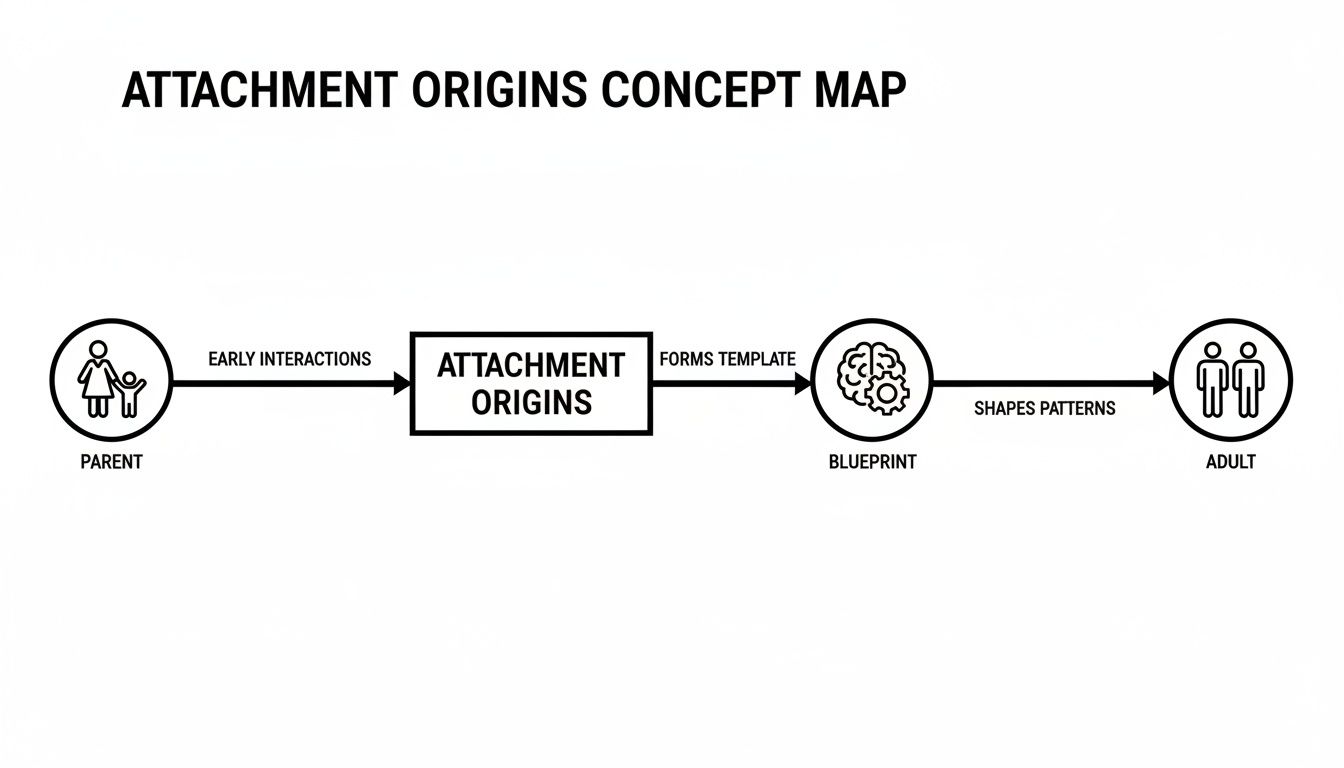
Your reactions today aren't random; they are the survival strategies you learned long ago to try and secure love and connection.
The Avoidant Partner's Deactivating Strategies
Now, let's look at the other side. If your partner leans avoidant, they use deactivating strategies to cope with their own brand of overwhelm. When intimacy feels too intense or they feel pressured for connection, their nervous system signals a different kind of threat: being engulfed. They need space to restore their sense of self and feel safe again.
A real-world example: After a great date where you shared a lot, you text them the next morning saying you can't wait to see them again. For them, this feels like pressure. They might not text back for a day, or reply with something short and impersonal like, "Busy week ahead." They're not trying to be cruel; they're trying to put the brakes on an intimacy level that feels overwhelming.
Common deactivating strategies include:
- Creating Distance After Closeness: Pulling away right after a wonderfully connected weekend.
- Vague Needs for "Space": Saying things like, "I just need to be alone" or "I'm really busy," without real explanation.
- The Emotional Shutdown (Stonewalling): During a disagreement, they become eerily quiet and unresponsive.
- Focusing on Flaws to Push You Away: Mentally nitpicking your habits to create emotional distance and justify their need to pull back.
It’s critical to understand that these aren't malicious acts of rejection. They are deeply automatic coping mechanisms learned in childhood to reduce the threat of being controlled or losing their independence in a relationship.
The "Aha!" Moment: Seeing the Dance in Action
Let’s put it all together. Imagine Alex (who leans anxious) and Sam (who leans avoidant) have a fantastic, connected weekend. On Sunday night, Alex feels full of hope and texts, "I had such an amazing time with you."
For Sam, that wave of intimacy feels like too much, too fast. It's overwhelming. Instead of leaning in, Sam's deactivating strategies kick in. Hours later, the reply comes: "Yeah, it was nice. Tired now."
Instantly, Alex's anxiety spikes. That shift in tone feels like a punch to the gut. Alex's protest behavior takes over: "Is everything okay? You seem distant."
Now Sam feels even more pressured and retreats further: "I'm fine, just busy. We'll talk later." For Alex, "later" feels like an eternity of abandonment. For Sam, "later" is a lifeline to breathe.
This is the anxious-avoidant dance. A painful, predictable cycle where one person pursues and the other distances, leaving both feeling misunderstood and alone. Beyond the emotional exhaustion, this constant push-and-pull can show up in your body as physical symptoms of chronic stress.
Recognizing your role in this dance—whether you’re the pursuer or the distancer—is your "aha!" moment. It's the point where you stop blaming yourself or your partner and start seeing your actions for what they are: a predictable pattern that you can finally choose to change.
How to Finally Break the Anxious-Avoidant Cycle
Knowing you’re stuck in the anxious-avoidant dance is one thing. Actually getting out of it is another. I see so many clients who have all the insight—they know the pattern, they know their triggers—but they’re still caught in that torturous push-pull. Real, lasting change isn't about understanding more; it's about doing differently.
This isn't about changing who you are at your core. It’s about giving yourself new tools to feel safe—safe in your own body and safe in your connection—even when things feel shaky. It's about learning to respond with intention instead of reacting from those old, tender wounds.
Here are the three pillars we need to build to create a new foundation.
Pillar 1: Regulate Your Nervous System First
At its heart, the anxious-avoidant cycle is a battle between two nervous systems. When an anxious partner senses distance, their system screams ‘fight-or-flight’, and the urge to chase and fix kicks in. For the avoidant partner, the pressure of closeness can feel so threatening that their system slams on the brakes, shifting into a ‘freeze’ response that demands withdrawal.
You can't talk your way out of a physiological alarm state. Before you can have a productive conversation, you have to help your body feel safe again.
The most important conversation you have during a conflict is the one you have with your own body. Regulation has to come before you can ever hope for resolution.
This means you have to start recognizing the second your internal alarm bells go off. Instead of immediately reacting, your very first job is to tend to your own system.
For the Anxious Partner (Actionable Tip): When you feel that panic surge, instead of reaching for your phone, place a hand on your heart and take three deep breaths. Exhale longer than you inhale. This simple act tells your brain you are safe. Then, go do something for yourself for 20 minutes—walk around the block, listen to a song—before deciding what to do next.
For the Avoidant Partner (Actionable Tip): When you feel that suffocating urge to run, don't just disappear. Go to another room, press your feet firmly on the floor, and name five things you see. This grounds you in the present. This small pause can stop the "freeze" response from taking over completely.
This video from my channel walks you through a simple but powerful regulation technique.
Pillar 2: Heal Through Honest (and Different) Communication
Once your nervous system is a little calmer, you can start to approach conversations in a whole new way. The goal is to stop seeing your partner as the enemy and start seeing the pattern as the problem you are tackling together. This takes vulnerability, and it requires using specific language that sidesteps blame and invites connection.
For the Anxious Partner: State Your Need, Not Their Crime
Your work is to express what you're feeling and what you need without making your partner the bad guy.
- Instead of: “You’re being so cold again. Why do you always shut me out?” (This is an accusation that guarantees a defensive reaction.)
- Try: “When I don't hear from you, a story I tell myself is that you're pulling away, and I start to feel anxious. I'd really love to connect with you later when you have the space.” (This owns your feeling and makes a clear, non-demanding request.)
For the Avoidant Partner: Ask for Space, Don't Just Disappear
Your challenge is to communicate your need for space with kindness and reassurance. This single shift is the key to preventing your partner’s abandonment fears from taking over.
- Instead of: Going silent for hours and hoping they get the hint.
- Try: "I’m feeling really overwhelmed right now and need some time to myself. I'm not mad. Can I check back in with you in an hour?" (This honors your need for solitude while also validating the connection, which prevents your partner's anxiety from spiraling.)
These might feel like small language shifts, but they can completely rewire the entire dynamic. For a deeper dive, our article on ways to regulate your nervous system has even more exercises to support you.
Pillar 3: Build Boundaries That Actually Protect the Connection
In this dynamic, boundaries often feel like weapons. We have to reframe this. Healthy boundaries aren't about pushing someone away; they are agreements you make with yourself to protect the connection by making it safer for both of you to be in it.
Here’s what this looks like in the real world:
The "One-and-Done" Text Boundary (for the Anxious Partner):
- The Problem: You feel anxiety and send a flood of texts, which overwhelms your partner and makes them retreat further.
- The Actionable Boundary: Make an agreement with yourself: "I will send one clear, kind message expressing my need. Then, I will put my phone away and do something to soothe myself for at least an hour, instead of waiting for a reply."
The "Reassurance" Check-In Boundary (for the Avoidant Partner):
- The Problem: You retreat into your cave, leaving your partner in a panic, which makes them pursue you even harder when you emerge.
- The Actionable Boundary: Commit to this: "When I need space, I will send one brief text like, 'Hey, having a busy day. Thinking of you & will connect tonight.' It takes 30 seconds and can prevent hours of conflict."
This small act of reassurance calms your partner’s anxiety, which ironically makes it much easier for you to get the genuine space you actually need. Breaking the cycle isn't about one big conversation. It’s about the courage to try these small, consistent actions, day after day.
When to Seek Professional Support for Attachment Healing
While all the strategies we’ve talked about are powerful tools, trying to heal the deep patterns of an anxious-avoidant relationship all on your own can feel like trying to untangle a massive knot while you're still tied up in it. There comes a point where self-help isn’t enough, and that’s not a sign of failure—it’s a sign of profound self-awareness.
Recognizing you need a guide is an act of courage. It’s you saying, “I’m ready for real change, and I need someone with a map to help me navigate this.”
Signs It’s Time to Seek Help
If you find yourself nodding along to the points below, it might be time to consider working with a specialist. These are signals that the dynamic has become too painful or stuck to manage on your own.
- The Same Fight on a Loop: You have the same exact argument over and over, but it never actually gets resolved. Each fight just adds another brick to the wall of resentment.
- Your Body Is Keeping Score: You’re living with chronic anxiety, exhaustion, or physical symptoms of chronic stress. This is your nervous system screaming that it’s been in survival mode for too long.
- Deeper Wounds Are Coming Up: The relationship is activating old, painful wounds from your past, like childhood emotional neglect or other traumas. A trauma-informed professional is essential for healing them safely.
- One or Both of You Are Thinking of Leaving: The pain of the push-pull cycle has started to eclipse the love you have for each other, and walking away is starting to feel like the only way out.
If these signs hit home, it doesn’t mean your relationship is broken beyond repair. It just means the wounds are too deep for surface-level fixes.
Why Traditional Talk Therapy Often Isn’t Enough
For so many people I work with, traditional talk therapy can be incredibly frustrating for this specific dynamic. You can spend hours logically talking through the pattern, but the second you’re triggered, you’re right back in that reactive, painful dance.
Why? Because insecure attachment isn't just a thought pattern; it lives in your body and your nervous system.
Attachment wounds are primarily physiological, not psychological. You can't think your way out of a nervous system that is screaming "danger." Healing requires a body-focused, or somatic, approach.
A trauma-informed attachment specialist gets this. Instead of just talking about your feelings, they help you work directly with the physical sensations of anxiety, shutdown, and fear. The goal is to first build a true sense of internal safety. You learn to regulate your own nervous system before you even attempt to connect with your partner during a conflict. If this is the kind of deep support you're looking for, you can learn more about attachment therapy for adults and see how it’s different from what you might have tried before.
How to Find the Right Therapist
Finding the right support is everything. When you're searching for a therapist or coach, remember that you are the one conducting the interview. You have every right to ask specific questions to make sure they have the expertise this work demands.
Here’s what to ask:
- “What is your experience working specifically with the anxious-avoidant dynamic?”
- “How do you use attachment theory in your sessions?”
- “Do you have a somatic or body-based approach to help clients regulate their nervous system?”
- “Are you trained in trauma-informed care?”
Listen for answers that go way beyond "talk therapy." You want to hear someone who speaks the language of the nervous system, internal safety, and embodied healing. Finding a professional who truly understands these deeper layers is what will finally help you move from just understanding the cycle to actually changing it.
Where Do We Go From Here? Your Path to Secure Love
If you’ve made it this far, I’m guessing you’re feeling a mix of emotions. Maybe some painful recognition, a little bit of relief that you’re not crazy, and maybe even a sense of hopelessness, wondering if things can ever really change.
I want to be very clear about this: The anxious-avoidant dance is incredibly painful, but it is not a life sentence. You are not broken. Healing is more than possible, and you absolutely deserve a relationship where you feel safe, seen, and deeply loved for who you are.
It’s not about becoming a whole new person. It’s about learning a new set of tools—tools to help you navigate your own feelings and your relationships in a way that finally feels good. The awareness you’ve gained just by reading this is huge. But turning that awareness into real, felt change in your body and your life? That’s where the real journey begins.
Your First Steps Toward Feeling Secure
Okay, I know. This is a lot of information, and it can feel overwhelming to figure out where to even start. I want to make this as simple and gentle for you as possible. You don't have to do this alone.
Let’s move you from just understanding the cycle to actually stepping out of it.
You’ve taken the time to understand the dynamic. Now it's time to take compassionate action for yourself. Your journey toward the secure love you've been searching for starts with one small, courageous step.
Here are two simple ways to get started right now:
Get Personalized Clarity with the Attachment Style Quiz
Your first move is to get crystal clear on your own patterns. My free Attachment Style Quiz is designed to give you personal insights into your specific style. Understanding your unique relational blueprint is the foundation for creating any lasting change.Book Your Complimentary Connection Call
Once you have your quiz results, you don’t have to figure out what they mean all on your own. I invite you to book a free, 15-minute Connection Call with me, Bev Mitelman. This is simply a private, no-pressure space for us to chat about what’s going on for you and see if I might be the right person to support you.
Taking one of these small steps is an act of love for yourself. It’s you telling yourself that you’re ready for a future filled with the kind of grounded, secure love you have always, always deserved.
Your Questions About the Anxious-Avoidant Dance, Answered
When you’re caught in the anxious-avoidant push-pull, it’s only natural to have a million questions swirling around. It’s a confusing and painful place to be. I get these questions a lot in my coaching practice, so I wanted to answer some of the most common ones with the clarity and hope you deserve.
Can an Anxious-Avoidant Relationship Actually Work?
The short answer? Yes, absolutely. But it’s not a simple fix, and it’s not about one person changing for the other. It only works when both people are willing to look at the painful dynamic they’re stuck in and commit to doing the hard work to break the cycle—together.
Success comes when both partners are ready to build self-awareness, learn how to soothe their own nervous systems, and try on new ways of communicating. When that happens, the relationship itself can transform into a space for healing, pulling both of you out of your corners and into a more secure middle ground. It's tough, but it’s so possible when you’re both dedicated to the journey.
What if My Avoidant Partner Won’t Do the Work?
This is one of the most painful realities I see. You cannot force someone to change, to show up, or to see the pattern they’re a part of. If your partner is unwilling or just not ready to meet you halfway, your focus has to shift entirely back to you and your own healing.
Your healing can't be dependent on them. This is your moment to pour all that energy you’ve been spending on the relationship back into yourself.
- Focus on your own regulation. Learn to become your own source of safety and calm your anxiety, instead of constantly seeking reassurance from them.
- Rebuild your world. Cultivate a life that feels full and joyful outside of the relationship. Reconnect with hobbies, friends, and things that give you a sense of purpose.
- Set firm, loving boundaries. Get clear on what you will and will not accept. This might mean creating more space or even asking yourself if this relationship is truly healthy for you right now.
Remember, you can only ever control your side of the dynamic. By focusing on your own healing, you empower yourself to break the cycle for good, whether they join you on that path or not.
I’m the Avoidant One—How Do I Even Start to Change?
First, acknowledging that you lean avoidant is a massive, courageous step. It’s huge. Change will probably feel terrifying because it goes against every self-reliant instinct you have. The secret is to start small and be incredibly gentle with yourself.
This isn't about diving headfirst into overwhelming intimacy. It's about taking small, manageable risks that feel just a little bit vulnerable.
- Practice staying put. When you feel that powerful urge to bolt or shut down, see if you can stay in the conversation for just five more minutes.
- Communicate your need for space. Instead of just vanishing, try saying, “I’m feeling overwhelmed and need about an hour to myself. I will come back to this conversation then.”
- Notice your inner critic. Pay attention to that voice inside that tells you connection is a trap or that you’re going to be engulfed. You don’t have to believe it.
These small actions begin to forge new pathways in your brain, slowly building your capacity for connection without making you feel like you're losing yourself in the process.
Are you ready to stop the painful push-pull and start your journey toward secure, grounded love? At Securely Loved, we specialize in helping individuals heal these deep attachment patterns. Take the first step by booking a free 15-minute Connection Call to see how we can support you.