
Healing the Anxious-Avoidant Relationship Dance
An anxious-avoidant relationship describes a painful but very common pattern where one partner is always chasing closeness and reassurance (the anxious partner), while the other constantly pulls away, needing space (the avoidant partner).
This dynamic creates a confusing and exhausting cycle of pursuit and withdrawal. It often leaves both people feeling completely misunderstood and desperately lonely, even though they genuinely care for each other. It’s a push-and-pull dance fueled by conflicting, subconscious needs for safety that were wired into you long ago.
What Is the Anxious-Avoidant Relationship Trap?
Have you ever felt like you’re walking on eggshells, constantly trying to close an emotional gap with your partner, only for them to pull even further away?
Or maybe you feel suffocated by your partner's need for connection, craving just a little space to breathe and feel like yourself again. If this exhausting push-and-pull feels painfully familiar, you’re likely caught in what I call the anxious-avoidant relationship trap.
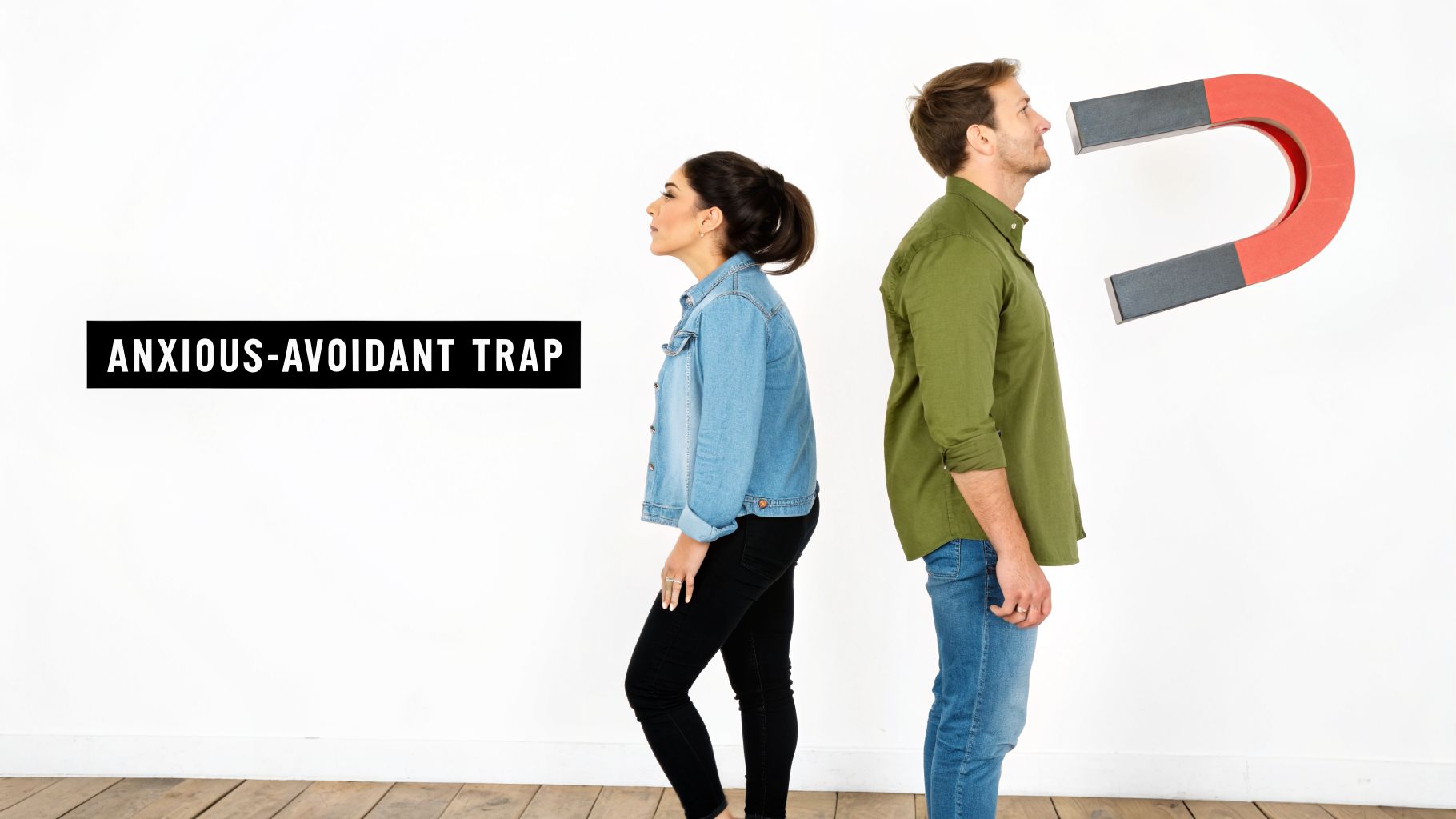
This pattern, often called "the dance," is one of the most common pairings I see in my coaching practice, and for good reason. It’s not a sign that you're incompatible or that the love isn't real. It's a predictable clash of two very different, deeply ingrained strategies for staying safe in relationships.
The Magnetic Pull of Opposite Strategies
Think of it like two magnets. The anxious partner is like a north pole, always seeking connection to feel secure. The avoidant partner is also a north pole, but they are wired to create distance to feel safe. When they try to get close, the anxious partner’s pursuit unintentionally repels the avoidant partner, who instinctively pulls back.
For example, imagine a Friday night. The anxious partner, let's call her Sarah, wants to plan a cozy weekend together. She suggests a dinner date, a movie night, and a Sunday hike. For her, this planning is how she feels connected and secure. But for her avoidant partner, Tom, this feels like his entire weekend is being boxed in. He feels pressure, so he responds with, "Let's just see how we feel," creating instant distance.
This creates a frustrating and painful cycle:
- The anxious partner senses distance, and their internal alarm system goes off. This triggers an urgent need to reconnect, so they might text more, ask for reassurance ("Are you mad at me?"), or try to initiate deep conversations to close that gap.
- The avoidant partner feels this pursuit as pressure, a threat to their independence. Their own alarm system warns them of being overwhelmed or controlled, so they retreat—becoming quiet, emotionally distant, or suddenly very busy with work or a hobby.
The core of the issue is that both partners are desperately trying to feel safe, but they are using opposing strategies to get there. The anxious partner's attempt to find safety by connecting triggers the avoidant partner's deep-seated fear, and vice versa.
This isn't a character flaw in either of you. These are survival strategies learned in childhood that are now operating on autopilot in your adult relationships. Your brain is simply defaulting to what it learned was necessary to protect itself back then.
To help you see this dynamic more clearly, here's a quick breakdown of how each partner typically thinks, feels, and reacts in the cycle.
Anxious vs. Avoidant Partner Dynamics
| Characteristic | Anxious Partner | Avoidant Partner |
|---|---|---|
| Core Fear | Abandonment & disconnection | Engulfment & loss of self |
| Motivation | To gain closeness, reassurance, and validation | To maintain independence, space, and emotional control |
| View of Partner | Sees them as distant, unavailable, and withholding | Sees them as needy, demanding, and overwhelming |
| Common Reaction | Pursues, seeks reassurance, becomes more emotional, "protests" | Withdraws, shuts down, creates distance, "deactivates" |
| Internal Belief | "If I try harder, they will love me." "I am too much." | "If I give in, I'll be trapped." "I need space to be myself." |
Seeing the patterns side-by-side helps you depersonalize the conflict. It's not that your partner is intentionally trying to hurt you; it's that their survival strategy directly collides with yours.
Why It Feels So Personal and Painful
The anxious-avoidant dynamic is so excruciating because each person’s defense mechanism directly triggers the other's deepest wound. The anxious partner’s core fear is abandonment, which gets activated every time the avoidant partner withdraws. The avoidant partner's core fear is being engulfed or controlled, which gets activated every time the anxious partner pursues.
This is why a simple unanswered text can feel like a catastrophe for one partner, while an emotional conversation can feel like a trap for the other. Each person’s actions, though intended to create personal safety, end up confirming the other’s worst relational fears, reinforcing toxic beliefs like "I am too much" or "I am not enough."
Understanding this cycle is the first, most crucial step toward breaking free. When you can recognize these behaviors as learned patterns—not personal attacks—you can begin to step out of the blame game. This isn't about pointing fingers; it's about seeing the dance for what it truly is and finally learning new steps together.
How Our Past Shapes Our Present Relationships
Have you ever wondered why you crave closeness when your partner pulls away, or why you feel the urge to run for the hills when things get too intense? The answer isn't really about your current relationship. It goes way back. The blueprint for how you connect with others was drafted when you were very young, based on the emotional care you did—or didn't—receive.
These early experiences literally program your nervous system. They teach it what to expect from love and what it needs to do to stay safe. If your caregivers were sometimes available and warm, but other times distant or overwhelmed, you probably learned that connection is unpredictable. That kind of inconsistency can wire a child’s brain for anxiety, creating a constant, low-level need to check if the relationship is still okay.
On the flip side, if emotional closeness felt smothering, invasive, or was just plain missing, a child learns that being self-reliant is the only way to be safe. Independence becomes the go-to survival tool. These aren't conscious decisions we make; they're deep, automatic adaptations made by a young nervous system just trying to get by.
Your Attachment Style Is an Adaptation, Not a Flaw
I need you to hear this: your attachment style—whether you lean anxious or avoidant—is not a personality disorder or a character flaw. It’s a brilliant, logical adaptation to the environment you grew up in. Your nervous system did exactly what it had to do to protect you.
Viewing your relationship patterns as a learned survival strategy, rather than a personal failing, is the first and most crucial step toward healing. It shifts you from self-blame to self-compassion.
When you can start looking at your impulse to chase or your urge to pull away with curiosity instead of judgment, everything changes. You stop asking, "What's wrong with me?" and you start asking, "What did I learn was necessary to survive?" This simple shift is the foundation for breaking free from the painful cycle of an anxious-avoidant relationship. If you want to dive deeper into this, you can check out our guide on what attachment styles are and how they develop.
The Generational Echo of Attachment
These patterns don't just come from nowhere; they are often passed down from one generation to the next, like a family heirloom you never asked for. The way our parents attached to us was heavily shaped by how their parents attached to them. It creates this powerful, often invisible, relational legacy that echoes through a family line.
Research on this is pretty eye-opening. It shows that in about 85% of cases, a child will develop the same attachment style as their parent. This means that insecure attachment isn't just a personal struggle; it's a pattern that can ripple across generations, leaving about 42% of American adults operating from an insecure style.
Understanding this helps you take it even less personally. You're not just dealing with your own history; you might be carrying the emotional weight of your family’s past, too. But here’s the good news: what was learned can be unlearned. By getting to the root of these foundational wounds, you can do more than just fix your current relationship—you can change the legacy for yourself and for the generations that come after you.
Recognizing the Anxious-Avoidant Cycle in Your Life
Knowing the theory of attachment is one thing. Watching it blow up your Tuesday night dinner is something else entirely. It’s in these small, everyday moments that the anxious-avoidant dance becomes painfully clear. This isn't just about the big, dramatic fights; it's a constant, quiet hum under the surface of your relationship, shaping every single way you try to connect (or disconnect).
Spotting these patterns in yourself and your partner is the first real step toward changing the dynamic. It's about shifting from a place of confusion and blame to one of clarity and compassion. Once you can name the dance, you can finally start to step off the dance floor.
Signs You Might Have an Anxious Attachment Style
If you see yourself on the anxious side of this equation, your world is often painted with a deep-seated fear of disconnection. Your nervous system is on high alert, scanning for any tiny sign that the relationship is in danger, which can turn a small shift in your partner’s mood into a five-alarm fire in your mind.
For an even deeper look, watch this video where I break down the anxious attachment style in detail:
You might find yourself:
- Constantly looking for proof you’re okay. You need to hear "I love you" or "we're good" on a loop just to feel grounded.
- Panicking when a text goes unanswered. Your mind doesn't just wonder; it spirals into worst-case scenarios, convinced they're mad, hurt, or have lost interest completely.
- Over-analyzing everything they do and say. You spend hours decoding their tone, word choice, and actions, searching for hidden meanings that usually aren't there.
- Living with a nagging fear that your partner will leave you. The threat of abandonment feels incredibly real and can be triggered by the smallest conflict or a little bit of distance.
- Feeling like you're "too much" for the relationship. You carry a secret worry that your needs for closeness and reassurance are a heavy burden on your partner.
Signs You Might Have an Avoidant Attachment Style
If you lean more toward the avoidant side, your main goal is to guard your independence and avoid feeling trapped or overwhelmed. You might want closeness on some level, but when it actually shows up, it feels threatening. This triggers a powerful instinct to pull back, create space, and retreat into your own world.
You might recognize these patterns in yourself:
- Feeling cornered or suffocated by emotional talks. You might shut down, quickly change the subject, or physically leave the room to escape the pressure.
- Using work, hobbies, or other distractions to create distance. When things get too intense in the relationship, you suddenly become very, very "busy."
- Thinking your way out of your feelings. You'd much rather deal with logic and practical problems than dive into the messy, unpredictable world of emotions.
- Feeling a strong urge to "escape" after moments of deep connection. A really great weekend together might be followed by an unexplained need to be alone.
- Believing you are completely self-reliant and don't "need" anyone. You take pride in your independence, sometimes to the point where you push away the very support you secretly crave.
The Pursue-Withdraw Dynamic in Action
This clash of needs—one for closeness, the other for space—explodes into a classic conflict cycle we call the pursue-withdraw dynamic. It’s a textbook case of how a tiny spark can ignite a massive fire, leaving both of you feeling completely alone and misunderstood.
Let's walk through a scene I see all the time in my practice:
- The Trigger: Sarah, who leans anxious, gets home from a long day, desperate to connect with her partner, Tom. Tom, who leans avoidant, is on his laptop and gives her a quick, distracted hello.
- The Pursuit: Sarah feels an immediate sting of rejection. Her brain instantly translates his distraction as "he doesn't care." She starts to pursue, asking, "Is everything okay? You seem distant."
- The Withdrawal: For Tom, this question feels like a demand. It's pressure to perform emotionally when he's just trying to decompress. He feels a flash of irritation and withdraws more, muttering, "I'm fine, just busy."
- The Escalation: Sarah's anxiety skyrockets. His withdrawal is all the proof she needs that her fear is real. She escalates her pursuit, her voice now filled with panic: "You're always busy! It feels like you don't even care that I'm here!"
- The Shutdown: Tom is now completely overwhelmed and feels attacked. His nervous system is screaming "threat!" He shuts down completely. He might get defensive ("I can't do anything right!") or just walk out of the room to "get some space."
And the result? Sarah is left feeling abandoned, her deepest fear confirmed: she is "too much." Meanwhile, Tom feels totally misunderstood, his belief that closeness only leads to conflict and pressure now set in stone. This painful, exhausting dance is the very heart of the anxious-avoidant relationship.
Your Brain and Body on Relational Stress
The intense, confusing, and often overwhelming feelings you experience in an anxious-avoidant relationship aren't just in your head. They are profound, whole-body biological events.
When that familiar cycle of pursuit and withdrawal gets triggered, your nervous system interprets the dynamic as a genuine threat to your survival. It’s not an overreaction; it's biology. Your racing heart, the pit in your stomach, or that feeling of being completely numb are all signals from a nervous system trying desperately to keep you safe. Understanding what’s happening in your body is the first step toward regaining control.
The Accelerator and the Brake
Think of your nervous system in this dynamic as a car with both the accelerator and the brake floored at the same time. The internal chaos is immense, but the car goes nowhere. This captures the physiological gridlock of the anxious-avoidant cycle perfectly.
The Anxious Partner (Accelerator): The moment you sense distance, your sympathetic nervous system kicks into high gear. This is your body's "fight-or-flight" response. It floods you with cortisol and adrenaline to mobilize you into action—in this case, to close that gap and reconnect. Your heart pounds, your thoughts race, and you feel an urgent, almost frantic need to "fix" things right now.
The Avoidant Partner (Brake): When you feel pressure or emotional demands coming your way, your nervous system slams on the brakes. This often triggers the dorsal vagal part of your parasympathetic nervous system, responsible for the "freeze" or "shutdown" response. It’s a primitive survival mechanism designed to conserve energy when faced with an inescapable threat. You might feel numb, disconnected, foggy, and have a powerful urge to pull away and just disappear.
It's also crucial to see how these internal states, like a heightened emotional response that can lead to anger toward a partner, are often a symptom of a nervous system pushed to its limit.
This visual shows exactly how the anxious partner's activation and the avoidant partner's shutdown create a painful loop of conflict and disconnection.
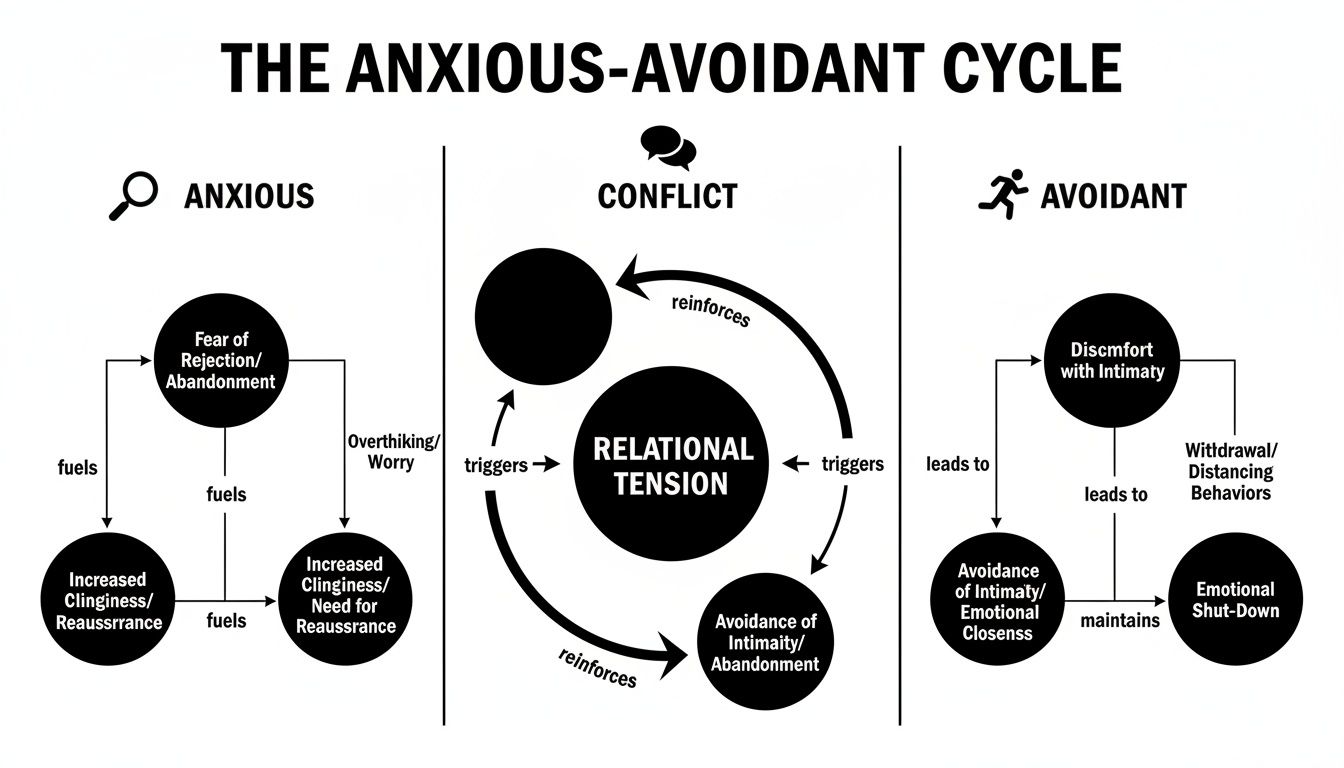
As you can see, the anxious partner’s pursuit directly fuels the avoidant partner’s retreat, and that retreat then triggers the anxious partner even more. It’s a self-perpetuating cycle of physiological distress.
Why Your Reactions Feel So Intense
These aren't mild feelings; they are full-body survival states. For the anxious partner, the fear of abandonment is experienced as a life-or-death threat, triggering genuine panic. For the avoidant partner, the fear of being consumed or controlled feels just as catastrophic, prompting a complete system shutdown.
Your intense physical reactions aren't a sign that you're broken or too dramatic. They are the predictable, biological result of your attachment history being triggered in the present moment. Your body is remembering a time when disconnection or engulfment was a real danger.
This is a critical insight. It means you are not at the mercy of your reactions. Because these are physiological states, you can learn to work with your body to shift them. Learning about nervous system regulation gives you the tools to manage these intense states and choose a different response, instead of being pulled into the same old dance.
This knowledge empowers you to stop blaming yourself or your partner for what are, ultimately, automatic biological processes. You can start to see these moments not as personal failures, but as signals that your nervous system needs attention and care. From there, true healing becomes possible.
How to Actually Start Healing the Anxious-Avoidant Dance
Realizing you’re stuck in the anxious-avoidant cycle is a huge first step. But here’s the tough truth I see in my coaching practice every day: insight alone won't break the pattern. The real change happens when you stop reacting on autopilot and start taking new, conscious actions.
Breaking free from this painful dance means making a powerful shift. Instead of trying to control your partner to feel okay, you have to learn to regulate yourself first. This is where your power lies. It's about creating your own sense of internal safety so you aren't dependent on their every move to feel secure.

Healing doesn’t start with fixing them. It starts with learning to anchor yourself when the storm hits. When you take responsibility for your own nervous system, you stop pouring fuel on the fire and start creating the space for a real, secure connection to finally grow.
Step 1: Regulate Yourself First
You can’t talk your way out of a problem when your body is in survival mode. Before you can communicate differently, you have to feel different. When you’re activated—whether that’s with heart-pounding anxiety or a wave of numbness—your logical brain goes offline, making any real conversation impossible.
Your first job is to hit the pause button and regulate your nervous system before you say or do anything. This isn't about stuffing your feelings down. It's about creating just enough inner calm to respond from a place of groundedness, not panic.
Here are a few simple ways to bring your body back to safety:
- Feel Your Feet on the Floor: Seriously. Press your feet into the ground and notice the solid surface beneath you. This tiny physical act sends a powerful signal to your brain: "You are here. You are stable."
- The 5-4-3-2-1 Method: This pulls you out of a thought spiral and back into your body. Look around and name 5 things you can see, 4 things you can physically touch, 3 things you can hear, 2 things you can smell, and 1 thing you can taste.
- Lengthen Your Exhale: Breathe in for a count of 4, then breathe out slowly for a count of 6 or 8. A longer exhale is like a brake pedal for your body's fight-or-flight response, activating the vagus nerve to help you calm down.
These aren't just distractions; they are potent tools for managing an overstimulated nervous system. If you want to dive deeper into these practices, we explore more in our article on grounding techniques for trauma.
Step 2: Shift Your Communication
Once you feel a bit more centered, you can approach your partner in a completely new way. The goal is to stop the old pattern—protest behaviors for the anxious partner, shutting down for the avoidant—and start clearly stating what you feel and need. This is about moving from blame to personal responsibility.
The most powerful tool for this is the "I feel" statement. It shifts the focus away from accusation and onto your own experience, which is your truth and is much less likely to make your partner defensive.
The formula is simple but it changes everything: "When [this specific thing happens], I feel [your emotion], and what I need is [a clear, positive request]."
This turns a reactive complaint into a vulnerable, actionable request. It invites your partner to be part of the solution, not the problem.
For the Anxious Partner:
- Instead of: "You obviously don't care about me! You always pull away." (This is a classic protest behavior that comes across as an attack.)
- Try This: "When I don't hear from you for a few hours after we've had a really close moment, I start to feel anxious and disconnected. What I'd love is if we could just share a quick 'thinking of you' text in the evening."
For the Avoidant Partner:
- Instead of: Going completely silent or just saying, "I need space." (This feels like a wall and can trigger deep abandonment fears.)
- Try This: "I feel really overwhelmed when we try to have a heavy conversation the minute I walk in the door. I need about 30 minutes to just decompress by myself, and then I can give you my full attention and really listen."
This isn't about getting the script perfect. It's about being brave enough to be clear and vulnerable, communicating your needs without making your partner the villain.
Step 3: Build Safety with Boundaries
Let’s be clear: boundaries are not walls you build to push people away. They are compassionate agreements you make that create predictability and safety in a relationship. For the anxious-avoidant relationship, where unpredictability is the source of so much pain, clear boundaries are non-negotiable for building trust.
Boundaries create a container where both people know the rules of engagement. This calms the anxious partner's fear of abandonment and the avoidant partner's fear of being engulfed. A boundary isn’t a threat like, "If you do that again, I'm leaving!" It’s a loving statement of what you will do to take care of yourself.
Here’s what compassionate boundaries look like in action:
- For the Anxious Partner: A boundary might sound like, "I feel disconnected when you're scrolling on your phone while we're talking. I'm going to step away and read my book, and we can connect later when you're able to be fully present with me."
- For the Avoidant Partner: A boundary could be, "I'm starting to feel flooded and I can't think clearly. I'm going to take a 20-minute break to calm down, and I promise I'll come back so we can finish this conversation."
Each of these steps—regulating yourself, communicating clearly, and setting boundaries—is a small but powerful act of self-love. You stop participating in the old, painful dance. This is how you reclaim your power and begin healing your relationship, one conscious choice at a time.
When to Seek Professional Guidance for Lasting Change
Taking the steps to regulate yourself, communicate better, and hold your boundaries is powerful, life-changing work. But sometimes, even with your best efforts, you find yourself stuck in that same painful anxious-avoidant loop. If you feel like you’re trying everything and still ending up in the same place, it might be time to bring in professional support.
Realizing this isn't a sign that you’ve failed—it's a testament to how deeply you're committed to your own healing. If you’re here, looking for answers, you’re already on the right path. In fact, research shows that people with insecure attachment styles are far more likely to seek out mental health services than those who are securely attached. Your desire for help is your inner wisdom guiding you toward wholeness.
Differentiating Your Healing Journey
For many, breaking free from the push-pull dance requires an outside perspective, and seeking professional counseling for couples in distress can be a crucial step forward. However, it's important to know that not all therapy is the same, especially when we’re talking about the deep roots of attachment trauma. Traditional talk therapy can give you valuable insights, but it often falls short when the real issue lives in your body and your nervous system.
The Securely Loved approach is different. I’ve designed it specifically for individuals, particularly high-achieving professionals and those navigating midlife, who want to see real, tangible shifts beyond just talking about the problem.
This method goes beyond just talking about your patterns. We focus on the somatic (body-based) experience, working directly to regulate the nervous system and heal the root attachment trauma that keeps the cycle going.
This is what creates lasting change that you can actually feel in your body. Instead of just knowing you have an anxious or avoidant pattern, you learn how to create a sense of safety and security from the inside out. This empowers you to show up differently in your relationships, no matter what your partner is doing.
Finding the Right Fit for You
Finding the right support is a deeply personal choice, and it's so important to find a practitioner and an approach that truly resonates with you. At Securely Loved, I believe in creating a compassionate, no-pressure space for you to explore what you truly want and need.
My work is all about helping you build the internal safety you’ve always deserved. It’s about finally stepping out of survival mode so you can step into the secure, grounded relationships you long for.
If you're curious whether this body-based, trauma-informed approach is the right next step for you, I invite you to book a free 15-minute connection call. This is simply a chance for us to connect and see if we're a good fit. No strings attached, no pressure at all.
Frequently Asked Questions About Anxious-Avoidant Dynamics
When you’re stuck in the anxious-avoidant spin cycle, it’s completely normal for a million questions to bubble up. It can feel confusing and isolating, but you're not alone in asking them.
I get these questions all the time in my coaching practice. Let's walk through some of the most common ones I hear on the path to healing.
Can an Anxious-Avoidant Relationship Become Secure?
The short answer is yes, absolutely. But it doesn't happen by trying to fix or change your partner.
Transformation begins when one or both of you commit to healing your own attachment wounds first. This means learning how to regulate your own nervous system when it’s screaming at you and figuring out how to voice your needs with compassion, not criticism. It's a process, but with consistent effort, you slowly build the emotional safety and trust that was missing. Over time, this can genuinely reshape your dynamic into a secure, loving bond.
What if My Partner Won't Change?
This is a tough one, but here’s the truth: you can only ever be responsible for your side of the relationship. The amazing thing is, that’s more than enough to create a massive shift.
When you start regulating your own emotional state, setting kind-but-firm boundaries, and refusing to participate in the old dance of chasing or shutting down, you change the entire dynamic. You’re essentially changing the music. Your partner might choose to learn the new steps, or they might not. Either way, your real goal is to build a sense of safety and security within yourself—and that’s a gift you give to you, no matter what they decide to do.
Your healing can't be dependent on your partner’s willingness to participate. When you focus on your own growth, you create security within yourself. That becomes the foundation for every healthy relationship you'll ever have, starting with the one you have with yourself.
Should I Just End the Relationship?
Walking away might feel like the only answer, but it doesn't solve the root of the problem—your own attachment patterns. This dynamic is incredibly common, and if you leave without doing your own inner work, you’ll likely find yourself in the same frustrating cycle with someone new.
Often, the most powerful thing you can do is use the relationship as a mirror for your own healing. It's a catalyst. That said, your safety is non-negotiable. If the dynamic involves any form of abuse or is severely and consistently destroying your mental health, your number one priority has to be taking care of yourself.
At Securely Loved, we specialize in guiding you through this exact healing process. We use a trauma-informed, body-based approach that goes beyond just talking about the problem to create real, lasting change. If you’re ready to move from insight into true embodied healing, I invite you to learn more and see if this is the right support for you at https://www.securelyloved.com.