
How to Make Anxious-Avoidant Relationship Work: A Practical Guide
If you’ve ever felt like you're stuck in a painful push-pull with your partner, you're not just imagining it. It’s a dynamic I see constantly in my work, especially with high-achieving couples in midlife.
One partner’s desire for closeness seems to perfectly trigger the other’s need for distance, creating an exhausting and predictable cycle. This isn't because you're incompatible or have fatal personality flaws. It’s a clash of survival strategies, often wired into us long before we ever met our partner.
The Anxious-Avoidant Dance and How to Change the Steps
Think about a scenario I hear all the time. Sarah, who has more anxious tendencies, starts to feel a growing distance from her husband, Mark. He's been slammed at work, and true to his more avoidant nature, he's become withdrawn.
When Sarah tries to bridge that gap by asking, "Are we okay?" or suggesting they "need to talk," it lands like a demand to Mark. It feels like pressure. His response? He retreats even further into the one place he feels competent and in control: his work.
For Sarah, his withdrawal feels like a five-alarm fire. Her nervous system screams abandonment, and she goes into pursuit mode—more texts, more calls, more attempts to connect. But for Mark, that pursuit feels like he's being completely overwhelmed, confirming his deepest fear of being suffocated. So, he shuts down.
This isn't a personal failing—it’s a biological one. It’s what happens when two nervous systems, both desperate to feel safe, use opposite and conflicting strategies to get there.
It's a Generational Thing
These patterns don't just materialize out of nowhere. I've seen it time and again: the way we learned to connect (or not connect) as children follows us directly into our adult relationships.
In fact, research shows that a staggering 85% of children inherit the exact same attachment pattern as their primary caregiver. This shows just how deeply these responses are passed down, setting the stage for the classic anxious-avoidant pairing so many of us find ourselves in. You can learn more about how these patterns get transmitted generationally by visiting heirloomcounseling.com.
This is precisely why telling an anxious person to "just relax" or an avoidant person to "just open up" is completely useless. Their reactions are not conscious choices; they are deeply programmed biological responses. The real issue is nervous system dysregulation. Your body is reacting to a perceived threat—abandonment or engulfment—long before your logical brain has a chance to catch up.
The graphic below perfectly illustrates the trap of this dysregulated cycle versus the secure path forward you can learn to build together.
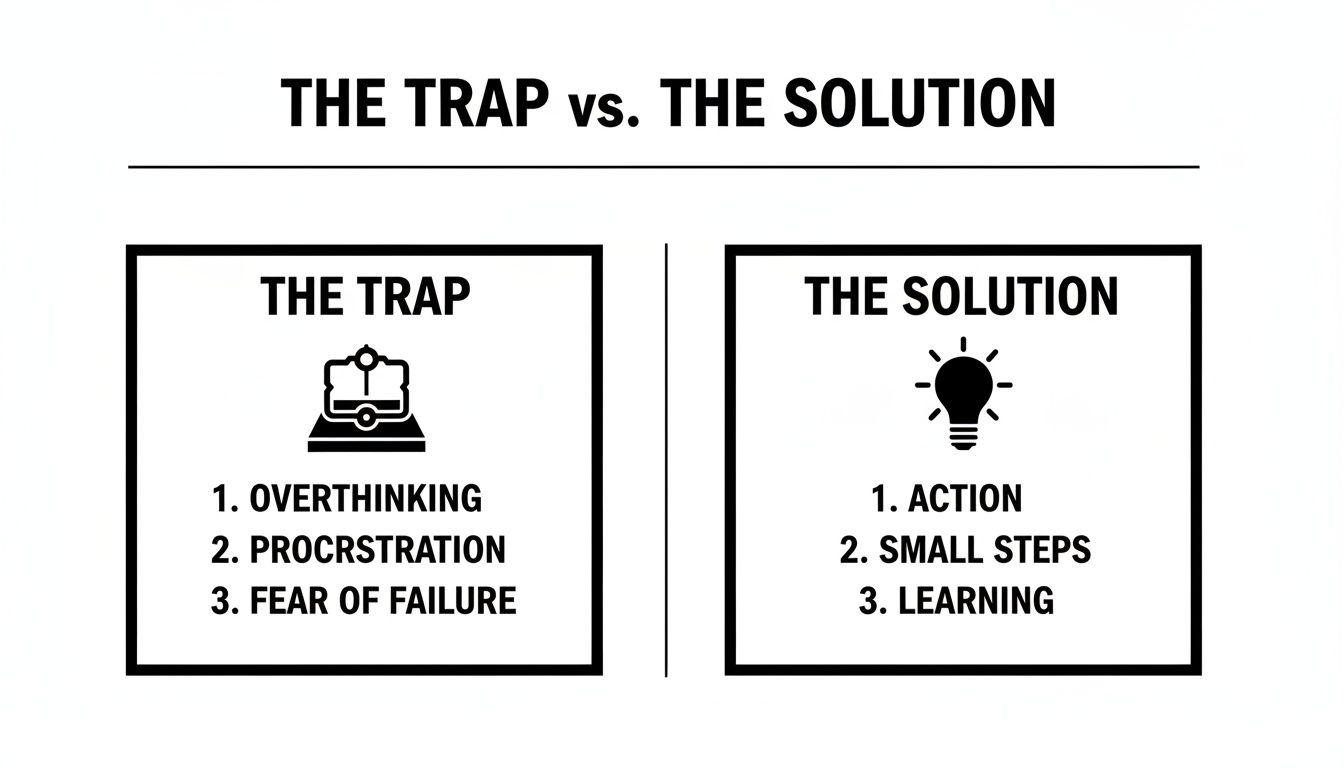
It’s the difference between being yanked around by fear and consciously choosing your response from a place of self-awareness and calm.
This next table breaks down what that looks like in real-time. It contrasts the automatic, reactive patterns of the anxious-avoidant dynamic with the secure, intentional responses that you can learn. Think of it as a cheat sheet for shifting from "The Trap" to "The Solution."
The Anxious-Avoidant Cycle vs The Secure Path Forward
| Challenge | Anxious-Avoidant Reaction (The Trap) | Secure Response (The Solution) |
|---|---|---|
| Partner Seems Distant | Anxious: Pursues harder, asks for reassurance, fears abandonment. Avoidant: Withdraws further, stonewalls, feels suffocated. |
Anxious: Self-soothes first, then communicates a need for connection calmly. Avoidant: Notices the urge to flee, takes space respectfully, and reassures partner of return. |
| Conflict or Disagreement | Anxious: People-pleases, fears being "too much," avoids stating true needs. Avoidant: Shuts down, deflects, avoids emotional topics entirely. |
Both partners learn to pause, regulate their nervous systems, and use repair tools to have a constructive conversation without attacking or defending. |
| Need for Space | Anxious: Interprets space as rejection, panics. Avoidant: Takes space without communication, leaving partner in the dark. |
Avoidant: "I need some quiet time to process. I'll check back in with you in an hour." Anxious: "Okay, thank you for letting me know. I'll use this time to do something for myself." |
Recognizing your side of the "trap" is the first, most powerful step. From there, you can start practicing the corresponding secure response, even when it feels unnatural at first.
The Path to a Secure Connection
So, how do you actually make an anxious-avoidant relationship work? You have to learn a new way of dancing together. Instead of getting tangled up in that reactive cycle, you learn to create safety—first for yourself, and then for each other.
This isn’t about changing who you are. It’s about adding new skills to your toolbox so you can stop playing out old survival scripts and finally build the secure, loving connection you both crave.
Throughout this guide, we're going to dive into the practical tools you need to do just that. We'll cover:
- How to build empathy and see your partner's behavior as their attempt to find safety, not a personal attack on you.
- Body-based tools for nervous system regulation to calm your own anxiety or overwhelm before you react.
- New communication and repair rituals for navigating hard conversations in a way that actually builds trust.
- The art of setting healthy boundaries that protect your peace without pushing your partner away.
This is where the real work—and the real transformation—begins.
Understanding Your Partner's World From the Avoidant Perspective
If you’re trying to make an anxious-avoidant relationship work, the first and hardest step is to move beyond blame. I know how difficult this is when you’re feeling hurt and abandoned, but it’s the only way to break the cycle.
What you feel as rejection is almost never about you. It's a deeply wired self-protection strategy, and understanding it is the key to finding compassion for both of you.
When someone with an avoidant attachment style asks for space, it’s not a personal attack—it’s a physiological need. Their nervous system has learned that too much closeness can feel overwhelming, controlling, or even suffocating. When you push for connection, their internal alarm system screams threat, and their only survival instinct is to retreat to a safe distance where they can catch their breath.
The Logic Behind the Withdrawal
This pattern often starts in childhoods that, from the outside, might have looked perfect. Many people with an avoidant style were praised for being independent, self-reliant, and "easy" kids who weren't needy. They learned early on that their emotional needs were an inconvenience or a burden to their caregivers.
So what did they do? They adapted. They learned to soothe themselves, push down their feelings, and rely on no one but themselves. This creates a high-functioning adult who crushes it at work and seems to have it all together, but finds real emotional intimacy completely destabilizing.
The very skills that make them successful in their career—like emotional compartmentalization and autonomy—suddenly become a huge liability in their romantic relationship.
I see this all the time. Think of the high-achieving executive who can command a high-stakes boardroom without breaking a sweat, but completely freezes when their partner says, "We need to talk about our feelings." The boardroom is structured and safe; the emotional conversation feels like a minefield threatening their very sense of self.
To the anxious partner, the withdrawal feels like "You don't love me." To the avoidant partner, the pursuit feels like a threat to their survival. Seeing this core difference is the first step toward real connection.
This dynamic is incredibly common. An eye-opening survey of over 5,000 adults revealed that about 20% of Americans—that’s over 50 million people—identify with an avoidant attachment style. The research also showed that men are significantly more likely to have this style, which is why the anxious-female and avoidant-male pairing shows up so often in my practice. You can read more about these patterns in this great overview of avoidant attachment on webmd.com.
Reframing Their Need for Space
When your partner pulls away, every instinct in your body might be screaming to close the distance. But the most powerful thing you can do is reframe what their request for space actually means.
- It's a Need for Regulation, Not Rejection: They aren't pushing you away; they are trying to manage a nervous system that is completely overwhelmed. Solitude is often the only tool they have to get back to a state of calm.
- It’s a Search for Safety: Their retreat is an attempt to find safety, just like your pursuit is your attempt to find safety. You’re both trying to get to the same place, just using opposite strategies.
- It’s a Sign of a Low Capacity, Not Low Care: An avoidant partner can love you deeply but have a very limited capacity for sustained emotional closeness. Think of it like a social battery that gets drained to zero during intense moments. They need to go off and recharge before they can show up for you again.
This is the insight that changes everything for couples stuck in this dance. When you can see their behavior not as a personal insult but as a predictable, non-malicious coping mechanism, the whole dynamic starts to soften.
Instead of reacting with panic, you can learn to respond with understanding. This doesn’t mean you have to swallow your own needs. It means you start creating enough safety in the relationship for both of you to get what you need—your connection and their autonomy. Shifting from blame to compassion is what finally allows the healing to begin.
Calming the Storm With Nervous System Regulation
Once you’ve started to build compassion for your partner's world, the real work begins. And it starts with you. This is where you learn to manage your own internal world, especially when your anxious attachment style takes the wheel.
For my clients with anxious attachment, this is the game-changer. It’s not about trying to “be less anxious”—that’s impossible. Instead, it’s about learning to speak your body’s language and give your nervous system what it needs to feel safe, even when your partner pulls away.
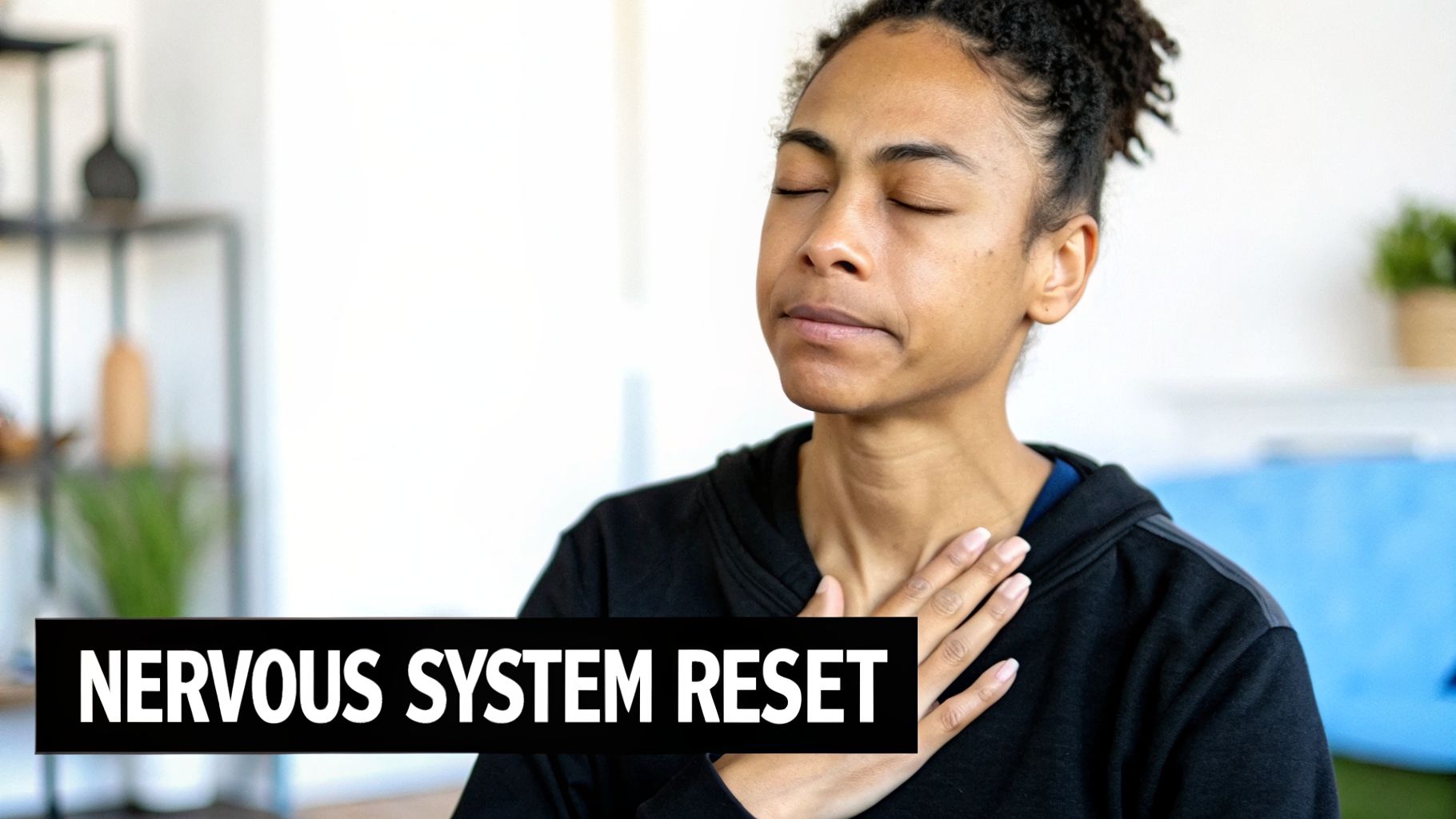
When your partner says, “I need space,” your body can register that as a life-or-death threat of abandonment. Your heart pounds, your thoughts spiral, and every cell in your body screams to bridge that distance right now.
These body-based practices are your first line of defense. They send a direct message from your body back to your brain that says, "I am safe right now."
The Containment Visualization
This is my go-to for those moments when your emotions feel way too big to handle—like when a text has gone unanswered for hours and the panic starts to set in. Instead of letting that feeling flood you, you’re going to mentally “contain” it.
- Name the Feeling: Close your eyes and just acknowledge what's there, without judgment. "This is panic." "This is the fear of being left."
- Picture a Container: Imagine a strong, secure container. Maybe it’s a beautiful wooden box, a heavy-duty metal vault, or whatever feels solid and safe to you.
- Place the Feeling Inside: In your mind, gather up that overwhelming emotion and gently place it inside your container. See yourself closing the lid, maybe even locking it.
- Set It Aside: This isn't about suppressing the feeling. It's about consciously choosing to deal with it later. Tell yourself, "I will come back to this when I feel more resourced."
This simple visualization creates breathing room. It halts the immediate spiral and hands the control back to you, stopping you from sending that string of reactive texts you'll regret later.
Vagal Tone Reset Breathing
Your vagus nerve is a powerhouse in your nervous system. Think of it as the emergency brake for your body's stress response. You can tap into this calming system with a simple breath pattern.
- Inhale Slowly: Breathe in through your nose for a count of four.
- Hold for Two: Gently hold that breath for a count of two.
- Exhale Longer: Breathe out slowly through your mouth for a count of six or even eight. The long exhale is the most important part; it’s what stimulates the vagus nerve and tells your body it’s safe.
Do this 5-10 times. You can do it anywhere—in your car, at your desk, or in the bathroom—the moment you feel that familiar wave of anxiety creeping in. It's like hitting a biological reset button. Since effectively regulating stress and anxiety is key for both partners, finding what works for you is crucial.
The goal of nervous system regulation isn't to eliminate anxiety. It's to increase your capacity to hold discomfort without being hijacked by it. This is how you build internal safety, the true foundation of a secure attachment.
Five Senses Grounding Practice
When your mind is off to the races with "what if" scenarios, this practice yanks you back into the present moment. It short-circuits the anxious thought loop by forcing your brain to focus on real, tangible sensations.
Just go through your five senses and name what you perceive right now:
- 5 Things You Can See: The pattern on your mug, the light hitting the wall, a book on the shelf, the color of your own shirt, a tree outside the window.
- 4 Things You Can Feel: The solid chair beneath you, your feet flat on the floor, the texture of your jeans, the cool air from the vent.
- 3 Things You Can Hear: The hum of your computer, a distant siren, the sound of your own quiet breath.
- 2 Things You Can Smell: The faint scent of old coffee, the soap on your hands.
- 1 Thing You Can Taste: The lingering flavor of toothpaste or your morning tea.
Practicing these when you're already calm is key. It builds the muscle memory so you can access these tools when you’re in a crisis. If you want to dive deeper, you can explore our guide on what is nervous system regulation. This is how you stop reacting and start responding—and that changes the entire dance of your relationship.
When you're trying to navigate an anxious-avoidant relationship, the goal isn't to find the "perfect" words to fix everything. Let's be real, that's not how human connection works. It’s about creating a conversation that actually feels safe. Tangibly safe.
This means stepping out of that painful, familiar dance of blame, defensiveness, and shutting down.
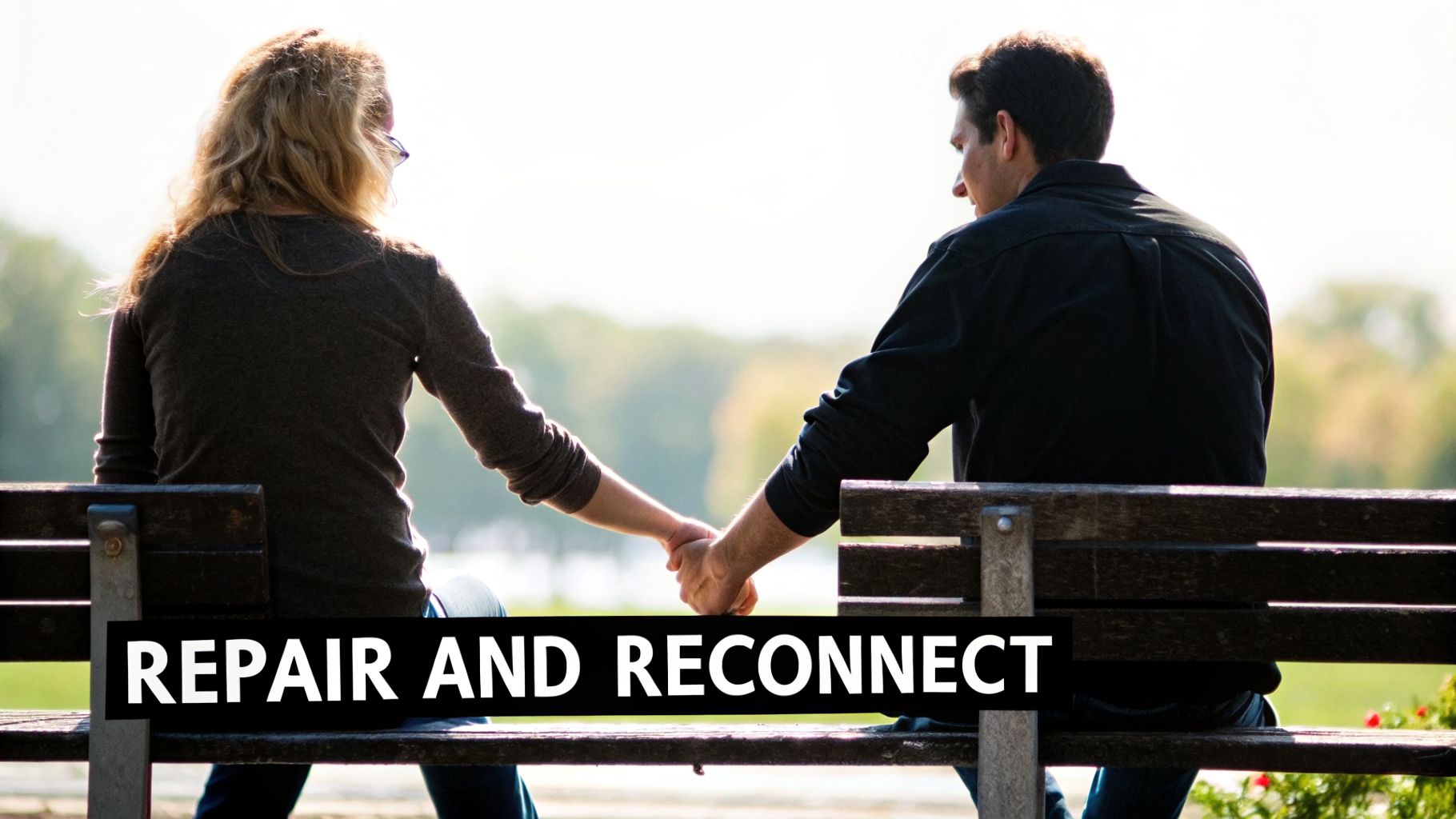
When a fight breaks out, both of your nervous systems go into high alert. The anxious partner's deepest fear—abandonment—surfaces. For the avoidant partner, it’s the fear of being swallowed whole, of losing themselves. The only way through is to build new rituals that honor both of those fears at the same time.
Think of these rituals as a predictable container for your big feelings. They stop you both from getting emotionally flooded, so you can actually talk about your needs without attacking or shutting down completely. That predictability is incredibly soothing for a nervous system that's screaming "DANGER!"
A New Script for Hard Conversations
Let's be honest: your old ways of talking during conflict probably don't work because they feel emotionally threatening. One person’s bid for connection sounds like a criticism to the other, which immediately triggers a wall to go up. A bit of structure can help you both de-escalate and actually hear each other.
Here are some sentence starters designed to make these conversations less threatening and more collaborative.
For the Anxious Partner (to soften your approach):
- "I'm feeling a little disconnected. The story I'm telling myself is… could you help me understand what's real?"
- "I feel anxious when [specific behavior happens]. Would you be willing to [suggest a small, concrete action]?"
- "I'd love to feel closer to you. When would be a good time for us to connect for just a few minutes?"
For the Avoidant Partner (to set boundaries with respect):
- "I'm feeling overwhelmed and need some space to process. I can check back in with you in [specific timeframe, e.g., 30 minutes]."
- "This is important, and I want to hear you. Can we take a short break so I can show up better for this conversation?"
- "When you [specific action], it makes me feel pressured. Could we try [alternative approach] instead?"
Using these scripts shifts the dynamic. You're no longer in a fight to win. You're working together to understand each other's inner worlds. If you find these conversations are still a major struggle, it might be helpful to dig deeper into how to address poor communication skills in relationships.
The Power of the Repair Ritual
Disconnections are going to happen. You will hurt each other's feelings—that's a guarantee in any relationship, but especially in an anxious-avoidant one. Secure relationships aren’t built on never fighting; they’re built on getting really good at repairing after the fight.
Repair is the most critical skill for long-term success. It's the concrete proof that you can come back together after a rupture, which builds trust and deepens the bond over time.
A fantastic place to start is with the "20-Minute Co-Regulation Break." When things get heated, either of you can call a timeout. You agree to separate for 20 minutes with one non-negotiable rule: you will reconnect afterward.
Here’s how it works:
- Separate and Self-Soothe: This is not the time to replay the argument in your head. Do one of the nervous system regulation exercises you learned, like box breathing or a grounding technique.
- Reconnect Non-Verbally: When you come back together, resist the urge to jump back into the fight. Start by re-establishing safety without words. Hold hands. Sit next to each other on the couch. Give a simple hug.
This simple ritual breaks the cycle of escalating and proves, over and over, that you can find your way back to each other.
While U.S. surveys show 63.5% of adults consider themselves securely attached, it’s the insecurely attached folks—an estimated 22.2% avoidant and 5.5% anxious—who end up driving 85% of therapy utilization. This tells me that even though these dynamics are incredibly challenging, they also push couples to actively seek growth and learn how to repair. You can explore more data on these attachment patterns and therapy-seeking behaviors if you're curious about the numbers.
When It’s Time to Move from Surviving to Thriving (and Get Professional Support)
Trying to make an anxious-avoidant relationship work can take a massive amount of effort. Even when you have all the right strategies, sometimes self-help just isn't enough to break patterns that have been ingrained for a lifetime.
Hitting that wall isn’t a sign that you’ve failed. It’s actually a courageous moment of commitment to your relationship’s future.
If you feel like you’re just spinning your wheels, it might be time to bring in a professional guide. This is especially true if you recognize these painful, recurring signs:
- The Same Fight, Over and Over: It feels like you’re stuck in a script you can’t escape. You have the exact same argument on a loop, and every time it ends, you both feel more alone and misunderstood than before.
- A Deep Sense of Loneliness: You feel profoundly lonely, even when you’re in the same room. That emotional bridge between you feels like it's crumbling, and the gap just keeps getting wider.
- Old Wounds Keep Showing Up: Unresolved trauma—whether from childhood or past relationships—is constantly hijacking your dynamic. One partner's terror of abandonment or the other's fear of being smothered is so powerful that it sabotages any real attempt at connection.
If these patterns feel painfully familiar, it’s a clear sign that the wounds are too deep to be fixed with communication tips alone.
Finding the Right Kind of Help Is Everything
When couples finally decide to get help, they often make one critical mistake: they assume all therapy is the same.
Traditional talk therapy, which focuses on changing thoughts and behaviors, often misses the mark for anxious-avoidant pairs. Why? Because it fails to address the real root of the problem: nervous system dysregulation.
You can't just talk yourself out of a biological survival response. This is why so many couples I see have left therapy feeling even more hopeless. The anxious partner felt heard but was still in a state of panic, and the avoidant partner felt blamed and retreated even further.
The key is to find a specialist who works with attachment and the nervous system. This approach goes beyond what you think and gets to the heart of what you feel on a physiological level. It's about rewiring the system, not just managing the symptoms.
Attachment-focused, trauma-informed therapy works from the bottom up. It helps you understand why your body is reacting with such intensity and gives you the somatic tools to regulate those deep-seated responses. It’s about creating a space where both partners can finally feel safe enough to put down their armor.
Recognizing the signs that you need this kind of specialized help is a huge step. You can learn more about some of the key relationship therapy signals that tell you it’s time to reach out.
Moving from Insight to Real, Embodied Change
A therapist who specializes in attachment trauma won't just ask, "So, how did that make you feel?" They'll guide you to notice the actual sensations in your body when you feel activated or shut down.
They help the anxious partner build a true, felt sense of safety within their own body, and they help the avoidant partner gently expand their capacity for connection without feeling overwhelmed and needing to bolt.
This is the exact work we do at Securely Loved. It’s not about finding some perfect, intellectual compromise. It’s about helping each of you build the internal resources you need to finally show up for yourselves, and for each other, in a new way.
It’s about creating an environment where the anxious partner learns to self-soothe and the avoidant partner learns that connection doesn't have to mean suffocation.
This path is especially powerful for those who have tried everything else without success. If you're ready to stop the painful cycle and explore a much deeper level of healing, learning more about specialized attachment trauma therapy is a powerful next step.
Reaching out isn't admitting defeat. It’s the first real step toward building the secure, thriving partnership you both deserve.
Your Questions, Answered
When you're trying to heal the anxious-avoidant dynamic, a lot of questions—and fears—come up along the way. I get it. Below are some of the most common ones I hear in my practice, with the kind of direct, practical answers you need to keep moving forward.
Can an Avoidant Partner Really Change?
Yes, they absolutely can. But we need to get clear on what "change" actually means here. It's not about "fixing" them or trying to mold them into a different person.
Real, lasting change for someone with an avoidant style is about them slowly building the capacity for emotional intimacy in a way that finally feels safe.
This happens when they learn to manage their own nervous system when that old, familiar urge to pull away kicks in. It doesn't happen because they're pressured, shamed, or chased into opening up. In fact, when an anxious partner learns to respect their need for space—and stops treating it like a personal rejection—the avoidant partner often feels safe enough to start moving closer, completely on their own terms.
The biggest paradox is this: when the anxious partner stops pursuing, the avoidant partner finally feels enough space and safety to turn around and move toward them.
This is where specialized coaching or therapy comes in. It helps them connect the dots back to their childhood—where fierce independence was a survival skill—and practice new, tangible ways of connecting that don't trigger a total shutdown. It’s a slow, steady process of expanding their window of tolerance for closeness, not yanking them out of their comfort zone.
What if My Partner Refuses to Do the Work?
This is one of the most painful and real fears for anyone in this dynamic. And the hard truth is, you can't love, convince, or argue someone into changing. That journey has to be their own.
But this is not a dead end for you. You can completely shift the dance by focusing on your own healing. As the anxious partner, when you learn to self-regulate, build a solid foundation of internal safety, and stop reacting to their distance with panic and pursuit, the entire dynamic has to change. You're changing your steps, so the old dance is no longer possible.
Often, when an avoidant partner sees you becoming more secure, less reactive, and more fulfilled in your own life, it does two powerful things: it creates safety and curiosity. Your calm presence is no longer a threat, and they may become genuinely curious about the changes they see in you. That curiosity is often the very thing that sparks their own desire for self-exploration.
How Long Does It Take to See Real Improvement?
There's no set-in-stone timeline, but you can feel things start to shift much sooner than you might think. Building a truly secure attachment is a long-term journey, but most couples who commit to this work report feeling a real drop in conflict intensity within just a few months.
The very first sign of progress is moving from a state of constant crisis to having a shared language and toolkit. You'll notice the fights still happen, but they become shorter and you repair them faster. A conflict that used to spiral into three days of silence might now get resolved in a few hours.
Think of the progress in stages:
- Initial Weeks: You'll start to see your own patterns more clearly. You’ll have small but huge wins, like choosing not to send that reactive text message.
- First Few Months: You might successfully use a repair ritual for the first time, like the 20-minute co-regulation break. It might feel awkward, but it works.
- Six Months and Beyond: The new communication scripts begin to feel more natural. You start to anticipate each other's triggers with more compassion and less panic.
Lasting change is a marathon, not a sprint. But the immediate relief you get from just breaking the cycle is incredibly motivating and gives you the fuel to keep going.
My Partner and I Are Both High-Achievers. Why Is Our Relationship So Hard?
This is a paradox that confuses so many successful, high-functioning adults. You can run a company, manage a team, and conquer every other area of your life, yet feel like you're completely failing in your relationship.
Here's why: your attachment patterns operate from a much deeper, more primal part of your brain than your professional skills do. These patterns were wired into your nervous system in childhood, long before you learned how to negotiate a deal or write a business plan.
For many high-achievers, especially those with avoidant tendencies, success was built on compartmentalizing emotions. The very skills that make you incredible at your job—like emotional detachment, hyper-independence, and logical problem-solving—are the exact opposite of what’s required for deep intimacy.
In your relationship, you're being asked to learn an entirely new skill set: emotional vulnerability, co-regulation, and how to tolerate the beautiful messiness of interdependence. The work isn't about being less successful; it's about adding a whole new dimension of relational intelligence to your already impressive toolkit.
At Securely Loved, we specialize in helping individuals and couples break these painful cycles and build the secure, connected relationships they’ve always wanted. If you recognize yourself in these patterns and are ready to move from surviving to thriving, I invite you to book a free, no-obligation connection call. This is your first step toward deep, sustainable healing. Learn more and book your call.