
Healing Avoidant Attachment Styles
An avoidant attachment style isn't a character flaw or a personality defect. It's a protective shield your nervous system built in childhood when your emotional needs weren't consistently met, leading you to prioritize independence and suppress your feelings as an adult. Think of it as a brilliant, yet outdated, survival strategy.
Deconstructing Avoidant Attachment Styles
Have you ever felt like you're a total rockstar in every area of your life—career, friendships, personal goals—but the moment someone gets emotionally close, an invisible wall shoots up? You might suddenly start picking them apart, feeling an overwhelming urge for space, or burying yourself in work. This confusing push-pull, a deep desire for connection met with an equally powerful fear of being vulnerable, is the signature struggle of the avoidant attachment style.
To really get what's happening here, we first have to look at the basics of attachment theory. This framework shows us how our very first relationships with caregivers create the blueprint for how we connect with others for the rest of our lives. When a child learns that reaching out for comfort is either ignored or dismissed, they internalize a powerful lesson: relying on others isn't safe. So, they adapt by becoming fiercely self-reliant.
The Lone Wolf And The Hesitant Dancer
But avoidant attachment isn't a one-size-fits-all pattern. It shows up in two main ways, each with its own internal logic and way of relating to others.
Dismissive-Avoidant ("The Lone Wolf"): This is the person who values their independence above all else. They often see themselves as strong and completely self-sufficient, sometimes viewing emotionally open people as "needy" or "dramatic." For them, real intimacy feels suffocating, and they cope by detaching from their own emotions and the feelings of their partners. You can dive deeper into this pattern in our guide to the dismissive attachment style.
Fearful-Avoidant ("The Hesitant Dancer"): This person lives in a state of intense internal conflict. They desperately want to be close to someone but are also terrified of the very thing they crave. This fear of being hurt or rejected creates a confusing "come here, go away" dance, where they pull people in only to push them away when things get too real.
To help you see the difference more clearly, here’s a quick breakdown of how these two styles show up in the real world.
Two Types of Avoidant Attachment at a Glance
| Characteristic | Dismissive-Avoidant | Fearful-Avoidant (Disorganized) |
|---|---|---|
| Core Belief | "I don't need anyone. I'm fine on my own." | "I want to be close, but I'm afraid you'll hurt me." |
| View of Self | Highly positive; self-sufficient and strong. | Fluctuates between positive and negative; often feels unworthy of love. |
| View of Others | Negative; sees others as needy or unreliable. | Negative; sees others as untrustworthy and a potential source of pain. |
| In Conflict | Shuts down, withdraws, becomes emotionally unavailable. | Can be unpredictable; may lash out, withdraw, or become anxious. |
| Intimacy Fear | Fear of losing independence and being engulfed. | Fear of both intimacy (being hurt) and abandonment (being alone). |
While their behaviors can look different on the surface, both styles are rooted in the same core wound: a deep-seated belief that true emotional closeness is unsafe.
This diagram helps visualize where the avoidant style fits into the bigger picture of attachment, branching off from the main category of insecure attachment.
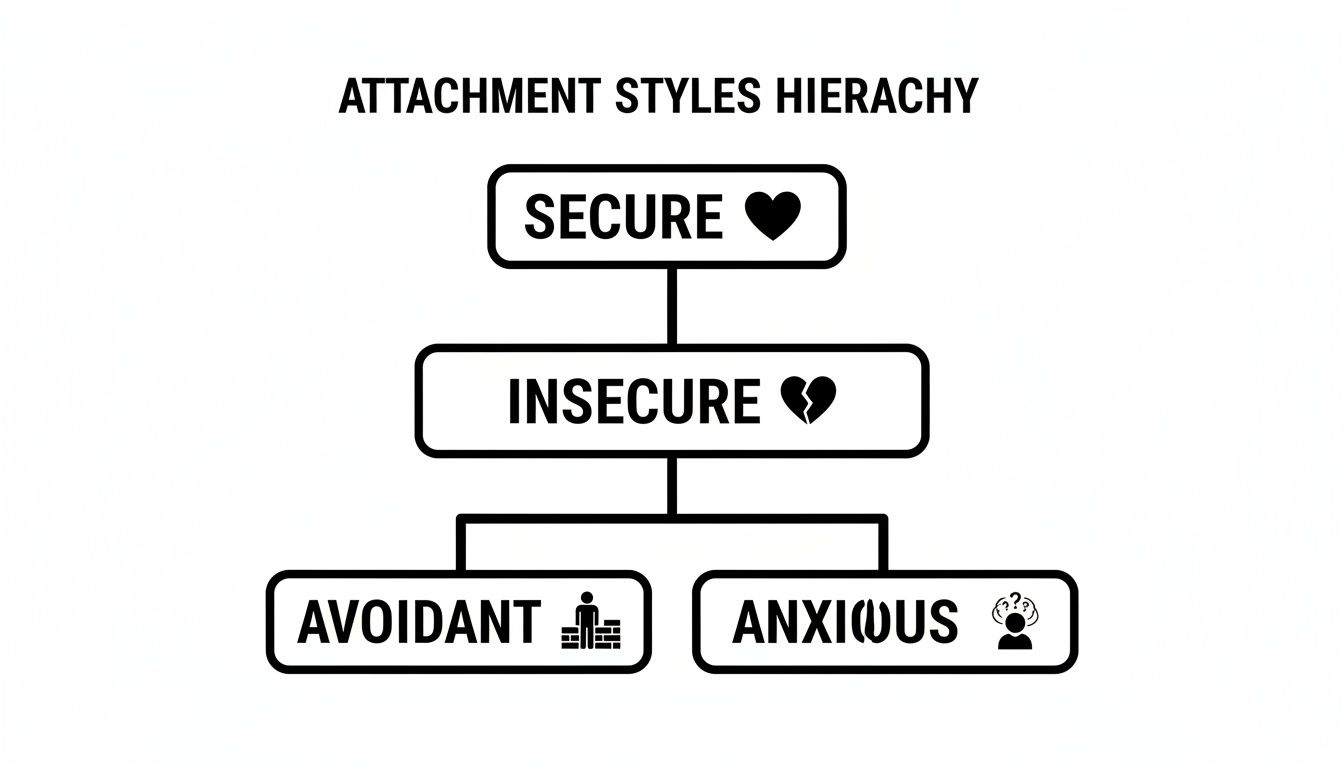
As you can see, the avoidant pattern is one of the two primary insecure styles, alongside the anxious style, both stemming from a foundation that isn't secure.
If any of this is starting to sound painfully familiar, please know you are far from alone. Research shows that avoidant attachment is incredibly common. One major meta-analysis found that dismissive-avoidant attachment is present in about 25% of adults. With secure attachment at around 59%, that means more than 40% of the population is navigating their relationships with some form of insecurity.
"Understanding your attachment style isn't about labeling yourself. It’s about recognizing a set of brilliant, yet outdated, survival strategies your nervous system developed to keep you safe in childhood. The goal is not to shame these parts, but to thank them for their service and gently update them for the secure, connected adult life you deserve." – Bev Mitelman, Securely Loved
The first, most powerful step toward healing is to see this pattern not as a personal failure, but as a logical adaptation. This simple shift reframes the entire journey. You're not trying to fix something that's broken; you're updating a protective system that no longer serves your adult desire for deep, meaningful, and secure love.
Recognizing the Common Signs and Behaviors
Trying to spot avoidant attachment patterns—whether in yourself or someone else—can feel tricky. These aren't character flaws; they're protective shields that were built a long, long time ago. They show up as an invisible wall that keeps intimacy just out of arm's reach.
By understanding what these behaviors look like without judgment, you can start to see why they showed up in the first place and decide if they’re still actually keeping you safe.

These signs tend to surface in three key areas: how you show up in your relationships, how you handle disagreements, and what’s really going on in your internal world. Let’s break down what this actually looks like in day-to-day life.
In Your Relationships
The main job of an avoidant strategy is to keep emotional closeness at a manageable distance. This doesn’t mean you avoid relationships altogether. It means you unconsciously put the brakes on how deep they’re allowed to get.
You fixate on flaws when intimacy deepens. In the beginning, a new partner might seem perfect. But as you get closer, you start noticing—and getting irritated by—every little imperfection. Suddenly their laugh is too loud, they chew funny, or their taste in movies is a deal-breaker. This is a subconscious tactic to create distance and give you a "good reason" to pull back.
You put everything else before the relationship. Your job, your hobbies, your solo "downtime"—these things always seem to win out over spending quality time with a partner. You might tell yourself you're just ambitious or independent, but the pattern keeps you from ever having to be fully present and vulnerable in the connection.
You feel "suffocated" by normal relationship requests. When a partner asks for a little reassurance, wants to plan a weekend together, or shares their feelings, it can feel like way too much. An internal alarm bell goes off, screaming, "Too close! Danger!"
During Conflict
Conflict is a fast track to raw emotion and vulnerability—the very two things an avoidant attachment style is designed to suppress. So when a disagreement comes up, the protective shield goes up instantly.
You might notice a pattern of:
Intellectualizing emotions. Instead of saying, “I feel hurt by what you said,” you might respond with, “Logically, that reaction seems disproportionate to the situation.” You analyze the argument from a detached, clinical point of view, steering clear of the messy and unpredictable world of feelings.
Shutting down entirely (stonewalling). This is the classic “I’m fine” when you are clearly anything but fine. You go quiet, withdraw, or physically leave the room. This isn’t just about needing a moment; it’s a full-body nervous system response that makes emotional engagement feel impossible.
Blaming your partner for being "too emotional." Their tears or raised voice are labeled as the problem—an overreaction. This move cleverly deflects from the real issue and your own intense discomfort with their emotional display.
Your Inner World
The most powerful signs of an avoidant style are often the quietest ones—the experiences happening inside your own mind and body. These internal patterns are the engine driving all the external behaviors.
"Many people with avoidant patterns are masters of self-reliance, but this strength often hides a secret fear: that needing someone is a weakness, and being needed is a trap. The internal narrative is often, 'I'm better off alone,' even when loneliness is painful."
This inner experience often includes:
Feeling easily overwhelmed by other people’s needs. Even a friend asking for simple advice can feel like a heavy weight. You feel an unspoken pressure to fix their problems, which makes you want to retreat into your own world.
A habit of idealizing 'phantom exes'. You might find yourself missing past partners after a breakup, conveniently forgetting all the reasons you felt smothered and wanted to leave. From a distance, the relationship finally feels "safe" again, allowing you to crave the connection without the real-world threat of intimacy.
A deep-seated belief that you are fundamentally on your own. Beneath the capable, independent surface is often a quiet resignation that, when it really comes down to it, you can only ever truly count on yourself.
Where Avoidance Begins: A Look at Our Childhood Roots
No one comes into this world with an avoidant attachment style. It’s a brilliant protective shell we build brick-by-brick in early childhood, a time when our very survival hinges on the connection we have with our parents or caregivers. Looking back at these roots isn’t about blame. It’s about wrapping our arms around that younger version of ourselves who learned, very early on, that self-reliance was safer than connection.
To really get it, we have to look at the kinds of homes that often nurture avoidance. These aren't always places of obvious abuse or neglect. More often, they are homes where emotions were simply not welcome at the dinner table—either subtly or very, very loudly.

Picture a small child who takes a tumble off their bike and runs to a parent, sobbing. Instead of getting a hug, they hear, “You’re fine. Shake it off. Big kids don’t cry.” What’s the lesson here? My feelings are a problem. That child learns to swallow their tears, patch up their own scraped knee, and perfect the art of saying, “I’m okay.”
The "Easy Kid" and the Burden of Independence
In some families, the script is a little different. A child's independence is praised so much that it becomes the only way they feel loved. They’re the "good little helper" or the "easy kid" who never makes a fuss or asks for anything.
This child internalizes a painful equation: Independence = Love, but Needing Someone = A Burden. They become experts at reading the room, sensing their parents’ stress, and squashing their own needs to keep the peace. They carry this blueprint into their adult relationships, convinced that to be loved, they must be completely self-sufficient.
Sometimes, a caregiver's capacity to be emotionally present is simply diminished because they are struggling themselves. Conditions like postpartum depression can make consistent, warm attunement incredibly difficult. It’s helpful to understand the postpartum depression warning signs to see how this can affect the whole family. This isn't about making excuses; it's about adding a layer of compassion for both the parent who was struggling and the child who had to adapt.
Your Nervous System's Faulty Smoke Detector
Think of your nervous system as a highly sensitive smoke detector, designed to alert you to danger. In a securely attached person, that alarm is well-calibrated. It goes off when there’s a real fire.
But for someone with an avoidant adaptation, that smoke detector was wired differently. Early experiences taught them that reaching out for closeness often led to being dismissed, ignored, or shamed. So, their nervous system learned to code intimacy itself as a fire.
Your nervous system started to see closeness not as a safe harbor, but as the storm itself. That powerful urge you feel to pull away isn't a character flaw. It’s a survival signal from a system still trying to protect you from a threat that is long gone.
This adaptation is more common than you might think. A global meta-analysis showed that 14.7% of children display signs of avoidant attachment. These are the toddlers who explore a new room without a backward glance and, when their parent returns, treat them almost like a stranger. It's a clear survival strategy learned from an environment that was emotionally distant or unpredictable.
Understanding these origins can shift everything. It moves the conversation from self-blame to self-compassion. Your avoidant patterns aren't proof that you are broken or "bad at relationships." They are the echoes of signs of unresolved childhood trauma in adults. Recognizing them for what they are—brilliant strategies that helped a younger you survive—is the first step. Now, as an adult, you get to gently update those strategies for the secure, connected life you truly want and deserve.
How Avoidance Shapes Your Relationships
It's one thing to read about having an avoidant attachment style, but it’s a whole other thing to watch it play out in real-time in your relationships. This pattern isn’t just some internal feeling you have; it’s an active force that choreographs the dance between you and your partner, often creating a confusing and painful distance.
This is the invisible script that can turn a loving connection into a heartbreaking cycle of push and pull. To really see how this works, let's look at one of the most common dynamics I see in my coaching practice.
The Anxious-Avoidant Dance
Let’s imagine a couple, Alex and Jamie. Alex has an avoidant attachment style, and Jamie has an anxious one. When they first get together, the connection feels electric. For a little while, everything is perfect because both of their attachment systems are getting exactly what they crave.
Alex gets to experience a powerful connection without the immediate pressure of true, deep vulnerability. Meanwhile, Jamie feels incredibly seen and wanted, which quiets their deep-seated fear of being abandoned. But as the relationship naturally moves toward deeper intimacy, both of their core wounds get triggered.
Jamie starts to need more reassurance and closeness. For Alex, whose nervous system is wired to see this as a threat, that internal "smoke detector" we've talked about starts blaring. To get back to safety, Alex does the only thing they know how to do: pull away.
At first, this retreat can be subtle. They might start:
- Working late more often.
- Saying they need more "solo time."
- Becoming quieter and less emotionally available.
For Jamie, this distance sets off their own internal alarm. Their fear of abandonment goes into overdrive, and they react by chasing Alex for connection. This is called a protest response. They might start texting more, calling more, or trying to force a serious conversation to close that terrifying gap.
This push-pull dynamic isn't a sign that you're incompatible or in a "bad" relationship. It's a clash of survival strategies. One person’s solution (space) is the other person's biggest trigger, creating a painful, self-feeding loop.
The more Jamie pursues, the more smothered and overwhelmed Alex feels, which makes them pull back even further. Alex’s system is screaming for space to feel safe, while Jamie’s is screaming for closeness to feel secure. Neither person is "wrong"; their nervous systems are just running on conflicting, outdated programming from their childhoods.
This video from Bev Mitelman compassionately walks through this cycle, helping you see how these opposing needs create such a painful trap. Shifting your perspective to see the pattern—not the person—as the problem is the first step toward breaking free.
When Two Avoidants Get Together
So, what happens when two people with avoidant attachment get into a relationship? You might think it would be a complete disaster, but what often happens is something else entirely: a unique kind of stability.
Instead of the chaotic push-pull you see with an anxious partner, two avoidants can create a relationship that is stable but distant. It's an unspoken agreement where both partners keep deep emotional intimacy at a safe distance.
From the outside, this relationship can look incredibly functional. They might be a "power couple," fantastic co-parents, or successful business partners. Their life together is organized, efficient, and pretty much free of emotional drama.
But just under the surface, there's a profound lack of true vulnerability and connection.
- Feelings are rarely, if ever, discussed. Conversations stick to safe, logistical topics like work schedules, finances, or what the kids are doing.
- Independence is valued far more than interdependence. Each person has their own separate life—their own friends, their own hobbies, their own emotional world.
- Conflict is rare because emotional expectations are so low. Since neither partner is asking for deep intimacy, there’s very little to argue about.
While this can feel safe and predictable, it often leads to a quiet, gnawing loneliness that lives right in the middle of the relationship. It's a silent pact to never truly challenge each other's walls, which prevents the very kind of deep, fulfilling connection that, deep down, both of them may secretly want. Seeing this pattern for what it is gives you the power to consciously choose a different way to relate.
A Practical Guide to Healing Your Attachment Style
If you have an avoidant attachment style, the idea of “healing” can feel daunting. It’s not about trying to erase your history or force yourself to become some bubbly, over-sharing version of a person that just isn't you.
Think of it more like gently updating your internal software—the programming that taught you to prioritize self-protection above all else. This journey isn't about thinking your way into a new personality. It’s about teaching your body, from the ground up, that connection can actually be safe.
The goal here isn't to dive headfirst into vulnerability. That would just send your nervous system into a panic. Instead, we’re going to slowly expand your capacity to feel safe while you’re connecting with someone. We'll do this by focusing on three core areas: mindful awareness, somatic regulation, and taking tiny risks with vulnerability.
Cultivate Mindful Self-Awareness
The very first step is simple, but not easy: you just have to notice. Without judgment, and without the pressure to fix anything, you need to become an expert observer of what's happening inside you.
That powerful, full-body urge to pull away from a partner? It often shows up before your conscious mind even registers a thought. Mindful awareness is the practice of catching that impulse in the act.
When your partner reaches for your hand and you feel your whole body go rigid, just notice it. When you get a text asking about your day and an instant wave of irritation washes over you, just pause. Acknowledge the feeling without needing to react to it.
A simple way to start building this muscle is with daily check-ins:
- Morning Intention: When you wake up, ask yourself, "How do I feel in my body right now?" Notice any tightness, tension, or openness without needing a story behind it.
- Mid-Day Pause: Set a quiet alarm for sometime in the afternoon. For just one minute, notice your breath and scan your body. Is there any activation? Any sense of shutting down?
- Evening Reflection: Before bed, gently look back on any moments you felt the urge to create distance. What was the trigger? What did it physically feel like in your body?
This isn’t about shaming yourself for wanting space. It’s about gathering information. By observing these patterns with genuine curiosity, you start to create a tiny bit of space between the automatic reaction and your conscious choice.
Learn Somatic Regulation
Your avoidant patterns aren't just in your head; they live in your nervous system. That classic feeling of being "suffocated" or overwhelmed by intimacy is your sympathetic nervous system screaming, "Flight!"
To heal, you have to learn to speak its language—and that language is sensation, not logic.
"You cannot think your way into a regulated nervous system. Safety is a felt sense, not an intellectual concept. The work of healing an avoidant attachment style is about teaching your body, through consistent practice, that connection is no longer a threat." – Bev Mitelman
Somatic regulation uses simple, body-based exercises to send safety signals to your brain. This quiets the internal alarm bells, making more room for connection to feel possible.
A powerful and simple technique is the Hand on Heart exercise:
- Find a quiet place where you can sit or lie down comfortably.
- Place one hand over your heart and the other on your belly. The gentle pressure and warmth are a direct signal of safety to your nervous system.
- Close your eyes if that feels okay, and bring your full attention to the feeling of your hands on your body.
- Notice the gentle rise and fall of your chest and belly with each breath. Don’t try to change your breathing; just observe it.
- Stay with this for 2-5 minutes, just allowing your body to settle.
This practice helps anchor you in the present and proves to your body, on a deeply physical level, that you are safe in this moment. If you want to explore more options, you can discover several ways to regulate your nervous system that feel right for you.
Practice Micro-Doses of Vulnerability
The final piece is to gently, and I mean gently, stretch your capacity for connection. The key is to start so small that it barely registers as a threat to your system. I call these "micro-doses" of vulnerability.
This is not about suddenly confessing your deepest, darkest fears. It’s about taking tiny, low-risk steps to let a safe person see a little more of your inner world.
Here are some real-world examples:
- Instead of just saying "My day was fine," try: "My day was pretty long. I’m feeling a little drained."
- Instead of silently stewing over a small annoyance, try: "Hey, I’m feeling a little overwhelmed by the noise right now. Would you mind if we turned the TV down a bit?"
- Instead of just thinking something positive, actually say it: "I really appreciated you making me coffee this morning. It made me feel cared for."
Every single time you share a small feeling and the world doesn't end—your partner doesn’t leave, you don’t get engulfed—you are literally rewriting that old script. You are giving your nervous system new, corrective experiences that prove connection can be safe, and maybe even a little bit wonderful.
Some Questions You Might Be Asking About Healing

Starting this journey of healing always brings up some important, and sometimes scary, questions. I get it. Below are some of the most common ones I hear in my practice, along with some honest answers to help you feel more clear.
Can an Avoidant Person Actually Change?
Yes, one hundred percent. The goal isn’t to erase who you are, but to grow into what’s known as “earned security.” This is where you consciously build new, healthier patterns for connection.
It's not about flipping a switch. It’s about taking small, consistent steps to understand yourself, learn to calm your nervous system, and practice tiny acts of vulnerability. You’re not trying to become a different person; you’re expanding your ability to let people in and teaching your body that closeness can finally feel safe.
My Partner Is Avoidant. What Can I Do to Help?
This is a tough one, because the instinct is often to push for more closeness, which only makes an avoidant partner retreat further. The most powerful thing you can do is stop trying to "fix" them and instead focus on your own security.
Model what a safe connection looks like. Learn to regulate your own anxiety, communicate your needs calmly without pressure, and hold your boundaries. Your emotional stability creates the secure base they likely never had, making it feel less risky for them to lean in when they feel ready—not when you demand it.
How Is Trauma-Informed Therapy Different?
Traditional talk therapy can be great, but for attachment issues, it often only scratches the surface. It focuses on thoughts and behaviors, but an avoidant attachment style is not just a thought pattern—it’s a survival strategy wired into your nervous system.
A trauma-informed approach understands this. It goes deeper to address the root cause, prioritizing a sense of safety in your body before you even talk about the hard stuff. Using body-based (somatic) techniques, it helps calm the fight-or-flight response that gets triggered by intimacy. This is how real, lasting change happens.
At Securely Loved, guiding adults through this exact healing process is what we do best. If you're ready to stop just understanding your patterns and start actually changing them, I invite you to book a free, no-pressure 15-minute connection call with Bev Mitelman. Let's see how we can support you.