

Unlock Love: Understanding Insecure Attachment Style
Some part of you may already know the pattern.
You meet someone and feel hooked fast. A delayed text can ruin your whole afternoon. Or the opposite happens. Someone kind and available gets closer, and suddenly you feel irritated, numb, trapped, or oddly sure they are asking for too much.
You might look high-functioning on the outside. You handle work. You show up for other people. You keep moving. But in love, dating, marriage, divorce, or even close friendship, the same pain keeps showing up in different clothes.
That does not mean you are broken. It often means you are living with an insecure attachment style.
This is not just about overthinking or choosing the wrong partner. It is a deeper relational template shaped early, then reinforced through experience. And for many adults, especially during major life shifts, this pattern is not only emotional. It is physical. Your body can start reacting to closeness, distance, conflict, uncertainty, and change before your thinking mind has caught up.
Why Your Relationships Feel So Hard
You send a thoughtful message and hear nothing back for hours.
One part of you wants to stay calm. Another part is already scanning for signs. Did you say too much? Did their tone change? Should you send a follow-up, or would that make things worse? Sometimes the reaction goes the other way. You go flat, tell yourself it does not matter, and create distance before anyone can get close enough to hurt you.

Later, you may look back and wonder why it hit so hard.
In the moment, though, your reaction is real because your nervous system is involved. Uncertainty in connection can register in the body as threat. Heart racing. Tight chest. Nausea. Restlessness. Numbness. An urgent need to fix it, flee it, or shut it down. By the time your thinking mind tries to sort out what is happening, your body may already be in a survival response.
Common signs people miss
Clients often describe this as being too sensitive, too needy, too guarded, or just bad at relationships. What I see more often is attachment distress showing up in ordinary moments.
- Texting spirals: A gap in contact starts to feel like evidence.
- Shutting down: You go quiet right when honesty and vulnerability are needed most.
- Push-pull dynamics: You crave closeness, then feel irritated, trapped, or exposed when it arrives.
- Conflict distortion: A small disagreement feels much bigger in your body than the situation calls for.
These patterns can shape dating, partnership, separation, and repair. They also tend to get louder during periods of change. Midlife, divorce, caregiving stress, perimenopause, menopause, grief, or a major health shift can lower your window of tolerance and intensify old attachment strategies. Many people think they are suddenly getting worse. Often, their system is under more strain.
The hidden pattern under the pattern
If relationships feel harder for you than they seem to feel for other people, that usually points to an old survival strategy.
When love feels confusing, your system may be responding to old threat, not current reality.
That can make neutral events feel charged. A partner asking for space may stir panic. A loving bid for connection may bring up pressure. Inconsistent attention can feel magnetic because it matches something familiar in your body, even when it hurts.
Because of this, insight alone often does not fix the pattern. You can understand exactly what you do and still feel pulled into the same reaction. Healing usually requires more than changing your thoughts. We also need to work with the body that learned closeness, distance, and unpredictability as matters of safety.
Understanding Your Attachment Blueprint
Think of attachment as your relationship blueprint.
It is the internal map your system built around a few basic questions. Is closeness safe? Will someone be there when I need them? Do my feelings matter? Am I too much, not enough, or both?
That blueprint usually forms in early relationships with caregivers. This is not about assigning blame. Many loving parents were overwhelmed, unsupported, emotionally shut down, or carrying their own unresolved pain. Children adapt to the environment they live in.
What secure and insecure patterns feel like
A more secure blueprint tends to create steadiness. You can want closeness without losing yourself. You can tolerate conflict without assuming the bond is over. You can need people without feeling weak for needing them.
An insecure blueprint creates cracks in the foundation. The relationship may look fine from the outside, but inside there is more vigilance, more interpretation, more self-protection, and less ease.
If you want a simple grounding overview, this page on attachment style definition explains the core framework in clear language.
How the blueprint gets written
Children are always learning what connection costs.
A child who gets comfort sometimes but not consistently may learn to amplify distress in order to stay connected. A child whose needs are dismissed may learn to minimize those needs. A child in a frightening or chaotic environment may learn that the person they need is also the person they fear.
None of those adaptations are random. They are intelligent responses.
A simple way to think about it
| Early experience | Protective lesson the child may learn | Adult relationship effect |
|---|---|---|
| Inconsistent care | I need to stay alert to keep connection | Clinginess, worry, reassurance-seeking |
| Emotional distance | I should not need too much from others | Withdrawal, self-reliance, discomfort with intimacy |
| Chaotic or frightening care | Closeness is what I want and what hurts me | Mixed signals, volatility, confusion in intimacy |
Why this matters now
Adults often judge the blueprint instead of recognizing it.
You may say, “Why am I reacting like this?” A more useful question is, “What did my system learn about love that made this reaction necessary?”
That shift matters. Shame keeps attachment wounds stuck. Understanding opens the door to change.
Your insecure attachment style is not your identity. It is a pattern your system learned, and learned patterns can be updated.
The Three Faces of Insecure Attachment
In practice, insecure attachment usually shows up in three recognizable patterns. The surface behavior differs, but the common thread is the same. Your system does not feel settled in connection.
Some people move toward closeness fast and stay alert for signs of disconnection. Some protect themselves by pulling back. Others swing between the two and feel exhausted by the whiplash. These are not random habits. They are nervous system strategies that once helped you stay connected, stay safe, or both.
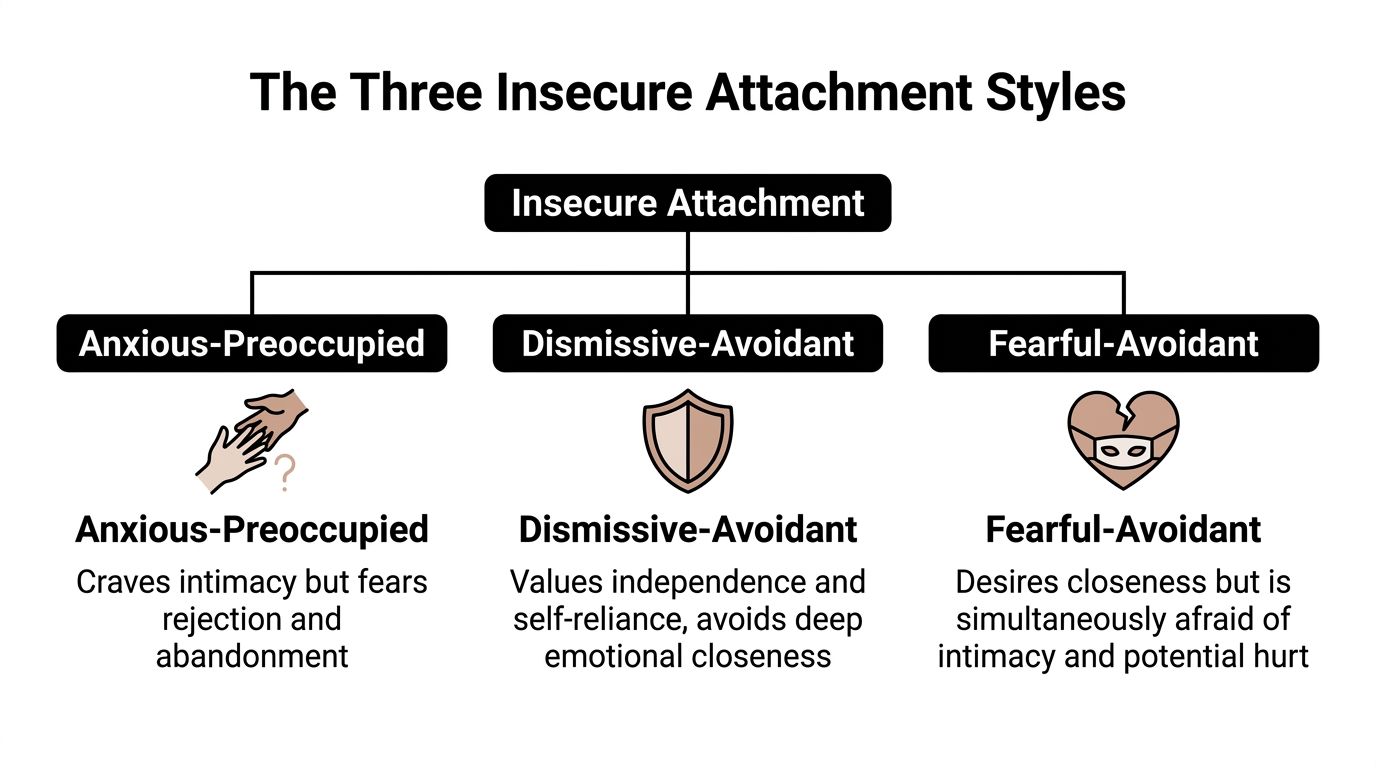
Anxious-preoccupied
Anxious attachment often feels like closeness mixed with alarm.
You may strongly desire love, then lose your footing as soon as contact changes. A slower text reply, a flat tone, a distracted look across the room. Your body reads it as risk before your thinking mind has time to sort out what is occurring.
A common inner script sounds like this:
- If they are quiet, something is wrong
- If I ask for too much, they will leave
- If I can just get reassurance, I will calm down
In conflict, this pattern usually protests. You might send repeated texts, overexplain, replay the conversation, or ask for reassurance in different forms. Relief comes briefly, then the alarm returns.
This style often overlaps with the fear of being disliked, especially when your sense of safety gets tied to approval, responsiveness, and signs that the bond is still intact.
Dismissive-avoidant
Avoidant attachment protects through distance.
You may come across as capable, calm, and highly self-sufficient. Inside, emotional dependence can feel costly. Closeness may register as pressure, neediness, or loss of control, even when part of you wants connection.
In dating or partnership, it can sound like this:
- I like them until they need me emotionally
- I feel crowded when someone wants deeper connection
- I shut down instead of saying what I feel
Conflict often looks less dramatic from the outside, but the body is still involved. Rather than reaching, you may go quiet, get analytical, stay busy, or convince yourself the relationship does not matter that much. That can bring short-term relief. It also blocks repair, which is how trust develops.
Disorganized or fearful-avoidant
Disorganized attachment carries the most internal conflict.
You want closeness. Closeness also feels dangerous. The same relationship can activate longing, fear, hope, shame, and distrust within hours or even minutes. Many clients describe this as feeling split against themselves.
You may pursue someone intensely, then pull away when they respond. You may fear abandonment and fear being fully known. During major life transitions, this pattern can get louder. Midlife stress, grief, caregiving strain, divorce, health changes, and hormonal shifts can all lower your system's sense of stability, which makes old attachment protections fire faster and harder.
What this can feel like in real life
| Situation | Anxious response | Avoidant response | Disorganized response |
|---|---|---|---|
| Partner is quiet for a day | Panic, overanalysis, urge to seek reassurance | Detach, minimize, focus elsewhere | Swing between reaching out and shutting down |
| Partner wants to talk about feelings | Relief mixed with fear of rejection | Tension, defensiveness, urge to escape | Desire for closeness followed by overwhelm |
| Argument happens | Chase repair urgently | Withdraw or become flat | Alternate between intensity and distance |
What people often get wrong
These are attachment adaptations, not casual personality labels.
An anxious person's experience extends beyond neediness. An avoidant person's behavior is not just coldness. A disorganized person is not too much. Each pattern reflects a body and mind that learned specific rules about closeness.
That distinction matters, because healing does not start with self-criticism. It starts when we recognize what your system is trying to protect you from, and why those protections now create the very loneliness, conflict, or instability you want to change.
The behavior is not the wound. The behavior is the protection around the wound.
Where Insecure Attachment Patterns Come From
Most insecure attachment patterns begin as adaptations to caregiving environments that felt inconsistent, emotionally unavailable, frightening, or hard to predict.
That matters because many adults still speak to themselves as if these patterns were chosen. They were not. They were learned in relationship.

Different homes teach different survival rules
A child with inconsistent caregiving often learns to stay highly attuned to the caregiver’s mood, availability, and responsiveness. That can become anxious attachment later. The person grows up reading the room constantly and fearing disconnection.
A child whose emotional needs are ignored, dismissed, or subtly rejected may learn to stop reaching. That can become avoidant attachment. The person looks independent, but that independence often formed around disappointment.
A child who experiences care mixed with fear, chaos, volatility, or emotional confusion may develop a disorganized pattern. The source of safety and the source of threat become tangled together.
Why self-compassion matters here
What helped you survive earlier can hurt you now.
The same hypervigilance that once helped you track safety can make dating feel unbearable. The same emotional shutdown that once protected you from hurt can make intimacy feel impossible. The same push-pull pattern that once managed danger can make adult love feel unstable.
Research suggests that children often develop similar attachment patterns to their primary caregivers. That is one reason these patterns often feel bigger than one relationship. They can be family patterns, not just personal ones.
The cycle can stop with awareness and practice
Many adults are trying to heal while also parenting, partnering, caregiving, or rebuilding after heartbreak. That can bring up guilt. It can also become the turning point.
A few realities help:
- You do not need perfect insight: You need enough awareness to notice the pattern while it is happening.
- You do not need perfect parenting: Repair matters more than performing calm all the time.
- You do not need to shame your history: Understanding where the pattern came from usually softens reactivity.
If you want to go deeper, a short video from @SecurelyLoved on intergenerational attachment patterns would fit well here.
How Attachment Shapes Your Nervous System
An insecure attachment style is not only a set of beliefs. It is also a nervous system pattern.
That is why you can know something logically and still react as if your life depends on it. Your body is often responding first. Your thoughts arrive afterward and try to explain the alarm, the shutdown, the urgency, or the numbness.

Hyperactivation and deactivation
Attachment researchers often describe insecure patterns across two core dimensions. Attachment Project’s overview of insecure attachment in childhood explains them as hyperactivation and deactivation.
Hyperactivation is the system turning up the volume. You feel more urgency, more emotional intensity, more scanning, and more activation around threat to connection. This often shows up in anxious attachment.
Deactivation is the system turning the volume down. You disconnect from needs, feelings, and dependence. This often shows up in avoidant attachment.
Disorganized attachment tends to involve both. You want contact and fear it. You move toward and away from the same person. The body can feel chaotic because there are contradictory impulses firing at once.
What this looks like in the body
Here, people often have their biggest “aha” moment. They stop seeing themselves as irrational and start recognizing state shifts.
- Hyperactivated state: racing thoughts, tight chest, urge to text, inability to focus, replaying conversations
- Deactivated state: numbness, flatness, disconnection, “I’m fine” while feeling unavailable inside
- Mixed state: craving closeness while feeling overwhelmed by it, reaching out and regretting it immediately
If you are new to this lens, this resource on what is nervous system regulation is a helpful place to begin.
Why midlife can intensify old patterns
Many adults tell me their attachment reactions got stronger later, not earlier. That surprises them.
But it makes sense. Midlife brings accumulated stress, caregiving load, loss, divorce, changing identity, grief, and body changes. Hormonal shifts can reduce your margin for stress and make old protective strategies more visible. If you used to outrun distress through productivity, achievement, caretaking, or control, you may find those strategies stop working the same way.
This is especially important for women in perimenopause and menopause. A nervous system that was already working hard to manage uncertainty can become less tolerant of strain. Relationship triggers that once felt manageable may suddenly feel enormous.
Why insight is not enough
You cannot think your way out of a body state in the moment you are flooded.
That does not mean reflection is useless. It means healing needs both top-down and bottom-up work. Insight helps you name the pattern. Regulation helps you interrupt it.
If your body reads closeness as threat, healing has to include the body.
A person with an insecure attachment style often needs repeated experiences of safety, pacing, co-regulation, and emotional truth. That is what starts to update the blueprint at a deeper level.
A Trauma-Informed Path to Secure Attachment
Healing insecure attachment does not mean becoming unbothered, perfectly calm, or endlessly available. It means building enough internal safety that connection no longer feels like a constant threat.
That work is different from talking about childhood every week and hoping insight turns into change. Insight matters. But many people already understand their story. What they need is help translating that understanding into a different felt experience.
What helps and what usually does not
Some approaches help you name the pattern but leave the body unchanged. That is why people often say, “I know why I do this. I just cannot stop.”
A trauma-informed approach pays attention to pacing, activation, shutdown, relational triggers, and the body’s cues in real time.
What tends to work better:
- Body-based awareness: noticing tightening, collapse, breath changes, agitation, numbness
- Small regulation practices: brief, repeatable exercises you can do before, during, and after triggers
- Relational repair: learning how to stay present for honest conversations without spiraling or disappearing
- Consistent support: working with someone who understands attachment injury, not just communication skills
What often falls short on its own:
- Pure insight: knowing the origin but not changing the response
- Forced vulnerability: pushing disclosure before the system feels safe enough
- Self-blame disguised as growth: treating every trigger like a personal failure
- Performing secure behavior: acting calm while the body remains overwhelmed
If you are exploring support, this page on attachment trauma therapy describes what that kind of work can look like.
Practical starting points
You do not need a dramatic overhaul. Start with what your nervous system can absorb.
Try this in a triggering moment
Orient to the room
Look around slowly. Name a few objects. Let your eyes register that you are here, now.Lengthen the exhale
Do not force a deep breath. Instead, make the exhale slightly longer than the inhale for a few rounds.Name the pattern, not the story
Say to yourself, “My attachment system is activated,” instead of “This relationship is doomed.”Delay the impulsive move
Pause before sending the tenth text, ending the relationship, or disappearing for two days.Choose one grounded action
Put your feet on the floor. Drink water. Step outside. Lean against a wall. Ask for a short pause.
Regulation is not suppression. It is creating enough steadiness to respond instead of react.
Earned security is built in repetition
People become more secure through lived experiences of safety, truth, and repair.
That can happen in therapy, in healthy relationships, in community, and in the way you relate to yourself. You learn to notice your triggers earlier. You recover faster. You stop making every activation mean something catastrophic. You become more able to say, “I need reassurance,” “I need space,” or “I am shutting down right now,” without shame taking over.
A regulation practice video from @SecurelyLoved would fit well here, especially one focused on grounding after relational activation.
Your First Step Toward Feeling Securely Loved
For many people with an insecure attachment style, reaching out for help is not straightforward. It can feel exposing, unnecessary, embarrassing, or strangely dangerous.
That is not resistance in the shallow sense. It is often part of the attachment wound itself. Research reviewed in this PubMed Central article on insecure attachment and help-seeking barriers notes that insecure attachment patterns, particularly avoidant and disorganized styles, are correlated with barriers to seeking help because of fear of vulnerability and shame about needing support.
Why people wait
Some people keep researching and never book anything. Some tell themselves they should be able to fix it alone. Some minimize the pain because they are functioning well in every other area. Others only reach out after a breakup, divorce, panic spike, or relationship crisis forces the issue.
All of that is understandable.
A low-pressure first step matters because attachment injuries often make high-pressure environments feel unsafe. Before choosing any kind of support, it can help to read resources that just steady you and help you improve mental wellbeing in daily life. Then you can notice what kind of care fits your nervous system, not just your schedule.
What a good first step feels like
A helpful next step should feel clear, humane, and manageable.
Look for support that allows you to:
- Ask questions without pressure
- Notice whether you feel emotionally safe
- Move at a pace your system can tolerate
- Talk about both relationships and the body
- Be honest about skepticism, shame, or fear
If you have spent years being the capable one, this may be unfamiliar territory. That is okay. Healing often begins when you stop demanding that you should already be over it.
You do not need to prove your pain is serious enough. You do not need to have the perfect words. You do not need to wait until your relationships fall apart again.
If this article felt uncomfortably accurate, that may be your cue to stop carrying it alone. Securely Loved offers attachment-focused, trauma-informed support for adults ready to understand their patterns, regulate their nervous system, and build more secure relationships. A free 15-minute connection call can be a gentle first step to explore fit, ask questions, and see whether this approach feels right for you.