

Insecure Attachment Theory Why You Feel Stuck & How to Heal
You keep having the same argument in different clothes.
One partner says you are too much. Another says you are hard to reach. You promise yourself you will stay calm, not overthink, not shut down, not chase. Then one delayed text, one flat tone of voice, one evening of distance, and your whole body reacts before your mind can catch up.
This is especially confusing when the rest of your life looks competent from the outside. You can lead meetings, care for other people, hit deadlines, manage a household, and still feel completely unsteady in love. You may even know the pattern well enough to describe it, but not well enough to stop it.
That is where insecure attachment theory can become profoundly relieving.
Not because it gives you another label to carry. Because it gives you a map.
When someone has insecure attachment, the issue is not that they are needy, cold, dramatic, broken, or too sensitive. The issue is that their nervous system learned certain relationship expectations early, then kept repeating them in adult life. Those patterns often make perfect sense once you understand what your system adapted to.
A woman in midlife might say, “I know my partner loves me, so why do I panic when he gets quiet?” Another person says, “I want closeness until I get it, then I feel trapped.” Someone else leaves every relationship just when it starts to matter. None of those responses are random.
They are organized. They are protective. They are often old.
If you feel stuck in cycles of overgiving, people-pleasing, withdrawing, conflict, emotional numbness, or longing for closeness that never quite feels safe, this framework can help you understand what is happening underneath the behavior. It can also show you why insight alone rarely fixes it.
That Feeling of Being Stuck in Your Relationships
You answer everyone else’s messages quickly. You show up. You think things through. Yet in your closest relationships, you feel like you become a different person.
You reread texts. You monitor tone. You say “it’s fine” when it isn’t. Or you go quiet, pull back, and tell yourself you do not need anything from anyone. Later, you wonder why closeness feels so hard when you want it so badly.
When competence and confusion live together
This is common in high-functioning adults. Outwardly, life may look stable. Internally, relationships can feel full of static.
A familiar scene looks like this:
- After conflict: You cannot settle. Your mind keeps replaying every word.
- After intimacy: You suddenly need distance and do not know why.
- After mixed signals: You feel pulled to work harder for connection instead of stepping back.
- After calm periods: You wait for something to go wrong.
None of this means you are failing at relationships. It often means your body learned that connection was unpredictable, emotionally costly, or unsafe in some way.
A compassionate lens, not a harsh diagnosis
In practice, attachment theory helps people name patterns they have blamed on character for years.
Instead of “I’m too much,” the language becomes, “My system goes into alarm when connection feels uncertain.”
Instead of “I’m impossible to get close to,” it becomes, “My system learned to protect me through distance.”
If a relationship pattern keeps repeating, it is usually carrying information. It is not proof that you are broken.
That shift matters. Shame keeps people frozen. Understanding creates movement.
The point is not to fit yourself into a rigid box. The point is to recognize the logic of your reactions so you can respond differently. Once people see that their behavior developed as protection, they often become less self-attacking and more available for real healing.
Your Attachment Blueprint How Your Past Shapes Your Present
Attachment theory begins with a simple idea. Early relationships help shape your expectations of closeness, safety, conflict, need, and repair.
Those expectations become an internal working model. In plain language, that is your relationship blueprint.
How the blueprint forms
Children do not sit down and consciously decide what love means. They absorb it through repeated experience.
If comfort is consistent, the child learns that closeness is safe and that needs can be met. If care is inconsistent, emotionally unavailable, intrusive, frightening, or confusing, the child adapts.
That adaptation can sound like:
- I need to stay close so I do not get left
- I should not need anyone
- Love is unpredictable
- If I show too much, I will be rejected
- If I trust, I may get hurt
These beliefs often live below conscious awareness. People feel them in their body before they can explain them in words.
Survival strategies, not flaws
This is the part many adults need to hear more than once. Your attachment pattern is not evidence that you are defective. It is evidence that your system was trying to survive and preserve connection in the best way it knew how.
A child cannot choose their environment. They can only adapt to it.
That is why insecure attachment can look so irrational in adulthood while making complete sense in context. The strategy may be outdated, but it was once useful.
Many painful adult behaviors began as brilliant protective moves in childhood.
Family patterns often repeat
Attachment patterns also move through families. Research summarized by Heirloom Counseling notes that in approximately 85% of cases, a child develops the same attachment pattern as their parent, while also noting that these patterns can change through later positive relational experiences and targeted intervention (Heirloom Counseling on intergenerational attachment).
That matters because it reframes the story.
You may have inherited not just beliefs, but ways of handling stress, conflict, affection, silence, and vulnerability. A parent who shut down under stress may have been carrying their own unprocessed attachment history. A parent who was intrusive, anxious, or unpredictable may have been doing the best they could with a dysregulated nervous system.
The blueprint can be revised
An early map is influential. It is not final.
People change when they experience enough safety, consistency, emotional truth, and repair. That can happen in therapy, in healthy relationships, and in the way you learn to relate to yourself.
The work is not pretending the old blueprint never existed. The work is noticing when it takes over, then building a new one through repeated, embodied experience.
The Three Types of Insecure Attachment
Insecure attachment is not unusual. It affects approximately 40 to 45% of adults, with meta-analytic findings showing about 23% dismissive-avoidant and 19% preoccupied or anxious in large populations (Connected Couples attachment style statistics). For many people, that fact alone reduces shame. You are not dealing with something strange or rare.
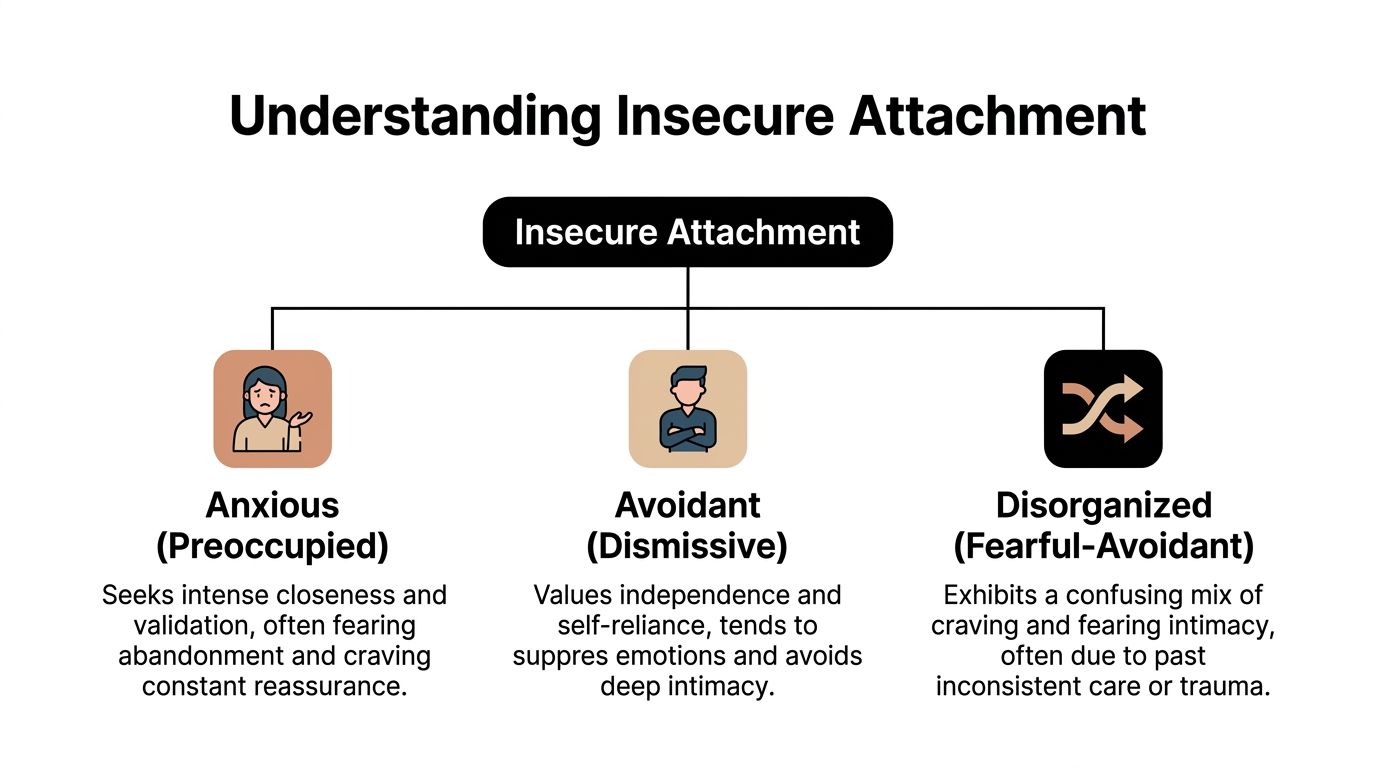
Insecure attachment styles at a glance
| Attachment Style | Core Fear | Behavior in Relationships | Internal Experience |
|---|---|---|---|
| Anxious | Abandonment | Pursues closeness, seeks reassurance, protests distance | Hyperaware, uncertain, easily activated |
| Avoidant | Engulfment or dependence | Pulls back, minimizes needs, avoids vulnerability | Tight, self-protective, emotionally muted under stress |
| Disorganized | Both abandonment and closeness | Alternates between pursuit and withdrawal | Conflicted, overwhelmed, unsafe either way |
Anxious attachment
Anxious attachment often centers on a fear of being left, forgotten, replaced, or emotionally dropped.
In daily life, this can look like sending another text because the first one has not been answered, scanning for changes in tone, feeling desperate for clarity, or becoming greatly distressed by relational ambiguity. The person is not usually trying to be difficult. Their system is trying to restore closeness as quickly as possible.
A real-world example is the partner who says, “Just tell me where we stand,” but asks in ten different ways because no answer feels settled for long.
Common signs include:
- Rapid activation: Small shifts feel large.
- Reassurance seeking: Relief comes from contact, but often fades fast.
- Self-abandonment: Personal needs get sidelined to preserve connection.
- Conflict escalation: Protest replaces direct vulnerability.
If this style fits, more detail can help you sort out your specific patterns around anxious attachment styles.
Avoidant attachment
Avoidant attachment tends to organize around the fear of being controlled, overwhelmed, exposed, or emotionally dependent.
The outside presentation often looks calm, independent, and capable. Inside, closeness can feel costly. The person may strongly want love yet feel pressure, numbness, or irritation when emotional demands increase.
A common example is someone who enjoys connection until it becomes more real. Then they need space, become less expressive, work longer hours, or focus on practical matters instead of emotional ones.
This style usually relies on deactivation. That means turning down attachment needs to reduce distress.
You might notice:
- Distance after intimacy: Closeness triggers retreat.
- Overreliance on self: Need feels unsafe or weak.
- Emotional minimalism: Feelings are hard to name or access.
- Defensive independence: “I’m fine” becomes a shield.
Disorganized attachment
Disorganized, sometimes called fearful-avoidant, combines the longing of anxious attachment with the protection of avoidant attachment.
This is often the most confusing style to live with because the person may move strongly toward closeness and away from it in the same relationship. They can crave intimacy, then panic when they receive it. They may idealize a partner one day and distrust them the next.
A familiar scenario is someone who says, “Please do not leave me,” and later says, “I need to get away from this,” even though the relationship itself may not have changed.
People with this pattern often experience:
- Mixed signals internally: Need and fear rise together.
- Difficulty trusting safety: Calm can feel suspicious.
- Strong emotional swings: Connection and danger get tangled.
- Push-pull behavior: They reach, retreat, then feel ashamed.
What these categories help with
These styles are not personalities. They are organizing strategies.
They help you ask better questions. Why does reassurance never seem to last? Why does care make me tense? Why do I choose unavailable people? Why do I shut down when I most need support?
Once the strategy is visible, healing becomes more precise.
How Insecure Attachment Shows Up in Your Adult Life

Adult attachment patterns rarely stay contained inside romance. They show up in dating, marriage, friendship, parenting, work, and even the way you interpret silence.
One of the most painful dynamics is the anxious-avoidant loop.
The push-pull cycle
One person feels distance and moves closer. The other feels pressure and moves away.
The more the anxious partner reaches, the more the avoidant partner shuts down. The more the avoidant partner withdraws, the more the anxious partner protests. Each person’s protective strategy triggers the other’s protective strategy.
From the anxious side, it feels like this: “Why can’t you just talk to me?”
From the avoidant side, it feels like this: “Why can’t you give me room to breathe?”
Research summarized by Psychology.org notes that insecure attachment styles are correlated with relational dysfunction, including intense conflict for anxious types and defensive withdrawal for avoidant types. The same review also notes that dismissing adults often show memory gaps and unsupported idealization of caregivers on the Adult Attachment Interview, reflecting a deactivating strategy that inhibits emotional arousal under stress (Simply Psychology on insecure vs secure attachment).
It does not stop at romantic love
Attachment patterns often shape ordinary moments that do not look like attachment on the surface.
You may notice them in work settings such as:
- Overfunctioning: You become the dependable one because being needed feels safer than being known.
- People-pleasing: You read the room constantly and struggle to disappoint anyone.
- Withdrawal under stress: You go quiet in meetings, then replay everything later.
- Workaholism: Productivity becomes a refuge from emotional exposure.
Sometimes people also wonder whether their intense internal distress points to something more complex than attachment alone. If you are trying to sort out quiet self-blame, emotional masking, and inwardly directed distress, this overview of Quiet BPD can offer useful distinctions.
Self-sabotage often looks protective from the inside
A breakup after a promising connection. Picking fights when things feel too calm. Losing interest when someone becomes available. Staying in fantasy instead of risking reality.
These behaviors often get labeled as self-sabotage, but the inner logic is usually protection from vulnerability, rejection, engulfment, or grief. If that pattern feels painfully familiar, this resource on how to stop self-sabotaging relationships can help you name the cycle more clearly.
The behavior that hurts your relationship may be the same behavior that once helped you survive closeness.
For readers who learn best by listening, a video from Bev Mitelman’s Securely Loved channel can be helpful here, especially one focused on anxious-avoidant dynamics or self-sabotage in love.
The Link Between Attachment, Anxiety, and Midlife Changes

Many adults do not fully feel the weight of their attachment pattern until midlife.
That surprises them. They managed for years. They built careers, raised children, kept going through stress, and told themselves they were fine. Then something shifts. Anxiety rises. Sleep changes. Tolerance drops. Old wounds feel closer to the surface.
Why midlife can intensify old patterns
Midlife often brings cumulative stress. There may be aging parents, changing roles, grief, divorce, caregiving, health concerns, identity questions, and relationship reckonings. For women, hormonal shifts during perimenopause and menopause can also destabilize the nervous system and increase emotional sensitivity.
That does not mean hormones create attachment wounds. It means hormonal change can make an existing attachment pattern harder to manage.
The woman who once kept herself composed may suddenly feel flooded by rejection fear. The avoidant partner who functioned through overwork may become more flat, brittle, irritable, or disconnected. Someone who always “handled it” may feel like they are unraveling.
Anxiety is often attachment-shaped
Attachment and anxiety overlap, but they are not identical.
Some anxiety is general. Some is distinctly relational. It spikes around emotional distance, conflict, uncertainty, visibility, dependency, or transitions in closeness.
Research on lifespan developmental theory indicates that the link between insecure attachment and internalizing symptoms changes with age. Anxious attachment is more predictive of symptoms in childhood, while avoidant attachment becomes a stronger predictor in adulthood, in part because avoidant deactivating strategies interfere with healthy emotional processing under stress over time (PMC article on insecure attachment and internalizing symptoms across the lifespan).
What this can feel like in real life
Midlife clients often describe experiences like these:
- A shorter fuse: You react faster and recover more slowly.
- More body symptoms: Tight chest, dread, agitation, numbness, exhaustion.
- Less tolerance for masking: Old coping strategies stop working well.
- More relationship urgency: You can no longer ignore what feels lonely, brittle, or unhealed.
If you feel more activated in your forties or fifties than you did in your thirties, that does not mean you are failing. It may mean your system can no longer carry old strategies the same way.
This is why purely cognitive advice often falls short at this life stage. Insight matters, but if your nervous system is inflamed, insight alone does not create safety.
A Trauma-Informed Path to Healing and Security

Healing insecure attachment is not about becoming perfectly calm, perfectly secure, or never triggered again.
It is about helping your body learn that closeness, boundaries, needs, and emotion can be tolerated without collapse, panic, or shutdown.
Why insight is not enough
Many adults already understand their pattern intellectually. They know they are anxious, avoidant, or disorganized. They know where it came from. They know what healthier communication sounds like.
Then they get triggered and none of that knowledge feels available.
That is not because they are resistant. It is because attachment lives in the nervous system as much as in thought. A trauma-informed approach pays attention to what the body does under stress, not just what the mind believes.
What nervous system regulation means
In simple terms, regulation is your ability to return to enough steadiness that you can think, feel, choose, and connect.
When you are dysregulated, you may go into fight, flight, freeze, fawn, or collapse. You might text repeatedly, shut down, lash out, dissociate, overexplain, or go numb.
Regulation does not erase emotion. It creates enough internal safety to stay with emotion without being run by it.
Three practical starting points
These are not glamorous. They are effective precisely because they are simple and repeatable.
Orient to the present
If you are spiraling, look around the room slowly. Name five neutral things you can see. Feel your feet on the floor. Let your eyes land on something steady. This helps remind the body that the current moment is not the original moment.Lengthen the exhale
Breathe in gently through the nose. Let the exhale be a little longer than the inhale. Do not force a deep breath if that makes you more anxious. The point is to cue a little more settling, not to perform relaxation.Name the state before the story
Instead of starting with “He does not care about me” or “I need to get out,” begin with “My chest is tight,” “I feel urgency,” or “I’m going numb.” State first, interpretation second. This interrupts automatic escalation.
What tends to work better than surface advice
People with attachment trauma often hear advice like “just communicate,” “just trust,” or “just stop overthinking.” That advice is not wrong. It is incomplete.
What usually works better includes:
- Somatic tracking: noticing activation in real time
- Pacing: not forcing vulnerability too fast
- Repair work: learning how to come back after rupture
- Consistent relational experiences: enough repetition to build trust
- Attachment-focused therapy: approaches that work with patterns, not just symptoms
One evidence-based option often used in attachment work is Emotionally Focused Therapy. It helps people identify the emotional cycle underneath conflict and create new patterns of responsiveness. Another option is therapy specifically focused on attachment trauma and nervous system regulation, such as attachment trauma therapy, which addresses how old relational wounds continue to shape present reactions.
A video from Bev Mitelman’s Securely Loved YouTube channel would fit well here, especially one demonstrating grounding, co-regulation, or a simple nervous system practice for relationship anxiety.
What does not usually help on its own
It is useful to be clear about trade-offs.
- More analysis without embodiment: can increase self-awareness but not change your triggered state.
- Forcing independence: may look strong while deepening loneliness.
- Constant reassurance: can soothe briefly without creating deeper security.
- Blaming your partner for every activation: blocks curiosity about your own pattern.
- Blaming yourself for every activation: creates shame and slows healing.
Security grows through repeated experiences of safety, truth, and repair. Not through pressure, perfection, or self-criticism.
You Can Feel Securely Loved Your Next Step
If this article stirred up recognition, pause there for a moment. Recognition is not regression. It is the beginning of honesty.
Attachment patterns are learned. That means they can also be updated. Not overnight. Not by force. But through awareness, support, and repeated experiences that help your body stop expecting danger in every intimate moment.
Clinical conversations often miss the intergenerational piece, yet that part matters. As the American Association for Marriage and Family Therapy notes, attachment cycles can be broken, and a first step is learning your own pattern so you do not unknowingly pass it forward into your relationships and family life (AAMFT on breaking the cycle of insecure attachment).
For some readers, it also helps to understand the broader link between trauma and mental health, especially when attachment wounds intersect with anxiety, overwhelm, concentration struggles, or long-standing emotional distress.
You do not need to figure all of this out alone.
You may start with a quiz. You may start with a course. You may start by noticing what happens in your body the next time you feel rejected, flooded, or shut down. The important part is not choosing the perfect first step. It is choosing a real one.
If you have spent years in talk therapy understanding yourself but still feel trapped in the same relational loop, that does not mean healing is out of reach. It may mean your nervous system needs a different kind of support.
If you want a gentle place to begin, Securely Loved offers a free 15-minute connection call where you can explore your goals, ask questions, and see whether attachment-focused support feels like the right fit. You can also find an attachment style quiz, courses, and practical resources that help turn insight into real, embodied change.