

Therapy for Avoidant Attachment Style: Heal & Thrive
You might know this pattern intimately. You want love. You want steadiness. You want to feel close to someone without feeling trapped by that closeness. But then a partner reaches for you emotionally, asks what you're feeling, wants more time, or notices your distance, and something in you shuts the door from the inside.
Suddenly you need space. You get tired. Irritated. Numb. You start focusing on their flaws. You tell yourself you were better off alone anyway. If you've tried therapy before, you may also know the second layer of frustration. You can explain your pattern well, but insight hasn't changed the reflex.
That gap matters. Therapy for avoidant attachment style works best when it doesn't stop at thoughts, relationship advice, or communication scripts. Real change often starts lower down, in the body and nervous system, where closeness can register as danger long before your mind has words for it.
The Silent Retreat Why You Pull Away and How Therapy Can Help
You meet someone kind. At first, it feels easy.
They text back. They care. They want to know you. For a while, that can feel relieving. Then the relationship becomes real. They ask where this is going. They notice that you go quiet after intimate weekends. They say, gently, “I feel you disappearing.”
Your body may react before your mind does. Your chest tightens. Your thoughts flatten. You tell yourself they’re asking for too much, even if part of you knows they’re asking for something reasonable. You may leave the conversation, change the subject, work later, or convince yourself you’ve lost feelings.
This is the part many people judge in themselves. They call it selfishness, coldness, commitment issues, or emotional immaturity.
A more accurate frame is this. Avoidance is often a protective strategy, not a character flaw. For many people, intimacy doesn’t just feel emotionally exposing. It feels physically dysregulating. As Monima Wellness explains in its discussion of nervous system dysregulation and avoidant attachment, perceived intimacy can trigger a shutdown response, making retreat feel biologically necessary rather than chosen.
The urge to withdraw often isn't proof that you don't care. It's often proof that your system doesn't yet experience closeness as safe.
That’s why traditional talk therapy can fall short for avoidant patterns. If therapy asks you to “just open up” without helping your body tolerate openness, your system may respond the same way it does in relationships. You intellectualize. You detach. You miss sessions. You leave saying, “I understand myself better,” while your actual relational reflex stays the same.
Healing starts when therapy recognizes that pullback as meaningful information. Not resistance to punish. Not stubbornness to push through. Information.
If this dynamic feels familiar, you may also recognize signs of emotional unavailability in relationships. Often, what looks like lack of feeling on the outside is a highly organized protection strategy on the inside.
Understanding Your Avoidant Pattern Beyond the Label
Avoidant attachment can sound like a personality type. It isn't. It's a pattern your system learned for good reasons.
One of the clearest ways to understand it is to think of it as an internal security system. At some point, your mind and body learned that depending on other people led to disappointment, intrusion, shame, or emotional dead ends. So the system adapted. It lowered expectations. It prized self-sufficiency. It treated emotional need as risky.
That strategy can work well in childhood. It often works well in high-performance adulthood too. You become capable, composed, productive, and hard to rattle on the outside. But relationships ask for something your old system wasn't built to trust. Mutual dependence. Emotional visibility. Staying present when someone matters.
Two ways avoidance often shows up
Not everyone with avoidant attachment looks the same.
- Dismissive-avoidant patterns often look like strong self-reliance, discomfort with emotional needs, and a quick move toward distance when closeness increases.
- Fearful-avoidant patterns can look more conflicted. Part of you longs for intimacy, and another part distrusts it. You may move toward connection and then abruptly pull back once vulnerability appears.
Both are protective. Both can soften with the right kind of work.
Why compassion matters more than labeling
About 20% of adults are estimated to be affected by avoidant attachment, and evidence suggests these patterns can change. A randomized controlled trial found that attachment-based therapy helped 28.4% of participants shift from insecure to secure attachment over 12 months, as summarized by WebMD’s overview of avoidant attachment.
That matters for one simple reason. It means your pattern is learned, not fixed.
Reframe: “I push people away” is less useful than “my system learned to reduce closeness when closeness feels unsafe.”
This is also why self-observation matters. Before change comes accuracy. If you're trying to increase self-awareness for lasting personal growth, it helps to notice your sequence rather than just your outcome. What happens right before you go numb, get critical, need space, or lose interest?
What the pattern usually protects
A few common drivers show up in practice:
Closeness feels like pressure
Care can register as expectation. Expectation can feel like loss of freedom.Need feels dangerous
If vulnerability once led to dismissal or disappointment, your system may still read needing someone as unsafe.Emotion feels disorganizing
Some avoidant adults can discuss feelings fluently but feel overwhelmed when those feelings are active in the room.Distance restores control
Pulling away can bring immediate relief, which teaches the nervous system to repeat it.
If you want to go deeper into this work, attachment therapy for adults can help connect current relationship habits to the early emotional conditions that shaped them. That kind of context doesn't excuse hurtful behavior, but it does make change possible.
Therapeutic Pathways to Secure Connection
Different therapies do different jobs. That matters with avoidant attachment because this pattern doesn't live in one place only. It shows up in beliefs, habits, emotional tolerance, body responses, and the way you manage closeness with another person in real time.
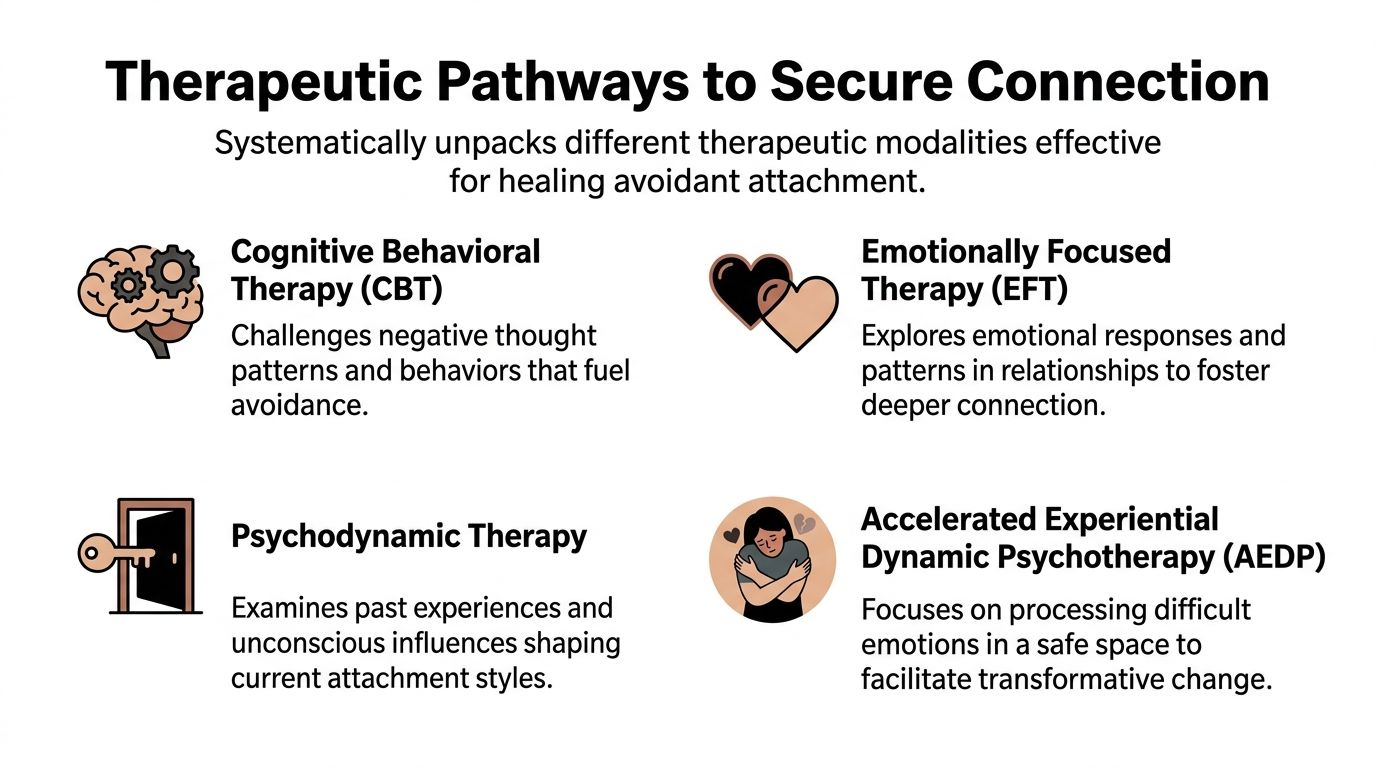
What each therapy aims to change
| Therapy approach | Main job | Helpful when |
|---|---|---|
| Attachment-focused therapy | Repairs relational templates through the therapeutic relationship | You want to understand why closeness triggers withdrawal |
| EFT | Helps you identify, tolerate, and communicate emotion in connection | You shut down during intimacy or conflict |
| IFS | Works with protective parts that enforce distance | You feel internally split between wanting love and pushing it away |
| Somatic therapy | Builds body-level safety and regulation | You know your pattern intellectually but still go numb or flee |
| CBT or DBT elements | Challenges beliefs and builds distress tolerance | You need practical tools for thoughts, urges, and emotional overload |
| Psychodynamic or AEDP approaches | Explores old relational templates and processes emotion | Your present reactions feel larger than the current moment |
No one method fits everyone. But some combinations tend to make more sense than others.
Attachment-focused therapy
This is often the backbone of therapy for avoidant attachment style.
The work is not just talking about relationships. The work is also watching what happens inside the therapy relationship. Do you minimize what matters? Feel pressure to “do therapy right”? Reveal something vulnerable, then want to cancel the next session? A skilled attachment therapist treats those moments as central material.
This approach helps because avoidant patterns don't heal only by understanding childhood. They heal when a person experiences a different kind of connection. One that is steady, boundaried, non-intrusive, and emotionally present.
A good therapist won't chase you or flood you. They also won't collude with distance by staying purely intellectual forever.
EFT for emotional engagement
Emotionally Focused Therapy is useful when you know the issue isn't lack of thought. It's lack of access.
Many avoidant adults can explain events clearly while staying far from the feeling itself. EFT slows the process down. It helps you notice the softer emotion underneath irritation, criticism, numbness, or the need for space. Often that means finding fear, grief, shame, tenderness, or longing that got covered over by protective distancing.
In couples work, EFT can also help translate behaviors that get misread. A partner may interpret your withdrawal as indifference. EFT helps reveal the hidden sequence underneath it.
IFS and protector parts
IFS can be especially helpful if you feel contradictory inside.
Part of you wants intimacy. Another part says, “No. Too risky.” Another part criticizes the relationship to create exit energy. Another goes numb. Another gets busy.
IFS treats these as parts, not pathology. The distancing part is understood as a protector. It likely learned that closeness once cost too much. Instead of trying to crush that protector, therapy gets curious about what it's afraid would happen if it stopped doing its job.
That shift often reduces shame. The goal isn't to force vulnerability. The goal is to build enough internal trust that protectors don't need to work so hard.
Why somatic work changes what insight can't
This is the piece many people miss.
When avoidant attachment is active, the body often reacts before the mind forms a coherent story. Shoulders tighten. Breathing flattens. The face goes blank. Words disappear. Touch can feel overwhelming. Emotional contact can feel like too much input.
That’s where bottom-up work matters. Sensorimotor and other somatic therapies help you track activation and shutdown in real time, so you can respond before your system goes offline.
Schema Therapy and Sensorimotor Psychotherapy can be a powerful combination for avoidant patterns. Schema work targets core beliefs such as “I am better off alone,” while Sensorimotor work addresses the tension and shutdown that happen before conscious thought, as described by the Bay Area CBT Center’s discussion of dismissive avoidant attachment.
If your body treats connection like danger, insight won't be enough. The body has to learn a new outcome.
The body has to learn a new outcome. Nervous system regulation therapy can then become the missing layer for adults who have already done years of reflective work. It gives the system repeated experiences of staying present without tipping into shutdown.
CBT and DBT still have a place
Cognitive and skills-based approaches are useful. They just aren't the whole answer.
CBT can help identify common avoidant beliefs:
- “If I need someone, I’ll lose myself.”
- “If I open up, I’ll be controlled or disappointed.”
- “If someone wants closeness, they’re too much.”
DBT-style tools can help with distress tolerance when vulnerability creates a surge of discomfort. That may include pacing, grounding, sensory orientation, or naming the urge to leave without acting on it immediately.
These tools are often strongest when paired with attachment and somatic work rather than used alone.
Psychodynamic therapy and AEDP
Psychodynamic therapy helps when your present relationships feel haunted by old emotional logic. You may understand that your reactions are “too much” for the current situation, yet they keep happening. This approach explores the unconscious expectations you carry into closeness.
AEDP is often helpful when someone needs a safe, emotionally engaged space to process feelings they have historically defended against. It can support transformation through relational safety and direct emotional experience.
Some readers also explore adjacent trauma therapies when attachment wounds overlap with unresolved trauma. If you're curious about alternatives, this overview of Emotional Transformation Therapy for healing trauma can offer another lens on trauma treatment approaches.
What tends not to work well by itself
Certain approaches often frustrate avoidant clients when used alone.
- Pure insight work can deepen understanding without changing reflexive withdrawal.
- Advice-heavy therapy can make you feel managed rather than understood.
- Premature emotional pressure can trigger stronger shutdown.
- Generic communication coaching may fail if your body cannot tolerate the state required to use the skills.
A practical way to think about fit
If you're choosing between modalities, this can help:
- Choose attachment-focused therapy if the pattern shows up most clearly in closeness and trust.
- Lean toward somatic work if your body shuts down, goes numb, or feels flooded during vulnerability.
- Add IFS if you feel split between different inner drives.
- Use CBT or DBT tools if you need immediate support with thoughts, urges, and regulation.
- Consider EFT if your shutdown comes alive most strongly in romantic relationships.
One option in this space is Securely Loved, which offers attachment-focused online therapy with a trauma-informed emphasis on nervous system regulation for adults working through avoidant, anxious, or disorganized patterns.
What a Therapy Session Looks Like
Alex comes to therapy sounding composed and thoughtful. He says he has “some intimacy stuff” but mostly wants practical tools. He speaks clearly about childhood. He can name that his last partner wanted more closeness than he could give. He says he isn't sure he felt much after the breakup, but he knows he should have.

On paper, it sounds like a good first session. But a skilled therapist is listening for more than content.
Early sessions often look deceptively calm
Alex describes events without much affect. When the therapist asks what he felt in a painful moment, he says, “I don't know. Fine, I guess.” Then he gives an intelligent analysis of why his ex was anxious.
The therapist doesn't push harder. Instead, they slow down.
They might ask:
- “What happened in your body when she asked for more closeness?”
- “Do you notice an urge to move away from this topic right now?”
- “What are you imagining I expect from you in this moment?”
Those questions help shift therapy from performance to presence.
A turning point rarely looks dramatic
In a later session, Alex mentions that after sharing something personal the week before, he almost canceled. He says it casually, like it doesn't matter.
It matters a lot.
For an avoidant client, that urge is often the therapy. The therapist may respond with steadiness rather than surprise. They might say that wanting distance after vulnerability makes sense, and that they can go slowly enough for Alex's system to stay with the process.
Clinical reality: Progress often begins when the client notices the urge to leave and stays anyway.
Research summarized in this PMC review on attachment and psychotherapy notes that clients with avoidant tendencies often have lower motivation for therapy and are more likely to drop out. It also highlights that effective therapists may respond with persistence, including follow-up after difficult sessions, because the therapeutic relationship itself becomes the mechanism of change.
What going slow means
Going slow doesn't mean staying surface-level forever. It means pacing depth so the nervous system can remain engaged.
A session may include:
Tracking activation
Alex notices he feels blank when discussing need or dependence.Building language for body cues
“Blank” becomes tight throat, shallow breathing, heavy chest, urge to look away.Practicing micro-doses of vulnerability
Instead of forcing a huge disclosure, he names one small truth in the room.Repairing the retreat
If he distances, the therapist helps him return without shame.
That process can feel ordinary from the outside. It isn't. Each repetition teaches the body that closeness doesn't always end in engulfment, criticism, or loss of self.
What clients are often surprised by
Many avoidant adults expect therapy to feel invasive. Good therapy usually feels more respectful than that.
You don't have to cry on command. You don't have to disclose everything immediately. You don't have to become highly expressive to be healing.
What you do need is a relationship that can tolerate your defenses without mistaking them for your whole identity. Over time, clients often find they aren't “bad at therapy.” They were trying to do deep relational work in settings that only addressed the story, not the protective system telling the story.
How to Find a Therapist Who Understands Avoidance
Finding a therapist for avoidant attachment isn't just about finding someone who lists “attachment issues” on a directory. You need someone who understands distance as a defense, not as lack of commitment or lack of depth.

Green flags worth noticing
Look for therapists who mention approaches such as:
- Attachment-focused therapy because they understand relationship templates, not just symptoms
- Somatic therapy or Sensorimotor work because they recognize shutdown as embodied
- Polyvagal-informed or nervous system regulation work because they know closeness can trigger threat states
- IFS, AEDP, EFT, or trauma-informed modalities because they tend to work respectfully with protection rather than bulldozing it
Read for tone too. A good profile often sounds grounded, patient, and relational. It doesn't promise quick fixes or rely on slogans about mindset.
Red flags that matter
Be cautious if a therapist seems focused only on changing thoughts, pushing exposure too quickly, or offering formulaic communication advice without any mention of trauma, attachment, or the body.
Another concern is subtle emotional distance in the therapist themselves. Research discussed in this dissertation on therapist attachment and outcomes found that therapists with higher avoidant attachment were associated with worsening client symptoms, while lower therapist avoidant attachment related to better client-reported symptom change.
That finding matters in practice. A therapist can know attachment theory and still become detached, minimizing, or uncomfortable with vulnerability in the room.
Your therapist's regulated presence is not a bonus feature. It's part of the treatment.
Questions to ask in a consultation
You don't need to interview a therapist aggressively. But asking clear questions can save months of mismatch.
Consider asking:
- How do you work with clients who intellectualize or go numb in session?
- How do you approach the nervous system in therapy?
- What do you do when a client feels the urge to withdraw after vulnerability?
- How do you pace therapy for someone who wants change but fears closeness?
- What training do you have in attachment and trauma-informed work?
- How do you think about the therapeutic relationship itself in this process?
Pay attention to how you feel, not just what they say
A consultation isn't only about credentials. Notice your body.
Do you feel rushed? Managed? Slightly invisible? Pressured to explain yourself fast? Or do you feel some room to breathe, think, and be uncertain?
For avoidant clients, the right therapist often feels steady without being invasive. Warm without crowding. Clear without being rigid. That balance is hard to fake.
Recognizing Your Progress and Continuing the Journey
Progress with avoidant attachment rarely starts with dramatic breakthroughs. It usually starts with subtler shifts that would have gone unnoticed by the old version of you.

Signs healing is happening
You might notice:
You catch the deactivating story earlier
Instead of fully believing “I need to get out,” you recognize it as a stress response.You stay present a little longer
Maybe not for the whole hard conversation. But longer than before.You can name one feeling before shutting down
That small act matters more than it sounds.You ask for something small
A little reassurance. More time. A pause instead of a disappearance.You recover faster after closeness
Vulnerability still activates you, but it doesn't require the same level of retreat.
Progress is often relational, not just internal
A major sign of healing is that your relationships start to feel less binary. Less all-or-nothing. Less “I’m in” or “I need out.”
You may begin to experience conflict as uncomfortable rather than catastrophic. You may let someone matter to you without immediately needing to regain control through distance. You may also feel grief. That's common. As protection softens, people often feel how lonely the old strategy really was.
This kind of change takes practice, support, and repetition. If you want a next step, start with an attachment style quiz, explore learning resources that focus on embodied healing, or book a free 15-minute connection call to see whether therapy feels like a good fit for where you are now.
A short video can also help this land in a more personal way:
Frequently Asked Questions About Healing Avoidance
Can avoidant attachment heal without therapy
Sometimes people make meaningful progress through self-reflection, relationships, and consistent practice. But if your body regularly shuts down during closeness, therapy often helps because it gives you a safe place to work with the pattern in real time, not just think about it afterward.
Should my partner be involved
Sometimes yes. Sometimes not yet.
If you're in a stable relationship and both people want to understand the cycle, couples therapy can help. But individual work may need to come first if closeness, conflict, or dependency feels so activating that you can't stay engaged.
Why do I feel nothing when someone gets close
Numbness is often a protective state, not absence of depth. For many avoidant adults, “nothing” is what the system does when emotion feels too risky or too intense to process in the moment.
What if I start therapy and want to quit
That urge is common. It doesn't automatically mean therapy is wrong for you.
If the therapist understands avoidance well, they won't shame the retreat. They will help you get curious about what the urge is protecting and pace the work so staying becomes more possible.
How long does healing take
There isn't a fixed timeline. Change depends on your history, your current relationships, the quality of the therapeutic fit, and whether the work includes both insight and nervous system regulation. What matters most is not speed. It's whether therapy is helping you become more able to stay present, feel safely connected, and recover from vulnerability without disappearing.
If this article felt familiar, Securely Loved offers attachment-focused support for adults who are tired of understanding their patterns intellectually but still feeling stuck in them. You can explore the attachment style quiz, browse resources, or book a free 15-minute connection call to talk through your goals and see whether the approach fits.