

Therapy for Anxious-Avoidant Attachment A Healing Guide
You’re tired of overthinking a text that hasn’t come. You want closeness, then panic when you get it. You might feel attached to someone who says they care, yet pulls away just when things start to feel real. Or you may be the one who goes numb, shuts down, needs space, then feels guilty and confused when your distance hurts someone you love.
That pattern can make you feel impossible to love. It can also make you question your own instincts. If you are in this situation, I want to say this clearly. You are not broken. You are likely running an old survival strategy that once made sense, even if it now creates chaos in adult relationships.
Therapy for anxious-avoidant attachment can help, but not all therapy works the same way. Insight matters. Naming your attachment style matters. But labels alone don’t calm a body that expects closeness to turn painful. Real healing asks for more than understanding. It asks for safety in the nervous system, attention to trauma, and a new lived experience of connection.
The Anxious-Avoidant Dance Why You Feel Pulled In and Pushed Away
You miss them when they’re distant. You brace when they get close.
That’s the anxious-avoidant dance.

One part of you aches for reassurance. Another part scans for danger. You may crave deep intimacy, then suddenly feel trapped, suspicious, irritated, or flooded. You may move toward someone after conflict, then feel the urge to disappear the moment they respond.
What this looks like in real life
You start dating someone emotionally available. At first, it feels soothing. Then they text consistently and want to see you again. Instead of relief, you feel pressure.
Or you’re in a long-term relationship and keep replaying the same argument. One of you reaches out harder. The other goes quiet. The more one partner protests, the more the other retreats. Soon, neither person feels safe.
Why this hurts so much
This pattern is common, and it’s painful because it creates emotional whiplash. Approximately 50% of adults exhibit insecure attachment patterns, with the anxious-avoidant pairing being one of the most common and challenging combinations (Lukin Center).
When I explain this to clients, I often call it a push-pull dance your body learned before your mind had words for it. You didn’t choose the choreography. But you can learn new steps.
You can want love and fear it at the same time. That conflict isn’t a character flaw. It’s a sign that connection has felt unsafe somewhere in your history.
The first shift that helps
Healing begins when you stop treating this pattern like proof that something is wrong with you. It’s a protective system. Protective systems can be updated.
That doesn’t happen through willpower alone. It happens by understanding what your reactions mean, learning how your nervous system responds under stress, and working with a therapist who knows how to address both attachment wounds and trauma responses.
Understanding the Anxious-Avoidant Pattern
Anxious-avoidant attachment is what many people mean when they say fearful-avoidant attachment. It often feels like living with two opposite urges at once.
One part says, “Please don’t leave me.”
The other says, “Don’t get too close.”
One foot on the gas and one on the brake
The simplest way to understand this pattern is to picture driving a car with one foot on the accelerator and one on the brake.
You move toward closeness, then pull away. You long for reassurance, then distrust it when it arrives. You may idealize someone from a distance and feel irritated by their actual needs up close.
That inner conflict creates a lot of confusion in relationships because your behavior can change fast. You might text all day, then suddenly go quiet. You might feel devastated by distance, then feel smothered by emotional availability.
Where it usually comes from
This pattern often develops when early relationships felt inconsistent, overwhelming, frightening, or emotionally unpredictable. A child learns that connection is necessary, but not always safe.
That can leave you with two deep beliefs running at once:
- Closeness is essential
- Closeness is dangerous
As an adult, those beliefs can show up in subtle ways:
- Testing people: You may look for signs that someone will disappoint you.
- Sabotaging calm: Peace can feel unfamiliar, so your system searches for threat.
- Mistrusting your own needs: You may judge yourself for wanting reassurance, care, or space.
- Pulling away after vulnerability: The moment after emotional openness can feel especially exposed.
How it differs from anxious or avoidant attachment alone
A mostly anxious style tends to move toward closeness when distressed. A mostly avoidant style tends to move away from closeness when distressed.
Anxious-avoidant attachment does both.
That’s why it can feel so disorienting. You may not recognize yourself in simple attachment descriptions. You’re not only clingy. You’re not only distant. You cycle.
Clinical reality: Many people with this pattern don’t need more self-judgment. They need help noticing the exact moment their body shifts from longing into alarm.
How your body may be speaking before your mind catches up
You may think your issue is “overthinking,” but often the body reacts first. Tight chest. Sudden numbness. Restlessness. Urge to flee. Need to check your phone. Feeling sick after intimacy. Feeling suspicious after tenderness.
Those reactions can also overlap with chronic anxiety, especially when your system stays on alert for abandonment, rejection, or engulfment.
Signs you may be stuck in this pattern
You don’t need every sign for the pattern to be relevant. A few common ones are enough to notice the shape of it.
- You chase and withdraw: You reach out intensely, then disappear when feelings get too close.
- You fear being abandoned and controlled: Separation hurts. Dependence also scares you.
- You read into mixed signals: Delays, tone changes, or emotional shifts can feel loaded.
- You struggle to trust stable love: Consistency may feel boring, suspicious, or oddly unsafe.
- You replay relationships that hurt you: The familiar can feel magnetic, even when it’s painful.
This isn’t about putting yourself in a box. It’s about recognizing a pattern clearly enough that you can stop calling it “just who I am.”
Finding the Right Therapeutic Approach for You
If you’re looking for therapy for anxious-avoidant attachment, the most important question isn’t “What’s the best therapy?” It’s “What kind of therapy matches the way my pattern works?”
If your struggle lives in thoughts, emotions, body reactions, and old relational wounds, you may need an approach that addresses more than one layer.
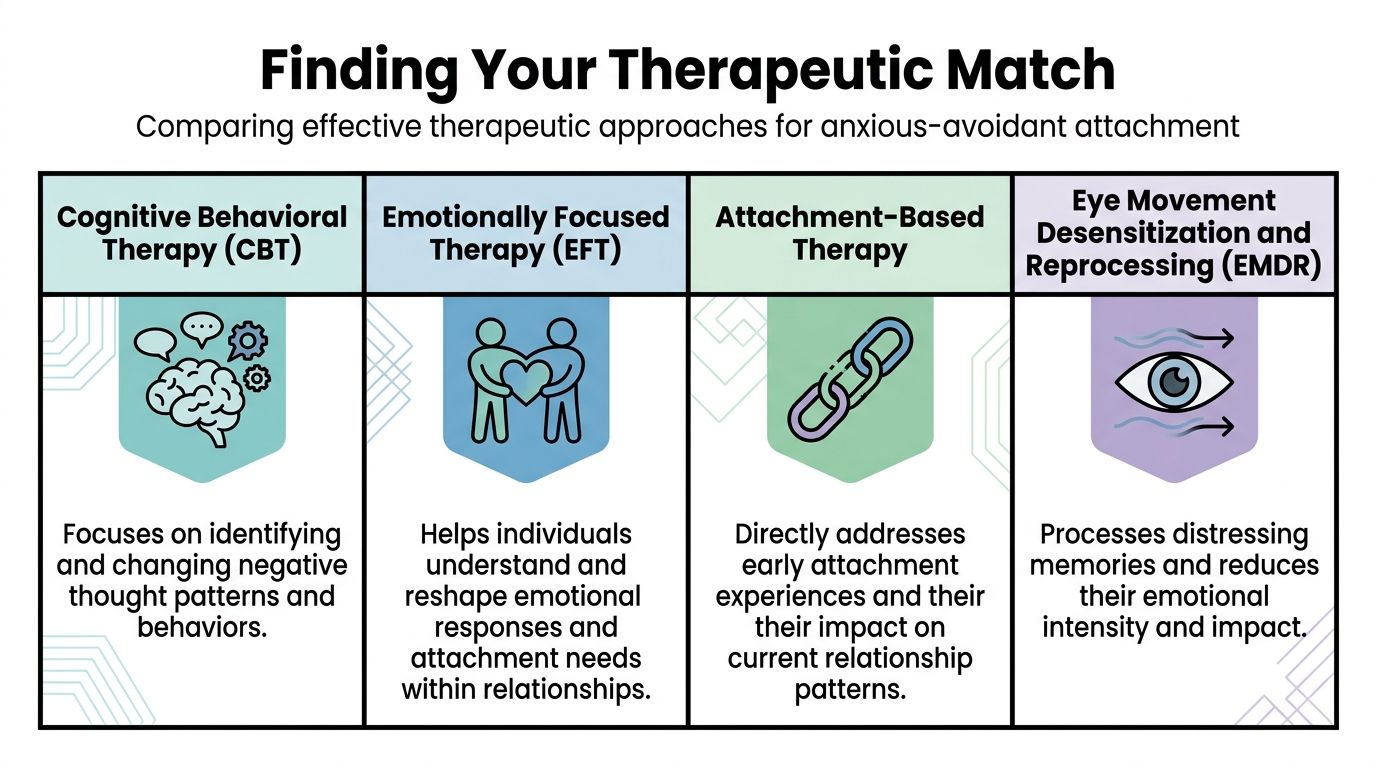
What works and what often falls short
Traditional talk therapy can help you understand your history. That’s useful. But insight by itself may not change what happens when your body goes into protest, shutdown, panic, or emotional numbness inside a relationship.
That’s where more targeted methods matter.
A useful example comes from a randomized controlled trial on adults with generalized anxiety disorder. For people with higher dismissing attachment, CBT plus interpersonal and emotional processing therapy led to significantly greater symptom reduction over two years than CBT plus supportive listening (PMC).
That finding matters because it points to a real trade-off. Supportive listening can feel good. It may not be enough if your pattern includes emotional suppression, self-protection, and trouble staying present in closeness.
Comparing Therapeutic Approaches for Anxious-Avoidant Healing
| Therapeutic Approach | Primary Focus | How It Helps Anxious-Avoidant Patterns |
|---|---|---|
| CBT | Thoughts, beliefs, behavior | Helps you identify catastrophic thinking, rejection stories, and rigid conclusions about yourself or others |
| EFT | Emotional experience and attachment needs | Helps you access vulnerable feelings under protest, shutdown, blame, or distancing |
| Attachment-Based Therapy | Relational templates from early life | Helps you understand the original blueprint you keep replaying and build a safer one |
| EMDR | Distressing memories and trauma triggers | Helps reduce the intensity of old experiences that still shape present-day reactions |
CBT when your mind spirals
CBT is especially useful if your system quickly turns uncertainty into certainty.
You don’t get a text back and think, “They’re busy.” You think, “I knew it. I’m too much. They’re pulling away. I should leave first.”
CBT helps slow that chain down. It teaches you to examine the story, not just obey it. If anxious thinking is one of your strongest drivers, this can be a powerful entry point. If you want a deeper look at this approach, this guide on cognitive behavioral therapy for anxious attachment may help.
EFT when your pattern shows up most in relationships
Emotionally Focused Therapy is useful when you know your reactions make sense emotionally, but you can’t seem to stop them in the moment.
EFT helps you move beneath the surface reaction.
Under “Why didn’t you text me back?” may be “I felt alone.”
Under “I need space” may be “I’m overwhelmed and afraid I’ll disappear if I stay open.”
That kind of emotional translation matters. It helps you stop fighting about the behavior and start working with the attachment need underneath it.
Practical rule: If conflict quickly turns into protest, shutdown, blame, or pursuing, look for a therapist who can track attachment cycles in real time, not just discuss them afterward.
Attachment-based therapy when the old blueprint keeps repeating
Some clients already understand the pattern intellectually. They can describe their childhood, identify their triggers, and explain why they pick unavailable people. But they still repeat the cycle.
Attachment-based therapy focuses less on symptom management alone and more on the relational template underneath your choices, expectations, and defenses.
This work is often especially helpful when you keep asking, “Why do I do this with people I care about?”
EMDR when trauma keeps hijacking connection
If closeness brings up fear that feels bigger than the current relationship, trauma may be part of the picture.
EMDR can help process memories that remain emotionally live in the nervous system. That may include neglect, humiliation, betrayal, frightening caregiving, relational instability, or later adult trauma.
When those experiences lose intensity, your present relationships have more room to be present. You’re less likely to react to your partner as if they are every painful person from your past.
A grounded way to choose
You don’t have to find a perfect modality on the first try. You do need a therapist who understands that this pattern is not only cognitive.
You may want to ask:
- How do you work with attachment wounds in session?
- What do you do when a client shuts down or gets flooded?
- How do you include nervous system regulation in the work?
- How do you approach trauma that shows up in relationships?
At Securely Loved, this kind of work is offered through attachment-focused, trauma-informed therapy that addresses both relational patterns and body-based regulation. That’s one option among several. The key is fit, not branding.
Your Healing Journey A Look Inside Therapy Sessions
Many people delay therapy because they’re afraid of what will happen in the room. They imagine they’ll be asked to explain their whole childhood perfectly, cry on command, or reveal something they aren’t ready to say.
Good therapy for anxious-avoidant attachment usually works differently. It starts with safety.

Early sessions often focus on stabilization
In the beginning, the work is often less dramatic than people expect. You and the therapist start noticing patterns with precision.
You might map what happens in a familiar sequence:
- Trigger: A delayed response, conflict, distance, or unexpected tenderness.
- Body reaction: Tightness, collapse, heat, numbness, urgency.
- Meaning: “I’m not safe,” “I’m too much,” “I’ll be trapped,” “I’ll be left.”
- Protective move: Texting repeatedly, shutting down, leaving, people-pleasing, picking a fight.
That map becomes useful because you stop seeing your reactions as random.
Regulation comes before deep processing
If your body flips into panic or shutdown quickly, therapy may first teach you how to come back into a workable window.
That might include:
- Grounding exercises: Orienting to the room, feeling your feet, slowing breath.
- Tracking activation: Learning the difference between overwhelm and manageable discomfort.
- Naming states: Noticing when you’re hyperactivated, numb, fused, or defensive.
- Practicing pause: Creating space between trigger and action.
If this part of the process speaks to you, support focused on nervous system regulation therapy can be a strong fit.
The middle phase gets more personal
Once more safety is established, therapy often moves into the roots of the pattern.
That may involve revisiting moments where you learned:
- closeness wasn’t reliable
- your needs felt too much
- vulnerability was ignored or punished
- self-protection mattered more than connection
This doesn’t mean retelling your life story over and over. It means helping your present-day system process what it still reacts to as if it’s happening now.
Sometimes the biggest shift in therapy is not a dramatic breakthrough. It’s the first time you stay present with a feeling you used to escape.
You may practice relationship differently inside the session
This part matters more than many people realize.
You may notice yourself wanting the therapist’s approval, fearing their disappointment, pulling back after a warm moment, or minimizing what you feel. Those moments are not failures. They are live data.
A skilled therapist helps you notice them gently and work with them in real time.
Neurocognitive research suggests therapies such as EFT and DBT can change hypervigilant pathways, and after 16 EFT sessions, 70% of clients with avoidant traits reported increased emotional awareness (Biolife Health Center).
That matters because many anxious-avoidant clients don’t lack depth. They lack safe access to it.
What progress often looks like
Progress is often quieter than people expect.
You notice the urge to send ten texts, and send one.
You ask for space without disappearing.
You feel hurt and don’t turn it into attack.
You let someone be kind without searching immediately for the catch.
Those are not small things. They are signs that your system is learning a new experience of closeness.
How to Start Healing Your Attachment Patterns Now
You do not have to wait until you find the perfect therapist to begin. Small daily changes can make your inner world less reactive and your relationships less chaotic.
They won’t replace therapy when deeper work is needed. But they can help you build traction.

Start with the body, not the story
When you’re triggered, your first job is not to figure out the whole relationship. It’s to notice your state.
Try this short sequence:
- Pause your action: Don’t send the extra text yet. Don’t announce a breakup yet.
- Name the state: “I’m activated.” “I’m shutting down.” “I feel panicky.”
- Ground physically: Press your feet into the floor. Hold something cool. Lengthen your exhale.
- Shrink the timeline: Focus on the next ten minutes, not the next ten years.
That interrupts the reflex to solve attachment pain through urgent behavior.
Use clearer relational language
People with anxious-avoidant patterns often communicate from alarm. Try communicating from observation and need instead.
Examples:
- “I noticed I got activated when plans changed.”
- “I want connection, and I also need a little time to settle.”
- “I’m not pulling away because I don’t care. I’m overwhelmed and trying not to shut down.”
This kind of language is less dramatic, but more honest.
Build a small self-trust practice
Anxious-avoidant patterns often include mistrust of your own experience. A daily check-in helps.
Ask yourself:
- What am I feeling?
- What am I assuming?
- What do I need right now?
- Is this need about the present, the past, or both?
Write one sentence for each. Keep it simple.
If your body is in alarm, don’t ask yourself to become wise and relational in the same second. Stabilize first. Reflect second.
Midlife clients need a wider lens
For some adults, especially women in midlife, attachment activation gets stronger during hormonal change. A 2025 study found that 68% of midlife women with fearful-avoidant attachment reported heightened emotional dysregulation during perimenopause due to hormonal fluctuations impacting the amygdala (Mend Modern Therapy).
If this is you, please don’t reduce everything to “I’m overreacting.” Your system may need attachment work, nervous system support, and menopause-informed care together.
Know when self-help isn’t enough
Self-help is not enough when:
- your relationships keep following the same painful arc
- you swing between panic and shutdown
- you’ve done years of insight work but still feel hijacked in closeness
- trauma symptoms show up in dating, sex, conflict, or separation
That’s usually the point to get professional help rather than trying to be your own therapist.
Moving Toward Secure Connection and Inner Peace
The goal isn’t to become perfectly calm, perfectly available, or endlessly self-aware. The goal is to become more secure, more honest, and less ruled by old survival patterns.
Anxious-avoidant attachment is learned. That means it can change.
Healing usually asks for two things at once. You learn how to regulate your inner world, and you learn how to relate differently with real people. That’s why the deepest work is both internal and relational. You’re not just changing thoughts. You’re building a new experience of safety.
For many people, part of that process includes learning about building secure attachment relationships and noticing what secure connection looks and feels like in everyday life.
If you’ve spent years cycling between longing and withdrawal, secure love may feel unfamiliar at first. That’s normal. Familiar and healthy are not always the same thing.
If you want to explore what healing can look like over time, this resource on earned secure attachment offers a helpful next step.
You do not need to fix your whole attachment history this week. You only need to begin moving in a new direction. A calmer body. Clearer boundaries. More truthful words. Less self-abandonment. More steadiness in love.
Your Questions on Anxious-Avoidant Healing Answered
Can I heal this on my own?
You can make meaningful progress on your own. You can learn your triggers, practice regulation, journal, slow impulsive reactions, and choose healthier relationships.
But self-work has limits.
This pattern usually formed in relationship, and a lot of healing happens in relationship too. If you keep understanding the pattern but still relive it, that’s a sign you may need support that reaches beyond insight.
What if therapy didn’t work for me before?
That doesn’t mean you can’t heal. It may mean the approach didn’t match the problem.
A lot of people with attachment wounds do well in therapy that is warm, reflective, and thoughtful. Then they leave the session and still get flooded, numb, or reactive in real life. That’s often because the work stayed at the level of insight.
A 2025 meta-analysis found that traditional talk therapy can have a 60-70% relapse rate within two years for insecure attachment patterns, while emerging hybrid models that integrate nervous system skills showed sustained secure attachment in 85% of individuals at 18-month follow-ups (Next Mission Recovery).
That doesn’t mean talk therapy is useless. It means insight alone may be insufficient for a pattern that lives in the body as much as the mind.
How long does healing take?
There isn’t one universal timeline.
Some people feel relief early because they finally have language for what happens inside them. Others need longer because the pattern is tied to trauma, relational loss, or years of defensive coping.
The better question is often not “How fast can I fix this?” but “Am I becoming more aware, more regulated, and more able to stay connected without abandoning myself?”
That’s measurable progress.
What if I’m afraid to trust a therapist?
That fear makes sense.
If closeness has felt unreliable, you may expect a therapist to misunderstand you, judge you, become too important, or not really be there when it counts. You may even feel a strong urge to quit right after a good session. That happens.
A therapist who understands attachment won’t treat that as resistance or failure. They’ll help you notice it, name it, and work through it safely.
Can people with this pattern have healthy relationships?
Yes.
Not because they become perfect. Because they become more conscious of their cycles, less reactive inside them, and more capable of repair. They learn how to ask for what they need without chasing or disappearing. They learn how to receive care without suspecting it. They learn how to take space without using distance as protection.
That’s what secure functioning looks like in real life. Not flawless love. Steadier love.
What should I do first if I’m overwhelmed?
Keep the first step very small.
You might:
- take an attachment quiz
- write down your most common trigger cycle
- book a consultation with an attachment-focused therapist
- choose one regulation practice and use it daily for a week
When you’ve been living in push-pull dynamics for a long time, simple and repeatable is better than ambitious and short-lived.
If this article felt uncomfortably familiar, you don't have to sort it out alone. Securely Loved offers attachment-focused support for adults healing anxious, avoidant, and disorganized patterns through trauma-informed therapy, nervous system regulation, courses, and practical tools. If you want a gentle next step, you can explore the site’s resources or book a free 15-minute connection call to talk about what’s been happening and whether this kind of support fits where you are right now.