
What Is No Contact Rule: Your 2026 Guide
Your phone is face down, but you still know where it is every second. You keep picking it up anyway. You reread the last text thread. You zoom in on tiny details that feel suddenly life-or-death. You wonder whether to send one more message, ask one more question, explain yourself one more time.
After a breakup, your mind often acts like contact equals safety. If you can just hear from them, maybe the panic will settle. Maybe the ache in your chest will loosen. Maybe you'll get clarity. But for many people, especially those with anxious, avoidant, or disorganized attachment patterns, contact keeps the wound open.
That’s where the no contact rule comes in. Not as a cold game. Not as punishment. Not as a trick to make someone chase you. It works best as an intentional pause that protects your nervous system when heartbreak has made everything feel loud and urgent.
If you're sitting in that unbearable in-between, craving both relief and one more conversation, you're not failing. You're grieving. And if you're trying to understand the difference between painful isolation and healing space, this piece on Loneliness Vs Solitude: Why One Hurts And The Other Heals can help you name what’s happening inside you.
The Unbearable Silence After a Breakup
The hardest part often isn’t the breakup conversation itself. It’s the hours after. Then the night after. Then the weekend when your body still expects their name to appear on your screen.
You may know the relationship was painful and still feel desperate to restore contact. That contradiction is common. A breakup doesn’t only remove a person. It removes routine, imagined future, emotional reference point, and the small rituals your brain used to depend on.
When silence feels like danger
For many people, silence after a breakup doesn't feel neutral. It feels threatening. Your body may read distance as abandonment, and then ordinary moments become loaded. The grocery store feels strange. Bedtime feels impossible. Even eating can feel hard when your system is stuck in alarm.
That’s why telling yourself to “just move on” rarely helps. You need something more specific than willpower. You need structure.
Sometimes the most loving thing you can do after a breakup is to stop looking outside yourself for immediate relief.
The no contact rule gives that structure. It creates a boundary when your emotions are too activated to make grounded decisions. It gives you a container for grief, clarity, and stabilization.
A familiar breakup loop
A lot of people get caught in the same cycle:
- Reach for reassurance: You text because the uncertainty hurts.
- Get a crumb: A short reply, a delayed reply, or no reply.
- Spiral harder: Now you're analyzing tone, timing, punctuation, and meaning.
- Try again: The next message feels even more urgent.
This loop can go on for weeks. Sometimes longer. And every round teaches your brain that distress should be answered with more pursuit.
The no contact rule interrupts that loop. That interruption can feel brutal at first. It can also be the beginning of healing.
Decoding the No Contact Rule What It Is and Isn’t

If you’ve been searching what is no contact rule, the internet has probably given you two extreme versions. One treats it like a breakup hack. The other treats it like disappearing without explanation. Neither is precise enough.
No contact rule means a deliberate period of stopping nonessential communication with your ex so your mind, body, and attachment system can settle. That includes texts, calls, DMs, checking stories, liking posts, and using mutual friends as emotional scouts.
That’s the core definition. But what matters just as much is what it is not.
What no contact is not
No contact is not the silent treatment. The silent treatment is meant to control, punish, or provoke. No contact is a boundary for healing.
It’s also not a performance. Posting strategically, watching who viewed your story, or “accidentally” liking an old photo keeps you psychologically entangled. Digital contact is still contact.
And it isn’t a guarantee that your ex will return. Based on coaching outcomes, 75% of clients report their ex reaching out during a period of no contact, often because sudden silence creates an information gap and sparks curiosity, but that does not guarantee reconciliation according to this analysis of no contact outcomes.
What no contact looks like in real life
In practice, no contact often means:
- No direct communication: No “just checking in,” no closure texts, no holiday messages.
- No indirect monitoring: No checking Instagram, LinkedIn, Spotify, Venmo, or mutual friends’ updates.
- No emotional baiting: No vague posts designed to be seen.
- No logistics beyond necessity: If you share children, property, or legal matters, keep it brief and functional.
A modern breakup often lives on your phone long after the relationship ends. That’s why no contact has to include your digital habits, not just your text thread.
The point of the pause
Some people use no contact hoping absence will make their ex miss them. That may happen. But if your whole reason for doing it is to generate a response, you’ll stay emotionally hooked.
The healthier frame is simpler. You are stepping back so you can hear your own experience again. You are reducing stimulation so your body can stop bracing for the next message. You are creating enough space to tell the difference between love, panic, habit, and trauma activation.
The Deep Psychology Behind No Contact
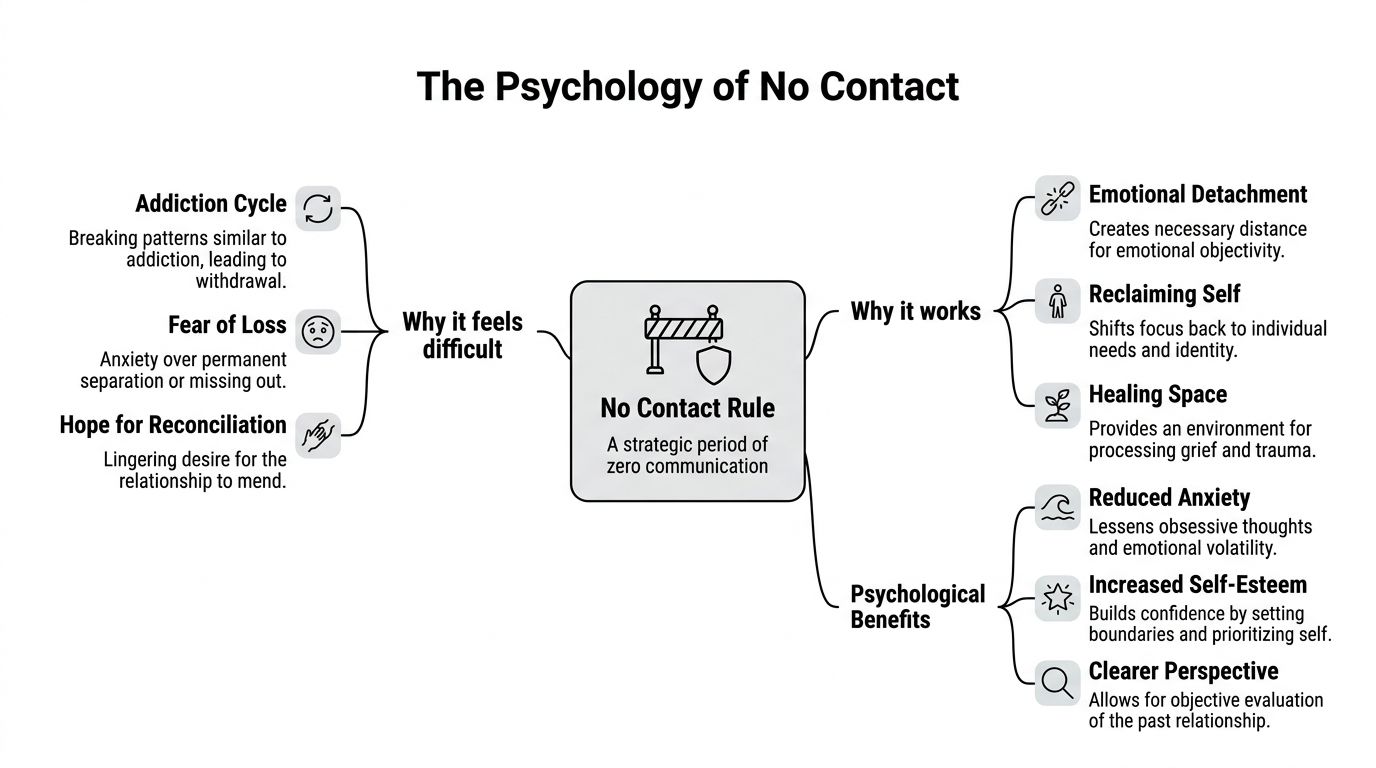
No contact feels hard for a reason. Your distress is not a sign that you’re doing something wrong. It often means your brain and body are reacting to separation exactly the way bonded systems react when connection is suddenly cut off.
Your brain may treat the breakup like withdrawal
After repeated connection with a partner, your brain gets used to certain reward patterns. Contact, anticipation, reconciliation, physical closeness, even seeing their name, can become loaded with dopamine, oxytocin, and serotonin associations. When the relationship ends, those expected cues disappear abruptly.
Research summarized by Attachment Project’s explanation of the no contact rule notes that fMRI studies on romantic rejection show activation in brain regions associated with cocaine cravings, including the ventral tegmental area. The same source explains that sustained no contact supports synaptic pruning, with a 50-70% reduction in urge intensity typically observed by week 6.
That helps explain why you may feel compelled to check, text, or search even when you know it hurts. Your higher reasoning may want peace, while your reward system is still demanding a familiar hit.
Why the first stretch can feel brutal
The early period of no contact often brings intrusive thoughts, a restless body, and emotional swings that can feel disproportionate. They aren’t random. Your old neural pathways are still active, and your brain is searching for the person who used to regulate part of your inner world.
A useful way to understand this is through Hebbian learning reversal. When an experience gets repeated enough, the brain strengthens that pathway. Without reinforcement, those pathways weaken over time. In breakup recovery, no contact removes reinforcement.
Your brain doesn’t instantly understand that the relationship is over. It learns through repetition, and no contact changes the repetition.
If you keep checking their profile, rereading messages, or reopening the conversation, you refresh the pathway. If you stop, the pathway gradually weakens. That weakening can feel like loss before it feels like freedom.
No contact also resets the attachment system
Heartbreak is not only emotional. It’s physiological. If you already tend toward anxious attachment, the breakup can push your attachment system into high alert. You may catastrophize, self-blame, or believe reconnection is the only route back to stability.
That’s why no contact works better when paired with nervous system support, not just self-control. If you want a clearer picture of that process, this guide on nervous system regulation gives a strong foundation.
A few grounded practices help during this phase:
- Journaling urge intensity: Track your daily urge to reach out on a simple scale. Patterns become easier to see when they’re written down.
- Sensory regulation: Evening walks, cold water on wrists, weighted blankets, calming music, and breath work can reduce escalation.
- Interrupting loops: When you feel the urge to check, move your body first. Stand up. Leave the room. Change sensory input.
The hidden relief inside the struggle
No contact works because it removes fuel. It stops the cycle of hope, disappointment, hypervigilance, and reactivation. It gives your prefrontal cortex more room to come back online, so decisions can come from clarity instead of panic.
That doesn’t mean the process is tidy. It means the pain starts becoming useful. Not because suffering is good, but because repeated non-contact teaches your brain something new. The emergency is over. You can survive longing without acting on it.
Is No Contact Right for Your Attachment Style
No contact is often presented as if everyone should do it the same way. That’s one of the biggest problems with breakup advice. People don’t all experience distance in the same way, because people don’t all organize around closeness, fear, conflict, and loss in the same way.
Roughly 60% of adults have an insecure attachment style, and most no contact advice ignores that. For people with anxious or disorganized attachment, abrupt no contact can amplify abandonment fears and even contribute to prolonged PTSD-like symptoms, which is why a trauma-informed approach matters according to this attachment-focused discussion of the no contact rule.
The same rule lands differently in different nervous systems
An anxiously attached person may experience no contact as pure panic at first. The mind looks for proof of rejection, and the body may become flooded with urgency. An avoidantly attached person may feel relief, then use the distance to reinforce emotional shutdown instead of healing. A disorganized or fearful-avoidant person may bounce between craving contact and fearing it.
That doesn’t mean no contact is wrong for these styles. It means the support around it has to match the attachment wound underneath it.
If you already know you spiral after breakups, this deeper resource on anxious attachment after breakup can help you understand why the distress feels so intense.
No Contact Rule A Guide by Attachment Style
| Attachment Style | Primary Challenge During No Contact | Trauma-Informed Strategy |
|---|---|---|
| Anxious | Obsessive checking, panic, bargaining, fear of being forgotten | Use external structure. Ask a trusted friend to hold you accountable, remove digital triggers, and regulate your body before making any communication decision |
| Avoidant | Emotional numbing, overfocus on work, dismissing grief too quickly | Stay connected to your own feelings through journaling, therapy, or voice notes. Don’t confuse shutdown with healing |
| Disorganized or fearful-avoidant | Push-pull between longing and fear, sudden urges to reconnect followed by retreat | Keep contact boundaries clear and create a crisis plan for trigger moments. Focus on safety, predictability, and body-based grounding |
| More secure | Sadness and longing without the same level of panic or shutdown | Use no contact as a clean period for reflection, grief, and boundary clarity |
What helps anxious attachment most
If you have anxious attachment, the worst moments are often not the whole day. They’re short windows of intense activation. That’s important, because it means you don’t need to “feel fine” to keep no contact. You need a plan for the wave.
Helpful supports include:
- Delay before acting: Commit to waiting before sending anything.
- Reduce access: Blocking or muting isn’t dramatic if the current access point is harming you.
- Name the wound: Sometimes the urge isn’t “I miss them.” Sometimes it’s “I can’t bear feeling discarded.”
If no contact makes you feel like you’re disappearing, the work is not to chase harder. The work is to help your body feel that you still exist, still matter, and are still safe.
The avoidant and disorganized patterns to watch
Avoidant attachment can make no contact look deceptively easy. But if you skip grief, intimacy fears stay intact. You may function well, stay busy, and feel nothing until a later trigger brings the whole loss back.
Disorganized attachment is usually the most confusing. You may want closeness and fear it in the same breath. In that case, no contact often needs more containment. Predictable routines, support people, and body-based regulation matter more than intellectual insight alone.
Midlife can intensify all of this. Hormonal shifts can amplify emotional sensitivity, sleep disruption, and regulation difficulties, so breakup recovery may feel more destabilizing than it would have earlier in life. That’s not weakness. It’s physiology interacting with attachment history.
Your Trauma-Informed Plan for Going No Contact

No contact works better when you prepare for it. Individuals often focus on the decision itself. The primary challenge is making the environment support the decision when your distress rises.
Studies measuring emotional trajectories after breakup found that maintaining contact within the first 28 days slows the natural decline in sadness, which supports a dedicated period of no contact such as 30 or 45 days to support healing according to this discussion of post-breakup contact patterns.
Step one is clear the access points
If your phone is the main trigger, start there. Archive the thread. Delete the chat if rereading is part of your loop. Remove shortcuts that make impulsive contact easy.
For social media, be honest about what happens when you “just look once.” If one peek sends you into a spiral, muting may not be enough. Blocking can be a form of self-protection, not hostility.
You also need to handle physical reminders with care. You don’t have to throw everything away in a dramatic purge. But you do need less stimulation.
Try this:
- Photos and gifts: Put them in a box, seal it, and place it out of immediate reach.
- Shared spaces: Change small environmental cues. Bedding, playlists, routine routes, and screensavers can all trigger reactivation.
- Mutual updates: Tell trusted friends you don’t want news unless it is necessary.
Step two is decide your communication boundary
If there are no shared logistics, you may choose complete silence. If some communication is unavoidable, define the lane before emotion takes over.
A simple script can help if you need to communicate a boundary:
I need some space to heal, so I’m stepping back from contact for now. Please only reach out if it’s about a practical matter that genuinely needs a response.
That kind of message is not a negotiation. It is a boundary. After you send it, the work becomes holding it.
If the relationship had strong highs and lows, it may help to understand the trauma bonding cycle because many “I just need to hear from them” moments are really bond activation, not evidence of compatibility.
Step three is build a first aid kit for trigger moments
You need tools for the exact moments when your system says contact is urgent. Don’t wait until you’re flooded to invent them.
A practical first aid kit might include:
- Bilateral stimulation: Tap your shoulders in an alternating rhythm or take a walk and notice the left-right pattern of your steps.
- Grounding by orientation: Look around the room and name what is present right now. Chair. Window. Lamp. Floor. Breath.
- A replacement ritual: When the urge to text hits, send a note to yourself, voice memo a friend, or write the message in your journal instead.
- Body discharge: Shake your arms, stretch, or step outside for brisk movement to interrupt the stress cycle.
- A written reality list: Keep a note on your phone called “Why contact hurts me” and read it before acting.
A video can also help when words aren’t landing. Add your own support here:
Watch Bev Mitelman on YouTube at @SecurelyLoved for breakup coping support
Step four is choose a container, not a countdown
Some people do better with a time frame because it reduces the mental chaos. A container can help. A countdown can backfire.
Think of 30 or 45 days as a healing boundary, not a scheduled reunion. You are not earning the right to message them later. You are giving your system enough uninterrupted space to settle.
Step five is know what you’ll do if they contact you
Many people find themselves freezing. The message arrives and suddenly every plan disappears.
Keep your response framework simple:
- Pause before answering. You do not owe an immediate response.
- Check your body. Are you calm, or are you activated?
- Name the category. Is this a real logistical issue, or is it emotional bait?
- Protect your progress. If contact is unnecessary, silence is a valid response.
Practical rule: If a message would reopen confusion, false hope, or self-abandonment, you don’t need to answer it just because it arrived.
And if you do break no contact, don’t turn one slip into a collapse. Repair the boundary quickly. One moment of pain does not erase your capacity to begin again.
Beyond the Breakup The True Benefits of Creating Space

The deepest benefit of no contact has very little to do with whether your ex misses you. The primary shift is that your life slowly stops orbiting someone else’s availability.
At first, that change is subtle. You notice one morning that you didn’t check your phone immediately. You realize you made dinner without replaying the breakup. You laugh at something and don’t feel guilty for it. These moments matter because they signal returning self-contact.
Space breaks cycles that love alone can't break
Many painful relationships are held together by more than affection. They’re sustained by intermittent reinforcement, unresolved attachment wounds, codependent habits, and the belief that one more conversation will finally create safety.
No contact interrupts those loops. It gives your mind fewer opportunities to rationalize what hurt. It gives your body fewer chances to get re-hooked by a breadcrumb, apology, flirtation, or mixed signal.
That’s especially important if the relationship had a chronic push-pull rhythm. Distance helps expose patterns that closeness kept blurring.
You start meeting yourself again
One of the quiet losses after heartbreak is identity. People often realize they were organizing their schedule, attention, mood, and self-worth around the relationship.
Creating space helps you recover ordinary parts of yourself that became background noise. Your appetite returns. Sleep becomes less chaotic. Interests that felt irrelevant begin to matter again. You remember what you like when no one is watching.
A few changes often show up here:
- Clearer work focus: Emotional noise takes less bandwidth. If your job has been suffering, rebuilding routine can help. Some people find practical structure from resources on how to maintain work life balance useful while they stabilize after a breakup.
- Stronger boundaries: You start noticing what you used to excuse.
- Less internal bargaining: The compulsion to overexplain, prove, or chase begins to loosen.
The outcome is not hardness
People sometimes worry that no contact will make them cold. Healthy no contact does the opposite. It can make you more available for real intimacy because you stop confusing intensity with safety.
You become more capable of asking better questions. Does this person bring steadiness? Can I stay connected to myself around them? Do I feel chosen only when I’m performing, rescuing, or waiting?
The point of no contact is not to erase your capacity for love. It is to protect it from being spent where it cannot grow.
That’s why the end result is often bigger than breakup recovery. You build self-trust. You learn that longing does not require action. You discover that peace feels different from chemistry, and that difference can change your future relationships.
Navigating Your Path Forward with Compassionate Support
The most useful answer to what is no contact rule is not “ignore your ex and wait.” It’s this. No contact is a boundary that gives your mind, body, and attachment system room to come back into alignment after rupture.
That boundary may be temporary. In some situations, it may need to become long-term. What matters is the function. It protects your healing from repeated reactivation. It helps you stop confusing urgency with truth. It creates the conditions for clarity.
When no contact feels harder than it should
If no contact makes you feel frantic, hollow, ashamed, or physically overwhelmed, that doesn’t mean you’re weak. It usually means the breakup has touched something older. An attachment wound. A trauma bond. A nervous system that learned love and uncertainty at the same time.
In those cases, generic breakup advice often falls short. You may understand exactly what to do and still feel unable to do it. That gap is where compassionate, attuned support matters.
What healing can look like
Healing doesn’t always arrive as a dramatic breakthrough. Often it looks like smaller, steadier changes:
- You pause before reacting
- You trust your own boundary more
- You stop needing contact to feel real
- You choose people who feel safer, not just more familiar
That’s substantial change. It changes who gets access to you. It changes what you call love. It changes how you move through endings and beginnings alike.
If you’re in the thick of heartbreak, be gentle with yourself. You do not need to do this perfectly. You need support, structure, and enough repetition to teach your system that choosing yourself is safe.
If you recognize yourself in these patterns and want support that goes deeper than surface-level coping, Securely Loved offers a compassionate, attachment-focused path forward. Bev Mitelman works with adults navigating anxious, avoidant, and disorganized attachment, emotional overwhelm, trauma bonding, and midlife transitions through a nervous-system-informed approach. You can book a free 15-minute connection call to explore whether this kind of support feels like the right fit for your healing.