

Anxious Attachment After Breakup: Simple Steps to Heal and Rebuild Trust
If you have an anxious attachment style, a breakup can feel like your entire world is imploding. This isn't just sadness—it's a raw, primal fear that hijacks your survival instincts, making the pain feel completely unbearable and the future look like a black hole.
That intense, gut-wrenching reaction you're feeling? It's not a sign that you're weak or "too much." It's a completely predictable response from an attachment system that's gone into overdrive.
Why Anxious Attachment Makes Breakups Feel Impossible
If the end of your relationship feels like a genuine, life-or-death crisis, you’re not making it up. For someone with an anxious attachment style, a breakup isn't just losing a partner. It’s the sudden, jarring loss of your primary source of safety and emotional regulation. Your nervous system, which is wired to seek and maintain closeness at all costs, interprets this separation as a severe threat.
And this isn't an exaggeration—it's pure biology. The emotional agony you're experiencing activates the very same regions in your brain as physical pain. That’s why it feels so visceral, so all-consuming. It literally hurts.

The Science Behind Those Overwhelming Urges
Your attachment system’s one and only job is to keep you safely connected to the people who matter most. When that connection is severed, it sounds a massive alarm. This alarm triggers what attachment experts call protest behaviors—instinctive, desperate attempts to reconnect with your ex and calm the storm of anxiety inside you.
These behaviors show up as powerful, compulsive urges that feel almost impossible to resist:
- Constant Checking: You find yourself opening Instagram every ten minutes, not to see what your friends are up to, but to check if your ex has watched your story or posted something new. Each check is a desperate search for a clue.
- Re-reading Old Messages: You scroll back to that "I love you" text from six months ago, just to feel a flicker of the connection you've lost, even though it hurts more each time.
- Impulsive Contact: It’s 1 AM, and you’ve drafted five different "are you awake?" texts. You invent excuses like, "I think you left a charger here," all driven by a deep, gnawing need for one more interaction.
It's so important to see these actions for what they are. They aren't logical choices; they are desperate pleas from your nervous system to restore a sense of safety after a perceived abandonment. Every single urge is a cry for help.
A breakup for the anxiously attached isn't just an emotional event; it's a physiological one. Your body is experiencing the loss of its primary 'co-regulator'—the person who helped your nervous system feel safe and settled. Now, it's left in a state of high alert.
To really understand the difference, let's look at how someone with a secure attachment style might process a breakup compared to the anxious experience.
Anxious Attachment Reactions vs Secure Responses to a Breakup
This table shows just how different the internal and external reactions to a breakup can be, depending on your attachment style.
| Breakup Aspect | Typical Anxious Attachment Reaction | Typical Secure Attachment Response |
|---|---|---|
| Initial Feeling | Panic, devastation, feeling of being "nothing" without them. Intense fear of being alone forever. | Deep sadness, grief, and disappointment. A sense of loss, but not a loss of self. |
| Core Belief | "I did something wrong. If I can just fix it, they'll come back. I can't survive this." | "This is painful, but it will pass. We weren't right for each other. I will be okay." |
| Urges & Behaviors | Compulsive checking of social media, re-reading texts, bargaining, pleading, protest behaviors. | Seeking comfort from friends and family, journaling, allowing space for grief, maintaining no-contact. |
| Self-Worth | Plummets. Self-worth was tied to the relationship's success and the partner's validation. | Remains stable. Self-worth is internal and not dependent on being in a relationship. |
| View of the Ex | Idealization. Forgetting the bad parts and focusing only on the good, believing they were "the one." | Balanced view. Can acknowledge both the good and the bad in the relationship and the ex-partner. |
Seeing these patterns laid out so clearly can be a real eye-opener. It highlights that the goal isn't to not feel pain, but to navigate that pain from a place of inner security.
A Predictable—and Healable—Pattern
Unfortunately, this heightened sensitivity to disconnection often creates a painful cycle of relationship instability. Research shows that adults with an anxious attachment style are 45% more likely to go through romantic breakups than their securely attached peers. And when a split does happen, this group experiences the most intense distress, with attachment anxiety being a strong predictor of just how agonizing the breakup will be. (You can explore more of the hard numbers in these attachment style statistics).
Recognizing this isn't about blaming yourself. It’s about finally giving yourself some much-needed compassion. Your reaction is a learned survival response, not a personal failing.
Understanding why you feel this way is the first, most powerful step toward healing. It reframes your entire experience, shifting the question from, "What's wrong with me?" to, "How can I support my nervous system through this?" This compassionate shift is the foundation for the recovery journey we're about to walk through together.
Your First 48 Hours: Navigating The Initial Shock
Let’s be honest: the first two days after a breakup are pure survival mode, especially when you’re anxiously attached. Forget trying to piece together what went wrong or spiraling about what the future holds. Your only job right now is to get through the next minute, then the next hour.
Your nervous system is screaming, caught in a state of primal shock. Right now, your absolute priority is stabilization.
This is not the time for deep emotional processing or intellectualizing your feelings. Trying to "think" your way out of this is like trying to reason with a tidal wave. It won't work. Instead, we need to communicate with your body in the language it understands: sensation.
Ground Your Body First
When your mind is a chaotic storm of "what ifs," your body is your anchor to the present moment. The goal here is to interrupt the panic loop with simple, physical actions that pull you back into yourself, even if just for a few seconds.
These aren't cures; think of them as circuit breakers.
Here are a few things I've seen work for clients that you can try immediately:
- The Ice Cube Method: The urge to text your ex feels unbearable. I get it. Go to your freezer and grab an ice cube. Hold it tightly in your hand until it becomes uncomfortably cold. That intense physical sensation will demand your brain's attention, pulling focus away from the emotional pain just long enough to ride out the wave.
- The Cold Water Plunge: Walk to the nearest sink and splash your face with cold water for 30 seconds. This simple act can trigger the mammalian dive reflex, which naturally slows your heart rate and soothes your entire system. It’s like hitting a physiological reset button.
- The 5-4-3-2-1 Sensory Method: Wherever you are, stop. Quietly name five things you can see (the lamp, your cat, a crack in the ceiling), four things you can feel (the soft fabric of your sweater, the cold floor under your feet), three things you can hear (the hum of the fridge, traffic outside), two things you can smell (the coffee on your desk), and one thing you can taste. This technique forces your brain to engage with your immediate surroundings, breaking the cycle of intrusive thoughts.
Don't underestimate the power of these small physical acts. In moments of acute distress, they are your lifeline, offering a brief but vital pause from the emotional overwhelm.
Reaching Out for Co-Regulation, Not Advice
Isolating yourself right now will only crank up the volume on that feeling of abandonment. But here's the tricky part: reaching out for advice can sometimes make things worse. Well-meaning friends might offer solutions ("Just block them!") that you're simply not ready to hear.
What your nervous system truly craves is co-regulation—that feeling of safety that comes from another person's calm, steady presence.
You don't need someone to fix this. You need someone to sit with you in the wreckage.
Here’s a simple, effective script you can text to a trusted friend:
"Hey, I'm going through a really hard time with the breakup and I'm feeling overwhelmed. I'm not looking for advice right now, but could we just sit on the phone for a bit? Just hearing your voice would really help ground me."
This script is powerful. It clearly states your need without putting pressure on your friend to come up with the "right" answers. It’s a direct request for presence, which is one of the most regulating resources we have as humans.
These initial hours are brutal, but by focusing on these immediate, tangible tools, you can navigate the shock without resorting to protest behaviors you might later regret.
How To Manage Intrusive Thoughts And Compulsive Urges
Once the initial shock wears off, the real work begins—and it's all happening inside your head. When you have an anxious attachment style, a breakup can unleash a relentless storm of intrusive thoughts, obsessive rumination, and powerful, gut-wrenching urges that feel downright impossible to ignore.
This isn't just you overthinking. It's your attachment system in full-blown panic mode, desperately trying to get back to the person it registered as "safe," even if the relationship wasn't. The mental chatter can be deafening, with thoughts like, "What if I made a huge mistake?" or "What are they doing right now?" playing on a constant loop.
It's a predictable, albeit excruciating, response to loss.
Give Your Thoughts A Job Title
Instead of trying to fight these obsessive thoughts head-on (which, let's be honest, usually just makes them stronger), try a technique called thought labeling. The goal is simple: create a tiny bit of space between you and the thought itself.
When a painful thought pops up, give it a name—like you're an observer cataloging a familiar pattern.
- When you think, "They've probably already moved on and forgotten all about me," you can label it: "Ah, that's my abandonment story showing up."
- If you find yourself thinking, "I'll never find anyone as good as them," label it: "There's the highlight reel playing again."
This simple act reframes the thought. It’s no longer an absolute truth but a familiar mental program your brain is running to try and protect you. You don't have to believe everything it tells you.
Create A Container For The Chaos
Constantly battling obsessive thoughts all day is draining. So, instead of letting them run wild, give them a designated time and place. This is what I call scheduling a "worry window."
Set a timer for 15-20 minutes once a day. For example, every day at 4 PM. During this window, you have full permission to worry, ruminate, obsess, and feel every single ounce of that anxiety. Scroll their social media, look at old photos, cry—let it all out. But when that timer goes off, you close the apps, put the phone down, and make a conscious agreement with yourself to shelve those thoughts until your next appointment.
This strategy helps contain the chaos instead of letting it bleed into every single moment of your day.
The goal isn't to stop the thoughts—it's to stop letting them run your life. You're creating a structure that says, "I see you, I hear you, but I am in charge of when I engage with you."
From Helplessness To Self-Empowerment
The story that anxious attachment tells us after a breakup often sounds something like, "I can't live without them." We need to rewrite this narrative. That intense feeling isn't really about your ex—it’s about a deeply felt, primal need for security that has just been ripped away.
Try this simple but powerful reframe:
- Instead of: "I can't survive this without them."
- Try: "My system is craving a feeling of safety, and I can learn how to give that to myself."
This shift is everything. It moves you from a place of powerlessness to one of agency. Your healing truly begins when you start learning to become your own source of comfort and regulation. To get there, it’s essential to explore strategies that provide a cure for stress and anxiety, offering both immediate relief and a path toward long-term peace.
No Contact As A Radical Act Of Self-Care
That urge to contact your ex—a classic protest behavior—can feel like a magnetic pull. It promises a quick fix, a temporary hit of relief from the crushing anxiety. But everything changes when you reframe "no contact" not as a punishment, but as a radical act of nervous system protection.
Every time you check their social media, re-read old texts, or send that "just checking in" message, you are pouring gasoline on the fire of your anxiety. You're re-activating the entire attachment system and setting your healing back.
This is especially critical for those of us with anxious attachment. Research shows that a staggering 26.8% of people who recently went through a breakup report depressive symptoms. Those with an anxious attachment style consistently score the highest on breakup distress scales, which is strongly linked to intrusive thoughts and the urge for digital surveillance.
When those urges feel all-consuming, you need a way to interrupt the panic.
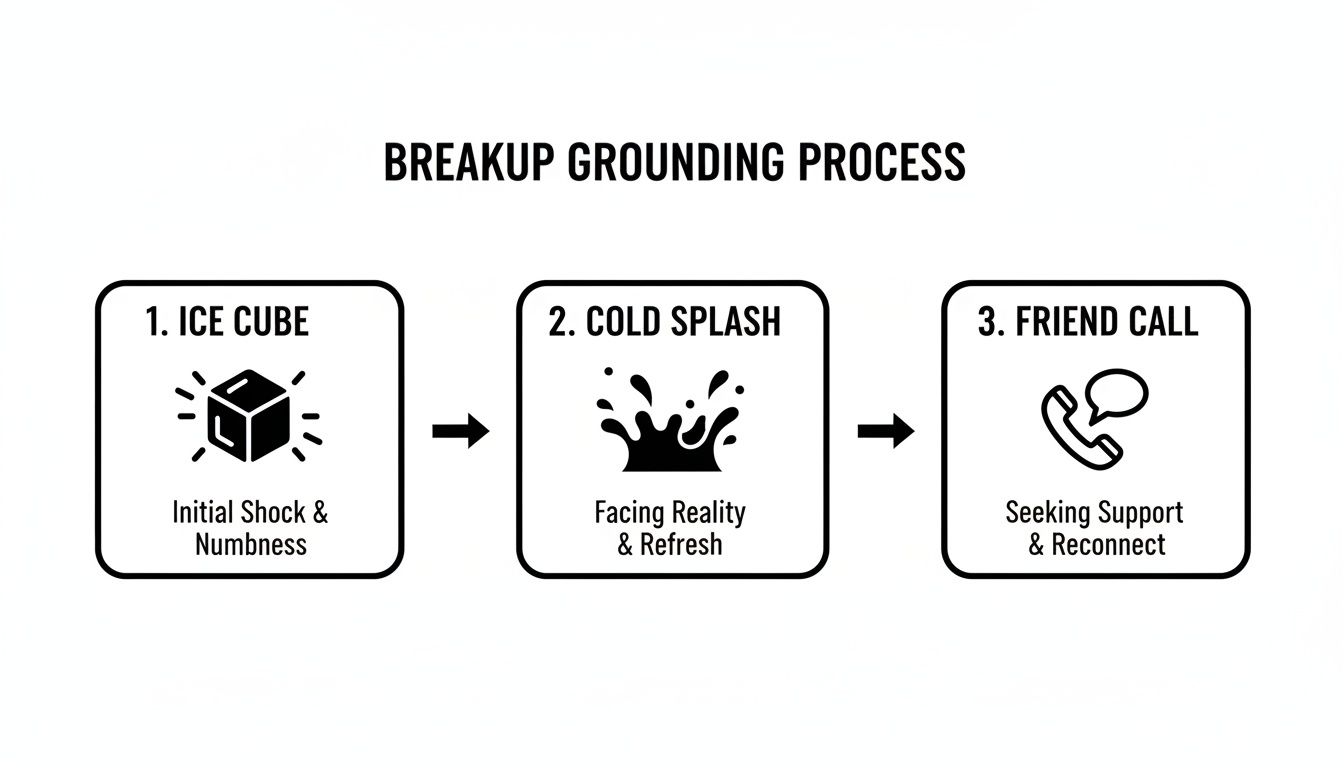
This process is about creating a physical pattern-interrupt. By using an intense sensation like holding an ice cube, splashing your face with cold water, or immediately calling a trusted friend, you're giving your nervous system a different signal. You're physically breaking the mental spiral, which gives you just enough space to breathe and reclaim control.
Building Your Foundation Of Internal Safety
Once you've made it through the initial storm of obsessive thoughts, the real work begins. This next phase is about making a fundamental shift—from desperately looking for safety outside of yourself (like in a text back from your ex) to patiently, deliberately building it within.
It's about learning to become your own secure base.
This doesn’t happen with grand, sweeping gestures. It happens in the quiet, consistent, daily practice of tuning in to yourself. You're learning to actually hear what your body and mind need and—this is the most important part—to respond with care. The goal is to prove to your nervous system, moment by moment, that you can and will show up for yourself.
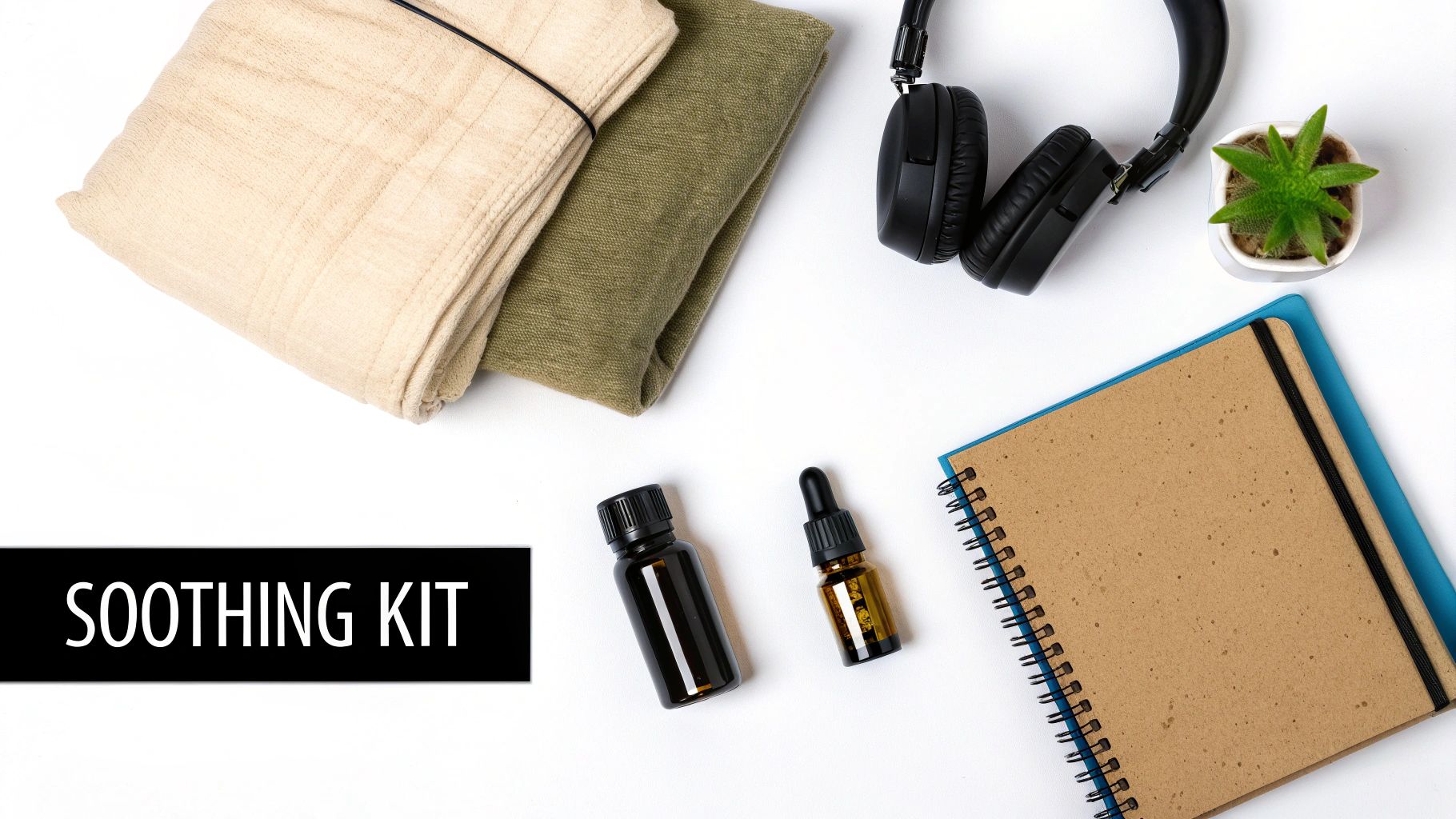
Create Your Personalized Soothing Kit
A powerful, tangible first step here is to create a physical 'soothing kit.' Think of it as your emergency go-bag for emotional overwhelm. It's a collection of items that you can turn to instead of your phone to directly calm your nervous system through your senses.
Your kit could include things like:
- A weighted blanket or heavy scarf: Deep pressure is incredibly grounding and has an almost immediate calming effect on the body.
- A specific playlist: Curate music that you know makes you feel grounded or gently uplifted. Steer clear of anything nostalgic that will send you down a rabbit hole.
- A comforting scent: An essential oil diffuser with lavender, a familiar candle, or even a specific hand lotion can anchor you right back in the present moment.
- A soft texture: A scrap of velvet, a favorite worn-in t-shirt, or a fuzzy pair of socks can be incredibly soothing to the touch.
The very act of putting this kit together is an act of self-care. You're anticipating your own distress and preparing a compassionate response ahead of time.
Internal safety isn't a destination you arrive at; it's a practice you build one moment at a time. Each time you choose to soothe yourself instead of seeking external validation, you are laying another brick in your foundation.
Journal To Uncover Your Needs
Journaling is so much more than just venting about your ex. It's a powerful tool for self-discovery and a direct line to your inner world. When your mind is racing with anxiety, these prompts can help you redirect that frantic energy inward to figure out what you really need in that moment.
Try asking yourself:
- "If the anxiety I'm feeling had a voice, what would it be asking for right now?" (Maybe the answer isn't "my ex," but "reassurance" or "a hug.")
- "What is one small thing I can do for myself in the next 10 minutes to feel even 1% safer?" (Maybe it's making a cup of tea or wrapping yourself in a blanket.)
- "Beyond my ex, what does the feeling of 'security' look, sound, and feel like to me?"
These kinds of questions shift you out of a reactive, helpless state and into a proactive one. You start to see that while you can’t control your ex, you have immense power over how you care for yourself. As you practice this, getting the fundamentals right is key; for instance, committing to good sleep hygiene is one of the most powerful things you can do for your emotional stability.
Set Boundaries With Yourself
Here's something we don't talk about enough: boundaries aren't just for other people. A huge part of building internal safety is setting and honoring boundaries with yourself. This is how you break the compulsive cycles that keep your anxiety fed and alive.
For example, make a clear, manageable rule for yourself, like deleting your ex's number from your phone. If you can't bring yourself to do that, change their contact name to "Do Not Contact" or "This Will Hurt." Or commit to muting their social media profiles for one month so you don't accidentally see their updates.
This practice isn't about restriction; it's about teaching your brain that you are in control, not the compulsive urge. It’s a profound act of self-respect that begins to rebuild trust in your own ability to keep yourself safe.
From Hindsight To Foresight: Recognizing Your Patterns
Once the initial emotional tidal wave starts to settle and you feel a bit more grounded, you can begin the gentle work of connecting the dots.
This isn’t about blaming yourself. Not at all. It’s about turning painful hindsight into powerful foresight. It’s about looking at your relationship history with genuine curiosity, not criticism, so you can finally understand the patterns that have kept you feeling so stuck.
This is how you stop repeating the same story over and over again. It's where you start to see how your anxious attachment has shaped who you choose and how you show up in your relationships.
Do You Fall Into The Anxious-Avoidant Trap?
Take a moment for some compassionate self-reflection. The goal here isn't to judge yourself but to gently identify themes that keep showing up. Grab a journal and sit with these questions for a bit:
- Do I seem to fall for partners who are emotionally distant, hot-and-cold, or maybe even a little bit broken—someone who needs "fixing"?
- Looking back, were there early signs of their unavailability that I brushed aside because the initial spark felt so intense and promising?
- Do I consistently end up doing most of the emotional heavy lifting in my relationships, just to keep the connection alive?
Answering these honestly can shine a light on a dynamic so many people with anxious attachment find themselves in: the anxious-avoidant trap.
This is the magnetic pull between someone craving security (that’s you) and someone who prizes their independence and is terrified of being smothered (the avoidant partner). It’s a perfect storm that creates a constant cycle of pursuit and withdrawal, leaving you in a perpetual state of insecurity.
Recognizing your pattern isn’t about assigning blame. It's about seeing the dance you’ve been a part of so you can consciously choose to learn new steps.
Maybe you realize you always date people who are emotionally checked out. You dive in headfirst, pouring all your energy into being the "perfect" partner, hoping to "win" their love. This makes you feel needed and quiets that deep-seated fear of abandonment… but only for a little while.
Inevitably, when they can't (or won't) return the same level of care, you're left feeling completely drained and unappreciated. And just like that, the cycle begins again with someone new.
This awareness—this new understanding—is your key to breaking free.
By seeing your attraction to unavailable partners for what it is, you can start to spot those red flags much earlier. You begin to learn what a truly secure, reciprocal connection actually looks and feels like. One built on mutual effort and emotional presence, not a desperate chase. This is how you empower yourself to make different, healthier choices moving forward, building a foundation for the secure, steady love you truly deserve.
When To Seek Professional Support
While all the self-healing work in this guide is powerful, sometimes you just need a guide. Someone who knows the terrain and can help you navigate it.
Reaching out for professional support isn’t a sign of weakness. It’s actually a courageous step toward making deep, lasting change, especially when you're reeling from a breakup with an anxious attachment style.
But knowing when to reach out can feel tricky.
If your feelings of depression or anxiety just won't let up, if they’re getting in the way of your daily life—like you can't focus at work or you've stopped eating properly—or if you feel completely stuck in a loop you can't break on your own, that’s your signal. It’s time to get some help.
Finding The Right Therapist For Attachment Work
Let's be clear: not all therapy is the same. When you're working to heal deep attachment wounds, it is absolutely vital to find a professional who truly understands the nuances of your experience. You don't want to waste time explaining the basics.
Look for a therapist who explicitly mentions these specialties on their website or profile:
- Attachment Theory: This is non-negotiable. They must have a deep understanding of anxious, avoidant, and secure attachment dynamics.
- Trauma-Informed: This approach is key because it recognizes that your attachment patterns are old survival strategies. It ensures you’ll be met with compassion, not judgment.
- Nervous System Regulation: A therapist skilled in somatic (body-based) work can help you heal the anxiety where it lives—in your body.
Finding a therapist who just gets it can feel like the biggest relief in the world. You won't have to spend your sessions explaining what anxious attachment is; you can dive right into the healing.
Going into a consultation call prepared can turn the process from intimidating to empowering. Have a few clear questions ready so you can quickly figure out if it's a good fit.
For example, ask them directly: "How do you approach healing an anxious attachment after a breakup?" Their answer will tell you everything you need to know about their experience and whether their approach resonates with you.
At Securely Loved, our entire practice is built around helping you heal these deep-seated patterns. We offer trauma-informed therapy and resources specifically designed to regulate your nervous system, build internal safety, and guide you toward the secure, loving connections you truly deserve.
If you're ready for attuned support from someone who gets it, you can book a free 15-minute connection call with us. It’s a private, compassionate space to explore your goals and see if we're the right fit for your healing journey.