

Anxiety in Relationships: Anxious Attachment Style Symptoms and How to Heal
If you’re the person who finds themselves staring at their phone, rereading the last message and wondering why three hours have passed without a reply, you’re not alone. The constant fear that your partner might leave, or the nagging feeling that you’re simply ‘too much’ in your relationships—these are classic signs of an anxious attachment style. At its core, this pattern comes from a deep-seated fear of abandonment and a powerful, almost desperate, desire for closeness.
Do I Have An Anxious Attachment Style
Does the silence between texts feel absolutely deafening? Do you spend hours replaying a simple conversation, trying to decode your partner's tone or searching for a tiny sign of rejection? That familiar, painful knot in your stomach when a partner says, "I just need a little space tonight," is a feeling many of us know all too well.
This pattern of relationship anxiety isn't a character flaw or a sign that you’re broken. Far from it. It's actually a very intelligent, protective strategy your nervous system developed a long, long time ago. For most people, anxious attachment patterns are born from childhood experiences where care was inconsistent—where love and attention felt unpredictable.
One moment, a parent might have been warm, present, and loving. The next, they were distant, overwhelmed, or unavailable. This inconsistency creates a blueprint for how we approach love as adults. Your system learned that to get its needs met, it had to stay on high alert, constantly scanning for connection and anticipating the moment it might disappear.
Recognizing the Pattern
This learned response shows up as a collection of feelings, thoughts, and behaviors that can feel completely exhausting. For example, your partner might mention a new coworker, and instead of feeling neutral, your mind immediately jumps to imagining their budding romance, triggering a wave of insecurity.
Here are some of the most common internal and external signs:
- Constant worry about your partner's feelings for you. Example: "They seemed quiet this morning. Are they mad at me? What did I do?"
- A deep-seated fear of being abandoned that can feel catastrophic. Example: A minor disagreement feels like it could be the end of the relationship.
- The overwhelming urge to seek reassurance. Example: Asking "Are we okay?" multiple times after a small argument, needing to hear "I love you" to calm down.
Anxious attachment is not a conscious choice; it is an automatic survival response. It’s your nervous system’s attempt to maintain connection at all costs, based on early life programming that taught you connection is fragile.
Living in this state of high alert is mentally and physically draining. Recognizing these patterns for what they are is the first, most compassionate step you can take toward understanding your inner world.
To help you see if these experiences resonate, here’s a quick guide to what anxious attachment often looks and feels like.
Quick Guide to Anxious Attachment Symptoms
The table below breaks down the common internal experiences and outward behaviors tied to this attachment style. See if any of these feel familiar to you.
| Symptom Category | What It Looks and Feels Like (Real-World Examples) |
|---|---|
| Internal Feelings | A persistent sense of unease or anxiety about your relationships. Example: Feeling a pit in your stomach when your partner goes out with friends. Low self-worth that depends on your partner’s approval. Example: Feeling great about yourself when they compliment you, but terrible when they're distracted. |
| Common Thoughts | "They're going to leave me." "I must have done something wrong." "Why haven't they texted back? Maybe they're with someone else." "I'm probably too much for them." |
| Outward Behaviors | Needing constant contact, like texting all day just to feel connected. Over-analyzing your partner’s words and actions. Example: Scrutinizing the punctuation in a text message for hidden meaning. Sometimes using "protest behaviors" like starting a fight just to get a response and feel connected again. |
If you see yourself in this table, please know there's nothing wrong with you. You're simply operating from an old survival map. Recognizing it is the first step toward drawing a new one.
The Core Symptoms of Anxious Attachment
Understanding anxious attachment isn’t about memorizing a textbook definition. It’s about recognizing yourself in those small, gut-wrenching moments of panic, doubt, and intense longing that pop up in your relationships.
These feelings aren’t random. They are specific, predictable patterns—anxious attachment style symptoms—that show up in your thoughts, emotions, and behaviors. When you can finally put a name to them, you can start to understand where they come from.
These symptoms often feel like they’re just part of who you are, a fundamental flaw in your personality. But what if they aren’t? Seeing them as learned patterns—as survival responses your nervous system adopted to keep you safe—is the first real step toward self-compassion and change. Let’s walk through the four core symptoms that define this experience, using real-world examples that might feel all too familiar.
1. Intense Fear of Abandonment
At the very heart of an anxious attachment style is a deep, often overwhelming fear of being left. This isn't just a casual worry; it's a primal terror that the connection you cherish is fragile and could shatter at any moment.
Real-World Example: Your partner mentions they’re going on a weekend trip with their friends in a month. Instead of feeling happy for them, a wave of panic washes over you. Your mind immediately fast-forwards to all the ways this could end the relationship: What if they meet someone else? What if they realize they're happier without me? This fear can make it feel impossible to just relax and trust the connection.
This fear of abandonment makes you interpret completely neutral events as massive threats. For instance, if your partner is quiet one evening, your mind doesn't default to, "They probably had a long day." Instead, it leaps straight to, "They're pulling away. I did something wrong. They're going to leave me." Your internal alarm system is stuck on high alert, scanning for any hint of disconnection.
2. A Constant Need for Reassurance
Because that fear of being left is so powerful, it creates an intense, almost insatiable need for proof that you're loved and the relationship is safe. You might find yourself constantly looking for validation from your partner, just to feel okay for a little while.
Real-World Example: You and your partner had a tiny disagreement over what to have for dinner. It was resolved in minutes, but an hour later, you still feel a lingering anxiety. You find yourself asking, "Are you sure you're not mad at me?" or trying to cuddle up to them, seeking physical proof that everything is truly okay. This isn't about being "needy"; it's a desperate attempt to quiet the internal alarm bells.
This is one of the most visible anxious attachment style symptoms, and it can show up in a lot of different ways:
- Frequent Questioning: "Are we okay?" "You're not mad at me, are you?"
- Seeking Compliments: Relying on praise about your appearance or accomplishments to feel worthy of love.
- Needing Verbal Affirmation: Requiring a steady stream of "I love yous" just to feel secure.
You’re essentially asking your partner to be an external regulator for your emotions because feeling secure on your own feels impossible.
3. Overthinking and Analyzing Everything
Another classic sign is living inside your head, endlessly analyzing every tiny detail of your relationship. Your mind becomes a detective, constantly searching for clues, hidden meanings, and potential problems that aren't even there. It's completely exhausting.
Real-World Example: Your partner sends a text that just says "Ok." instead of their usual "Ok!" Your mind immediately goes into overdrive. Why the period? Are they annoyed? Was it something I said earlier? I should look back at our conversation. You might spend the next hour replaying interactions and trying to pinpoint where you went wrong, all based on a single piece of punctuation.
This constant analysis is a protective strategy. Your brain truly believes that if it can just figure everything out and anticipate any potential threat, it can prevent the ultimate pain of abandonment.
This overthinking creates a nasty feedback loop. The more you analyze, the more "evidence" of potential disaster you find, which just fuels more anxiety. Globally, anxious attachment affects roughly 5.5-11% of adults, but its impact on well-being is huge. You can read more about American attachment styles and their societal impact to see the bigger picture.
4. High Emotional Reactivity
When your entire system is primed to spot danger, your emotional responses are often amplified. Small issues can feel like five-alarm fires, leading to reactions that might seem completely out of proportion to the situation. This isn’t a character flaw; it’s a sign that your nervous system is totally overwhelmed.
Real-World Example: Your partner is running 15 minutes late and didn’t text you. By the time they walk through the door, you're not just annoyed; you're flooded with a mix of panic and anger. Instead of saying, "Hey, I was worried," you might launch into accusations: "You never think about me! I was sitting here thinking you were in a car crash!"
This high emotional reactivity is often called "protest behavior." It’s an unconscious, desperate attempt to jolt your partner into action—to get them to respond and prove they still care. From your nervous system's perspective, even negative attention feels safer than the terrifying silence of potential abandonment. Recognizing these patterns isn't about blaming yourself; it's about understanding the "why" behind your reactions so you can finally begin to heal.
So, we've unpacked what an anxious attachment style looks and feels like. The next big question that usually comes up is, Why am I like this?
Let me be clear: understanding where these patterns come from isn't about blaming your parents or anyone else. It’s about building the self-compassion you need to truly heal. These reactions aren't character flaws or personal failures; they are deeply ingrained survival strategies that your younger self brilliantly developed to stay safe.
The roots of an anxious attachment style almost always lead back to our earliest experiences with caregivers. This is where our internal blueprint for relationships gets wired. Think of it like learning your first language—it happens automatically, without conscious thought, and becomes the default way you communicate your needs for the rest of your life.
When the care you receive is inconsistent, your world feels incredibly unpredictable. One day, your parent might be warm, tuned-in, and responsive. The next, they might be emotionally distant, overwhelmed, or just… gone. For a child who depends entirely on that connection for survival, this inconsistency creates a profound sense of uncertainty and anxiety.
The Faulty Wi-Fi Signal Analogy
Imagine your feeling of safety and connection to your caregiver is like a Wi-Fi signal. For a securely attached child, that signal is strong and reliable. They know they can go out, explore the world, and always reconnect to their safe base without a problem.
But for a child who develops an anxious attachment, that signal is faulty and unpredictable. Sometimes it's strong, but then it cuts out without any warning. The child never knows when they’ll have a solid connection and when they'll be left buffering, desperately waiting to reconnect.
This forces them to become hyper-focused on the signal itself. They're constantly checking it, trying to stay connected, and panicking the moment it feels weak. This early dynamic creates a lifelong sensitivity to any hint of disconnection.
This isn't a conscious choice. It's a learned survival mechanism. Your nervous system adapted to an unpredictable world by becoming hypervigilant about connection—a skill that was absolutely essential back then but causes a lot of distress in your adult relationships now.
This early programming has a massive, lasting impact. Research shows that about 11% of adults live with this anxious attachment pattern. And it's often passed down through generations—studies reveal that a staggering 85% of children may end up with the same attachment style as their primary caregiver. You can learn more about attachment style percentages and their origins here.
The Science Behind the Anxiety
This isn't just a psychological theory; it's wired into our biology. That inconsistent care literally trains a developing nervous system to exist in a constant state of high alert. Specifically, it leads to chronic activation of the sympathetic nervous system—our body's "fight-or-flight" response.
Your body’s internal alarm system essentially gets stuck in the "on" position. Here's what that feels like day-to-day:
- Heightened Threat Detection: Your brain becomes an expert at scanning for any potential sign of abandonment. This often means you misinterpret neutral things—like a delayed text or a change in tone—as major threats to the relationship.
- Elevated Stress Hormones: Your body is frequently flooded with cortisol and adrenaline. This is why you might feel constantly on edge, restless, and unable to fully relax, even when things are going well.
- Difficulty Self-Soothing: Because you learned early on to rely on someone else for comfort, learning how to calm your own nervous system becomes a real challenge. You're always looking outside of yourself for that sense of safety.
Seeing this through a trauma-informed lens is a game-changer. It helps us reframe the symptoms of an anxious attachment style not as things that are "wrong" with you, but as brilliant adaptations.
Your clinginess was a way to make sure a connection didn't disappear. Your anxiety was a way to stay alert to potential disconnection. Seeing these patterns as evidence of your resilience, not your brokenness, is the first and most powerful step toward creating a new, more secure way of being in the world.
How Anxious Attachment Compares to Other Styles
Getting a handle on your own patterns is a huge step. But the whole picture snaps into focus when you see how your reactions fit into the bigger world of attachment styles. Those confusing push-pull dynamics that drive you crazy in relationships? They often start making sense once you realize you and your partner might be working from two completely different blueprints for connection.
Seeing these differences isn’t just about decoding your partner’s behavior; it’s about building a bridge of understanding. Each insecure style is just a different adaptation to what happened in our early lives—a unique survival strategy for navigating relationships. No single style is "bad." But understanding the core differences is everything.
This simple flowchart shows how inconsistent caregiving in childhood directly wires someone for an anxious attachment style.
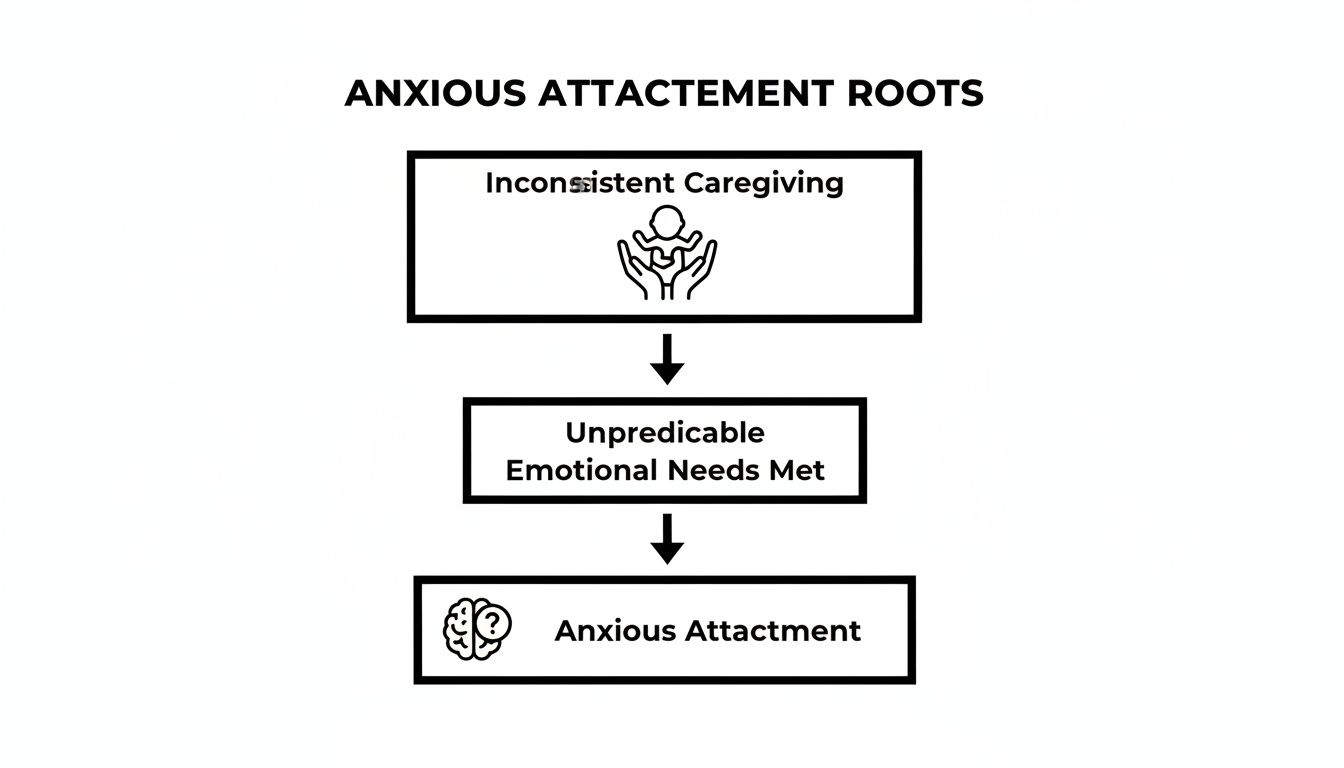
When a caregiver's presence is unpredictable, a child's brain learns to constantly question connection and chase it down, forming the very foundation of anxious attachment.
The Four Main Attachment Styles
To really get a feel for anxious attachment style symptoms, it helps to see them side-by-side with the other three styles. Each one has its own internal logic and a predictable set of responses, especially when things get stressful.
- Secure Attachment: This is the gold standard for healthy connection. Folks with a secure style generally feel safe in relationships, trust their partners, and are comfortable with both closeness and their own independence. For them, a relationship is a secure home base, not a battlefield.
- Anxious Attachment: As we've been talking about, this style is driven by a deep fear of abandonment. There's a constant need for closeness and validation just to feel okay. Independence can feel terrifying, and a ton of mental energy goes into monitoring the relationship for any sign of trouble.
- Avoidant Attachment: People with an avoidant style put independence and self-sufficiency on a pedestal. They often get uncomfortable with too much closeness, seeing it as a threat to their freedom, and will shut down their emotions to keep people at arm's length.
- Disorganized Attachment: Often born from childhood trauma, this style is a painful mix of both anxious and avoidant tendencies. There's a simultaneous craving for and terror of intimacy, which leads to unpredictable and often chaotic relationship patterns. They desperately want to get close but are terrified of what will happen if they do.
Core Differences in Action
The real test of these styles pops up during conflict. Imagine your partner says, "I'm feeling a bit overwhelmed and just need a quiet night to myself."
- An anxious response might be to immediately panic, thinking, Overwhelmed by what? By me? You might start pursuing, texting, and asking what’s wrong to "fix" it right now. This is a desperate attempt to force a reconnection.
- An avoidant partner in a similar situation might say, "Okay," and then retreat into another room, creating physical space to handle their own overwhelm.
To the anxious person, this withdrawal feels like a five-alarm fire, a catastrophic abandonment that triggers their deepest fears. But to the avoidant person, the anxious pursuit feels suffocating and invasive.
It all comes down to this: The anxious partner pursues because they need connection to feel safe. The avoidant partner withdraws because they need space to feel safe. Both are just survival strategies, but they clash in the most painful ways.
Attachment Styles at a Glance
To make it even clearer, this table breaks down the fundamental operating systems for each attachment style.
| Attachment Style | Core Fear | Behavior Under Stress | View of Intimacy |
|---|---|---|---|
| Secure | Loss of the relationship | Seeks support, communicates needs | Seen as safe, comforting, and desirable |
| Anxious | Abandonment and rejection | Pursues, seeks reassurance, "protests" | Craved, but a source of constant worry |
| Avoidant | Loss of independence | Withdraws, shuts down, creates distance | Seen as suffocating or threatening |
| Disorganized | Both intimacy and abandonment | Erratic; may pursue and then withdraw | Deeply desired but also terrifying |
Seeing it laid out like this can be a real lightbulb moment. It helps us move from blaming our partners (or ourselves) to understanding the deeply ingrained patterns we're both bringing to the table.
Your First Steps Toward Healing and Security

Realizing you have anxious attachment patterns is a massive first step. Seriously, give yourself credit for that. But the real journey starts when you begin giving your nervous system the one thing it's been craving all along—a feeling of safety that comes from you.
Healing isn't about getting rid of anxiety overnight. It’s about gently, patiently building your ability to sit with those uncomfortable feelings without letting them completely take over.
Lasting change has to be built from the body up. When your nervous system is constantly on high alert, no amount of positive self-talk is going to convince it that you’re safe. The goal here is to learn simple, physical practices that send safety signals directly to your brain, rewiring your stress response one tiny action at a time.
Regulating Your Nervous System in Real Time
Think of your nervous system as a smoke detector that’s way too sensitive. It shrieks at the slightest hint of trouble, even when there’s no real fire. These practices are like learning how to manually reset that alarm, giving you a precious moment of calm right in the middle of a storm.
That emotional chaos behind anxious attachment symptoms—the jealousy, the overanalyzing, the constant need for reassurance—all stems from this hypersensitive internal alarm. And you're not alone in this. About 41% of adults have insecure attachment styles. In the US, where only 38% of people report feeling secure, these patterns often run in families, highlighting a cycle of inherited anxiety. You can explore more on the familial echoes of attachment styles in recent research.
Here are a few simple but powerful techniques you can start using today.
The 5-4-3-2-1 Grounding Technique
When to use it: The next time you're staring at your phone, waiting for a text back, and you feel that familiar panic rising in your chest.
- Look: Pause and name 5 things you can see around you (e.g., "my blue coffee mug," "the dust on the TV," "a green plant").
- Feel: Bring your awareness to 4 things you can physically feel (e.g., "the soft fabric of my sweater," "my feet flat on the floor," "the cool air from the vent").
- Listen: Tune into 3 things you can hear (e.g., "the hum of the fridge," "a car passing outside," "my own breathing").
- Smell: Identify 2 things you can smell (e.g., "the coffee on my desk," "the laundry detergent on my shirt").
- Taste: Acknowledge 1 thing you can taste (e.g., take a sip of water or notice the lingering taste of toothpaste).
This practice is so effective because it breaks the obsessive thought loop by anchoring you in physical reality.
Box Breathing to Soothe Fight-or-Flight
When to use it: Right after a tense conversation with your partner when you feel your heart racing and your thoughts spiraling.
- Step 1: Inhale slowly through your nose for a count of 4.
- Step 2: Gently hold your breath for a count of 4.
- Step 3: Exhale slowly through your mouth for a count of 4.
- Step 4: Hold your breath out for a count of 4.
Repeat this for 1-2 minutes. That predictable rhythm is incredibly soothing for a system that's used to feeling chaotic and uncertain.
Mindful Check-Ins for Self-Attunement
How to start: Set a random alarm on your phone for three times a day. When it goes off, just pause, place a hand on your heart, take one deep breath, and ask yourself, "What am I actually feeling in my body right now?" Don't judge it or try to fix it. Just notice. Is your chest tight? Is your stomach fluttering? This practice builds the muscle of turning inward for information instead of constantly looking outside yourself for validation.
Healing begins when you start giving yourself the consistent, compassionate attention you may not have received as a child. This is the foundation of building internal security.
Exploring practical mind-body connection exercises can be a really powerful next step on this journey.
When It's Time to Ask for Help
While self-regulation practices are a powerful place to start, sometimes our best efforts just aren’t enough to shift patterns that have been running the show for decades. You might feel like you’re stuck on a hamster wheel, repeating the same painful relationship cycles even when you know exactly what you wish you could do differently.
This feeling of being stuck is a huge sign that it might be time to bring in professional support. Recognizing you need help isn't a weakness—it's a sign of incredible strength. If the anxiety from your attachment style is constantly getting in the way of your daily life, your work, or your well-being, getting help is a courageous next step. It's you telling yourself that you deserve a more peaceful way of being in the world.
Why a Trauma-Informed Therapist Is a Game-Changer
It’s so important to find the right kind of support. While traditional talk therapy can be helpful, healing deep-rooted anxious attachment style symptoms often requires more than just talking about your thoughts and feelings. An attachment-focused, trauma-informed therapist gets that these patterns are wired directly into your nervous system.
This approach goes way beyond just talking. It includes embodied, or body-based, healing methods that help you work directly with your nervous system’s knee-jerk reactions. These therapists are trained to create a safe space where you can finally process the underlying wounds that created the anxious patterns in the first place. This is where the real, lasting change happens.
Healing happens when we feel safe enough to explore our deepest fears. A trauma-informed therapist co-regulates with you, helping your nervous system learn what safety and security truly feel like in a relational context—often for the very first time.
Taking the Next Step
Imagine ending a relationship without that familiar, crushing spiral of self-blame. Or picture yourself being able to voice a need without that paralyzing fear of being "too much." This is the kind of security that becomes possible when you get the right support. It all starts with building a secure, grounded relationship with yourself first.
If you’re tired of the emotional rollercoaster and ready to find a path toward earned security, consider reaching out to a professional. Many practitioners, like those at Securely Loved, offer a connection call so you can see if their approach feels like a good fit. Taking this step is a powerful commitment to your own healing—and you absolutely deserve it.
A Few Common Questions I Get Asked
As you start to see these anxious attachment patterns in your own life, it's totally normal for questions to bubble up. This is a really important part of the journey—you're moving past just spotting the symptoms and getting curious about how real change actually happens.
Here are a few of the most common questions that come up in my coaching practice.
Can Anxious Attachment Be Cured?
This is a big one. While anxious attachment isn't a disease you can "cure," you can absolutely heal its grip on your life and develop what we call earned secure attachment. This just means that through awareness and intentional work, you can build the internal safety and self-trust that maybe wasn't available to you as a kid.
The goal isn't to magically erase your past or to never feel a drop of anxiety again. It’s about learning how to sit with those feelings, soothe your own nervous system, and handle relationship triggers from a place of groundedness instead of panic. You learn to become the secure base for yourself that you always needed.
What If I Have Both Anxious and Avoidant Traits?
It's actually super common to see traits from different styles, especially when you're under stress. If you find yourself desperately needing connection one minute (anxious) and then pushing it away the next because it feels like too much (avoidant), you might be experiencing a disorganized attachment style.
This style often comes from a childhood where fear or trauma was present, and it creates a deep internal tug-of-war: the desire to be close is just as intense as the fear of it. The point isn't to slap a perfect label on yourself, but to understand the different survival strategies your nervous system is using to try and keep you safe.
How Do I Express My Needs Without Sounding Needy?
Ah, the fear of being "needy." This is a core wound for anyone with an anxious attachment style. The secret is to shift from anxious protest behaviors (like making accusations or demands) to clear, vulnerable communication. A simple but powerful way to start is by using "I feel" statements.
A Simple Script to Try:
"I feel [your emotion] when [a specific, non-blaming situation happens] because [the story I'm telling myself]. I would really appreciate [a clear, simple request]."
Real-world example: Instead of saying, "You never text me back! Don't you care about me?" you could try: "I feel anxious when I don't hear from you for a few hours because I start to worry something is wrong between us. I would really appreciate it if you could send just a quick text when you get a free moment to let me know you're thinking of me." See the difference? You're sharing your need without making the other person wrong.
Is Having an Anxious Attachment Style My Fault?
Let me be incredibly clear: Absolutely not. Anxious attachment is not a character flaw or something you did wrong. It’s a brilliant and logical adaptation your younger self created to survive in an environment where care and connection felt unpredictable.
Your heightened sensitivity and deep desire for closeness were once essential tools for your survival. When you start to see it this way, you can begin to shift the inner story from self-blame to self-compassion—and that is where all true healing begins.
At Securely Loved, my coaching practice is dedicated to helping adults heal these deep-rooted attachment patterns. If you feel ready to move from anxiety to a more grounded way of connecting, you can book a free, 15-minute connection call to see how my trauma-informed approach can support your journey.