
Heal Your Fear of Abandonment In Relationships
A text goes unanswered for two hours, and your whole body changes. Your chest tightens. Your mind starts building a story. They’re pulling away. They’re upset. You did something wrong. By the time the phone lights up again, you’re already flooded, angry, ashamed, or tempted to send a message you’ll regret.
That reaction can feel dramatic from the outside and terrifying from the inside. It often gets mislabeled as neediness, overthinking, or being “too much.” But fear of abandonment in relationships usually runs deeper than that. It’s often a survival pattern. Your system learned that closeness can disappear, attunement can shift without warning, and love may not stay steady.
This fear isn’t a formal diagnosis. It’s a human response to inconsistency, loss, emotional neglect, rupture, betrayal, or relational trauma. It can show up in dating, marriage, friendships, work relationships, and even when nothing is objectively wrong. If you’ve ever felt calm one moment and panicked the next because someone’s tone changed, this pattern will probably feel familiar.
Healing starts when you stop treating the reaction as proof that you’re broken and start understanding it as information. There are reasons this happens. There are ways to calm it. And there are paths to building relationships that feel far more secure than what you may have known before.
That Familiar Panic When a Relationship Feels Unsafe
It often starts with something small. A shorter-than-usual reply. A canceled plan. A partner who seems distracted after work. On the surface, it’s ordinary. In your body, it can feel like an emergency.
One client once described it this way: “I know a delayed text isn’t abandonment, but my body doesn’t know that.” That’s the experience many people have. The trigger looks minor, but the reaction is immediate and intense. You might scan for clues, replay the last conversation, or feel an urge to fix the distance fast.
Sometimes the physical symptoms are so strong that people wonder if something is medically wrong. If racing heart, chest tightness, or shortness of breath are part of your trigger cycle, this guide on distinguishing between panic attacks and heart issues can be a useful resource alongside emotional support.
When fear feels bigger than the moment
Fear of abandonment in relationships doesn’t usually announce itself clearly. It shows up as:
- Urgency: You need reassurance now, not later.
- Mind reading: You assume distance means rejection.
- Self-blame: You quickly decide the problem must be you.
- Protective behavior: You cling, lash out, shut down, or leave first.
None of those responses mean you’re weak. They usually mean your system has linked connection with instability.
Practical rule: If your reaction feels much bigger than the present moment, there’s often an older wound underneath the current trigger.
This is why insight alone often isn’t enough. You can know your partner is busy and still feel flooded. You can understand the pattern and still feel grabbed by it. The fear is real, but it isn’t always current reality. That distinction changes everything.
Understanding the Deep Roots of Abandonment Fears
A delayed reply from your partner can hit your system like a threat, even when part of you knows nothing serious has happened. That reaction usually has a history. Fear of abandonment often grows out of repeated experiences that taught your body and mind that closeness could shift without warning.
For many adults, the present trigger is only the match. The deeper pattern was shaped over time through relationships that felt inconsistent, conditional, emotionally confusing, or hard to trust.

Early attachment and childhood attunement
Children do not need flawless parenting. They need enough steadiness to learn, “When I’m distressed, someone helps me settle.” If care is warm one day and withdrawn the next, a child often adapts by tracking mood, distance, and approval very closely.
That adaptation can look impressive in adulthood. Many high-functioning adults with abandonment fear are capable, perceptive, and skilled at reading a room. They often become the reliable one, the thoughtful one, the one who notices everything. Under relational stress, those same strengths can turn into hypervigilance, overinterpretation, and a constant need to check whether connection is still intact.
That pattern is common in anxious attachment dynamics in adult relationships.
Relational trauma changes your expectations of love
Some people connect their fear to obvious trauma. Others grew up in homes that looked stable from the outside but felt emotionally unsafe on the inside. Chronic criticism, emotional neglect, betrayal, parental inconsistency, addiction, enmeshment, or love that depended on performance can all leave the same imprint. Close relationships start to feel meaningful and risky at the same time.
In practice, I often see adults dismiss these histories because “nothing that bad happened.” But nervous systems do not organize themselves around appearances. They organize around repeated experience. If closeness often came with tension, withdrawal, unpredictability, or shame, your system may still expect those outcomes long after the original environment is gone.
This is why abandonment fear can feel so confusing. The adult part of you wants connection. Another part stays on guard for the moment it changes.
Fear of abandonment often begins as an adaptation. It developed to protect connection in relationships that did not feel reliably safe.
Adult stress can reactivate old attachment pain
Old wounds do not only surface in new relationships. They often return during life transitions that strain the nervous system and reduce your margin for coping. Breakup, divorce, parenthood, caregiving, grief, illness, burnout, retirement, and children leaving home can all make previously managed fears come back with surprising force.
People often say, “I thought I had already worked through this.” Sometimes they had. Then life changed, stress rose, sleep worsened, and the system lost flexibility. Progress was real. The conditions around that progress changed.
That distinction matters because it reduces shame and points to the right kind of support.
The overlooked role of hormonal shifts
Midlife hormonal transitions deserve much more attention in conversations about abandonment fear. Perimenopause and menopause can increase anxiety, sleep disruption, irritability, sensory sensitivity, and emotional intensity. If an older attachment injury is already present, those body-based changes can make relationship triggers feel sharper and harder to settle.
This does not mean everything is “just hormones,” and it does not mean every fear is rooted only in childhood. Both explanations are too narrow. In many high-functioning adults, abandonment fear is shaped by the interaction between attachment history, current stress, and physiology.
That is a real trade-off. Insight helps, but insight alone may not be enough when your body is running on poor sleep, hormonal fluctuation, and chronic strain. Healing usually goes better when you address both the story and the state of your nervous system.
Common Signs You Fear Abandonment in Relationships
You get a shorter text than usual. Your chest tightens. Part of you wants to ask, “Are we okay?” Another part wants to go quiet first, act unbothered, and protect your dignity. That inner split is one of the clearest signs of abandonment fear in adult relationships.
Fear of abandonment often hides inside competent, high-functioning behavior. It can look like over-functioning, people-pleasing, emotional self-protection, or a strong need to stay ahead of any possible rejection. The goal stays the same. Prevent disconnection before it happens.
Some people respond by reaching harder for closeness. Others create distance before anyone else can. I see both patterns often, especially in adults who seem steady from the outside but feel intensely unsafe once connection feels uncertain. During periods of poor sleep, chronic stress, or hormonal change, these signs often become sharper and more confusing.
What it looks like in daily life
You might notice one or several of these patterns:
- Reassurance-seeking: Asking whether your partner is upset, still loves you, or is pulling away, then struggling to settle even after they answer.
- Tone monitoring: Tracking shifts in facial expression, texting style, energy, or timing and reading them as signs of danger.
- Testing behavior: Pulling back, becoming cool, or making indirect comments to see whether your partner comes after you.
- Jealousy and comparison: Feeling thrown off by ex-partners, friends, coworkers, or anyone else who seems to matter to your partner.
- People-pleasing: Becoming overly accommodating because disapproval feels risky.
- Difficulty tolerating space: Experiencing ordinary separateness as a threat to the bond.
- Preemptive shutdown: Deciding not to need, not to ask, or not to care, because numbness feels safer than longing.
These responses can seem contradictory. They are often organized around the same fear.
How fear can express itself differently
| How Fear of Abandonment Can Manifest | ||
|---|---|---|
| Behavioral Pattern | Anxious Expression (Protest Behavior) | Avoidant Expression (Defensive Distancing) |
| After a delayed text | Sends follow-up messages, spirals, seeks reassurance | Tells self it doesn’t matter, shuts down, delays replying back |
| During conflict | Pushes for resolution immediately, argues to restore closeness | Withdraws, goes numb, leaves emotionally or physically |
| Need for closeness | Clings, over-explains, fears space | Minimizes needs, insists on independence, resists vulnerability |
| Response to criticism | Becomes highly reactive, ashamed, or desperate to repair | Detaches, gets cold, dismisses the issue |
| Internal belief | “Please don’t leave me.” | “I’ll leave internally before you can hurt me.” |
As noted earlier, research has linked attachment trauma, fear of abandonment, and heightened conflict sensitivity in romantic relationships. In practice, that often means a small rupture does not stay small internally. It quickly becomes a referendum on whether the relationship is secure.
The self-protective loop that strains connection
This is the hard trade-off. The strategies that help you feel safer in the moment can make closeness harder to sustain over time.
Repeated reassurance can leave a partner feeling tested or responsible for calming your whole system. Going cold can leave them confused, defensive, or shut out. Hypervigilance can turn ordinary relationship friction into constant threat management.
Many people with abandonment fear are not “too sensitive.” They learned to detect instability early, and that skill can become overactive in close relationships.
I also want to name something that gets missed. If these patterns have intensified in midlife, your body may be part of the story. Perimenopause, menopause, sleep disruption, and chronic stress can lower your window of tolerance and make relational cues feel more urgent than they did before. That does not make your experience less real. It means healing often works better when you pair attachment work with nervous system regulation tools that help your body settle.
The goal is not to become less attached. The goal is to relate from steadiness instead of fear.
How Your Nervous System Powers the Fear of Being Left
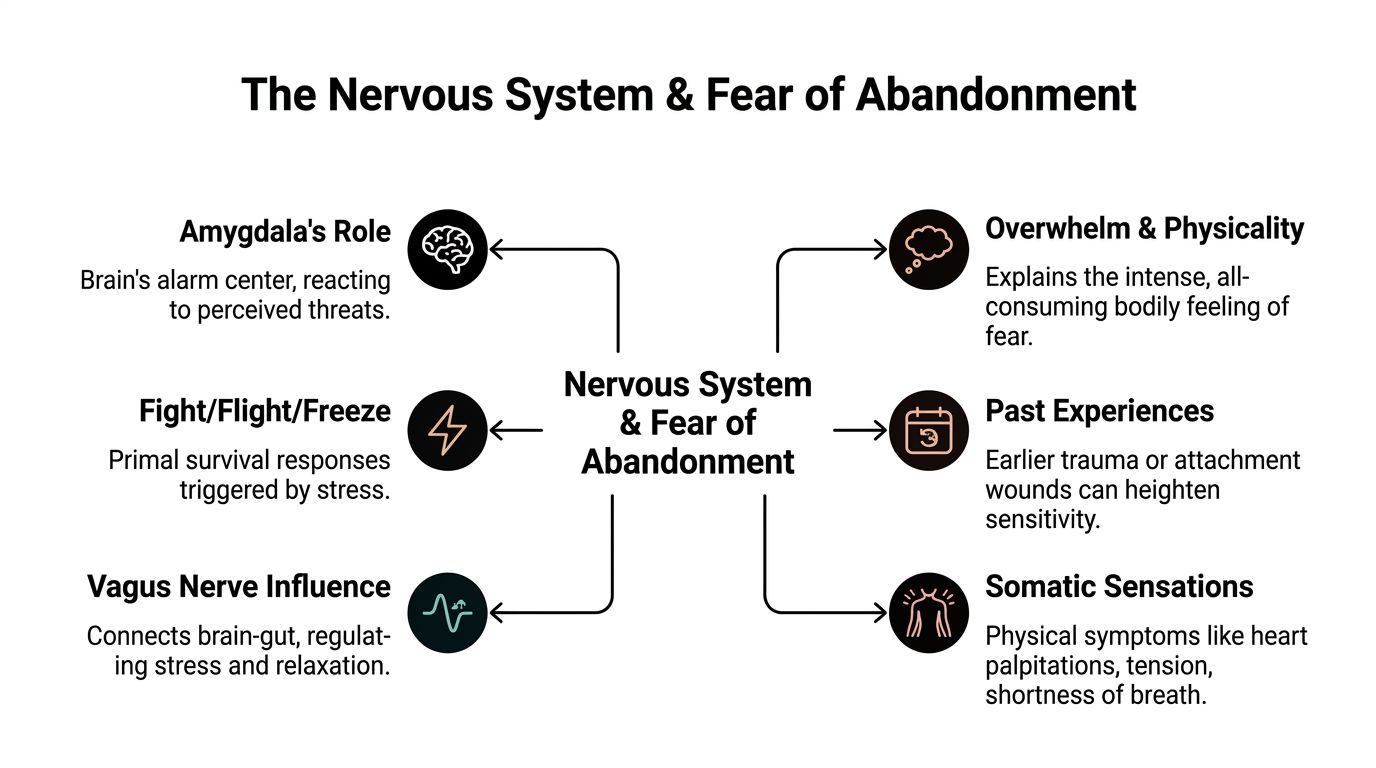
Fear of abandonment often feels irrational until you understand the body’s role in it. The reaction is not just emotional. It’s physiological. Your nervous system is making a rapid safety assessment, and in many people, that system has learned to treat relational distance as danger.
A useful analogy is a smoke detector that’s too sensitive. Burnt toast sets it off like a house fire. In relationships, a delayed response, a flat tone, or a missed goodnight can trigger the same internal alarm that a serious rupture would trigger.
Why the body reacts so fast
When the system perceives threat, you may move into fight, flight, freeze, or shutdown. In abandonment fear, that can sound like:
- Fight: “Why are you acting like this?”
- Flight: frantic texting, overexplaining, trying to fix it immediately
- Freeze: going blank, feeling numb, losing access to words
- Shutdown: “I’m done,” emotional collapse, total withdrawal
Without object constancy, which means holding a stable, positive image of a partner when they’re absent or unavailable, relationships can feel unstable moment to moment. That pattern is described in this discussion of object constancy and abandonment fear, and it helps explain why minor separations can feel so charged.
What regulation changes
When people learn how nervous system regulation works, they often stop moralizing their reactions. The goal isn’t to become emotionless. It’s to increase the gap between trigger and action.
That gap matters because it gives you access to choices such as:
- pausing before sending the fifth text
- noticing chest tightness before starting an argument
- naming a trigger without collapsing into it
- asking for connection without making the other person responsible for your entire sense of safety
Your body may be reacting to an old map of danger, not the full reality of the present relationship.
That doesn’t mean the relationship is always healthy. Sometimes your fear is amplified, and sometimes it’s picking up on real inconsistency. Regulation helps you tell the difference.
Actionable Exercises to Calm Your Nervous System Now
When abandonment fear gets triggered, the first task isn’t perfect communication. It’s helping your body come out of alarm enough that communication becomes possible. These tools won’t erase the wound in one moment, but they can interrupt the spiral and reduce damage.

The 5-4-3-2-1 grounding practice
When to use it: When your thoughts are racing and you feel pulled into catastrophic stories.
How to do it:
- Name 5 things you can see.
- Name 4 things you can touch.
- Name 3 things you can hear.
- Name 2 things you can smell.
- Name 1 thing you can taste.
How it works: This redirects attention from imagined future loss back to present-moment sensory reality. That shift can lower the intensity of spiraling.
Hand-on-heart self-soothing
When to use it: When you feel shame, emptiness, or an urge to beg for reassurance.
Place one hand on your heart and one on your upper abdomen. Press gently. Then say, slowly and out loud if possible, “I’m triggered right now. This feeling is real. I don’t have to act from it immediately.”
This practice helps create internal co-regulation. Instead of outsourcing safety entirely, you’re giving your system a direct signal of steadiness.
A guided practice can make this easier to follow in real time. Embedding a video from the @SecurelyLoved YouTube channel here works well when readers need a calm voice to borrow during a trigger.
The reality-testing journal prompt
When to use it: When your mind is certain abandonment is happening.
Write down three short responses:
- What happened
- What I’m telling myself it means
- What else could be true
Keep it plain. For example: “They haven’t replied in three hours.” “It means they’re losing interest.” “They may be in a meeting, overwhelmed, driving, or not available yet.”
This isn’t about gaslighting yourself. It’s about loosening the grip of a single fear-based interpretation.
Orienting to safety
When to use it: When your body feels trapped, frozen, or hyper-alert.
Slowly turn your head and look around the room. Let your eyes land on corners, doorways, windows, colors, and stable objects. Notice what in your environment is not threatening right now.
This can sound almost too simple, but it’s effective because the body needs cues of present safety, not just cognitive reassurance.
For more body-based tools, this collection of ways to regulate your nervous system offers practical next steps.
Gentle reminder: Don’t wait to practice these only when you’re overwhelmed. Repetition during calmer moments helps your system access them when you need them most.
Pathways to Lasting Healing and Secure Relationships
Coping tools matter. They can prevent impulsive texts, escalated arguments, and the kind of shutdown that leaves both people confused. But lasting change usually comes from deeper work. If the root pattern stays untouched, the trigger may keep changing shape while the fear stays the same.
A longitudinal study found that early fear of abandonment significantly predicted both romantic attachment anxiety and depressive symptoms six years later, underscoring the need for deeper healing in the long-term study on abandonment fear and later distress. This is one reason many adults feel exhausted by repeating the same relational cycle in different relationships.
What tends not to work on its own
For many high-functioning adults, traditional insight-only work has limits. You may understand exactly why you react. You may be able to trace it to childhood, name your attachment style, and explain your patterns beautifully. Then a partner goes quiet and your body still acts like the floor dropped out.
Common limits include:
- Endless analysis without regulation: Insight grows, but the trigger response stays fast.
- Behavior control without compassion: You try to stop the behavior while ignoring the pain underneath it.
- Relationship advice without trauma context: Communication tools get applied to a dysregulated body.
- Waiting for the right partner to fix it: A healthy relationship helps, but it doesn’t replace healing.
What creates more durable change
Healing usually becomes more sustainable when the work includes attachment, trauma, and the nervous system together. That can involve:
- Attachment-focused therapy: identifying the relational blueprint you’re repeating
- Trauma-informed care: addressing the survival responses beneath the pattern
- Somatic work: noticing and shifting what happens in the body before the mind takes over
- Relational practice: learning to ask for closeness, space, repair, and reassurance in ways that build trust instead of panic
One option is Securely Loved, which offers attachment-focused, trauma-informed therapy and support for adults working through relationship anxiety, attachment wounds, and nervous system dysregulation.
A familiar transformation
Consider someone like Sarah, a high-achieving lawyer in midlife. She looked composed at work, led teams well, and handled pressure with a proficiency that few could match. But in close relationships, she became consumed by small signs of distance. If a partner was tired or less expressive, she either pursued hard for reassurance or went cold and detached.
What changed things wasn’t more self-criticism. It was learning that her body was detecting threat long before she had words for it. Once she began tracking her activation, practicing regulation, and connecting present triggers to older attachment pain, her reactions became less automatic. She stopped treating every shift as proof of abandonment.
For people whose fear overlaps with compulsive relationship chasing or dependency dynamics, resources on love addiction treatment and recovery can also add useful perspective.
Healing doesn’t mean you never get triggered again. It means the trigger stops running your relationships.
Secure attachment is built through repetition. Safe experiences. Honest repair. Better boundaries. A body that learns closeness doesn’t have to equal danger.
When to Seek Professional Guidance for Your Healing
A lot of people delay support because they think they should be able to handle this on their own. That belief keeps many adults stuck for years. Self-awareness is valuable, but it isn’t always enough to unwind a thoroughly embodied pattern.
Consider professional help if any of these feel true:
- Your reactions are disrupting daily life: work, sleep, eating, focus, or parenting are being affected.
- Your relationship patterns keep turning destructive: repeated breakups, panic cycles, silent treatment, testing, or emotional collapse.
- You also feel depressed, hopeless, or chronically anxious: the abandonment fear isn’t staying contained to one part of life.
- You understand the pattern but can’t shift it: insight is there, change isn’t.
Support is not a last resort
Getting help doesn’t mean you’ve failed at healing. It usually means you’ve reached the point where nervous-system work, attachment repair, and guided practice would serve you better than trying to muscle through alone.
Some people also find complementary body-based practices helpful alongside therapy. If that interests you, you might explore energy healing as one supportive option within a broader care plan.
The key is choosing support that doesn’t just analyze your story, but helps you work with the body, the relationship template, and the present trigger loop together. That’s often where real traction begins.
Frequently Asked Questions About Abandonment Fear
Can fear of abandonment fully heal
It can heal significantly. For many people, the fear becomes far less intense, less frequent, and much less controlling. The goal isn’t to become someone who never feels vulnerable. The goal is to build enough inner safety that distance, conflict, or uncertainty no longer sends you into panic or shutdown.
My partner has this fear. How can I support them without becoming responsible for it
Be consistent, clear, and kind. Say what you mean. Follow through when you can. If plans change, communicate directly. At the same time, don’t take full responsibility for regulating your partner’s nervous system. Support works best when paired with boundaries, honesty, and their willingness to do their own healing work.
A simple approach helps: validate the feeling, avoid defensiveness, and keep your limits clean. “I can see this brought up fear for you. I’m here, and I also need us to talk about this without attacking each other.”
Why does this affect me even when I’m single
Because attachment patterns don’t only activate inside formal relationships. They can show up in dating apps, friendships, work dynamics, family contact, and even in anticipation of future rejection. Being single can also remove distractions, which sometimes makes the underlying fear more visible.
Is fear of abandonment always anxious attachment
No. It can appear in anxious, avoidant, or disorganized patterns. Anxious styles often show it through pursuit, reassurance-seeking, and hypervigilance. Avoidant styles may show it through distancing, numbness, or needing to stay in control. Disorganized patterns can swing between both.
The key question isn’t “What label fits me best?” It’s “What do I do when closeness feels uncertain?” That answer usually points to the healing work.
If this article felt uncomfortably familiar, you don’t have to keep managing it alone. Securely Loved offers attachment-focused, trauma-informed support for adults who want to understand their patterns, regulate their nervous system, and build steadier relationships from the inside out. You can explore resources, take the attachment style quiz, or book a free 15-minute connection call to see whether this kind of support fits what you need.