

Anxious Attachment Style Help: A Practical Healing Guide
You check your phone again. No reply.
Ten minutes ago you told yourself you were done looking. Then your chest tightened, your mind started scanning for clues, and suddenly you were replaying the last message, the last conversation, the look on their face when you said goodbye. You wonder if you said too much, asked for too much, needed too much.
That spiral is exhausting. It can make a capable, intelligent adult feel small, needy, and out of control.
If this is familiar, you may be looking for anxious attachment style help, not because something is wrong with you, but because your system learned to treat connection like uncertainty. What you call overthinking is often a body preparing for loss before loss has even happened. What you call clingy is often a nervous system trying to restore safety as fast as it can.
I want you to hear this clearly. Anxious attachment is not a character flaw. It is a learned survival strategy.
And it usually doesn't shift just because you understand it. Many people already know why they react the way they do. They can name the wound, describe their childhood, and explain the pattern beautifully. Then one delayed text or one distant tone of voice happens, and all that insight disappears under panic.
That doesn't mean you're failing. It means healing has to include the body, not just the mind.
That Familiar Ache Anxious Attachment in Everyday Life
A lot of anxious attachment doesn't look dramatic from the outside. It looks like functioning. Going to work. Taking care of everyone else. Smiling through dinner. Then going home and unraveling because someone you love feels half a step away.
It shows up in small moments.
You notice a short text and feel your stomach drop. Your partner says they're tired, and you hear rejection. A friend takes longer than usual to call back, and your mind starts building a case that the relationship is changing. You tell yourself to calm down, but your body is already in alarm.
What it often sounds like inside
- Did I do something wrong: You search for mistakes that explain the distance.
- I need to fix this now: Waiting feels unbearable, so you reach, text, explain, or over-explain.
- I'm too much: After asking for reassurance, shame moves in fast.
- Maybe I should just stop caring: You try to shut down, but the anxiety keeps buzzing underneath.
The painful part is that the need underneath these reactions is usually very human. You want closeness. Consistency. Warmth. Reassurance that the bond is still there.
You are not irrational for wanting connection. You are dysregulated when your body treats uncertainty like danger.
That difference matters. It changes the whole approach.
If you've tried to think your way out of this, you've probably discovered the limit of insight alone. You can know your pattern and still get hijacked by it. Real healing starts when you learn how to make your body feel safe enough to stay present, to ask directly for what you need, and to stop confusing activation with intuition.
Understanding the Roots of Your Relationship Anxiety
Relationship anxiety usually starts much earlier than the relationship that is triggering it now.
For many people, the root is inconsistent emotional attunement in childhood. A caregiver may have loved you and still felt hard to reach. They may have been affectionate one day, preoccupied the next, and dismissive when your feelings were intense. A child cannot make sense of that with logic. The body learns it instead.

That learning becomes fast and automatic. You get skilled at reading tone, facial expression, timing, and distance. You notice the small shift before anyone else does. Many clients tell me, "I've always been the sensitive one." Often that sensitivity began as an adaptation. It helped you stay connected to someone who did not feel consistently available.
Your internal blueprint
Attachment works like an internal relationship map your mind and body carry together. It shapes what you expect, what you fear, and what your nervous system prepares for before you have time to think.
That map often includes messages like:
- Love can change without warning
- I need to work hard to stay important to someone
- Distance means danger
- My feelings may overwhelm people
- If I relax, I'll get hurt
Children build these expectations for a good reason. They are trying to preserve connection with the people they depend on. The trade-off is that what protected you early can strain your adult relationships later. You may become highly responsive, intensely caring, and very tuned in to others. You may also carry chronic fear, urgency, and self-doubt into moments that are only mildly uncertain.
This is why insight alone often falls short. You can understand your history and still feel a surge of panic when someone goes quiet. The pattern lives in your body, not only in your thoughts.
How it shows up in adult relationships
Anxious attachment often looks like protection disguised as reaction.
You may scan for signs that something is off. You may over-explain to prevent misunderstanding. You may become the one who monitors the emotional temperature, initiates repair, remembers every detail, and tries to keep the bond steady for both people.
Common patterns include:
- Hypervigilance: Tracking pauses, wording, eye contact, and changes in routine
- People-pleasing: Smoothing things over so disconnection feels less likely
- Protest behaviors: Repeated texting, pushing for immediate reassurance, picking a fight, or threatening to pull away
- Over-functioning: Carrying the emotional labor of the relationship
- Self-abandonment: Ignoring your own limits to avoid rocking the boat
These responses usually make sense once you see the fear underneath them. The problem is that they often create the very distance you are trying to prevent.
I tell clients to pay attention to intensity. If your reaction feels disproportionate to what is happening, an older attachment alarm may be firing. If you want language for how early pain can keep shaping adult life, this guide on signs of unresolved childhood trauma in adults can help you make sense of the pattern.
Why this pattern can feel so heavy
People with anxious attachment are often hard on themselves because they assume they are overreacting. What I see clinically is something different. Their system is carrying a large amount of anticipatory stress. Even ordinary relationship friction can feel physically costly.
A delayed reply can pull your attention away from work for hours. A partner needing alone time can trigger sleep problems, stomach tension, or a strong urge to restore closeness immediately. If your body stays in this state often, rest gets harder too. Good sleep does not solve attachment wounds, but it does lower your baseline vulnerability. Practical habits that create a sleep schedule for truly restorative rest can support the regulation work you are doing.
A simple comparison can help:
| Relationship moment | What a more secure system may register | What an anxious system may register |
|---|---|---|
| Delayed reply | They may be busy | Something is wrong |
| Need for space | A normal rhythm | Withdrawal or rejection |
| Conflict | A painful but repairable rupture | A threat to the bond |
When you see the pattern clearly, shame starts to soften. Your body learned that closeness could become uncertain without warning. Of course love can feel comforting and scary at the same time.
Your Foundation for Healing Regulating Your Nervous System
Many people with anxious attachment have done a lot of cognitive work. They've journaled, reflected, read the books, listened to podcasts, and had years of talk therapy. Yet when attachment panic hits, the body still floods.
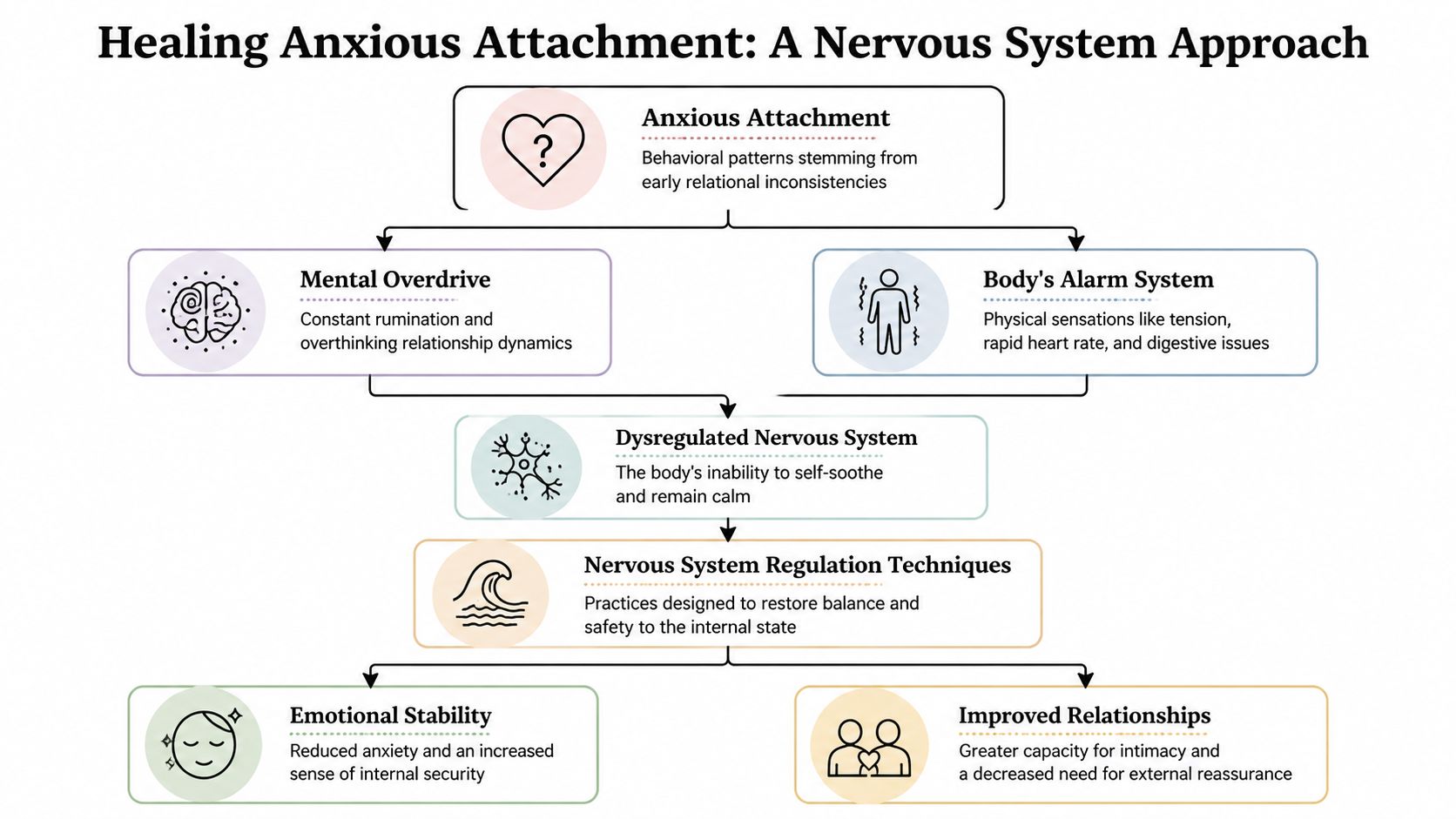
That's because anxious attachment isn't only a thought pattern. It's also a nervous system pattern.
If your body detects disconnection as danger, insight won't always reach you in time. You don't need more self-criticism in those moments. You need regulation.
Research suggests these patterns are firmly learned. Approximately 85% of children replicate their parent's attachment pattern, which helps explain why the nervous system can default to the same relational responses so early, as noted in this discussion of attachment transmission and healing.
Why positive thinking often doesn't work
When your system is activated, you're not just having a bad thought. Your body may be mobilizing for threat. That can feel like:
- a racing heart
- tight shoulders or jaw
- shallow breathing
- nausea or a hollow feeling in the stomach
- urgency to reach out, explain, chase, or fix
This is why people say, "I know I'm safe, but I don't feel safe."
They're telling the truth.
Bottom-up healing works with the body first. Once the body settles, the mind becomes more flexible. Then communication, boundaries, and discernment become possible.
Three practices that help in real time
These are not meant to be fancy. They are meant to be usable when you're activated.
The grounding chair
Use this when you're spiraling, waiting, or obsessing.
- Sit all the way back in a chair and let the chair hold your weight.
- Press both feet into the floor and notice the contact points.
- Name five things you can see without rushing.
- Say to yourself: “The chair is holding me. The floor is holding me. I am here right now.”
- Stay for one to two minutes before you decide whether to text, call, or respond.
Why it helps: grounding interrupts the floating, untethered feeling of attachment panic. It gives your body orientation and support. That support is the first cue of safety.
The longer exhale breath
Use this when your chest feels tight and your mind is speeding up.
- Inhale gently through your nose.
- Exhale more slowly than you inhaled.
- Don't force a dramatic breath. Let it be steady and repeatable.
- Continue for several rounds until the urgency drops a little.
Why it helps: a longer exhale sends your system the message that immediate danger is passing. You don't have to feel calm right away. You are aiming for less flooded, not perfect peace.
If sleep disruption is making regulation harder, that's worth addressing too. A tired nervous system is more reactive. Practical sleep structure can support emotional steadiness, and this guide on how to create a sleep schedule for truly restorative rest offers useful basics.
The self-hold
This one can feel awkward at first. That's okay.
- Place one hand on your chest.
- Place the other hand on your upper arm, shoulder, or belly.
- Apply gentle pressure.
- Say something simple and believable: “This is hard.” “I am activated.” “I don't have to abandon myself right now.”
- Stay with the sensation long enough to notice even a slight shift.
Why it helps: self-contact can reduce the feeling of emotional freefall. For many people with anxious attachment, the deepest terror is not just losing the other person. It's the feeling of being alone with the distress. This practice begins to change that.
If you always move straight to analysis, you may be skipping the step your body needs most.
What works and what usually backfires
A lot of anxious attachment style help fails because it asks you to behave securely while you're still physiologically overwhelmed.
This comparison is useful:
| When you're activated | Usually backfires | Helps more |
|---|---|---|
| You want instant reassurance | Sending repeated texts | Regulate first, then send one clear message |
| You feel ashamed of needing | Pretending not to care | Naming the need without apology |
| You want certainty now | Demanding an answer on the spot | Asking for a specific time to reconnect |
| You feel abandoned | Attacking or collapsing | Orienting to the present and self-soothing |
You don't need to become emotionless. You need to become more anchored.
If you want more body-based tools, this collection of ways to regulate your nervous system can give you more options to practice consistently.
Consistency matters more than intensity
Regulation is less about one breakthrough and more about repetition. Five calm minutes practiced regularly will do more than one dramatic attempt during a crisis.
I've seen people make meaningful change when they stop asking, "How do I never get triggered again?" and start asking, "How do I come back to myself faster, with less self-abandonment?"
That is the work.
Transforming Your Relationships From Protest to Connection
Once your body is less flooded, your relationships start to change in a very practical way. You can stop reaching for connection through protest and start reaching through clarity.
That shift is huge.
Protest behavior often begins with a real need. You want reassurance, responsiveness, care, or repair. But the strategy comes out sideways.

A before and after example
Before
Your partner says they had a long day and need some time alone tonight.
You feel the sting immediately. Within an hour, you send several texts. Then one more that sounds annoyed. When they respond briefly, you pick a fight about how they never prioritize you. The evening ends with both of you disconnected, and you feel ashamed, angry, and even more scared.
After
Same moment. Same trigger.
This time you notice the activation first. You sit down, breathe, and let the first wave pass. Then you send one message:
“Part of me got activated when I heard you needed space tonight. I know that may not be your intention. I don't need you to fix it right now, but I'd love a quick check-in and a clear plan for when we'll reconnect.”
That message does three important things:
- it names your internal experience
- it avoids blame
- it makes a direct request
This is how secure communication grows. Not by having no needs, but by expressing needs without turning them into accusations.
Healthy space or emotional inconsistency
Many people get confused. Not every pullback is avoidance. Not every boundary is rejection.
A secure partner can need rest, solitude, or time to think. The difference is usually in the pattern. A secure person tends to remain emotionally coherent. Their space doesn't feel like disappearance. There is still responsiveness, clarity, and follow-through.
An emotionally inconsistent person tends to create whiplash. They may be warm one day, shut down the next, available when it suits them, and unreachable when you need steadiness.
A critical insight from attachment research is that ongoing inconsistent emotional attunement in adult relationships can recreate the same reinforcement pattern that formed the original attachment wound, as discussed in this article on anxious attachment triggers and solutions.
That matters because sometimes your anxiety is not only a wound from the past. Sometimes it is also information about the present.
Questions to ask yourself about the relationship
Use these questions when you're trying to sort out your activation from the actual dynamic:
- Do they repair after disconnection: Or do they leave you to manage every rupture alone?
- Are their boundaries clear: Or vague and confusing?
- Do they respond with steadiness over time: Or do you live on emotional breadcrumbs?
- Can you bring up concerns safely: Or do they punish vulnerability with distance, criticism, or contempt?
Anxiety can distort reality. But it can also alert you to a relationship that lacks consistency.
Both can be true. This is why healing anxious attachment isn't just about calming down. It's also about developing discernment.
Scripts that move you toward connection
When you're regulated enough to speak clearly, simple language works best.
Try lines like these:
- When you got quiet, I noticed I started to spiral. Can you let me know where we stand?
- I respect your need for space. It helps me when we also name when we'll reconnect.
- I don't need constant reassurance. I do need consistency.
- I'm working on not protesting when I feel scared. I'd rather tell you directly that closeness matters to me.
If emotional closeness has been hard to create in your relationship, this guide on how to build emotional intimacy may help you put words to what secure connection requires.
One more trade-off is worth naming. If you're used to intensity, calm may feel unfamiliar at first. You may mistake steadiness for lack of chemistry. You may also mistake inconsistency for passion.
Healing often includes learning that safety can feel quieter than chaos.
Finding the Right Support Professional Help for Anxious Attachment
Self-help can take you far. It can help you recognize your pattern, regulate in the moment, and communicate more clearly. But there are times when self-help isn't enough.
If you keep repeating the same relationship cycle despite insight, if panic takes over your body quickly, or if your childhood experiences still feel emotionally alive inside you, professional support can make the work more contained and more effective.
That isn't weakness. It's an appropriate response to a pattern that formed in relationship and often heals best in relationship.

Signs it's time to get help
You don't need to wait until life falls apart.
Consider therapy if:
- You know the pattern but can't interrupt it
- Relationships dominate your mental and emotional bandwidth
- You swing between chasing, collapsing, and shutting down
- You feel calm alone but dysregulated in closeness
- Talk therapy has helped you understand, but not shift, the body-level reaction
A trauma-informed therapist should do more than analyze your past. They should help you notice activation in real time, build tolerance for vulnerability, and develop new relational experiences without pushing you too far too fast.
What kinds of support can help
Different modalities help in different ways.
| Type of support | What it can be useful for |
|---|---|
| Attachment-focused therapy | Understanding patterns and building new relational experiences |
| Somatic therapy | Working directly with activation, shutdown, and body cues |
| Emotionally Focused Therapy | Repairing bond patterns in couples work |
| Integrative care | Supporting anxiety when stress, sleep, hormones, or mood are also involved |
Longitudinal research suggests change is possible. 12.4% of adults shifted from anxious to secure attachment over time, and with Emotionally Focused Therapy, 70 to 73% of couples move from distress to recovery, according to this attachment statistics summary.
Those numbers don't mean every path looks the same. They do show that attachment isn't fixed.
What good therapy should and shouldn't feel like
Helpful therapy won't usually feel like endless explaining with no change. It also shouldn't feel like being pushed into vulnerability before your system has enough support.
A good fit often includes:
- Pacing: The therapist tracks when you're activated and helps you stay within a workable range
- Clarity: You understand what you're practicing and why
- Embodiment: Sessions include the body, not just the story
- Relational safety: You feel seen without feeling engulfed
- Practicality: You leave with something to apply in everyday life
For some people, broader mental health support also matters, especially when anxiety is affecting sleep, work, or overall functioning. Options like integrative anxiety treatment can be worth exploring alongside attachment-focused work when you want a more whole-person approach.
The right support won't just teach you why you panic. It will help your system learn that connection can be safe.
If you're looking for one option in this area, Securely Loved offers attachment-focused therapy and learning resources centered on nervous system regulation, trauma-informed care, and relationship patterns. What matters most is finding a practitioner whose approach helps you feel both understood and steadily challenged toward change.
Your Toolkit for Building Lasting Internal Safety
Lasting change happens in the small moments that used to send your body into alarm.
Your phone stays silent longer than usual. Your partner sounds distracted. A text ends with a period instead of a heart emoji. If you have an anxious attachment pattern, your mind may race, but the first shift often happens lower down. Tight chest. Dropped stomach. Urge to reach, explain, fix, or pursue. This is why insight alone so often falls short. If your nervous system reads uncertainty as danger, understanding the pattern does not automatically stop the surge.
Internal safety grows when your body learns, over time, that discomfort does not always mean abandonment. That is the work.
A simple toolkit to come back to
Use these tools in order. Sequence matters.
- Name the state: Say, “I’m activated,” or “My body is bracing.” Accurate language reduces shame and helps you respond with more care.
- Orient to the present: Look around the room. Press your feet into the floor. Feel the chair under you. Give your nervous system evidence that you are here, now, and safe enough in this moment.
- Regulate before you reach out: Pause before texting, calling, or asking for reassurance. Try one minute of longer exhales, a hand on your chest, or walking until the charge drops a little.
- Ask clearly: Say what you need in plain language. “I’m feeling wobbly and I’d like some reassurance” works better than protest, testing, or silence.
- Track the pattern: One delayed reply is not the whole story. Repeated inconsistency, mixed signals, and emotional unavailability are different. Your job is to notice the difference.
- Practice self-attunement: Stay on your own side while you wait. Notice what you feel, what story you’re telling, and what would help right now.
I often tell clients this. The goal is not to stop caring so much. The goal is to care without leaving yourself.
What lasting change usually looks like
It is often quieter than people expect.
You catch the spiral earlier. You know the difference between activation and intuition. You stop treating every change in tone as proof that something is wrong. You become more honest, and also more selective. Relationships built on inconsistency start to feel less exciting and more costly.
That is what earned security looks like in daily life. Not perfection. More steadiness. More choice. Less chasing after safety from people who cannot offer it.
If you’re ready to go deeper, take the next step that fits your actual capacity right now. You might begin with an attachment quiz. You might want structured tools you can practice between hard moments. Or you may already know you want personal support and a real conversation about what healing could look like in your life.
If you'd like support, Securely Loved offers ways to explore your attachment pattern, learn practical regulation tools, and book a free 15-minute connection call to talk through your goals in a private, compassionate space.