

What Does Vulnerability Mean in a Relationship? A Guide
You’re lying in bed next to someone you care about, replaying a conversation you didn’t have. You wanted to say, “I felt hurt when you pulled away.” Instead, you said, “It’s fine,” then went quiet, then felt resentful, then hated that you went quiet.
If that’s where you are, your struggle makes sense.
For many people, vulnerability doesn’t feel like a soft, beautiful opening. It feels like standing at the edge of a cliff without a railing. Part of you wants closeness. Another part is scanning for danger, bracing for misunderstanding, rejection, dismissal, or shame. That inner conflict is especially common if you grew up with inconsistent emotional attunement, relational unpredictability, or trauma.
So when you ask, what does vulnerability mean in a relationship, the answer isn’t just “sharing your feelings.” It’s much more precise than that. It’s the ability to stay connected to yourself while letting another person see something real, without abandoning your boundaries or flooding your nervous system.
The Vulnerability Paradox You Know Too Well
You may know this pattern intimately. You want more closeness, but the moment it’s time to speak openly, your body tightens. Your chest gets hot. Your mind races. You suddenly decide it’s safer to minimize, joke, explain too much, or shut down completely.
That doesn’t mean you’re bad at relationships. It often means your protective system is doing exactly what it learned to do.
When closeness and fear show up together
A lot of people assume vulnerability should feel natural if the relationship matters enough. It usually doesn’t work that way. The deeper the need, the more exposed you may feel. Saying “I miss you,” “I need reassurance,” or “I’m scared you’ll leave” can feel far riskier than discussing logistics, opinions, or even conflict.
That’s why vulnerability is often confused with things that only look similar on the surface:
- Emotional dumping means releasing unprocessed feelings onto someone and hoping they’ll sort them out.
- Oversharing means disclosing too much, too fast, without enough safety or mutuality.
- Performative openness means saying vulnerable-sounding things while still trying to control how you’re perceived.
- True vulnerability means sharing something genuine, grounded, and emotionally owned.
Vulnerability isn’t weakness. In healthy love, it’s the brave act of being known without collapsing into self-protection or self-erasure.
If you’ve been told to “just open up” and felt even more alone after hearing that, there’s a reason. Opening up without enough internal safety can feel awful. It can even reinforce the belief that your feelings are too much.
What real vulnerability starts with
Real vulnerability usually begins smaller than people think. It might sound like:
- Naming the present moment: “I’m noticing I’m getting anxious bringing this up.”
- Owning your feeling: “I felt hurt.”
- Staying out of blame: “I want to tell you what happened for me.”
- Letting the truth be simple: “I need more reassurance than I wish I did.”
That kind of honesty is not dramatic. It’s intimate.
Redefining Vulnerability As Intentional Exposure
Healthy vulnerability is not throwing your heart into the middle of the room and hoping someone handles it well. It’s a deliberate choice to reveal something authentic while accepting that you cannot fully control the response.
One of the clearest descriptions of this comes from Mark Manson’s discussion of vulnerability in relationships, which defines genuine vulnerability as the conscious choice to express authentic thoughts, feelings, and desires despite uncertainty about the outcome and the willingness to accept real consequences. That same piece makes an important distinction: this is not the same as emotional oversharing or boundary-less disclosure.
Think shallow end, not stormy ocean
A better model is learning to swim.
You wouldn’t teach someone to swim by throwing them into rough water and shouting instructions from shore. You’d start in the shallow end. You’d build familiarity. You’d practice breathing. You’d stay close to safety while the body learns that water is survivable.
Vulnerability works the same way.
If you have anxious attachment, you may try to relieve the discomfort of uncertainty by saying everything at once. If you have avoidant attachment, you may convince yourself that silence is maturity when it’s self-protection. Neither extreme creates secure intimacy.
What healthy vulnerability is and isn’t
Here’s the middle path:
| Pattern | What it sounds like | What it usually does |
|---|---|---|
| Oversharing | “Let me tell you every fear I have so you’ll reassure me” | Creates intensity without safety |
| Shutdown | “I’m fine” when you’re clearly not | Protects short-term, disconnects long-term |
| Intentional vulnerability | “I want to share something that feels tender, and I’m not sure how it will land” | Builds trust through honesty and pacing |
Practical rule: Vulnerability works best when it is intentional, mutual, and bounded.
A grounded way to practice it
Before you share something tender, ask yourself three questions:
- Is this true for me right now?
- Have I processed it enough to say it clearly?
- Am I sharing to connect, or to control the other person’s response?
That third question matters. When vulnerability is used to extract reassurance, it can feel urgent but not connecting. When it comes from self-awareness, it lands differently.
A grounded statement sounds like, “When that happened, I felt scared and a little unimportant.” It doesn’t sound like, “You always make me feel this way.”
The Surprising Benefits of Showing Your True Self
Often, the main benefit attributed to vulnerability is closeness. Closeness matters, but it’s not the whole story. Vulnerability also changes your relationship with yourself.
When you tell the truth about your inner experience, you stop abandoning yourself to keep the peace. That builds self-respect. You may still feel exposed, but you also know you showed up authentically.
It reduces the exhaustion of performing
Masking is tiring. Pretending you’re less sensitive, less needy, less affected, or less hopeful than you really are drains enormous energy. Vulnerability removes some of that strain because you no longer have to manage a false version of yourself in the room.
It also reveals who can meet you there.
A 2020 Hinge survey reported through Cosmopolitan found that 93% of daters prioritize emotional vulnerability in a partner, yet only 32% display it on first dates. For 61%, it outranked attractiveness, income, or height. That gap tells you something important. Many people deeply want emotional honesty, but fear keeps them from practicing it.
Vulnerability acts like a filter
Not everyone deserves access to your inner world. Vulnerability helps you see who responds with care, curiosity, steadiness, and respect, and who becomes dismissive, defensive, or exploitative.
That filtering function matters. It can save you months or years of trying to build intimacy with someone who only likes the polished version of you.
Some of the less obvious benefits look like this:
- Clearer boundaries. You notice faster when someone cannot tolerate your reality.
- Less mind reading. You say what you feel instead of waiting to be guessed correctly.
- More congruence. Your outer words match your inner experience.
- Better partner selection. Authenticity tends to repel unsafe dynamics and support healthier ones.
The right relationship won’t make vulnerability feel effortless every time. But it will make honesty feel more possible, not more punishing.
How Your Attachment Style Shapes Your Experience of Vulnerability
Attachment style changes how vulnerability feels in your body before it ever becomes words. If your early environment taught you that closeness was inconsistent, intrusive, or chaotic, your adult nervous system may react to emotional exposure as if it carries real danger.
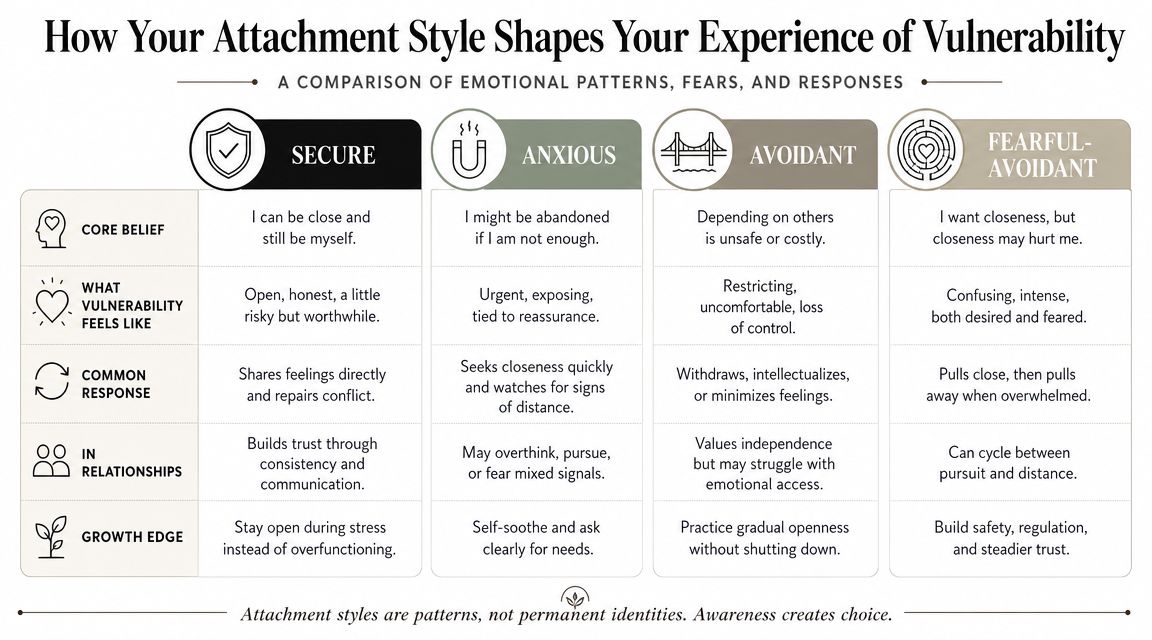
A 2023 study discussed by Be Bold Psychotherapy found that 62% of anxiously attached adults report hypervigilance to rejection during vulnerability attempts, and only 15% of popular relationship blogs reference nervous system regulation techniques. That gap matters because many people don’t need more pressure to open up. They need more support to feel safe enough to do it.
If you want a deeper foundation for identifying your pattern, this guide to attachment style definitions can help you name what you’re experiencing.
If you lean anxious
Vulnerability may feel urgent. You might sense distance quickly, feel flooded by uncertainty, and want immediate closeness to settle the fear.
You may notice yourself:
- Sharing a lot, very fast
- Re-reading texts for signs of rejection
- Bringing up painful topics when you’re already activated
- Hoping that if you explain enough, your partner will finally respond the “right” way
The pain underneath is often simple and tender: Please don’t leave me alone with this feeling.
Anxious vulnerability can become overexposure when the actual goal is relief rather than connection. That doesn’t make you manipulative. It means your system is trying to secure attachment quickly.
If you lean avoidant
Vulnerability may feel invasive. The moment emotional intensity rises, your system may interpret it as pressure, obligation, or loss of autonomy.
You may notice yourself:
- Going blank when asked how you feel
- Preferring problem-solving over emotional presence
- Delaying hard conversations until they become bigger
- Feeling irritated when someone wants “too much” closeness
The deeper fear is often: If I let you in too far, I’ll lose myself, disappoint you, or get trapped.
Avoidant strategies usually look calm from the outside. Inside, there can be a lot of unspoken activation.
If you lean disorganized
This is often the most confusing experience. You want connection intensely, but once it arrives, it can feel destabilizing. You may move toward closeness and then abruptly pull away, or long for safety while distrusting it at the same time.
A few common signs:
- Reaching out and then regretting it
- Feeling attached to people who don’t feel safe
- Panicking when someone is distant, then panicking when they are close
- Struggling to know whether a reaction is intuition, trauma memory, or overwhelm
When your attachment is insecure, vulnerability can feel less like honesty and more like exposure without armor.
A simple comparison
| Attachment pattern | Vulnerability often feels like | Common protective move |
|---|---|---|
| Anxious | “Please stay with me” | Oversharing, protest, pursuing |
| Avoidant | “Don’t corner me” | Withdrawal, minimizing, intellectualizing |
| Disorganized | “Come close, but not too close” | Approach and retreat cycles |
| Secure | “I can be honest and stay grounded” | Direct, paced communication |
None of these patterns make you broken. They reflect adaptation.
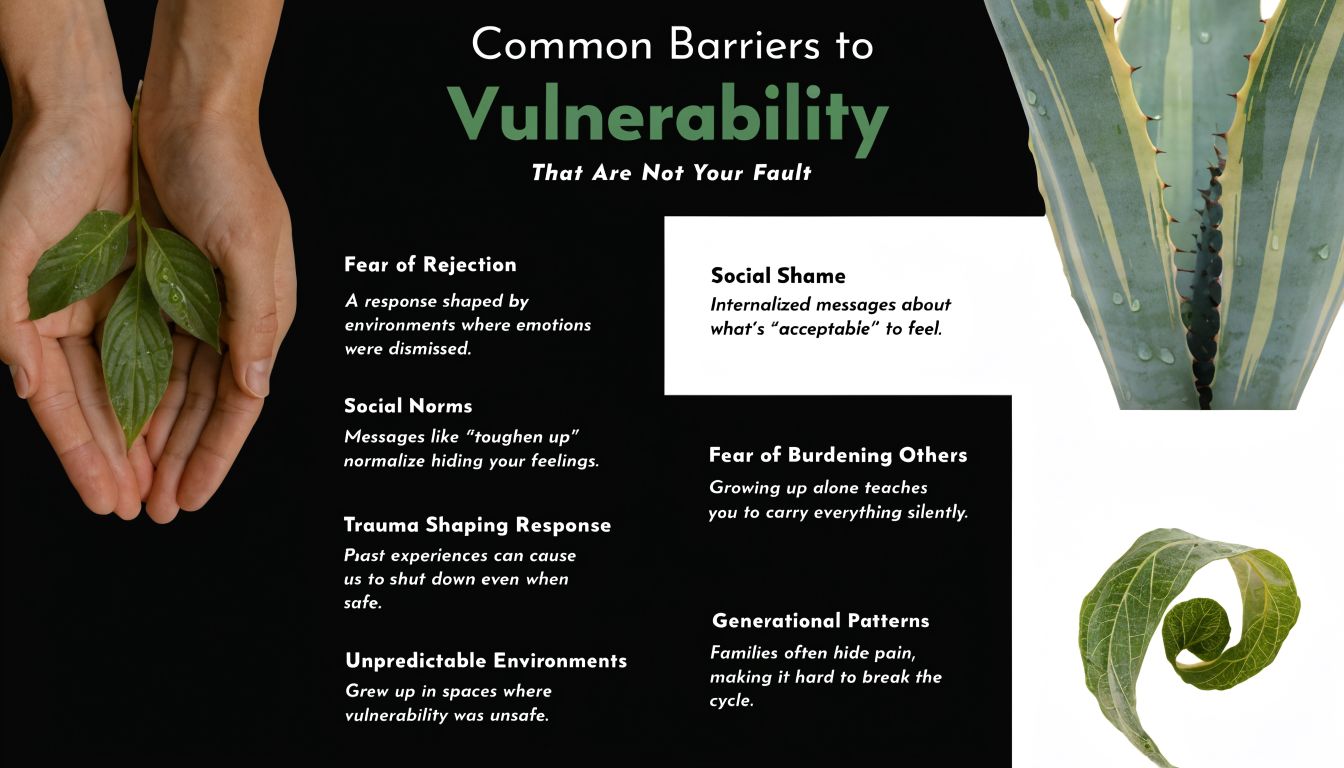
Common Barriers to Vulnerability That Are Not Your Fault
Many people blame themselves for struggling with vulnerability. They call themselves closed off, too much, needy, cold, dramatic, or impossible to love. Usually, what they are describing is a nervous system that learned to survive under strain.
Vulnerability can, in fact, involve real risk. CDC data on intimate partner violence shows that more than 1 in 3 women and more than 1 in 6 men in the United States experience physical violence, contact sexual violence, or stalking by an intimate partner. For people with trauma histories, the body often remembers that openness has not always been met with care.
Your body may treat openness like danger
If you grew up with criticism, neglect, volatility, emotional inconsistency, or role reversal, your system may have learned that honesty brings pain rather than comfort. In adulthood, that can show up as a rapid shift into fight, flight, freeze, or appease when a conversation becomes emotionally meaningful.
The window of tolerance becomes useful. When you’re inside your window, you can feel emotion and stay present. When you’re pushed outside it, you may become flooded, numb, defensive, panicked, or detached.
Common barriers often include:
- History, not weakness. Your reactions may be tied to what relationships taught you long before this current partner.
- Body memory. You may know intellectually that a conversation is safe while your body responds as if it isn’t.
- Shame conditioning. If your feelings were mocked or dismissed, being seen can still trigger old humiliation.
- Unclear internal boundaries. If closeness once meant being engulfed, vulnerability may feel like losing yourself.
Why “just talk about it” often fails
Advice that skips the body tends to backfire. If someone tells you to be more open while your nervous system is already in alarm, your body doesn’t hear “connect.” It hears “expose yourself.”
That’s why self-compassion matters so much here. Your resistance may be protective intelligence, not dysfunction.
Some people aren’t afraid of vulnerability because they’re guarded. They’re afraid because their system learned that openness can cost them safety.
A more helpful question is not, “Why am I like this?” It’s, “What would help my body feel safer while I tell the truth?”
A Practical Guide to Cultivating Vulnerability Safely
Vulnerability becomes sustainable when you build capacity before you build intensity. The goal is not to say the hardest thing you’ve ever felt and hope for the best. The goal is to help your body learn that truth can be spoken in manageable doses.
The nervous system piece matters here. In this Securely Loved video on vulnerability and regulation, vulnerability is described as a deliberate lowering of defenses, and reciprocal disclosure is framed as a process that can activate the parasympathetic nervous system when it is met with empathy. In other words, mutual and titrated vulnerability helps the body register safety.
If you need more foundation first, learning about nervous system regulation can make these steps easier to apply.
Start with titration
Titration means sharing a small, honest piece instead of the whole emotional backlog. Then you pause. You notice what happens inside you. You notice how the other person responds. You don’t force the next layer until your body has had time to register the moment.
Try this sequence:
Choose one specific moment
Not “our whole relationship.” Try one event, one interaction, one feeling.Name your internal state first
“I’m nervous bringing this up.”Speak one truth, not ten
“When dinner ended abruptly last night, I felt dismissed.”Pause and track
Notice your breath, jaw, shoulders, chest, and urge to keep talking or shut down.Decide whether to continue
Safety grows through pacing, not force.
Regulate before you talk
Before a difficult conversation, do this simple three-step practice:
- Exhale longer than you inhale. Breathe in gently, then breathe out more slowly. Repeat several rounds.
- Press your feet into the floor. Let your legs feel the support under you.
- Orient to the room. Look around slowly and name a few neutral objects you can see.
This isn’t about becoming perfectly calm. It’s about becoming more present.
Use language that opens connection
Specific wording can reduce defensiveness and help you stay inside your body.
A few strong starters:
- “I’m feeling scared to bring this up, but it matters to me.”
- “The story I’m telling myself is that I don’t matter, and I want to check that with you.”
- “When that happened, I felt hurt and pulled back.”
- “Part of me wants to shut down right now, and part of me wants to stay in this conversation.”
What tends not to work:
| Less helpful | More connecting |
|---|---|
| “You always do this” | “When this happened, I felt…” |
| “You don’t care” | “I’m feeling alone and I need clarity” |
| “Forget it” | “I’m getting overwhelmed and need a short pause” |
“I’m activated, but I still want connection” is often more healing than saying something perfectly.
Watch for reciprocity
Vulnerability is not a solo performance. It deepens connection when the other person shows responsiveness, steadiness, and care. If they consistently mock, dismiss, weaponize, or avoid your honesty, that’s not a sign you need to “be more vulnerable.” It may be a sign the relational container is not safe enough.
If you’re someone who creates, teaches, or facilitates conversations online, it can help to study how thoughtful prompts create emotional safety in groups. A resource on community engagement for creators offers useful ideas about pacing, participation, and how people open up when the environment feels structured and attuned. The same principle applies in intimate relationships.
Aftercare matters too
Once you’ve had a vulnerable conversation, don’t immediately judge it. Your body may still feel shaky even if it went well.
Afterward, try one of these:
- Drink water and walk for a few minutes
- Journal the facts of what happened, not just your fears about it
- Place a hand on your chest and name what you did well
- Delay big conclusions until your body settles
That’s how capacity grows. Not through one dramatic breakthrough, but through repeated experiences of truth, pacing, and repair.
When Self-Work Is Not Enough Seek Professional Support
Sometimes insight helps, but it doesn’t change what happens in real time. You understand your pattern, you know the scripts, and you still get flooded, shut down, or pulled into the same painful dynamic. That’s usually a sign that deeper support would help.
Therapy may be especially important if:
- You become overwhelmed fast. Conversations escalate into panic, rage, collapse, or complete shutdown.
- You repeat harmful relationship patterns. You keep choosing unavailable, unsafe, or destabilizing dynamics.
- You confuse intensity with intimacy. Vulnerability turns into enmeshment, overexposure, or trauma bonding.
- You’ve tried traditional talk therapy and still feel stuck. You understand the story, but your body keeps reacting the same way.
Hormonal shifts can add another layer. According to this discussion of vulnerability and midlife transitions, a 2025 meta-analysis in Menopause Journal reported that women ages 45 to 55 with avoidant attachment experienced a 35% reduced vulnerability tolerance during midlife hormonal transitions. If vulnerability has started feeling harder after 40, your body may need support that generic communication advice doesn’t address.
If relationship anxiety, shutdown, or overwhelm keeps repeating, working with support specific to these patterns can make a real difference. This page on therapy for relationship anxiety outlines what that kind of help can look like.
If you’re tired of understanding your patterns but still living them, Securely Loved offers attachment-focused, trauma-informed support for adults who want to feel safer in love, communication, and connection. Bev Mitelman helps clients build internal safety, regulate the nervous system, and practice vulnerability in a way that feels grounded rather than overwhelming. You can explore the site’s resources or book a free 15-minute connection call to see whether the support feels like the right fit.