

Healing The Mother Wound: Steps to Internal Safety
You keep it together at work. You answer texts. You show up for people. You may even be the one everyone calls “so strong.”
But in close relationships, something shifts. You overthink a delayed reply. You feel hurt faster than you want to admit. You say yes when you mean no. Or you go emotionally numb the moment someone gets too close. Part of you wants love. Another part braces for disappointment.
Many people live with this split for years without having language for it. They assume they’re too sensitive, too needy, too guarded, or somehow hard to love. They try to reason their way out of it. They read the books, journal, gain insight, and still find themselves pulled back into the same fear.
If that’s you, there may be a gentler explanation.
The Unspoken Ache You Carry
You might be the woman who is competent in public and privately exhausted by how much emotional energy relationships take. You replay conversations after they happen. You notice small changes in tone. You feel responsible for keeping the peace, even when no one asked you to.
Or maybe you’re the person who learned long ago not to need too much. You listen well, support everyone else, and struggle to answer a simple question like, “What do you need?” When conflict appears, your chest tightens or you shut down completely.
These patterns often don’t begin in adulthood. They usually make sense in light of what your nervous system learned early.
A lot of adults carry a quiet ache that sounds like this:
- I’m never fully at ease with love
- I work hard for approval, then resent how hard I work
- I don’t trust support, even when I want it
- I feel lonely, even around people who care about me
Sometimes this pain traces back to what many therapists call the mother wound. That phrase can sound loaded at first. It isn’t a diagnosis, and it isn’t about villainizing mothers. It’s a way of naming the impact of growing up without enough emotional attunement, safety, mirroring, or space to be fully yourself.
For some people, the wound formed through obvious harm. For others, it came through subtler experiences. A mother who was physically present but emotionally absent. A mother who loved you but couldn’t tolerate your feelings. A mother who needed you to stay small, pleasing, high-achieving, or self-sufficient.
If you’re carrying pain around these dynamics, it can help to pair self-understanding with practical strategies for healing hurt, especially when old emotional injuries keep resurfacing in present-day relationships.
The most important thing to know is this. Your patterns didn’t appear out of nowhere. They were shaped for a reason. And healing the mother wound starts when you stop treating your pain like a character flaw and begin meeting it like a story your body has been trying to tell.
What the Mother Wound Really Is
The mother wound is the emotional imprint left when a child’s need for consistent care, attunement, protection, and emotional understanding isn’t met well enough. That can happen through neglect, criticism, emotional volatility, role reversal, enmeshment, or simple emotional absence.
It’s not about assigning all blame to one person. It’s about telling the truth about impact.
Think of a plant growing near a window with inconsistent light. The plant doesn’t fail because it’s weak. It bends, strains, and adapts to the environment it has. Children do the same. If love feels conditional, they adapt. If a caregiver is frightening, unavailable, or overwhelmed, they adapt. Those adaptations often become adult relationship patterns.
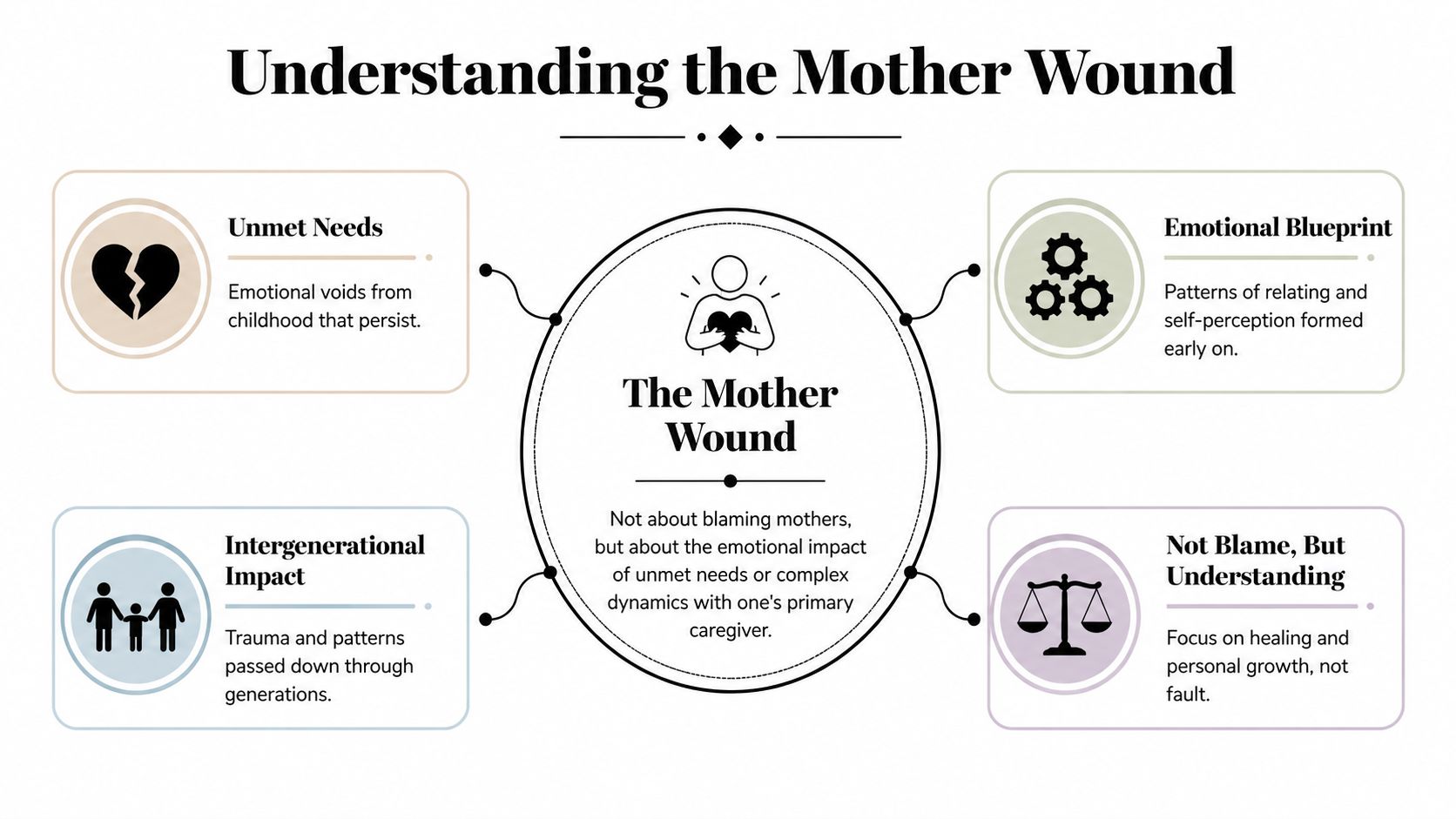
It’s about impact, not accusation
Many readers get stuck here. They think, “My mother did her best, so maybe I shouldn’t feel hurt.” Both things can be true. Your mother may have been doing what she could with the resources she had, and you may still carry real wounds from what was missing.
Understanding your mother’s pain doesn’t require you to minimize your own.
A mother wound can form when a mother is openly cruel. It can also form when she is depressed, dissociated, anxious, emotionally dependent on her child, or unable to respond with warmth and steadiness. The child doesn’t interpret this philosophically. The child’s system learns, “Connection is uncertain,” or “My feelings are too much,” or “I have to earn closeness.”
How trauma gets passed down
Unprocessed maternal trauma often shapes the emotional climate a child grows up in. A longitudinal study on posttraumatic stress symptoms in parents of children with cancer found that five years post-trauma, 19% of mothers of survivors and 20% of bereaved mothers still reported partial PTSD (research on persistent maternal trauma). When a parent’s nervous system stays overwhelmed, children often adapt around that stress.
That doesn’t mean every child of a traumatized mother develops the same wound. It means the parent’s unresolved pain can influence how safety, comfort, and emotional connection are offered.
Here are a few common pathways:
- Emotional unavailability. Your mother provided food, shelter, and logistics, but not much emotional presence.
- Conditional approval. Love felt strongest when you achieved, complied, or stayed easy to manage.
- Reversal of roles. You became the listener, helper, mediator, or emotional caretaker.
- Criticism or comparison. You learned to scan yourself constantly for flaws.
- Inconsistent warmth. Some days brought closeness. Other days brought distance, shame, or unpredictability.
If you learn visually, it can help to watch a concise explanation from a trusted therapist. A video from Bev Mitelman’s @SecurelyLoved channel on mother wounds or intergenerational trauma would fit well here.
The shift that begins healing
The first deep relief often comes when you realize your symptoms are not random.
Reframe: What you call “too much,” “too sensitive,” or “too guarded” may be an intelligent adaptation to early emotional conditions.
That shift matters. It moves you away from self-blame and toward compassionate clarity. From there, healing the mother wound becomes less about fixing yourself and more about updating what your mind, body, and relationships have been taught to expect.
How the Mother Wound Shows Up in Your Adult Life
Many individuals don’t walk around thinking, “I have a mother wound.” They notice the echoes instead. The same breakup pattern. The same panic when someone pulls away. The same guilt when they try to set a boundary.

In the general population, around 20% of adults show anxious attachment, 25% avoidant attachment, and up to 15% disorganized patterns (attachment patterns linked to mother wound dynamics). For women in midlife, the same source notes that hormonal shifts during menopause can heighten emotional dysregulation in those with early relational trauma.
In relationships
Anna looks calm on the outside. Inside, she’s always monitoring. If her partner gets quiet, she assumes something is wrong. She apologizes quickly, asks if they’re okay, and feels intense relief when reassured. The relief doesn’t last. A few hours later, the fear returns.
Marcus has the opposite pattern. He wants closeness until it becomes emotionally real. Then he goes flat, needs space, or finds a flaw in the relationship that lets him pull back. He tells himself he’s independent, but dependence feels dangerous.
Leila swings between both. She longs to be chosen, but when intimacy grows, she feels trapped and overwhelmed. She may cling, then distance, then feel ashamed for both responses. This push-pull dynamic can feel confusing, especially when you don’t understand that the nervous system may be reading closeness as both needed and unsafe.
In your inner world
The mother wound often leaves behind an internal atmosphere, not just visible behaviors.
You may notice:
- A harsh inner critic that sounds relentless and familiar
- Chronic guilt when you disappoint someone
- Difficulty resting without feeling lazy or undeserving
- A hidden belief that your needs burden other people
- Trouble receiving care without suspicion, discomfort, or tears
For many adults, this is also where emotional neglect becomes easier to recognize. If that part of your story resonates, this piece on understanding emotional neglect effects can help name what was absent, even if nothing looked obviously wrong from the outside.
In everyday behavior
These patterns show up in ordinary moments.
| Pattern | What it can look like day to day |
|---|---|
| People-pleasing | Saying yes too fast, then feeling drained or resentful |
| Perfectionism | Believing mistakes will cost you love, approval, or safety |
| Boundary confusion | Explaining yourself excessively or feeling cruel for saying no |
| Emotional shutdown | Going blank in hard conversations and not knowing what you feel |
| Self-sabotage | Pulling away from healthy love because it feels unfamiliar |
Some adult symptoms are old childhood strategies wearing grown-up clothes.
Why midlife can stir it all back up
Many women are surprised when old attachment pain flares during perimenopause, menopause, divorce, caregiving stress, empty nest transitions, or a major career shift. You may think, “I already dealt with this years ago. Why is it back?”
Often, your body is moving through a season of change that lowers your usual coping capacity. The patterns were never irrational. They were dormant, managed, or hidden by productivity. When life asks you to slow down, feel more, or face loss, the old attachment ache can become louder.
That doesn’t mean you’re going backward. It often means something unhealed is finally ready for care.
The Science of Why It Feels So Deeply Ingrained
Many high-functioning adults understand their story perfectly well. They can explain their childhood. They know where the pattern came from. They’ve had insight for years. What frustrates them is this: the body still reacts.
That happens because early relational pain is not stored only as a memory with words attached. It’s also stored as a felt expectation.
According to Annie Wright’s overview of the neuroscience of the mother wound, chronic maternal misattunement encodes implicit memories in the right brain and nervous system, leading to default states of fight, flight, or freeze. The same article explains why talk therapy alone often falls short when it focuses on narrative but not bodily-held procedural memory (neuroscience of the mother wound).
Your body learned before your mind could explain
In early life, you didn’t need language to learn whether closeness felt safe. Your system tracked tone of voice, facial expression, touch, availability, tension, and unpredictability. Those repeated experiences became a map.
That map may still be active now:
- Fight or flight can look like anxiety, overexplaining, controlling, fawning, chasing reassurance, or irritability.
- Freeze or collapse can look like numbness, shutdown, fog, disconnection, and not knowing what to say when emotions run high.
- Social safety feels hard to sustain when your system expects disappointment, criticism, engulfment, or abandonment.
This is why healing often requires more than analysis. Your body needs new experiences of safety, not just better ideas about safety.
Why relationships trigger so much
Adult intimacy activates the same territory where the original wound formed. Being seen, needing comfort, asking for reassurance, disappointing someone, receiving feedback, or depending on a partner can all light up old pathways.
A simple way to understand it is this:
| Early experience | Adult nervous system expectation |
|---|---|
| Care felt inconsistent | “I need to stay alert so I don’t get caught off guard.” |
| Feelings were dismissed | “I should hide what I feel.” |
| Love felt conditional | “I must perform to stay connected.” |
| Closeness felt intrusive | “Distance is safer than need.” |
If nervous system language is new to you, this overview of nervous system regulation can help make the body side of attachment feel more understandable.
Clinical truth: You cannot shame a survival response into becoming trust.
Why body-based healing matters
If your body learned danger through relationship, it often relearns safety through relationship and regulation. That might include attuned therapy, breathwork, grounding, movement, orienting, or practicing staying present in moments that usually send you into panic or shutdown.
This doesn’t mean you need to relive everything. It means healing the mother wound often happens when you notice your nervous system in real time and gently help it update. Over time, your body can learn that closeness is not automatically danger, needs are not automatically rejection, and rest is not the same as losing love.
Your Path to Healing and Wholeness
Healing the mother wound usually isn’t one dramatic breakthrough. It’s a series of experiences that help you become safer inside your own life. You grieve what you didn’t receive. You stop organizing yourself around old survival rules. You learn to care for the parts of you that still expect love to disappear.

Research on attachment reorganization notes that healing involves shifting the underlying pattern, not just managing symptoms. Therapies informed by the Dynamic Maturational Model and Internal Family Systems can help integrate trauma memories and reparent younger parts, with clinical trials showing a 40 to 60% reduction in relational anxiety within 12 to 24 sessions (attachment reorganization and relational anxiety findings).
First, tell the truth about what was missing
Many adults try to skip this step because grief feels disloyal. But healing begins when you let yourself acknowledge the gap.
Maybe no one noticed your feelings unless they became inconvenient. Maybe affection came with control. Maybe you were praised for being “mature” when you were suppressing needs. Naming that loss matters because you can’t heal what you keep minimizing.
A helpful question is, “What did I need repeatedly that I did not receive reliably?”
Grief is not punishment for your mother. It is care for yourself.
Then, begin reparenting instead of self-abandoning
Reparenting means developing an inner relationship that is steadier, kinder, and more protective than the one you internalized. This isn’t pretend work. It’s pattern-changing work.
That can sound like:
- When you feel panic. “Of course this feels activating. I’m here with you.”
- When you make a mistake. “You don’t lose love because you were imperfect.”
- When you need rest. “Your worth isn’t measured by how much you produce.”
- When you want care. “Needing support doesn’t make you too much.”
IFS can be especially useful here because it helps you notice different parts of yourself. The overachiever. The caretaker. The one who goes numb. The one who still longs to be chosen. Instead of battling those parts, you start listening to what they’ve been trying to protect.
Boundaries are part of healing, not proof of rejection
Many people with mother wounds feel intense guilt when they begin setting limits. They confuse boundaries with cruelty because early relationship dynamics taught them that keeping other people comfortable was their job.
In practice, healthy boundaries may look like:
- Leaving a conversation when it turns shaming
- Not answering emotionally loaded messages right away
- Declining family roles that drain you
- Refusing to explain your reality to someone committed to misunderstanding it
A boundary is not a punishment. It’s a structure that protects your nervous system and dignity.
Build safety in the body, not just the mind
Insight helps. Embodied safety changes things.
If your body still braces, part of healing the mother wound is giving it repeated experiences of settling. That may happen in therapy, through breath, movement, touch, sensory soothing, or co-regulation with safe people. It may also mean learning that slowness is not failure.
Here are signs you’re moving toward wholeness:
| Earlier pattern | Healing shift |
|---|---|
| Immediate self-blame | You pause and get curious |
| Chasing reassurance | You can soothe before reaching outward |
| Shutdown in conflict | You stay present longer |
| Rigid self-reliance | You let support in without as much shame |
| Confusing intensity with love | You begin to value steadiness |
Healing doesn’t erase the past. It changes your relationship with it. The old ache stops running the whole system.
Practical Exercises to Begin Today
Big healing happens through small repetitions. The goal isn’t to do these perfectly. The goal is to help your body and mind experience a little more steadiness, choice, and self-contact.
A short journaling practice
Set a timer for ten minutes. Write without editing.
Try one of these prompts:
- What did I learn I had to be in order to stay connected?
- What feelings felt welcome in my family, and which ones felt unsafe?
- When do I abandon myself most quickly in adult relationships?
- What did I need from my mother that I’m still hoping someone else will finally give me?
- What would a deeply kind inner voice say to me today?
If writing feels intense, stop before you feel flooded. This work should stretch you a little, not overwhelm you.
A simple breath practice for safety
When attachment pain gets activated, your breathing often becomes shallow or tight. A slower exhale can help cue safety.
Try this for a few rounds:
- Inhale gently for 4 to 5 seconds
- Exhale slowly for 7 to 8 seconds
- Let your shoulders drop at the end of the exhale
- Look around the room and name three neutral things you see
The longer exhale is often used in polyvagal-informed practices to support parasympathetic settling. If breathwork makes you more anxious, shorten it and keep your eyes open.
A guided grounding practice can help if you need more structure. These grounding techniques for trauma are a good starting point.
If you’d like a gentle video resource, a guided meditation or breathwork video from Bev Mitelman’s @SecurelyLoved YouTube channel would work well here.
Meet your younger self
Close your eyes, or soften your gaze. Picture yourself at a younger age during a moment you felt alone, criticized, or unseen.
Then ask:
- What does this younger part need to hear?
- What does she need me to stop doing?
- What protection or comfort was missing?
Keep it simple. You’re not trying to force a breakthrough. You’re practicing contact.
Try speaking to the younger you in short, concrete language. “You didn’t cause this.” “I believe you.” “You don’t have to earn care from me.”
Use a boundary script
When you’re triggered, words disappear. A script can help.
Try this fill-in-the-blank structure:
“I’m not available for _______. If that continues, I’m going to _______. We can talk again when _______.”
Examples:
- “I’m not available for being spoken to that way. If that continues, I’m going to end this call. We can talk again when things are calmer.”
- “I’m not available to decide right now. I’ll get back to you tomorrow.”
You can make this exercise feel more supportive by creating a calming environment first. Some people like soft lighting, a blanket, tea, or candles. If that helps you settle into reflection, these insights on home tea light styling can give you simple ideas for creating a softer space.
When to Seek Professional Support for Your Healing
Self-help can open the door. Sometimes it’s not enough to walk you all the way through.
You may benefit from professional support if you notice that insight hasn’t changed the pattern, or if emotional reactions feel too intense to manage on your own. That can include relationship panic, shutdown, chronic people-pleasing, repeated conflict with your mother, or deep grief that surfaces whenever you try to set boundaries.
Signs that extra support would help
A therapist can be especially useful when:
- You understand your history but still feel hijacked by it
- Your relationships swing between anxiety and withdrawal
- You keep choosing unavailable, critical, or inconsistent people
- Family contact leaves you dysregulated for days
- You’re in midlife and old wounds are suddenly much louder
This last piece matters. One of the biggest gaps in mother wound conversations is how often unresolved attachment pain resurfaces during perimenopause and menopause. A resource focused on this gap notes that hormonal shifts during midlife can intensify emotional dysregulation and bring old attachment patterns back to the surface, yet this connection is rarely addressed (midlife and mother wound support needs).
What kind of help tends to work best
If the wound lives partly in the nervous system, support should address more than thoughts alone. Many people need therapy that helps them notice activation as it happens, understand their attachment style, and build regulation in the body alongside emotional insight.
That’s where trauma-informed therapy can make a meaningful difference. It doesn’t treat your reactions like overreactions. It understands them as protective responses shaped by lived experience.
Gentle reminder: If traditional talk therapy helped you understand yourself but didn’t help you feel safer, that doesn’t mean you failed therapy. It may mean you need an approach that includes the body, attachment, and life-stage context.
Professional support can also help you sort through one of the hardest questions in this work. Not “How do I forgive?” and not “How do I confront?” but “What kind of contact, distance, repair, or protection is right for me now?”
That answer is personal. A good therapist won’t force reconciliation or estrangement. They’ll help you hear yourself more clearly.
Healing the mother wound is possible. Not because the past changes, but because your relationship to yourself can.
If you’re ready for support, Securely Loved offers attachment-focused, trauma-informed care for adults who feel stuck in anxious, avoidant, or disorganized patterns. Bev Mitelman brings a nervous-system-centered approach with special understanding of midlife and hormonal transitions, so your healing doesn’t get reduced to “just think differently.” You can book a free 15-minute connection call to explore your goals, ask questions, and see if it feels like the right fit.