

Secure vs. Insecure Attachment: Transform Your Relationships
You answer a text, then regret sounding needy. Or you tell yourself you’re better off alone, then feel the ache when someone gets too close and pulls back. Maybe you keep choosing emotionally unavailable partners. Maybe you’re in a solid relationship, but small moments still hit your body like danger.
If that’s familiar, you’re not broken. You’re likely living inside an attachment pattern.
Attachment theory gives language to experiences that often feel personal, shameful, and confusing. It helps explain why one person reaches for reassurance, another goes quiet, and another flips between wanting closeness and fearing it. These aren’t random habits. They’re learned strategies for staying emotionally safe.
For many adults, especially in midlife, these patterns get louder. A breakup, divorce, caregiving stress, an empty nest, dating again, perimenopause, or menopause can strip away the coping methods that used to work. Suddenly you’re more reactive, more flooded, more detached, or more exhausted by relationships than you used to be.
The good news is that secure vs. insecure attachment isn’t a life sentence. These patterns can be understood, worked with, and changed. When you know what your nervous system is trying to protect you from, your reactions start to make sense. And once they make sense, healing becomes much more possible.
Why Do My Relationships Feel This Way
You meet someone kind and available. Instead of relaxing, you start scanning. Why haven’t they texted back? Did their tone change? Are they losing interest? Another person has the opposite experience. The relationship starts to deepen, and suddenly they feel trapped, irritated, or numb. They pull away, then wonder why closeness never lasts.
Both people may want love. Both may sabotage it in very different ways.
When closeness feels unsafe
A lot of adults come to attachment work believing their problem is that they’re “too much,” “too sensitive,” or “just bad at relationships.” Usually that isn’t the actual issue. The deeper issue is that their system learned powerful rules early on.
Those rules can sound like this:
- Stay vigilant: If I don’t monitor the connection, I’ll get blindsided.
- Stay guarded: If I need too much, I’ll be disappointed.
- Stay split: I want love, but love doesn’t feel safe.
These patterns often show up in ordinary moments. You ask for reassurance and then feel embarrassed for asking. You need space but can’t explain it without sounding cold. You overfunction at work, in parenting, or in partnership because being indispensable feels safer than being vulnerable.
Your reactions may be painful now, but they often started as intelligent survival strategies.
A more compassionate lens
Attachment theory helps shift the question from “What is wrong with me?” to “What did my system learn about closeness, safety, and need?” That changes everything.
It moves you out of shame and into understanding. It also gives you a practical map. If you know your attachment pattern, you can begin to see which situations activate it, what your body does under stress, and what helps instead of repeating the same cycle.
Understanding Secure and Insecure Attachment
Attachment theory began with John Bowlby’s idea that human beings need a reliable secure base. In childhood, that secure base is usually a caregiver. When a caregiver is emotionally available, protective, and responsive enough, a child learns that connection is safe and that distress can be met rather than ignored.
In adulthood, those early experiences often become a relational blueprint. They don’t determine your future in a rigid way, but they do shape what feels normal, what feels threatening, and how you respond when love matters. If you want a grounding overview of the model itself, this guide to attachment style definitions is a helpful starting point.
The four main attachment styles
These styles are best understood as relational strategies, not fixed identities.
| Attachment style | Core experience | Common pattern in relationships |
|---|---|---|
| Secure | Closeness feels possible without losing yourself | You can give and receive support, repair conflict, and tolerate normal distance |
| Anxious-preoccupied | Connection feels uncertain | You may seek reassurance, overthink signals, and fear abandonment |
| Dismissive-avoidant | Dependence feels risky | You may minimize needs, withdraw during conflict, and value self-sufficiency over vulnerability |
| Fearful-avoidant or disorganized | Love feels both wanted and dangerous | You may move toward closeness and then recoil, creating a painful push-pull pattern |
What secure attachment actually means
Secure attachment doesn’t mean you never get triggered. It means that, when stress happens, you can usually return to steadiness. You can stay connected to yourself while staying connected to another person.
In contrast, insecure attachment tends to pull you into one of several protective responses. You may escalate for connection, shut down to avoid pain, or alternate between both.
There’s also a broader cultural reason this topic matters now. A 2014 meta-analysis on rising insecure attachment patterns found that secure attachment dropped from 49% in 1988 to 42% by 2011, while avoidant attachment increased by 56% over the same period. That points to a wider shift in how many adults experience trust, closeness, and emotional safety.
Attachment styles describe how you learned to protect connection, not whether you’re lovable.
Secure vs Insecure Attachment A Side-by-Side Look
The clearest way to understand secure vs. insecure attachment is to compare what each style believes, fears, and does under stress. Clinically, attachment is often organized along two dimensions: anxiety, which is fear of abandonment, and avoidance, which is discomfort with closeness. A summary of these psychometric dimensions in adult attachment explains how secure attachment reflects low anxiety and low avoidance, while insecure patterns involve higher levels of one or both.
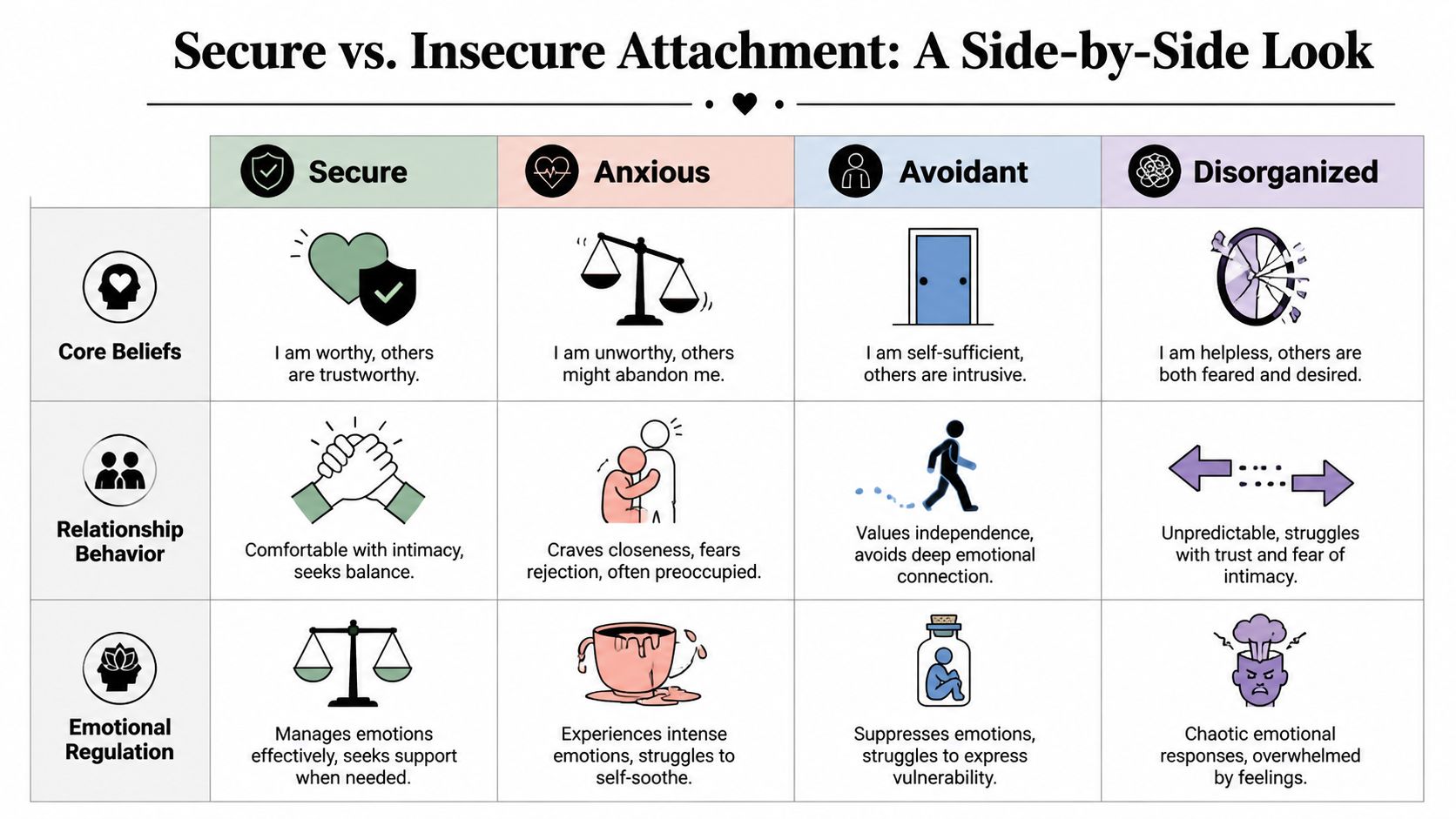
A quick comparison
| Pattern | Belief about self | Belief about others | Stress response | Approach to intimacy |
|---|---|---|---|---|
| Secure | I’m worthy of care | Others can be dependable | Names feelings, seeks repair | Wants closeness with boundaries |
| Anxious | I might not be enough | Others may leave | Pursues, protests, overthinks | Craves reassurance and contact |
| Avoidant | I can only rely on myself | Others may intrude or disappoint | Distances, intellectualizes, shuts down | Wants connection but protects space hard |
| Disorganized | I feel unsafe with need | Others are both desired and feared | Fluctuates between intensity and withdrawal | Wants closeness and fears it at the same time |
How these patterns look in real life
A secure person can say, “I felt hurt when that happened,” without turning the moment into a crisis or disappearing emotionally. They can tolerate normal friction and trust that conflict doesn’t automatically mean abandonment.
An anxious style often shows up as preoccupation. You may reread texts, track changes in tone, or feel a wave of panic after small separations. You’re not “dramatic.” Your system is trying to reestablish connection fast.
Practical rule: If your reaction feels bigger than the moment, your attachment system may be running the show.
Avoidant attachment often gets misunderstood as not caring. In reality, many avoidant adults care a great deal, but they learned that needing people leads to disappointment, engulfment, or shame. So they downplay emotion, delay hard conversations, or focus on tasks when feelings arise.
Disorganized attachment can feel the most confusing from the inside. You might long for intimacy, then feel flooded by it. You may trust someone one day and doubt everything the next. This isn’t inconsistency for its own sake. It’s what happens when closeness is linked with both comfort and threat.
What the labels don’t capture
No one is only one thing in every relationship. You may be mostly secure with friends, anxious in dating, and avoidant when someone asks too much emotionally. Attachment is dynamic. Stress, life stage, trauma history, and the other person’s pattern all matter.
That’s why I don’t treat these labels as boxes. I treat them as maps. A good map helps you stop arguing with your reactions and start working with them.
The Roots of Your Attachment Style in Your Nervous System
Attachment isn’t only a mindset. It’s also a body pattern.
A child’s nervous system develops in relationship. If comfort comes reliably, the body learns that distress can settle. If care is inconsistent, intrusive, neglectful, or frightening, the body adapts in other ways. Those adaptations often become your default adult settings in love.
How the body learns protection
If your caregiver was warm sometimes and unavailable at other times, your system may have learned hypervigilance. You scan for mood shifts, distance, and signs that connection is slipping. That often becomes an anxious pattern.
If your environment taught you that feelings wouldn’t be welcomed, your system may have learned to suppress need. You detach, go logical, or insist you’re fine. That often becomes an avoidant pattern.
If the same relationship that offered care also brought fear, chaos, or unpredictability, your body may never have built a clear pathway for safe closeness. That often becomes disorganized attachment.
A simple nervous system lens
Many people find it helpful to understand these reactions through broad nervous system states:
- Ventral vagal safety: You feel connected, present, and able to engage.
- Sympathetic activation: You feel agitated, urgent, panicked, angry, or driven to act.
- Dorsal shutdown: You feel numb, collapsed, foggy, distant, or checked out.
A fuller explanation of nervous system regulation in relational healing can make these shifts easier to track in your own body.
What looks irrational in a relationship often makes perfect sense when you understand the nervous system underneath it.
Why self-compassion matters here
These patterns usually formed because your body chose the best available strategy. That doesn’t mean the strategy still serves you. It means you can stop meeting it with contempt.
If it helps to hear how other adults and families describe this kind of change work, these Testimonials for Aboundparenting Com offer a useful window into what it can look like when relational safety is built over time. Different practices use different language, but the underlying theme is familiar. People change when they experience enough steadiness, attunement, and repair.
How Attachment Styles Impact Your Relationships and Life
Attachment patterns don’t stay inside romance. They show up in friendships, work, parenting, health decisions, and the way you talk to yourself when you’re under strain.
What anxious attachment can look like
The anxious-attached professional often appears highly capable. They’re responsive, productive, and highly conscientious. But internally, they may tie worth to approval. A delayed email from a boss can feel like rejection. A partner asking for space can trigger spiraling thoughts, sleep disruption, and the urge to fix the connection immediately.
In relationships, this can look like overexplaining, overgiving, or losing touch with your own needs while trying to keep someone close.
What avoidant attachment can look like
The avoidant partner may be reliable in practical ways but disappear emotionally when the stakes rise. They may struggle to answer simple questions like “What do you need from me?” or “Are we okay?” Not because they’re cold, but because vulnerability activates threat.
At work, this can show up as independence that others praise. In close relationships, the same trait can become distance, mixed signals, or emotional unavailability.
What disorganized attachment can look like
Disorganized attachment often carries the most internal whiplash. You may long for intimacy, then feel overwhelmed once you have it. You might trust someone after a tender moment, then become suspicious or shut down after conflict. People around you can experience this as unpredictability. You experience it as confusion, shame, and exhaustion.
Midlife often exposes old attachment wounds because the body has less capacity to absorb stress the way it once did.
Why midlife can intensify old patterns
Perimenopause, menopause, divorce, caregiving, grief, changing identity, and dating after a long relationship can all amplify attachment stress. Hormonal shifts can lower your buffer for uncertainty. Things you used to push through may now feel impossible to ignore.
That doesn’t mean you’re regressing. It often means your old protective system is getting louder because your body needs more support than coping alone can provide.
There’s also a strong mental health connection. A national survey of 5,645 adults on attachment and mental health service use found that adults with insecure attachment were significantly more likely to use mental health services and reported higher rates of depression and anxiety. If you’ve been telling yourself you should be able to “just get over it,” that finding matters. Your struggle is clinically recognizable. It isn’t a character flaw.
The Path to Earned Security Practical Steps and Strategies
You can develop earned secure attachment as an adult. That phrase matters because it means security isn’t reserved for people who had ideal childhoods. It can be built through repeated experiences of safety, attunement, boundaries, and repair.
Some people make progress through self-work. Many need relational healing with a therapist or other solid steady support. In either case, change happens less through insight alone and more through repetition. Your body has to learn that closeness can be safe now.
Start with the body, not the story
If you’re activated, insight usually won’t land first. Begin with regulation.
Try this simple sequence:
Orient to the room
Let your eyes move slowly. Name five neutral things you see. A lamp. A window. A chair. A plant. The floor. This helps interrupt tunnel vision.Lengthen the exhale
Breathe in naturally. Let the exhale become a little longer than the inhale. Don’t force it. The goal is less performance and more softening.Add pressure or support
Press your feet into the floor, wrap in a blanket, or place a hand on your chest and one on your belly. Your body often needs contact, weight, or containment before your mind can settle.
A guided practice can make this easier in the moment. Embed a grounding or breathwork video from Bev Mitelman’s @SecurelyLoved YouTube channel here so readers can regulate while they read.
Learn your pattern in real time
Attachment healing gets practical when you can catch the sequence early. Use a short tracking practice:
- Trigger: What happened?
- Body cue: What did I feel first? Tight chest, buzzing, collapse, numbness?
- Story: What meaning did my mind make?
- Action urge: Chase, text, argue, shut down, leave, appease?
- Need: What would support look like right now?
This turns a spiral into information.
Replace coping that backfires
Insecure strategies usually work short term and hurt long term. Reassurance-seeking may bring quick relief but deepen dependence. Distancing may reduce overwhelm but block intimacy. Healing asks for different moves.
Try these substitutions:
- Instead of repeated texting, send one clear message and then regulate your body before sending another.
- Instead of silent withdrawal, say, “I need a pause, and I want to come back to this.”
- Instead of mind-reading, ask one direct question.
- Instead of shaming yourself for being triggered, name the state: “My attachment system is activated.”
Security grows when you can stay connected to your body, your boundaries, and the other person at the same time.
Get support that matches the pattern
Many adults have already done years of talking about the problem. What’s often missing is a method that includes the nervous system and the relationship itself as part of the healing process. A review of secure-base and nervous-system-focused attachment interventions notes that these approaches can lead to a 65-80% shift toward secure attachment on pre- and post-treatment benchmarks.
If you want a deeper roadmap, this resource on how to become securely attached offers practical next steps.
Your Next Steps Toward Secure Relationships
Awareness is the first turning point. Once you can recognize your attachment pattern, you stop treating every reaction like a mystery or a moral failure. You can respond earlier, choose better support, and build relationships that feel steadier.
Self-help may be enough to get started. It’s usually not enough if your patterns bring severe distress, repeated relationship ruptures, panic, shutdown, trauma responses, or a strong sense that you understand the problem but still can’t shift it when you’re activated.
Professional help is especially worth considering if:
- Conflict feels overwhelming: You lose access to words, perspective, or emotional balance.
- Relationships repeat the same pain: Different people, same cycle.
- Your body reacts intensely: You feel panic, numbness, insomnia, or collapse around closeness.
- Midlife stress is amplifying everything: Hormonal and life transitions are making old wounds louder.
Healing attachment isn’t about becoming perfectly calm all the time. It’s about becoming more rooted, more honest, and more able to stay present in love without abandoning yourself.
If you’re ready for support, Securely Loved offers attachment-focused, trauma-informed therapy for adults who feel stuck in anxious, avoidant, or disorganized relationship patterns. Bev Mitelman combines attachment work with nervous system regulation and specialized support for midlife transitions, including perimenopause and menopause. You can start with a free 15-minute connection call to explore whether the approach feels like the right fit.