
Healing Your Anxiety Attachment Styles
Are you staring at your phone, willing it to light up with a text that’s taking an eternity to arrive? Do you find yourself replaying every little detail of a conversation, searching for a hidden meaning or a sign that you did something wrong? This constant, draining worry you feel in your relationships isn't some personal flaw. It’s a pattern, and it’s often tied to what we call anxiety attachment styles—a way of understanding why connection can feel so tangled up with fear.
Why Do I Feel So Anxious In Relationships
If you feel like you’re always on high alert for the first sign of trouble in your relationships, I want you to know how exhausting and confusing that can be. This isn't just "all in your head." It's a response that’s been wired into you, often starting in your early life when your needs for safety and consistent connection weren't always met.
Think of it like having an emotional smoke detector that's way too sensitive. For example, your partner is quieter than usual one evening. Someone with a secure attachment might think, "They must have had a long day." But your smoke detector starts blaring, instantly interpreting their silence as, "They're mad at me, they're pulling away, the relationship is in danger." This isn't a defect; it’s a survival skill your nervous system created to shield you from the pain of being abandoned or disconnected.
Your Past Wires Your Present Reactions
This state of hyper-vigilance is a classic sign of an anxious attachment style. It’s a full-body experience where you're physically primed to look for threats to your sense of security in a relationship. That ache in your chest when your partner asks for some space? The racing thoughts after a minor disagreement? Those are real, physical reactions.
For instance, you might have a small disagreement over dinner plans. An hour later, you're still replaying the conversation, your heart is pounding, and you feel a deep sense of dread. Your body has gone into fight-or-flight mode over something that your partner may have already forgotten. Your past has taught your system that relationships are unpredictable, so it's running on "better safe than sorry" programming, constantly scanning for threats. This can trap you in a state of what is nervous system dysregulation, where you feel chronically on edge.
This isn't about blaming the past. It’s about looking at its impact with compassion. Recognizing that your anxiety is a learned, physiological response is the first, most powerful step toward healing and finally creating the secure love you deserve.
Understanding the Attachment Landscape
It's no secret that we all crave deep, meaningful connection. Yet for so many, it feels just out of reach. It might feel like you're the only one, but insecure attachment is incredibly common. While research shows that about 59-63.5% of adults have a secure attachment style, that leaves a huge portion—up to 41%—grappling with insecurity.
The anxious styles make up about 5.5-11% of that, though many self-reported surveys hint that the real numbers for overall insecurity could be even higher.
To give you a clearer picture, here’s a quick breakdown of how insecurity and anxiety often show up.
Quick Guide To Insecure Attachment And Anxiety
This table summarizes how the three main insecure attachment styles often manifest as anxiety in relationships. Each style has a different core fear that drives its unique set of anxious behaviors.
| Attachment Style | Core Fear | Common Anxious Behavior |
|---|---|---|
| Anxious-Preoccupied | Fear of abandonment | Clinginess, seeking constant reassurance, over-analyzing partner's actions. |
| Dismissive-Avoidant | Fear of engulfment | Emotionally distancing, valuing independence over intimacy, shutting down. |
| Fearful-Avoidant | Fear of both abandonment and engulfment | A push-pull dynamic; desiring closeness but pushing it away when it arrives. |
Understanding where you fit can feel like turning on a light in a dark room. For many people with an anxious attachment style, even a small hint of rejection can feel devastating. This is why learning about related concepts like Rejection Sensitive Dysphoria can be so validating. It helps explain why a partner needing a night alone can feel like a full-blown rejection rather than a simple request for space.
This knowledge is your starting point. It moves you out of a place of shame and into a space of empowered understanding—the perfect foundation for deep, lasting healing.
Understanding The Three Insecure Attachment Styles
Let's move past the clinical labels for a moment and talk about what these insecure attachment styles actually feel like. The best way to understand them is to see how they show up in real life, driving the anxious thoughts and relationship patterns that keep you feeling stuck.
This is how we start to connect the dots between the idea of anxiety attachment styles and what's happening in your heart and your head.
The map below shows a simple truth: the anxiety you feel in your adult relationships isn't random. It’s a learned response, often with roots that go way, way back.
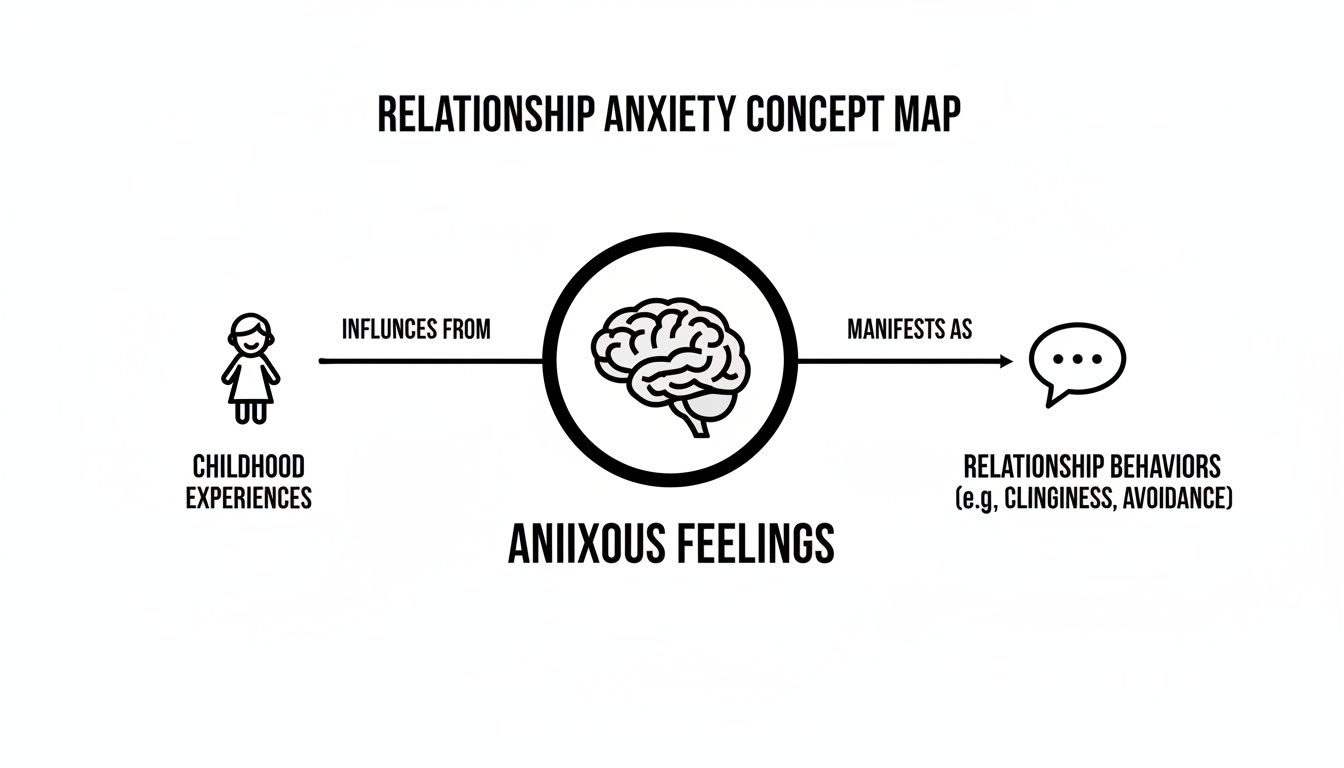
Seeing it laid out like this makes it clear. Your past shapes your present reactions. Now, let’s look at who these patterns belong to.
The Anxious-Preoccupied Style: The Emotional Detective
Meet Sarah. She's a high-achieving marketing director who is confident and brilliant at work. But when she gets home, a different side of her takes over. In her relationships, she becomes an "emotional detective," constantly scanning for clues that she's about to be left.
A text from her partner without the usual heart emoji sends her spiraling. A quiet mood after a long workday feels like a personal rejection—a sure sign the end is near. Her deepest, most primal fear is abandonment, and it creates a desperate need for constant reassurance.
This anxiety often leads to behaviors that, ironically, end up pushing her partner away:
- Constant Reassurance Seeking: She's always asking, "Are we okay?" after a minor disagreement, needing to hear everything is fine multiple times.
- Over-Analyzing Everything: She can spend hours decoding the tone of a voicemail or obsessing over why a text took 20 minutes to arrive instead of the usual five.
- Picking Fights for Connection: Sometimes, she'll start an argument about him leaving a cup on the counter, but the real issue is a desperate cry for him to notice her and engage. The silence feels worse than conflict.
For so many high-functioning adults, especially in midlife, this pattern feels maddening. You can run a company, but you can't seem to stop the cycle of fear-driven arguments at home. Research shows that people with anxious attachment are 0.949 times less likely to maintain close relationships, not because they don't want love, but because closeness itself feels so unsafe. You can read more about this style's sensitive "emotional radar" over at PsychologyToday.com.
The Dismissive-Avoidant Style: The Self-Sufficient Island
Now, let's talk about Mark. Outwardly, he's the picture of independence—a total "self-sufficient island." He prides himself on never needing anyone and handling everything himself. His personal motto might as well be, "I'm better off on my own."
But that fierce independence is really a suit of armor. Mark’s core fear isn't being abandoned; it's engulfment. He's terrified of losing himself, his freedom, and his autonomy in a relationship. For him, intimacy feels like a trap.
When a partner gets too close, he feels a powerful, almost suffocating urge to pull back and create distance. His anxiety shows up in a much quieter, more withdrawn way:
- Emotional Distancing: During a tough conversation about the future, he might suddenly say, "I need to go for a run," or pivot to talking about something completely unrelated, refusing to engage with the feelings.
- Prioritizing Independence Above All: He books a solo weekend hiking trip without mentioning it, constantly emphasizing his need for "space."
- Devaluing Connection: When his partner expresses a need for more quality time, he might think, "She's so needy," fixating on her flaws to justify keeping her at a safe distance.
Mark's anxiety isn't the loud, frantic alarm bell that Sarah hears. It's a cold, constricting feeling that whispers, closeness is a cage. He uses his independence as a weapon to avoid the vulnerability he learned to see as a profound weakness.
The Fearful-Avoidant Style: The Push-Pull Dance
And finally, there's Maya, who is stuck in a painful and confusing "push-pull" dance. She wants deep, meaningful connection more than anything, but she is also deeply, fundamentally terrified of it. Her world is a chaotic mix of Sarah's fears and Mark's fears.
Maya lives with a core conflict: the fear of being abandoned is just as strong as the fear of being engulfed. This creates a deeply disorganized internal state where love feels both like the ultimate goal and the ultimate danger.
One day, Maya might be texting her partner constantly, desperate for closeness and reassurance. But the moment he responds with loving warmth and suggests a future together, a wave of panic sets in. She feels trapped and overwhelmed. To escape, she starts a huge fight over a small issue, goes emotionally numb, or ends the relationship altogether, only to regret it days later.
This inner battle is exhausting. It often leads to a history of intense, volatile relationships that never feel stable. She can't relax into closeness, but she also can't stand being alone. Her anxiety is a storm of contradictions, leaving both her and her partners feeling whipsawed, confused, and hurt.
By seeing these stories, you can start to recognize these patterns—not as personal flaws, but as old survival strategies that just aren't serving you anymore.
How Your Past Wires Your Present Reactions
That intense, gut-wrenching anxiety you feel in your relationships today isn’t a character flaw. It’s not a sign that you’re “too much” or broken. It’s an echo from your past.
Your nervous system learned how to react to connection long before you were old enough to understand it, creating a blueprint that still runs the show in your adult life.
This isn’t about blaming your parents or dwelling on the past. It's about empowering yourself. Once you see that your reactions are embodied—physical, automatic responses, not just thoughts in your head—you reclaim the power to change them. This is the first, most crucial step toward rewiring yourself for security and deep, lasting connection.
The Slot Machine Of Affection
Think back to your childhood. Was affection predictable and freely given, or did it feel like a game of chance? For so many of us with anxiety attachment styles, love was wildly inconsistent. Maybe a parent was warm and engaging one moment, then cold and distant the next due to their own stress or struggles. You never knew if you’d get a hug or a dismissive wave.
This creates what I call the "slot machine of affection." You keep pulling the lever, trying to connect, but you never know if you'll hit the jackpot of love or come up empty-handed. This very inconsistency is what wires the brain for hypervigilance. Your system learned that to get its needs met, it had to be constantly on alert—watching for the tiniest shift that might signal a chance for connection, or a sign of abandonment.
This early training is what creates the "sensitive emotional radar" so many anxiously attached adults have. You become an expert at noticing subtle changes in your partner’s mood, tone, or body language because, as a child, your very survival and sense of safety depended on it.
This sensitivity was a brilliant adaptation for a child, but it often becomes the source of immense anxiety in our adult relationships. A real-world example: you notice your partner's tone is slightly off on the phone. Someone else might not even register it, but for you, it's a blaring alarm bell that something is wrong, sending you into a spiral of "What did I do?"
How Your Brain Learned Fear Instead Of Safety
From a neurobiological perspective, your brain is a pattern-matching machine. During your earliest years, it learned to associate intimacy with one of two things: safety or danger.
- If caregivers were consistently attuned and responsive, your brain wired intimacy to mean safety, comfort, and regulation. Connection feels like coming home.
- If caregivers were inconsistent, emotionally unavailable, or threatening, your brain wired intimacy to mean danger, unpredictability, and threat. Connection feels like a potential trap.
This isn't just a distant memory; it's a physiological reality stored in your body. When you feel that knot in your stomach because your partner seems distant, that's your nervous system lighting up an old survival circuit. It’s screaming, "Warning! The connection is threatened! Do something, now!"
This is a deeply embodied experience. The racing heart, the shallow breath, the obsessive thoughts—you aren’t choosing these. They are the echoes of a young nervous system that learned to equate a break in connection with a fundamental threat to its safety. Recognizing these reactions as old programming is the key. If these patterns feel deeply rooted, you may want to learn more about the signs of unresolved childhood trauma in adults. Your healing journey begins not by fighting these reactions, but by understanding their origins with deep compassion and learning new ways to signal safety to your own body.
Seeing Your Attachment Style In Action
It’s one thing to read about anxiety attachment styles on a page, but it’s another to feel them take over your life. Theory becomes painfully real in those quiet moments of panic, the racing thoughts you can’t shut off, and the knee-jerk reactions that feel so out of your control.
To show you what I mean, let's look at how these patterns show up for real people. These are people who, from the outside, seem to have it all figured out, but behind the scenes, they’re wrestling with a deep, consuming relationship anxiety. See if you recognize a part of yourself in their stories. Doing so isn't about judgment; it's the first step toward self-compassion.
The Anxious Executive And The Unanswered Text
Let’s talk about Jessica. At 42, she’s a powerhouse executive who walks into a boardroom and owns the room. She’s sharp, respected, and at the absolute top of her professional game. But in her love life? A completely different person shows up.
Her new partner, Mark, told her he had a day packed with back-to-back meetings. Logically, she knows this. But when her 9 a.m. “Good morning!” text is still sitting there, unanswered, at noon… her whole world starts to feel like it’s tilting.
First, it’s just a tiny knot of worry in her stomach. But then the thoughts start, and they are relentless.
- “Maybe he’s mad about what I said last night.”
- “What if he’s losing interest? I knew this was too good to be true.”
- “He’s probably with someone else. He realized he can do better than me.”
By 2 p.m., that little knot is a crushing weight on her chest. Her heart is pounding, her palms are sweating, and she can’t even look at the critical report that's due in an hour. This isn’t just a worry anymore; it’s a full-body panic. Her nervous system has been completely hijacked by that old childhood wound, screaming that she’s about to be abandoned.
For someone with an anxious attachment style, this kind of hyper-vigilance is common. It can lead to constantly looking for signs of trouble, even driving some to check if someone is on dating apps just to soothe that desperate need for certainty.
When Mark finally texts back at 4 p.m. with a simple, “Crazy day! Just came up for air. How are you?” Jessica’s relief lasts for a split second. Then, it’s replaced by anger. She fires back a text that’s dripping with passive aggression: “Fine. Glad you're still alive.” This is what we call a protest behavior—it's a classic anxious response. She's trying to punish him for the anxiety she felt, while at the same time, trying to pull him back in.
The Avoidant Entrepreneur And The Fear Of Closeness
Now, let's look at David. He’s a successful entrepreneur in his late 40s, recently divorced, and tells all his friends he’s ready for a healthy, new relationship. He meets Anna, and for the first few months, it feels like magic. But as they get closer and Anna starts planning a weekend trip together, David feels an invisible wall slam down. He’s suffocating.
For someone with an avoidant style, intimacy doesn’t feel like safety—it feels like a threat to their independence. The closer someone gets, the more intense the internal pressure to flee becomes.
Suddenly, all the little things he loved about Anna are now intensely irritating. Her laugh is too loud. Her questions feel invasive. He starts canceling dates, blaming “work emergencies.” He becomes critical and emotionally distant, finding fault with her as a subconscious way to push her away and create space.
His anxiety isn't the frantic, hot panic that Jessica feels. It's a cold, constricting feeling of being trapped. His trigger wasn’t a lack of communication; it was the promise of more of it. He eventually ends things, leaving a confused Anna with the line, “I'm just not ready for something serious.” The truth is, he sabotaged a great connection because his attachment system screamed that he was about to be engulfed.
These stories show just how powerfully our early wiring can drive the bus. For Jessica, the fear of being left fuels a desperate need to cling tighter. For David, the fear of being smothered fuels a desperate need for distance. Recognizing which story feels closer to home is a powerful first step in learning to write a new, more secure one for yourself.
Actionable Steps To Feel More Secure
Knowing your attachment style is one thing, but this is where the real work—and the real healing—begins. It’s time to stop just understanding the anxiety and start building a real, felt sense of safety from the inside out.
These aren’t just nice ideas. These are concrete, body-based tools I use with my clients every day to help them stop being hijacked by their triggers. The goal is to interrupt those old, painful loops and start creating new, secure pathways in your brain and body, one small step at a time.
Name It to Tame It
The first step in changing any pattern is simply noticing it. When that familiar wave of anxiety crashes over you—your heart starts to pound because a text went unanswered—the instinct is to get completely swept away by it. There's a third option: acknowledgement.
Just pausing to put a name to the feeling is an incredibly powerful move. Instead of drowning in a vague sense of dread, you can gently say to yourself, “Ah, this is my attachment anxiety,” or “I’m feeling that old fear of being left behind right now.”
This simple act does two profound things:
- It creates a little bit of space. Suddenly, you aren't the anxiety; you're the one noticing the anxiety. You're the sky, not the storm passing through.
- It actually calms your brain down. Naming the emotion engages the more logical part of your brain (the prefrontal cortex), which helps quiet down your brain’s frantic alarm system (the amygdala).
The next time you feel that ache in your chest, try it. Just whisper to yourself, “This is anxiety.” You might be surprised at the pocket of peace it creates.
The Body Scan
Attachment anxiety doesn't just live in your thoughts—it lives in your body. It's the racing heart, the tight throat, the knot in your stomach. The body scan is a way to get to know these physical sensations without panicking or trying to make them go away.
Here's a simple way to practice:
- Find a quiet place to sit or lie down.
- Close your eyes and bring your attention to the top of your head.
- Slowly, gently, scan your awareness down through your body—your face, neck, shoulders, chest, belly, all the way to your toes.
- Just notice what’s there. Is there tightness in your shoulders? A hollowness in your chest? A buzzing in your legs? Don’t try to fix it. Just be curious and breathe into it.
This practice teaches you to befriend your body instead of fighting it. It shows you that these sensations are just energy, and like waves, they will rise and fall if you give them the space. Learning how to regulate your nervous system in different ways can give you even more tools for your toolbox here.
From Co-Regulation To Self-Regulation
When we’re triggered, our nervous system is basically screaming for safety. As babies, we learn to calm down through co-regulation—being soothed by a parent. As adults with insecure attachment, we often unconsciously look for that same soothing from our partners, which is where the desperate texts and need for constant reassurance come from.
The journey to real security is about learning to provide that soothing for yourself. This is self-regulation.
The next time you feel a trigger coming on—that panic when your partner says they need space—try this: place one hand over your heart and the other on your stomach. Take a few slow, deep breaths, feeling the gentle pressure and warmth of your own hands.
This simple act sends a powerful message of safety directly to your nervous system. It's a physical way of telling yourself, “I’m here. I’ve got you. I can handle this feeling.” You’re building the inner foundation of safety that you may not have received as a child.
Protesting Vs. Requesting
Anxious attachment often fuels what we call protest behaviors. These are the things we do to get a partner’s attention indirectly—starting a fight, going silent, or trying to make them jealous. These behaviors come from a place of deep fear, but they only end up pushing people away and eroding trust.
The secure alternative is learning to make a direct request. This means vulnerably and clearly stating what you need.
- Protest Behavior: After your partner comes home late from a night out without texting, you give them the silent treatment, hoping they'll notice you're upset.
- Direct Request: The next day, you say, "When I didn't hear from you last night, my mind started to create a story that something bad had happened, and I felt really anxious. In the future, would you be willing to send a quick text to let me know you're okay?"
I know, making a direct request feels incredibly vulnerable. But it's the bedrock of secure communication. It gives your partner a clear roadmap to help you feel safe, which strengthens your connection instead of sabotaging it. This is a vital skill, as higher attachment anxiety directly correlates with lower psychological well-being. You can explore further insights into the impact of attachment on well-being and relationships at droracle.ai.
Your Path To A Securely Attached Future
This work isn't just about reading articles and understanding concepts. It’s about taking that knowledge and bringing it home to your body—it's about embodied healing. An insecure attachment pattern is not a life sentence, and I want you to really hear that. Recognizing your patterns is the first, brave step. The tools we’ve talked about are your next.
Your reactions—that knot of anxiety in your stomach, the urge to pull away, or the dizzying back-and-forth between the two—are not flaws. They aren't who you are. They are simply old survival strategies your nervous system learned a long, long time ago to keep you safe. The path forward is about gently teaching your body a new way, one where connection finally feels like safety, not a threat.
Hope And Empowerment For Your Journey
This is the work of moving from being hijacked by your past to getting firmly in the driver's seat of your present. It’s about trading those reactive, anxious protests for clear, vulnerable requests. Every time you pause to notice the anxiety without judgment, every time you self-soothe with a hand on your heart, you are literally rewiring your nervous system for security.
The cycle of insecure attachment often gets passed down, creating waves of generational pain. In fact, research suggests as many as 85% of children may end up mirroring their parent's attachment style, which can lead to years of trying to fix things on the surface without getting to the real root. You can find more details on these patterns in this attachment style research. By choosing to heal yourself, you're not just changing your own future. You're potentially breaking that cycle for generations to come.
This is a journey of hope. The goal is to build an internal sense of safety so strong that it becomes your new default, allowing you to show up in your relationships with clarity, confidence, and an open heart.
Your Next Steps To Secure Attachment
Ready to take action? Here are a few clear, supportive next steps to continue your path toward earned security:
- Take the Securely Loved Attachment Quiz: Let's start by getting clear. Our quiz is designed to help you pinpoint your specific attachment patterns and give you a personalized starting point for your healing journey.
- Explore Our Courses: Ready to go deeper? My courses offer structured guidance to help you translate these insights into real, embodied change that you can feel in your body and see in your relationships.
- Book a Free Connection Call: If you're looking for personalized, one-on-one support, I invite you to book a free 15-minute connection call with me. We can explore your goals in a compassionate, no-pressure space and see if we're a good fit to work together.
Frequently Asked Questions About Attachment Healing
Diving into your attachment patterns can feel overwhelming, and it's natural for a lot of questions (and fears) to surface. I get asked these all the time in my coaching practice, so I want to give you some clear, honest answers to help you feel more confident on this path.
Can My Attachment Style Really Change?
Yes, a thousand times, yes. Your attachment style is not a life sentence. While it was wired in early, you have the power to consciously build what we call "earned security."
Think of it this way: your brain is like a muscle. For years, you've been doing "anxious bicep curls." Now, we're going to start training a new muscle of self-soothing and security. It feels weak and awkward at first, but with consistent practice—using tools like the ones above—you build that inner strength until it becomes your new default.
My Partner Is Avoidant and I Am Anxious. Are We Doomed?
This is one of the most common pairings I see, and no, you are not doomed. But it is a challenging dance. The anxious-avoidant dynamic creates a painful cycle: the more you chase for connection, the more your partner pulls away for space, which only makes you chase harder.
It’s a torturous pattern, but it can also be a massive catalyst for healing if both people are willing to look at their own patterns without blame. The key is for both of you to understand that you're reacting to the same core thing—fear—just in opposite ways. It takes a lot of patience, and often professional guidance, but you can learn to meet in the middle with empathy instead of getting stuck in the push-pull.
How Is This Different From Regular Talk Therapy?
Traditional talk therapy is often a "top-down" process. It focuses on changing your thoughts to shift your feelings. You might talk for an hour about why you shouldn't feel anxious when your partner doesn't text back, and logically you get it. But the second it happens again, your heart is still pounding.
An attachment-focused approach is more "bottom-up." We work directly with the body and the nervous system—where these survival patterns are actually stored. Instead of just talking about the anxiety, we use tools like body scans and self-soothing touch to calm the physical panic response. This helps you build a felt sense of safety inside, so your body learns it doesn't need to hit the alarm bell so quickly. For many people who feel "stuck" after years of talk therapy, this embodied work is what finally creates lasting change.
Ready to move from understanding to embodied healing? At Securely Loved, we specialize in helping you regulate your nervous system and build the secure, fulfilling connections you deserve. Explore our resources and begin your journey at https://www.securelyloved.com.