
What Are Deal Breakers in a Relationship? A Deeper Guide
You’re lying awake after another confusing conversation, replaying it line by line.
Your partner said they forgot. Or that you’re too sensitive. Or that they didn’t mean it that way. Part of you feels unsettled. Another part rushes in to calm you down. Maybe it’s not that serious. Maybe every relationship has this. Maybe you’re asking for too much.
If you grew up with inconsistent emotional attunement, this kind of inner debate can become its own relationship pattern. You don’t just evaluate the behavior. You evaluate your right to feel affected by it. That’s why the question what are deal breakers in a relationship often isn’t as simple as a checklist. It’s a question about self-trust, safety, and whether your body is trying to tell you something your mind keeps talking over.
A deal breaker isn’t only a rule for when to leave. Often, it’s the moment your internal alarm says, “I can’t keep organizing myself around this and still feel safe, respected, or emotionally intact.” Some people hear that alarm clearly. Others hear it through anxiety, shutdown, overexplaining, or guilt.
I work with many people who don’t need more dating advice. They need help separating fear from intuition. They need a way to tell the difference between a painful but workable issue and a pattern that keeps costing them their peace.
That Gut Feeling Is a Deal Breaker Trying to Speak
You may know this feeling well. Your partner does something that lands badly. They cancel again. They hide something small, then act irritated when you ask about it. They go cold when you need comfort. You feel the sting immediately, but then the second wave comes. Self-doubt.
For someone with secure attachment, that inner signal often becomes a direct thought. “This doesn’t work for me.” For someone with anxious, avoidant, or disorganized attachment, it can sound more tangled. “Am I overreacting?” “Should I be more understanding?” “Why does this bother me so much?”
When confusion is the real symptom
The confusion itself matters.
Many people think deal breakers should feel dramatic and obvious. Sometimes they do. But often they arrive as chronic unease. Your body tightens before a date. Your chest sinks when their name appears on your phone. You keep needing to explain basic respect, honesty, or follow-through.
A deal breaker often starts as repeated nervous system strain, not a dramatic final straw.
That strain is easy to dismiss if you learned early that closeness required you to override your own cues. If connection in childhood came with inconsistency, criticism, or emotional unpredictability, your adult system may treat discomfort as something to manage rather than something to investigate.
This is one reason body-based healing matters. If you want a deeper understanding of how trauma gets stored and worked through physically, this guide on somatic therapy for trauma helps explain why your body often recognizes a relational problem before your thoughts do.
A familiar example
A woman I might see in practice could describe it like this. “He’s kind. We have chemistry. But every time I bring up something important, he disappears emotionally for two days. Then he comes back acting normal, and I end up apologizing for bringing it up.”
On paper, that may not sound like a crisis. In lived experience, it can become one. She isn’t only dealing with conflict. She’s dealing with the emotional cost of having no safe way to address conflict. Over time, that kind of pattern teaches the nervous system that honesty leads to disconnection.
That’s why deal breakers need more respect than they usually get. They are not always signs of being rigid. Sometimes they are signs that your deepest relational needs are trying to protect you.
The True Definition of a Relationship Deal Breaker
A relationship deal breaker is not just something you dislike. It’s a pattern, trait, value conflict, or behavior that significantly disrupts safety, trust, respect, or long-term compatibility.
Think of a relationship like a house.
If your partner likes a different movie genre, that’s paint color. If they leave dishes in the sink, that may be annoying landscaping. If they repeatedly lie, mock your feelings, refuse accountability, or want a completely different life than you do, that’s a crack in the foundation.

Three ways to sort what you’re seeing
| Type of issue | What it usually means | Example |
|---|---|---|
| Pet peeve | Irritating, but not threatening to the relationship core | They’re messy, talk loudly, or have different tastes |
| Negotiable issue | Stressful, but workable if both people engage honestly | Different communication habits, scheduling strain, conflict style |
| Deal breaker | Violates core values, safety, or long-term viability | Repeated dishonesty, contempt, cruelty, chronic emotional neglect |
This sorting matters because many people reverse it. They panic over chemistry shifts or texting patterns, while minimizing dishonesty, emotional unavailability, or contempt because those feel more familiar.
Why deal breakers feel so final
There’s a psychological reason negative traits land so hard. Research on mate selection found that people systematically overweight dealbreakers relative to dealmakers, and that while a positive trait might increase attraction by 10 to 20%, a single dealbreaker such as untrustworthiness can reduce partner desirability by 40 to 60% (PubMed abstract).
That doesn’t mean people are too harsh. It means the brain often treats major red flags as costly mistakes to avoid.
Practical rule: If one recurring trait keeps canceling out many good ones, your system may be reading the situation accurately.
What works and what doesn’t
What works is naming the issue at the right level.
- Call a preference a preference. If it’s mostly style, pacing, or personality difference, don’t inflate it into proof that the relationship is doomed.
- Call a pattern a pattern. If the same harm keeps happening, don’t keep treating it like an isolated incident.
- Call a violation what it is. If trust, emotional safety, or respect is repeatedly broken, clarity helps more than optimism.
What doesn’t work is using attraction, potential, or empathy to cover over foundational problems. Many people stay stuck because they keep asking, “Could this person be different?” instead of asking, “What is it costing me that they are not?”
A healthy relationship can survive irritation, imperfection, and repair attempts that are clumsy but sincere. It can’t stay healthy if one person keeps having to betray themselves to make it function.
Common Deal Breakers and Why They Cut So Deep
Relationships are not ended over one annoying habit. They are ended over patterns that erode safety, dignity, or hope.
That’s why the most common deal breakers are not random. They tend to target the exact needs that make love feel sustainable.
Dishonesty breaks safety first
Among common relationship deal breakers, lack of trust and honesty stands out most clearly. In The Knot’s review of relationship deal breakers, 63% of singles identified it as an unacceptable issue.
That makes sense clinically. When someone lies, withholds, or keeps you in confusion, the injury is bigger than the specific fact being hidden. Your nervous system loses a reliable map of reality. You start second-guessing what’s true, what’s safe, and whether connection comes with hidden costs.
This is why even “small” dishonesty can hit hard in practice. A lie about money, messaging an ex, where they were, or what they meant often reopens older attachment wounds around inconsistency and betrayal.
Apathy injures attunement
Apathy and lack of motivation are often misunderstood. People assume the issue is ambition alone. It usually goes deeper than that.
A broader review of deal breaker research notes that apathy and lack of motivation are rated as the strongest red flags in long-term relationships by both men and women, and that 17% of singles in The Knot data cited lack of career aspirations as a deal breaker (discussion here).
When a partner is apathetic, inattentive, dismissive, or chronically disengaged, the wound is often about attunement. You don’t feel met. You feel alone beside someone. In long-term relationships, that loneliness can become more painful than open conflict.
A few deal breakers and the need they violate
Chronic dishonesty
This violates your need for trust, orientation, and emotional safety.Apathy or emotional disengagement
This violates your need to feel seen, valued, and responded to.Contempt or disrespect
This attacks dignity. Once contempt becomes normal, intimacy rarely stays healthy.Substance misuse or untreated chaos
This destabilizes reliability. You spend more time managing fallout than building connection.Mismatched life goals
Love may still be real, but real love does not erase incompatible visions for children, money, fidelity, or lifestyle.
Some deal breakers hurt because they are painful. Others hurt because they feel familiar.
That second category deserves careful attention. Familiar pain can be the hardest to leave.
When the issue moves beyond compatibility
Some behaviors don’t belong in a conversation about compromise. If a relationship includes intimidation, stalking, threats, or physical harm, the priority is safety and legal protection. For readers who need practical information on protective options, this overview of the Florida injunction legal process can be a useful starting point.
A deal breaker is not only “bad enough” when it becomes extreme. Sometimes it is already a deal breaker because your body has been paying the price for too long.
How Your Attachment Style Shapes Your Deal Breakers
Two people can face the same behavior and experience it very differently.
One person sees a clear red flag and steps back. Another person explains it away, gets more attached, or spirals into panic. That difference is not a character flaw. It’s often attachment at work.
Research summarized in Psychology Today’s discussion of romantic deal breakers describes six broad deal breaker factors and notes that “Apathetic” traits such as inattentiveness and untrustworthiness rank highest for long-term relationships, while “Gross” traits rank highest in short-term settings. The same discussion also highlights something I see often in practice. Nervous system dysregulation from insecure attachment can impair how people rank red flags.

The anxiously attached pattern
Anxiously attached people often feel the red flag. They just don’t trust themselves to act on it.
They may minimize dishonesty because the fear of abandonment feels bigger than the cost of staying. They may turn emotional inconsistency into a problem to solve. They often become highly skilled at explaining why the other person acted that way.
A common example is repeated emotional withdrawal after conflict. An anxious partner may say, “He just needs space,” while their body is living in chronic threat. Over time, they stop asking whether the behavior is acceptable and start asking how to be less affected by it.
The avoidantly attached pattern
Avoidant attachment tends to create a different distortion. These individuals often have a low tolerance for dependence, emotional intensity, or bids for closeness. They may label normal relational needs as “too much,” while overlooking their own emotional distance.
So the avoidant person may treat a partner’s desire for reassurance as the deal breaker, while missing that their own inaccessibility is what keeps the relationship starved.
This doesn’t mean every complaint about clinginess is wrong. It means attachment history can make closeness feel intrusive even when it’s healthy.
The disorganized attachment pattern
Disorganized attachment usually creates the most confusion. These readers often crave intimacy and fear it at the same time.
They may feel drawn to chaotic, unpredictable people because the nervous system recognizes chaos as familiar. Then they suffer greatly inside that chaos because another part of them longs for peace and steadiness.
If your relationship choices feel inconsistent with your values, it may be an attachment pattern, not a lack of intelligence.
A disorganized client may call calm partners “boring” and unstable partners “intense.” They may leave safe people quickly, then stay too long with unsafe ones. Their deal breaker radar doesn’t fail because they don’t care. It fails because activation scrambles discernment.
A quick comparison
| Attachment pattern | What gets minimized | What gets amplified |
|---|---|---|
| Anxious | Inconsistency, dishonesty, emotional neglect | Signs of distance or abandonment |
| Avoidant | Emotional unavailability, lack of responsiveness | Closeness, dependence, requests for reassurance |
| Disorganized | Serious instability when chemistry is high | Minor threats when vulnerability feels exposed |
If you’re unsure which filter you’re looking through, learning more about your attachment style definition can help you make sense of why the same behavior feels tolerable one day and unbearable the next.
Your attachment style doesn’t decide your standards. But it does influence what you notice, what you excuse, and what your body mistakes for love.
An Honest Framework to Assess a Deal Breaker
When you’re emotionally flooded, almost everything feels urgent. That’s why you need a framework simple enough to use while you’re still in the relationship, not just after it ends.
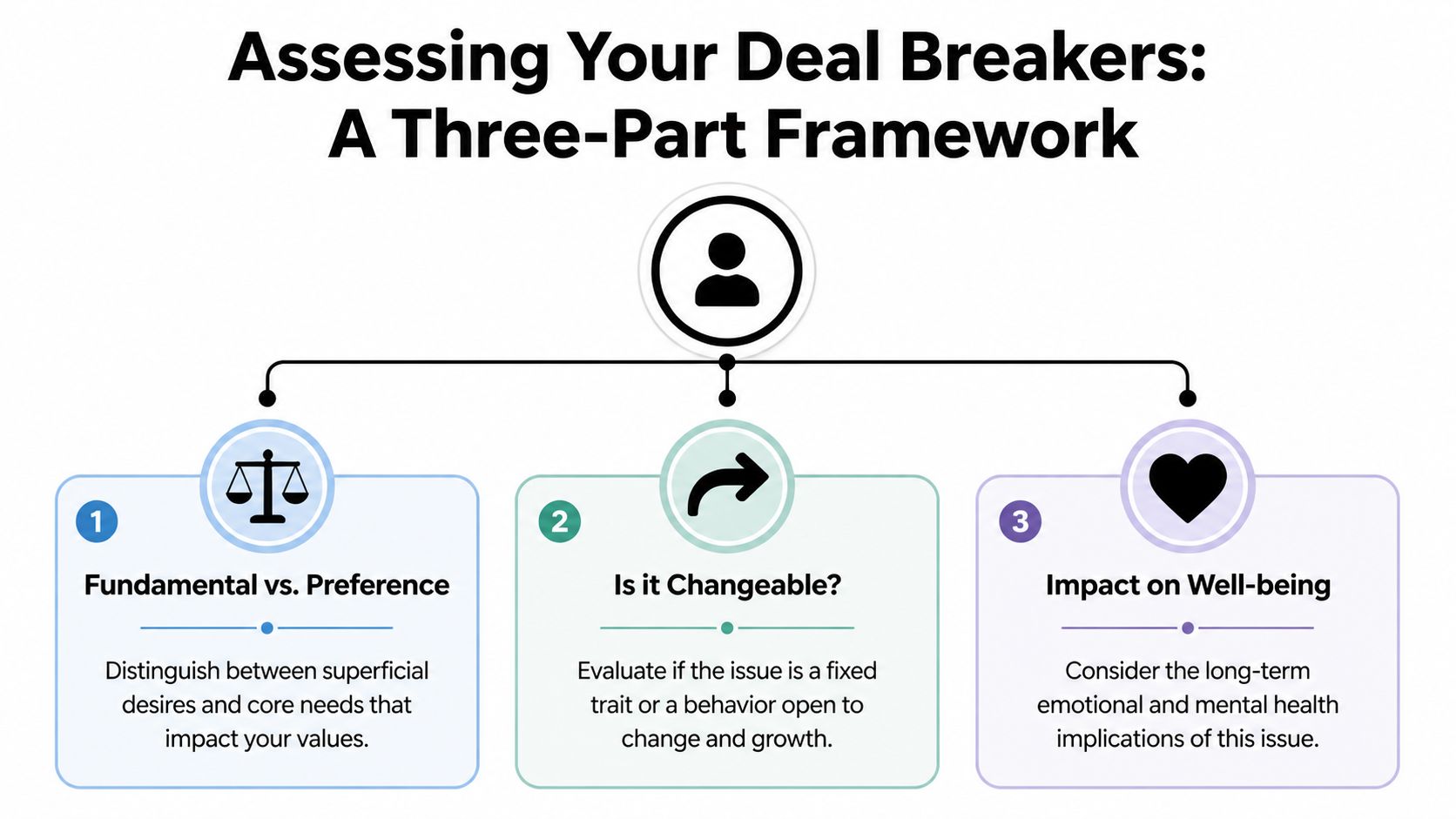
I like to reduce the assessment to three questions. Severity. Frequency. Impact.
Severity
Ask yourself whether the issue is a preference problem, a skill deficit, or a character and values issue.
If your partner interrupts you when stressed, that may reflect a skill problem. If your partner repeatedly lies and then blames you for noticing, that’s a much more serious breach. Severity is about the nature of the issue, not just how upset you feel in the moment.
Frequency
One painful event matters. Repetition matters more.
An isolated mistake with repair is very different from a recurring pattern with excuses. If you’ve had the same conversation many times and the behavior keeps returning, the relationship is giving you data.
Impact
At this point, many people finally get clear.
Ask:
- What happens in my body after this? Do I feel grounded, confused, anxious, numb, or hypervigilant?
- What happens to my self-respect? Am I speaking more openly, or shrinking to keep peace?
- What happens to my daily life? Do I have more stability, or do I spend large amounts of energy recovering from the relationship?
When a relationship repeatedly destabilizes your body and lowers your self-trust, the impact is already significant.
Walk it through with one real example
Let’s say your partner becomes cold and unavailable every time you bring up hurt feelings.
Use the framework like this:
Severity
This isn’t just awkward conflict. It blocks emotional repair and teaches you that honesty leads to disconnection.Frequency
If this has happened repeatedly, you’re not dealing with a mood. You’re dealing with a pattern.Impact
You may start avoiding important conversations, doubting your needs, and carrying tension for days after each interaction.
At that point, the question isn’t “Am I overreacting?” The question becomes “How long can I stay in a relationship where I have no safe route to repair?”
One more distinction that helps
A short table can keep you from collapsing everything into one category.
| What you notice | More likely to be | Best next step |
|---|---|---|
| Annoying but not harmful | Pet peeve | Accept, discuss lightly, or let it go |
| Painful but workable | Negotiable issue | Communicate, set boundaries, watch for change |
| Repeatedly unsafe or depleting | Deal breaker | Name it clearly and decide what action protects you |
Frameworks won’t make the grief disappear. They will keep you from calling every discomfort a deal breaker, and from calling every deal breaker “something to work on.”
Communicating Boundaries or Preparing to Leave
Once you’ve identified a deal breaker or a serious issue, the next task is action. Yet, many find themselves paralyzed at this point.
They either say nothing and hope the problem fades, or they explode after months of buildup. Neither approach usually creates clarity.
What a healthy boundary sounds like
A boundary is not a threat. It’s not punishment. It’s a clear statement of what behavior does not work for you and what you will do if it continues.
Try language like this:
For repeated dishonesty
“Trust is central for me. When I find out something wasn’t truthful, I feel unsafe in the relationship. If honesty can’t be consistent here, I can’t keep building with you.”For emotional shutdown during conflict
“I’m willing to have hard conversations. I’m not willing to be emotionally abandoned for bringing them up. If we need pauses, that’s fine. If the pattern is withdrawal and no repair, this won’t work for me.”For dismissive behavior
“When I share something painful and it gets minimized, I shut down. I need respectful engagement, even if we see things differently.”
Notice the difference between boundary language and character attacks. You’re naming the behavior, the effect, and the limit.
If you need support developing this skill, this article on boundaries in a relationship offers a useful starting point.
What doesn’t work
Reactive ultimatums usually come from a flooded state.
Examples include:
- “If you do this again, I’m done.” when you don’t yet know if you’ll follow through
- “You never care about me.” which invites defensiveness instead of clarity
- “You’re just selfish.” which labels identity instead of naming conduct
A better conversation stays specific and grounded. Good listening matters too. If both people are trying to understand, not just rebut, structured tools can help. This WeUnite guide to effective listening offers practical exercises that support calmer, more useful conversations.
A place for video guidance
This is also where I’d place a short teaching video from the @SecurelyLoved YouTube channel on boundary setting, especially for readers who understand the words but still go blank in real conversations.
When the answer is to leave
Some issues are not waiting for a better script. They are waiting for your acceptance.
If you’ve communicated clearly, seen the pattern continue, and watched your body pay the price, leaving may be the boundary. That doesn’t mean you failed. It may mean you finally stopped negotiating with what hurts you.
Before leaving, many people need a small plan:
- Get grounded support. Tell one trusted person what’s happening.
- Write down the pattern. This helps when nostalgia and doubt show up.
- Prepare for grief. Missing someone does not mean the relationship was healthy.
- Expect attachment protest. Anxious parts often interpret separation as danger, even when separation is protective.
You can feel heartbroken and still be making the right decision.
A healthy boundary conversation can improve a workable relationship. An honest exit can save your sense of self. Both require courage. Only one requires mutual participation.
Healing Triggers and Redefining Your Relationship Needs
Not every deal breaker is flexible. Some should remain firm. Abuse, coercion, chronic dishonesty, and repeated contempt are not things to meditate your way into tolerating.
But not every intense reaction means “leave now,” either.
Some reactions are amplified by unresolved attachment trauma. A partner needing reassurance may feel suffocating if closeness once meant engulfment. A request for space may feel unbearable if distance once meant abandonment. Healing helps you tell the difference between a real incompatibility and an old survival response.

Some deal breaker perceptions can change
This is where nervous system work matters. A future-dated source discussing attachment therapy claims that 65% of anxiously attached adults renegotiated perceptions of “clinginess” after nervous system regulation work (CounselingATL discussion). Because that source refers to 2025 to 2026 material, it should be read as emerging evidence rather than a settled current consensus. Still, the underlying idea fits what many clinicians observe. When the nervous system becomes safer, people often judge relational behaviors more accurately.
What once felt intolerable may become discussable. What once felt exciting may start to feel unsafe. That shift is not inconsistency. It is recalibration.
What healing changes in practice
Healing doesn’t make you more tolerant of mistreatment. It makes you less likely to confuse old pain with present truth.
You may notice changes like these:
- You pause before fusing or fleeing. Instead of reacting instantly, you can assess what is happening.
- You stop romanticizing dysregulation. Intensity loses some of its pull when your body no longer equates chaos with love.
- You set cleaner standards. You can want closeness without abandoning discernment.
- You recover self-trust. You no longer need as much external validation to honor what feels off.
For readers in British Columbia who want local support options, it can help to find support in Penticton or seek a trauma-informed provider in your own area who understands attachment and nervous system regulation.
Redefining your needs without shame
One of the most healing things I see is when someone stops asking, “Are my deal breakers too much?” and starts asking, “What kind of relationship lets my body settle?”
That question changes everything.
It moves you out of performance and into truth. It helps you define standards based on lived well-being, not chemistry, pressure, or fear. It also leaves room for growth. Some issues are workable with accountability, capacity, and repair. Others are not. Healing helps you know which is which.
If your relationship history keeps pulling you into confusion, collapse, or emotional overfunctioning, support can help you sort out what belongs to the present and what belongs to the past.
If this article brought up questions about your own patterns, Securely Loved offers attachment-focused, trauma-informed support for adults who feel stuck in relationship anxiety, self-doubt, or repeating dynamics. You can book a free 15-minute connection call to explore whether this kind of work fits what you need.