

Insecure Attachment Therapy: A Guide to Healing
You can know exactly why your relationships keep hurting and still feel unable to change them.
Maybe you tell yourself not to panic when a partner goes quiet, but your body surges anyway. Maybe you pride yourself on being independent, then notice you shut down the minute someone wants more closeness. Maybe you've done years of insight-based therapy, read the books, named the pattern, and still find yourself in the same arguments, the same heartbreak, the same private shame.
That stuck feeling usually isn't a character flaw. It's often an attachment pattern that lives in your nervous system, not just in your thoughts. When closeness has felt uncertain, intrusive, or inconsistent, your mind and body learn protective moves. They become fast, automatic, and hard to override with logic alone.
That's where insecure attachment therapy can be different. It doesn't just help you understand your pattern. It helps you practice safety, connection, boundaries, and self-regulation in a way your whole system can absorb.
Why You Feel Stuck in Relationships and How to Heal
You might look successful on the outside and still feel chaotic in love.
A common pattern looks like this. Someone you're dating asks for space after a hard week. Part of you knows that's reasonable. Another part spirals fast. You reread texts, monitor tone, and start preparing for rejection before anything has happened. Or you do the opposite. You feel disappointment, need, or tenderness rise up, and you go numb, busy, sarcastic, or distant before anyone can get too close.
These reactions can feel confusing because they often clash with the person you know yourself to be. Smart. caring. capable. Self-aware. Yet in intimate relationships, something older takes over.
That older pattern has a name. Insecure attachment. And you're far from alone in it. Data from the US National Comorbidity Survey Replication shows that about 36.5% of adults have an insecure attachment style, and those adults are significantly more likely to use mental health services, which tells us that struggling with relationship patterns and emotional distress is widespread, not unusual (adult attachment and mental health service use).
You don't need more shame about your reactions. You need a map for why they happen and support that helps your body stop treating connection like danger.
For many people, traditional talk therapy helps with insight but doesn't fully touch the panic, shutdown, or mixed signals that show up in real time. You may understand that your partner isn't your parent. You may even be able to explain your childhood in detail. But when conflict hits, your chest still tightens, your thoughts race, or your words disappear.
That's why healing usually has to include more than interpretation. It helps to build emotional regulation, body-based safety, and a clearer inner relationship with yourself. If you're also trying to understand the bigger picture of your emotional health, this guide to emotional well-being can be a useful companion because attachment wounds rarely stay confined to romance. They shape stress, sleep, self-worth, and how supported you feel in daily life.
What healing starts to look like
At first, progress is subtle.
You pause before sending the fourth text.
You notice the urge to withdraw and stay present for one more minute.
You stop assuming every strong feeling is a fact.
You learn that being triggered doesn't mean you're broken. It means something important needs care.
Insecure attachment therapy helps you move from reacting automatically to responding with choice. That shift is the beginning of secure love.
Understanding Your Insecure Attachment Blueprint
Your attachment style is less like a personality test and more like an old operating system.
It formed around repeated experiences of closeness, distance, comfort, misattunement, and repair. If care was inconsistent, emotionally unavailable, frightening, or hard to trust, your system adapted. Those adaptations were intelligent. They helped you stay connected, stay protected, or stay unnoticed in the environment you had.
A 2023 global meta-analysis found that 48.4% of children develop insecure attachment patterns, which is why so many adults later discover that their relationship struggles have deep roots in early life (global attachment patterns in children).

If you're not sure which pattern fits best, taking an attachment style quiz can give you a starting point. It won't replace therapy, but it can help you put language to what you've been feeling.
Anxious attachment feels like an overactive alarm
If you lean anxious, your system tends to scan for signs of disconnection.
A delayed reply can feel loaded. A change in tone can land like proof. You may become preoccupied with what the other person feels, whether they're pulling away, and what you need to do to restore closeness. The mind starts problem-solving. The body starts bracing.
This doesn't mean you're needy in some simplistic sense. It usually means closeness once felt unpredictable, so your system learned to track it carefully.
Common signs include:
- Reading between the lines constantly because neutral moments don't feel neutral.
- Protesting disconnection through texting, reassurance-seeking, overexplaining, or emotional intensity.
- Losing contact with your own center when someone important feels unavailable.
Avoidant attachment looks calm from the outside
Avoidant attachment often gets misunderstood because it can appear high-functioning.
You may value independence, competence, privacy, and self-containment. Those aren't problems. The issue is what happens when vulnerability, dependence, or emotional need enters the room. You may minimize it, intellectualize it, feel trapped, or pull away before anyone can ask too much of you.
A useful image is a fortress with a locked gate. The fortress isn't bad. It was built for a reason. But if the gate only opens on your terms and closes the moment intimacy deepens, connection stays limited.
People with avoidant patterns often notice:
- A strong urge to create distance after closeness, conflict, or emotional intensity.
- Discomfort with needing others, even when support would help.
- A habit of dismissing pain quickly by staying busy, analytical, or self-sufficient.
Important reframe: Avoidance isn't a lack of feeling. It's often a learned strategy for managing feelings that once felt unwelcome, ineffective, or unsafe to express.
Disorganized attachment pulls in two directions at once
Disorganized attachment can feel the most bewildering because it combines longing and fear.
You want closeness, but trust gets scrambled. You may move toward someone and then panic once they respond. You may crave reassurance and resent it at the same time. Conflict can feel disorganizing fast. It's like driving with one foot on the gas and the other on the brake.
This pattern often develops when care was both a source of comfort and a source of distress. Your system never got a consistent answer to the question, "When I reach for connection, what happens next?"
You might recognize disorganized attachment if you:
- Swing between pursuit and shutdown in the same relationship.
- Feel flooded by intimacy even when you want it.
- Struggle to trust stable love, because calm can feel unfamiliar.
Why labels help when they're used kindly
A label should reduce shame, not increase it.
The point isn't to box yourself in. It's to understand the rules your nervous system has been following so you can change them. Once you see your pattern as a survival strategy instead of a personal defect, healing becomes much more workable. You stop asking, "What's wrong with me?" and start asking, "What is my system protecting me from, and what would help it feel safer now?"
A Guide to Common Insecure Attachment Therapy Models
People often ask what works for insecure attachment therapy. The short answer is that no single model solves every layer.
Some approaches work directly with your attachment pattern. Some help process specific relational trauma. Some challenge beliefs that keep the pattern running. Some teach your body how to register safety in the present instead of reacting as if the past is still happening.
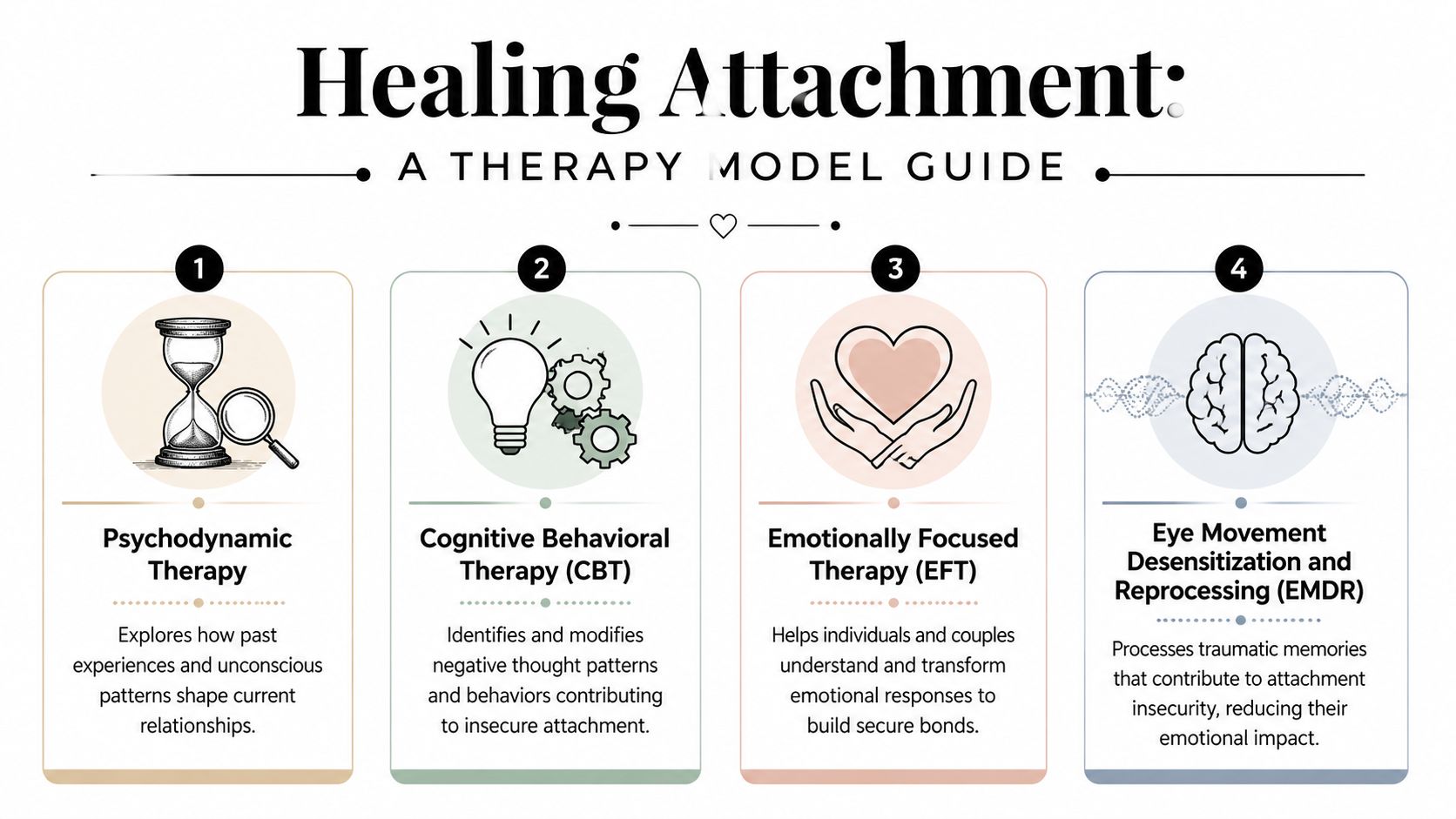
One of the strongest researched options for relationship distress is Emotionally Focused Therapy (EFT). Evidence-backed models like EFT show that 70 to 75% of couples move from distress to recovery, and roughly 90% show significant improvements, which is why many attachment therapists use it as a core framework for repairing bonding patterns (EFT outcomes in attachment-focused couples work).
Comparing approaches in insecure attachment therapy
| Therapy Model | Primary Focus | What It Looks Like | Best For Healing… |
|---|---|---|---|
| Attachment-focused therapy | Internal sense of safety and secure relating | Exploring relational patterns, corrective emotional experience, guided practices that build security | Chronic relationship anxiety, fear of closeness, unstable inner sense of safety |
| CBT | Thoughts, beliefs, and behavior loops | Identifying automatic thoughts, testing assumptions, practicing different responses | Catastrophic thinking, reassurance cycles, harsh self-talk |
| EFT | Emotional bonding and relational cycles | Slowing conflict patterns, naming vulnerability, reshaping pursue-withdraw dynamics | Couples stuck in repeating fights, distance, or mistrust |
| EMDR | Unprocessed trauma that keeps the system reactive | Targeting distressing memories while reducing their emotional charge | Specific relational trauma, betrayal, abandonment shocks, old experiences that still feel current |
| Somatic or polyvagal-informed therapy | Nervous system regulation | Tracking body cues, grounding, breath, orienting, learning how activation and collapse work | Panic, shutdown, chronic hypervigilance, feeling unsafe even when life looks stable |
| Psychodynamic therapy | Unconscious relational themes | Looking at recurring patterns, defenses, early experience, and the therapy relationship itself | Deep repetition patterns, identity-level themes, long-standing relational defenses |
What attachment-focused therapy does differently
Attachment-focused therapy doesn't just ask, "What happened?" It also asks, "What did your system learn about closeness, need, conflict, and repair?"
A well-known example is the Ideal Parent Figure method, which uses guided imagery around five core conditions of secure attachment: felt safety, being seen and known, felt comfort, being valued, and support for independence. In practice, that can help clients build self-soothing and self-compassion instead of only analyzing why they struggle.
This kind of work can be especially useful if you've said, "I understand my pattern, but I still feel it in my body."
Where EMDR fits
EMDR can be a strong fit when one or more memories still carry a live emotional charge.
That might be a sudden breakup, repeated emotional neglect, humiliating conflict, betrayal, or growing up with caregiving that felt frightening or chaotic. If your present relationships keep getting hijacked by reactions that feel bigger than the current moment, there may be unprocessed material underneath.
EMDR isn't attachment therapy by itself, but it can remove some of the emotional intensity that makes secure relating harder.
What CBT helps, and where it can fall short alone
CBT is useful for insecure attachment when thoughts are pouring fuel on the fire.
If your mind jumps from "They haven't answered" to "I'm about to be abandoned," CBT can help you identify the leap, slow it down, and test other interpretations. If you tend to translate vulnerability into "I'm too much" or "I shouldn't need anyone," CBT can help loosen those rules.
For practical thought work outside therapy, some people also benefit from learning how to reduce anxiety with CBT strategies, especially when spiraling thoughts dominate. Still, CBT alone often isn't enough for attachment wounds that live in the body and in relational expectations.
If insight helps you feel clear for an hour but conflict still sends you into panic or shutdown, the missing piece is often regulation, not intelligence.
Why body-based work matters
Attachment isn't only a story. It's a state.
You can know you're safe and still feel unsafe. That's why somatic and polyvagal-informed work matters so much in insecure attachment therapy. It teaches you to notice activation earlier, support your body through it, and expand your capacity to stay connected without flooding or disappearing.
That might involve:
- Tracking your cues such as tight jaw, shallow breath, numbness, or urgency.
- Practicing regulation before hard conversations so you don't enter them already overloaded.
- Learning the difference between discomfort and danger, which is a major turning point in healing.
One practical trade-off to know
The deeper the therapy goes, the more likely it is to stir the exact defenses you're trying to heal.
That's not a sign therapy is failing. It's often a sign you're touching the core material. A thoughtful therapist won't only help you uncover patterns. They'll help pace the work so you don't get overwhelmed, detached, or pushed into compliance.
One option in this space is Securely Loved, which offers attachment-focused, trauma-informed therapy with nervous system regulation for adults working with anxious, avoidant, or disorganized patterns. The point isn't to pick the perfect brand. It's to find a therapist or practice that understands attachment as both relational and embodied.
The Journey to Earned Security What to Expect From Therapy
Those seeking therapy usually don't want a theory. They want relief.
They want to stop checking their phone every five minutes. They want to make it through a disagreement without collapsing, exploding, or disappearing. They want to trust their own perceptions, ask for what they need, and stop feeling like love always costs too much.
That change is often described as earned security. It means you weren't handed secure attachment early, but you build it later through healing experiences, practice, and new patterns of regulation and relating.

Protocols like the Ideal Parent Figure method aim for initial neural integration within 8 to 12 sessions, with benchmarks showing 70% of clients shifting toward earned-secure status as measured by changes in how they discuss relationships and process emotions (earned-secure change through IPF protocols). If you'd like a fuller explanation of what that shift means, this guide on earned secure attachment lays it out clearly.
Before and after often looks ordinary
The changes that matter most are rarely dramatic from the outside.
Before therapy, you may assume distance means rejection. After some healing, you still notice the fear, but you don't obey it immediately. You reach for grounding first. You ask a direct question instead of mind reading.
Before therapy, conflict may trigger shutdown. You go blank, cold, or compliant. After some healing, you can stay in the room longer. You can say, "I'm getting overwhelmed. I need a pause, and I want to come back."
Before therapy, you may chase reassurance and still not feel reassured. After some healing, reassurance lands more completely because your body is less convinced that abandonment is around the corner.
Progress usually comes in layers
Early progress often shows up as more awareness and a little more space between trigger and reaction.
Then comes the harder middle. You see the pattern clearly, but you're still living it. This phase frustrates people because they expect insight to create instant freedom. It doesn't. Repetition matters. Practice matters. Repair matters.
Later, something steadier emerges:
- You recover faster after activation.
- You choose partners and boundaries more carefully.
- You don't confuse intensity with intimacy.
- You trust consistency more than chemistry alone.
Healing doesn't mean you never get triggered. It means a trigger no longer decides your next move.
What therapy can and can't do
Good therapy can help you build security. It can't make every relationship healthy.
One of the clearest signs of growth is that you stop using all your energy to adapt to people who can't meet you. Earned security changes not only how you feel. It changes what you're willing to tolerate, what you name sooner, and what you no longer call love.
How to Find and Prepare for a Therapist Who Gets It
Starting therapy isn't the same as building a therapy process you can stay in.
Attachment patterns don't pause at the office door; they show up with the therapist too. A significant challenge in insecure attachment therapy is treatment dropout, especially when avoidant clients struggle with commitment and anxious clients feel hurt or unseen and want to quit. Successful therapy requires anticipating those attachment-driven hurdles instead of being surprised by them (attachment style and therapy dropout challenges).

If you've had therapy that felt too surface-level, too abrupt, too intellectual, or oddly shaming, you may already know how easy it is to leave without saying why.
Questions worth asking a therapist
You don't need to interview someone aggressively. But you do need useful information.
Ask things like:
- How do you work with attachment patterns in adults rather than only naming them?
- What do you do when clients want to quit, shut down, or become highly activated?
- How do you pace trauma work so it doesn't become overwhelming?
- Do you include nervous system regulation or body-based interventions, or is your work mostly insight-oriented?
- How do you handle ruptures in the therapy relationship if I feel misunderstood or pull away?
A therapist doesn't need perfect answers. They do need grounded, specific ones.
Prepare for the way your style may show up
At this stage, many people get more traction. Don't only prepare your questions. Prepare for your predictable reactions.
If you tend anxious:
- Name the fear early. Tell the therapist you may feel sensitive to inconsistency, delayed responses, or moments when you don't feel understood.
- Create a between-session plan. Decide ahead of time what you'll do when you feel activated after a session. That may include journaling, grounding, or writing down what you want to bring back next time.
- Watch for mind reading. Feeling disconnected from your therapist doesn't automatically mean you are disconnected.
If you tend avoidant:
- Expect the urge to downplay what matters once the work gets intimate.
- Make a rule not to quit on the most defended day. If you suddenly feel therapy is pointless, bring that in before you leave.
- Notice intellectual escape routes. Analysis can be useful, but it can also protect you from feeling.
If you tend disorganized:
- Ask for pacing. Fast depth can feel intoxicating and destabilizing.
- Track your swing states. You may want closeness intensely one week and want to disappear the next.
- Use structure. Predictable session times, clear agreements, and explicit repair help.
Practical rule: Don't treat the urge to quit as proof. Treat it as information.
Trauma-informed matters for attachment healing
Attachment work can stir grief, anger, fear, body memories, and old survival responses. That's why it helps when a therapist understands trauma-informed pacing and regulation, not only relationship dynamics. If you want a simple explanation of what that framework includes, this overview of trauma-informed therapy is a helpful place to start.
A good fit often feels like this. You don't feel rushed to perform healing. You don't feel pathologized for protecting yourself. And you don't feel pushed deeper than your system can handle. You're challenged, but you're also supported.
The Midlife Factor How Hormones Impact Your Attachment
Many adults are surprised when old attachment wounds get louder in midlife.
You may have managed for years with work, parenting, productivity, caretaking, or sheer momentum. Then a hormonal transition arrives and your usual coping tools stop working the same way. You feel more reactive, more raw, less buffered. A partner's emotional distance becomes harder to tolerate. Social situations that once felt manageable suddenly feel draining or exposing. Grief from old relationships resurfaces with a force that seems out of proportion until you realize your system is carrying more strain.
This isn't all in your head. Midlife can change the threshold at which stress becomes overwhelm.
Why the pattern can intensify
Hormonal shifts can affect sleep, mood stability, stress tolerance, and the body's ability to recover after activation. When your baseline is more fragile, attachment triggers don't need to be dramatic to hit hard. A small rupture can feel enormous when you're already depleted.
That matters because insecure attachment patterns depend on perceived safety. If your body feels less settled overall, the old blueprint can take over more quickly. Anxious parts may get louder. Avoidant defenses may harden. Disorganized responses may feel more chaotic.
What this looks like in real life
Midlife attachment distress often sounds like this:
- "I know my reaction is big, but I can't get back down."
- "I used to brush this off. Now I can't."
- "I don't know if this is hormones, grief, relationship truth, or all three."
Usually it's all connected. Biology doesn't cancel psychology. It interacts with it.
If you're trying to understand one piece of that picture, learning about the effects of low progesterone on women can help you make sense of symptoms that lower your resilience and amplify emotional sensitivity.
What helps during this life stage
Midlife healing often requires more respect for capacity.
That can mean slowing conflict down, building more recovery into your week, taking sleep disruption seriously, and not assuming every intensified reaction is purely relational. It can also mean revisiting attachment wounds with more compassion. Many people in this stage stop blaming themselves once they see that their nervous system is working harder than it used to.
For adults navigating perimenopause, menopause, divorce, caregiving strain, or identity shifts, insecure attachment therapy works best when it considers the whole context. Not just your relationship history, but the physical and hormonal reality you're living in now.
Take Your First Step Toward Secure Love
You don't have to heal everything before you ask for help.
If you've recognized yourself in these patterns, that's already important. It means the chaos has context. It means your reactions make sense. And it means change is possible, even if you've felt this way for a long time.
The next step doesn't need to be dramatic. It needs to be doable.
A simple explanation can help before you decide anything further:
Start with one clear action
Choose one of these:
- Book a connection call if you're ready to talk with a therapist about your patterns, goals, and what kind of support would fit.
- Take an attachment quiz if you need a quieter first step and want language for what you're experiencing.
- Write down one repeating relationship moment that keeps hurting you. Bring that into therapy instead of trying to summarize your whole life story.
You don't need a perfect explanation of your past to begin. You need enough honesty to notice what keeps repeating and enough support to stop carrying it alone.
What to remember as you begin
Healing insecure attachment isn't about becoming less sensitive, less relational, or less human.
It's about becoming more anchored. More able to stay with yourself when closeness stirs fear. More able to tell the difference between old danger and present discomfort. More able to choose relationships that feel steady, mutual, and emotionally honest.
That's what secure love starts to feel like. Not flawless. Not fear-free. Just steadier, clearer, and far less lonely.
If you're ready for a gentle next step, Securely Loved offers a free 15-minute connection call where you can talk through your goals, ask questions, and see whether attachment-focused support feels like the right fit. If you're not ready to book yet, the site also offers an attachment style quiz and practical resources to help you start where you are.